Take an online electronics store in Bengaluru. In Market Segments 8.1 and 8.2, it gathered its own data, its orders, payments and returns, and looked at it on dashboards. But some questions need data the store doesn't have:
- How many phones did all the shops in the country sell last month, and what share of them did we sell?
- Which phone brands are shipping more phones into India this year?
- What did a phone maker tell its investors last quarter?
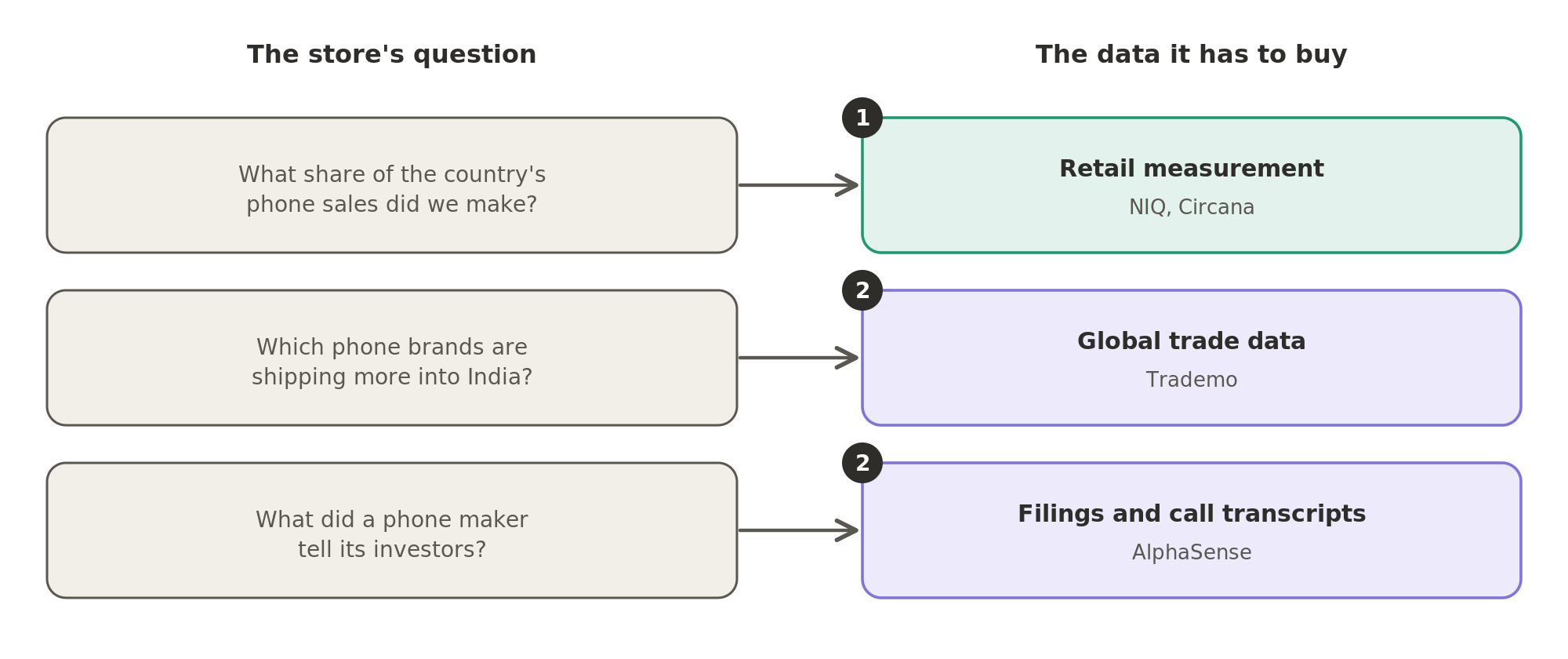 Each of the store's questions needs data it cannot collect itself: its share of the country's phone sales comes from retail measurement, phone imports from global trade data, and what a phone maker told investors from filings and call transcripts.
The store cannot collect this data itself. It has to buy it.
This Market Segment is about companies whose product is the data itself. They collect it, clean it and sell it, usually on a subscription. The industry calls them data vendors. Their buyers include companies' strategy and marketing teams, investors, insurers, lenders, broadcasters and betting companies.
Selling data takes a lot of engineering. A dataset that covers a whole market has to be collected from many sources, and the sources have to be matched against each other every day. That is why these companies hire software engineers.
Some well-known data vendors are covered in other Market Segments:
The financial data that investors usefrom Bloomberg, S&P Global, LSEG, FactSet and Moody's. (More on them in Market Segment 20.3, Financial data, ratings and research, in Industry Vertical 20, Wealthtech and capital markets.)
The credit bureausExperian, Equifax and TransUnion, which keep records of how people and businesses repay loans. (More on them in Market Segment 18.3, Credit bureaus, scoring and underwriting, in Industry Vertical 18, Lending and credit.)
Analyst firms sell expert judgement rather than data. The best-known of them, Gartner, is not covered in this Market Segment.
Every company named here has posted software engineering jobs in India. Famous companies that don't actively hire software engineers in India are left out.
This Market Segment has four sub-segments:
What people buy and watch: measuring what a whole country buys and watches
What the market knows: information about companies, industries, science and trade
Who won and how: the live data behind sport
Expert networks and review data: the opinions of experts and of software buyers, sold as data
What people buy and watch
Consumer panels, retail measurement, audience measurement, market research data
Take the online store from the start of this Market Segment. It knows how many phones it sold last month. It doesn't know how many phones every other shop sold, so it can't tell whether its share is growing. The companies in this sub-segment sell that kind of answer. They measure what a whole market buys and watches.
They collect it in two main ways. Many shops share the sales recorded at their tills. The industry calls this retail measurement. And a panel, a fixed group of households, records everything those households buy. The industry calls this a consumer panel.
NIQformerly NielsenIQ, split from Nielsen in 2021 and merged with GfK, the German research company, in 2023. It tracks the sales of consumer goods in many countries, through retailers' tills and household panels. Its engineers in Chennai, Pune and Mumbai work on the platform through which that data is delivered to buyers.
Nielsenthe company NIQ came from, measures what people watch. It sells television and streaming ratings: how many people watched each show. Advertising is priced on these ratings. Nielsen has engineers in Bengaluru and Mumbai.
Circanawith engineers in Bengaluru and Pune, is NIQ's rival in retail and consumer measurement. It was formed from the merger of IRI and NPD. Retailers also use its data to set prices. (More on Circana in Market Segment 27.2, Retail pricing and merchandising analytics, in Industry Vertical 27, Retail tech.)
Euromonitor Internationalwith engineers in Bengaluru, sells market-sizing data: how large every product category is in every country. Strategy teams build their plans on it.
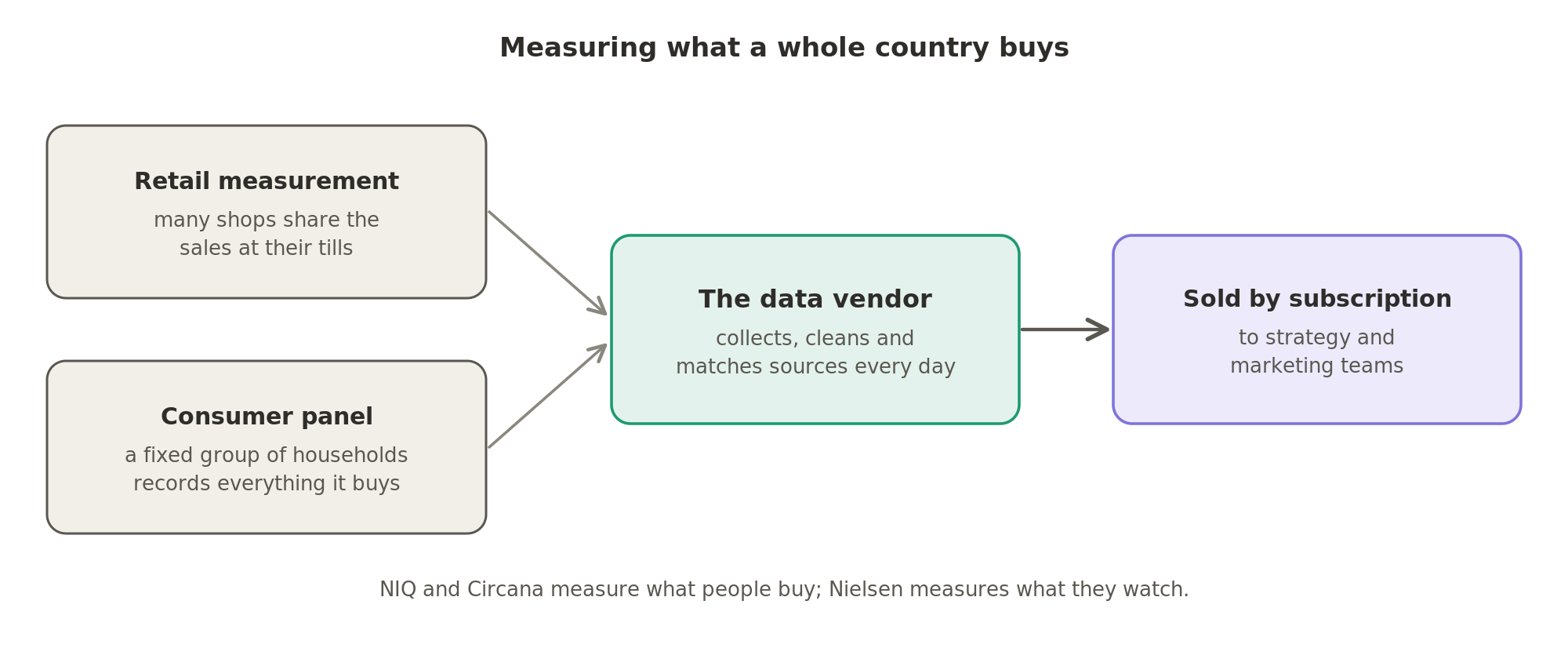 A data vendor measures what a whole country buys by combining the sales many shops record at their tills with what a fixed panel of households records, matching the sources every day and selling the result by subscription.
Some research is done to order for one client, rather than sold as a dataset to many. Kantar, the other large research group, does this kind of work. (More on Kantar in Market Segment 13.6, Survey and consumer research platforms, in Industry Vertical 13, Martech.) Ipsos and Comscore are not covered in this Market Segment.
What the market knows
Market intelligence, industry and scientific information, trade data, alternative data, web data
Back to the online store from the start of this Market Segment. Its strategy team wants to know more than sales. Which phone brands are importing more? What are phone makers telling their investors? The companies in this sub-segment sell information about companies, industries, science and trade.
AlphaSensewith engineers in Bengaluru, Delhi and Pune, is a search engine that investment and strategy teams use. It searches filings, the reports companies must submit to regulators. It also searches research from stockbroking firms, news, and transcripts of the calls in which companies explain their results to investors. It now uses large language models to summarise what it finds. Tegus is now part of AlphaSense.
Mobility Globalformerly S&P Global Mobility, became a separate company from S&P Global in July 2026. The car industry plans with its data: vehicle registrations, forecasts, vehicle specifications and, through its CARFAX brand, the history of individual vehicles. (More on S&P Global in Market Segment 20.3, Financial data, ratings and research, in Industry Vertical 20, Wealthtech and capital markets.)
Clarivatewith engineers in Bengaluru and Delhi, sells scientific and patent information. Its Web of Science is a citation index: a database of which research papers cite which. It also sells patent databases. (More on Clarivate in Market Segment 33.3, Academic and scientific publishing, in Industry Vertical 33, News, publishing and social media.)
Three more companies sell newer kinds of data:
YipitDatawith engineers in Bengaluru, sells alternative data. This is data from outside a company's own reports, such as transaction data and signals from the web. An investment fund uses it to estimate a company's sales before the company reports them.
Trademowith its headquarters in Palo Alto and its office in Gurugram, sells global trade data. Its shipment records show who is importing what, and from whom. This is the data that answers the store's question about phone imports.
PromptCloudin Bengaluru, is a web-scraping service. Web scraping means using software to read public websites automatically and copy data from them. PromptCloud builds a dataset to order this way.
Two companies covered mainly in other Market Segments show where this kind of data ends up:
Veriskwith engineers in Hyderabad, sells data and risk models to insurers. They cover property and casualty insurance: insurance for homes, cars and businesses, rather than life or health. Here, Verisk stands for the data vendors that serve the insurance industry. (More on Verisk in Market Segment 21.3, Underwriting, pricing and claims analytics, in Industry Vertical 21, Insurtech.)
Dun & Bradstreetwith engineers in Hyderabad, sells commercial credit data. Businesses use it to judge each other, for example before a supplier agrees to be paid later. (More on Dun & Bradstreet in Market Segment 18.3, Credit bureaus, scoring and underwriting, in Industry Vertical 18, Lending and credit.)
The dataset read by an AI model.
AlphaSense shows what many data vendors are becoming. The buyer no longer searches a database. Instead, an AI model has read the whole dataset and answers the question directly. A subscription to data becomes a subscription to an analyst.
Crunchbase, PitchBook and Similarweb are not covered in this Market Segment.
You're reading as a guest. Sign in free to follow links for five minutes, once an hour.
Sign in
Who won and how
Sports data and performance analytics
Watch a football match on TV, and the screen shows possession, shots on target and passes completed. A broadcaster doesn't count these itself. It buys them from a sports data company. Two such companies are covered here.
Stats Performwith engineers in Bengaluru, collects live data from thousands of matches: every pass and every shot. Its best-known brand is Opta, whose football statistics often appear on TV and social media. It sells the data to broadcasters, betting companies and the teams themselves. On top of the data, it sells models that predict results.
PFFwith engineers in Chennai, watches video of every play of American football and grades every player on it. Teams and broadcasters now argue over these grades. In March 2026, Teamworks, a software company for sports teams, announced it was buying the part of PFF that sells this data to teams. The fan-facing PFF stays with Cris Collinsworth, the American TV commentator.
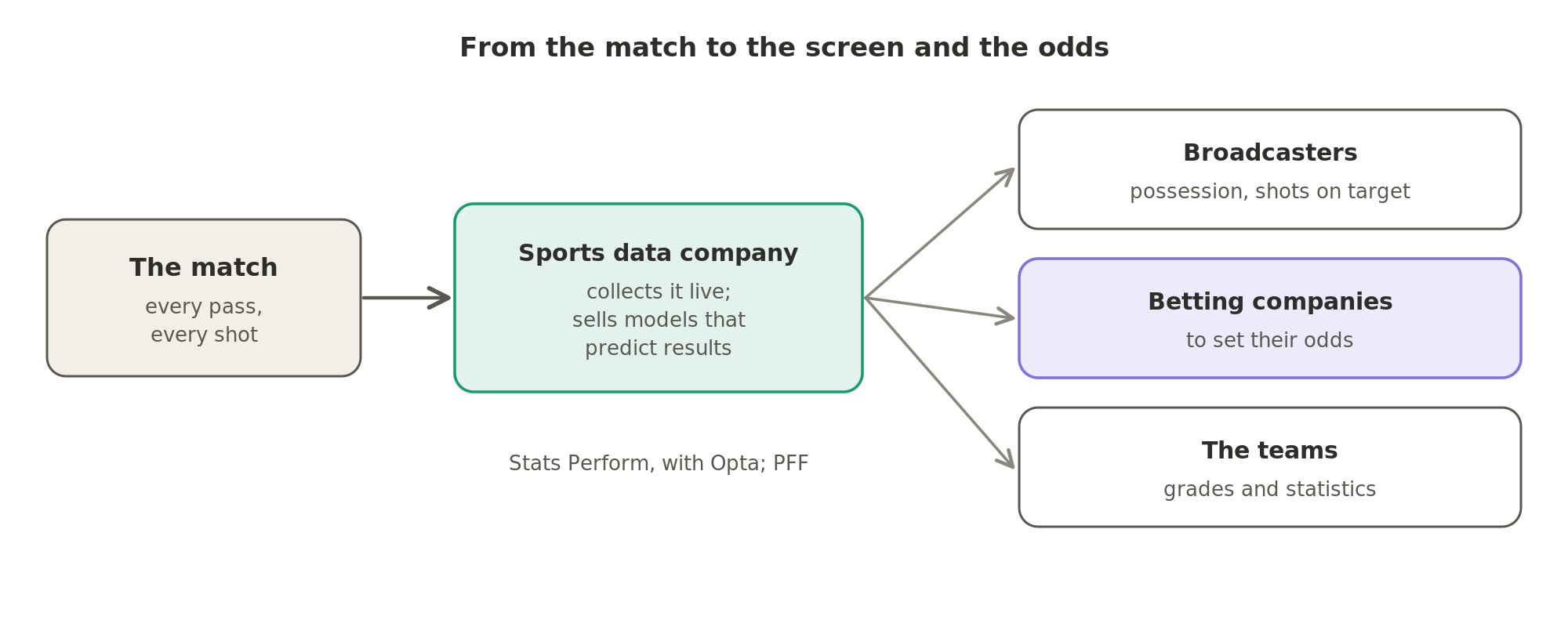 A sports data company collects every pass and every shot of a match live, and sells the data to broadcasters for the screen, to betting companies to set their odds, and to the teams themselves.
Betting companies use both companies' data to set their odds. (More on both in Market Segment 31.4, Sports betting and real-money gaming, in Industry Vertical 31, Gaming.)
Sportradar and Genius Sports, the other large sports data companies, are not covered in this Market Segment.
Expert networks and review data
Expert networks, peer-review platforms
The last sub-segment sells opinion as data.
An expert network connects investors and consultants with people who know an industry from the inside, usually for a paid call. An investor studying a phone maker, for example, might pay to speak with someone who used to run its sales.
Arboluswith engineers in Delhi, is an expert network built as software. An investor or a consultant uses its platform to find and question a former executive of the company they are studying. The call is transcribed and made searchable, so the conversation becomes a dataset.
The expert networks that run on people rather than software, GLG and Guidepoint, are not covered in this Market Segment.
Back to the online store from the start of this Market Segment. When its data team chose a dashboard tool, of the kind described in Market Segment 8.2, it probably read what other buyers said about each tool first.
G2with engineers in Bengaluru, is the review site for business software. Buyers rate the tools they use, and these peer reviews are the product. G2 sells them to the software companies being reviewed, as intelligence and as leads. A lead is a company that is reading about a type of software, and so may be about to buy it. (More on selling this kind of buyer data in Market Segment 14.2, B2B sales intelligence and ABM platforms, in Industry Vertical 14, CRM and sales tech.)
That is the data a company buys when its own is not enough. It covers what a whole market buys and watches, what is known about companies and trade, what happens on the field, and what experts and users think.