ingrid.fyi India's software hiring trends, explained.
Sign in to ingrid.fyi with Google
Your Google account
name@gmail.com
Continue with Google
Home / Product companies / V · Fintech / Insurtech / Underwriting, pricing and claims analytics
On this page
Underwriting, pricing and claims analytics Deciding what to charge, and what to pay when a claim comes in Back to the bakery chain in Ohio from Market Segment 21.2, Insurance agency and broker software. Before insuring its twelve shops, an insurer must decide what to charge. Is the shop near a river that floods? How old is the roof? How safely do its van drivers drive? Then, one winter, a burst pipe floods a shop, and the insurer must decide what to pay.

An insurer makes these two decisions over and over:

What to chargehow much to charge for a risk, before taking it on. This is called underwriting and pricing. What to payhow much to pay when a loss happens. This is called claims.

Both decisions rest on data, and on models built from it: the history of past losses, the property's location, the driver's behaviour, the photograph of the damage. This Market Segment covers the companies that sell that data and those models. The buyers are insurers, and large companies that manage their own risks. It is a small Market Segment: six companies, and one more that is covered mainly in another Market Segment.

Every company named here has posted software engineering jobs in India. Famous companies that don't actively hire software engineers in India are left out.

Keep reading, free

One more section is on this page: What this section holds. Sign in to read it here, in full.

Continue with Google
  • What this section holds
What this section holds

The data behind the price. Back to the questions about the bakery's shops, from the start of this Market Segment.

Veriskwith engineers in Hyderabad, has the most job postings in this Market Segment. It is the data company of American property and casualty insurance. It holds the industry's pooled data on past losses. It makes catastrophe models, which estimate what a hurricane or an earthquake would cost insurers. And it makes Xactimate, the software with which most American home claims are estimated. (It also appears in Market Segment 8.3, Market research and market intelligence providers, in Industry Vertical 8, Analytics and data providers.) Archipelagowith engineers in Delhi, organises the data about large companies' collections of commercial buildings, for the insurers that cover them. (It also appears in Market Segment 41.2, Property and facilities management software, in Industry Vertical 41, Proptech.) Cambridge Mobile Telematicswith engineers in Chennai, uses the sensors in a phone or a car to score how safely someone drives. It also detects crashes as they happen. Its buyers are insurers that set prices by how people actually drive, which is called telematics.

One company covered mainly in another Market Segment brings data on homes:

Cotalityformerly CoreLogic, with engineers in Delhi, is here for the property data used to price a home's insurance. (More on it in Market Segment 41.4, Real estate portals and mortgage tech, in Industry Vertical 41, Proptech.)

The underwriter's and the claims handler's tools. An underwriter is the person who decides whether to insure a risk, and at what price.

Sendwith engineers in Bengaluru, sells the underwriter's workbench: one screen for reviewing each application. FurtherAIuses an AI model to read applications for cover and first notices of loss. A first notice of loss is the first report a customer makes after something goes wrong, like the bakery's call about the burst pipe.

One company works on the other side, for the insured company:
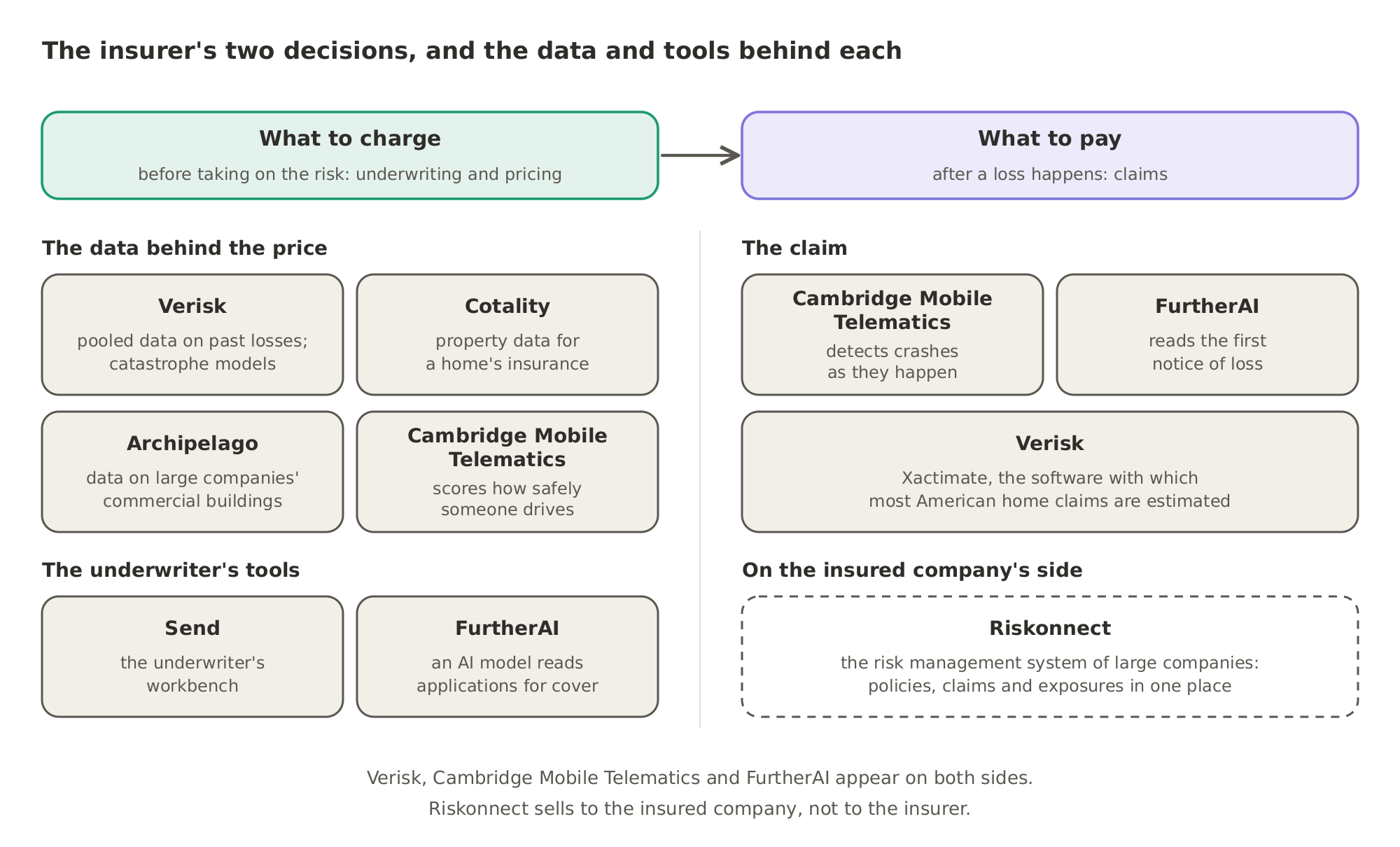
Riskonnectwith engineers in Delhi, Bengaluru and Pune, sells the risk management system of large companies. It keeps their policies, claims and exposures, the risks they face, in one place. An insurer first decides what to charge, then, after a loss, what to pay. Verisk, Cotality, Archipelago and Cambridge Mobile Telematics supply the data behind the price, Send and FurtherAI serve the underwriter, and Cambridge Mobile Telematics, FurtherAI and Verisk's Xactimate help with the claim, while Riskonnect works for the insured company instead.An insurer first decides what to charge, then, after a loss, what to pay. Verisk, Cotality, Archipelago and Cambridge Mobile Telematics supply the data behind the price, Send and FurtherAI serve the underwriter, and Cambridge Mobile Telematics, FurtherAI and Verisk's Xactimate help with the claim, while Riskonnect works for the insured company instead. The claim settled from a photograph.

A car claim used to need an assessor, a person who came to see the car. Now an AI model estimates the damage from photographs. A phone's sensors report the crash before the driver even calls. The same models read an underwriting application in minutes. The frontier is both of the insurer's decisions made by models, and checked by people.
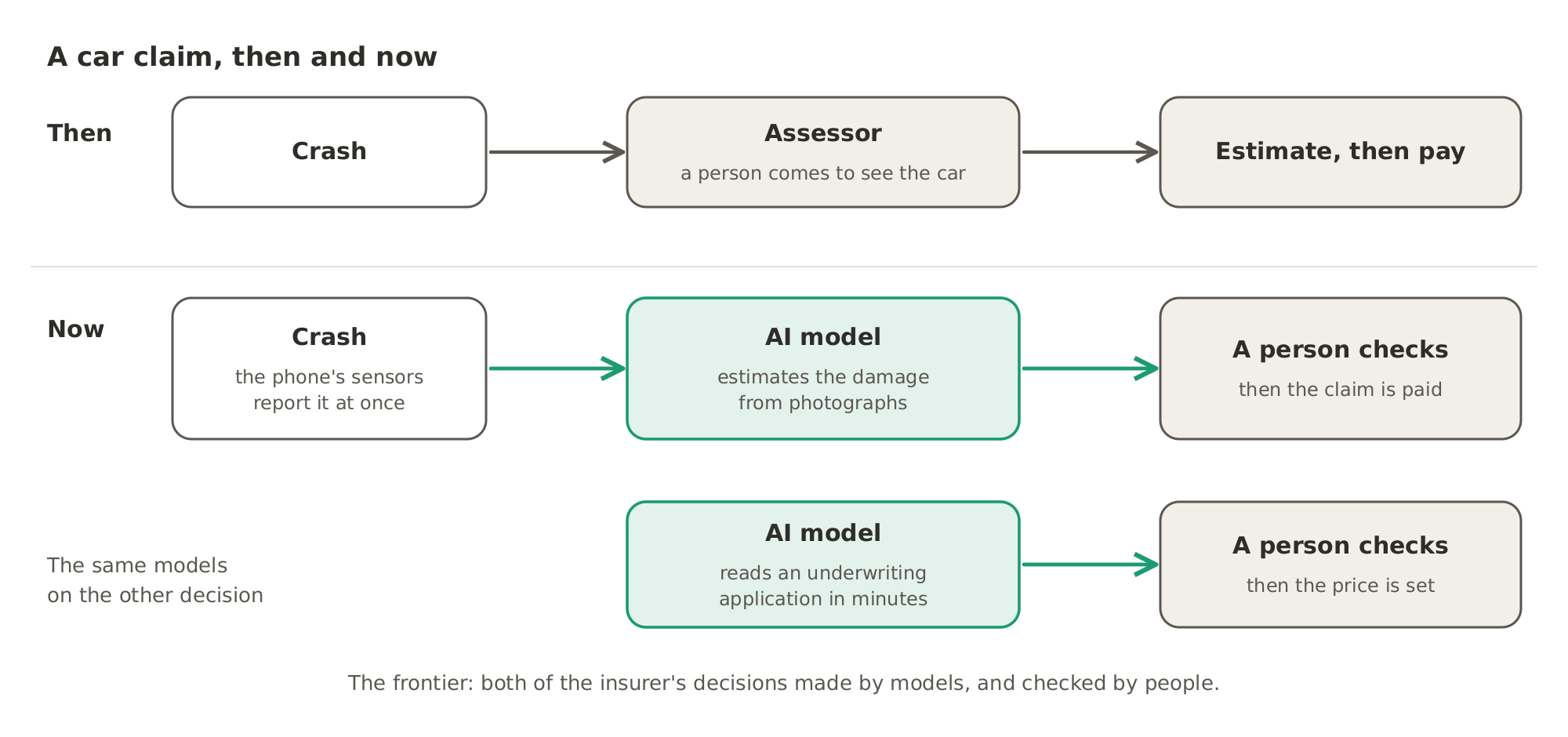
A car claim used to need an assessor who came to see the car. Now a phone's sensors report the crash, an AI model estimates the damage from photographs and a person checks it, and the same kind of model reads an underwriting application in minutes.A car claim used to need an assessor who came to see the car. Now a phone's sensors report the crash, an AI model estimates the damage from photographs and a person checks it, and the same kind of model reads an underwriting application in minutes. So the bakery from the start of this Market Segment was priced from data: flood maps, roof records and its drivers' records. And when the pipe burst, the claim was read, estimated and paid with the help of the same kind of models.
Who they hire

Who these companies hire, and for what, is on What insurtech hires for.

Privacy Terms Refunds and cancellation Shipping and delivery © 2026 ingrid.fyi · Payments by Razorpay
You're browsing as a guest. Sign in free to follow links for five minutes, once an hour.