ingrid.fyi India's software hiring trends, explained.
Sign in to ingrid.fyi with Google
Your Google account
name@gmail.com
Continue with Google
Home / Product companies / IV · Enterprise SaaS and software / CRM and sales tech / B2B sales intelligence and ABM platforms
On this page
B2B sales intelligence and ABM platforms Finding which companies might buy, who works there and which of them are ready now A company in Pune sells payroll software to hospitals. Its salesperson has to find new hospitals to sell to. Before calling anyone, the salesperson needs four answers: Which hospitals might buy? Who in each hospital decides: the head of HR, or the head of finance? What are that person's email address and phone number? Which of these hospitals is looking for payroll software this month?

The industry now sells the last answer hardest. This Market Segment is the business of answering all four. Most of it is B2B, short for business-to-business: one company selling to another.

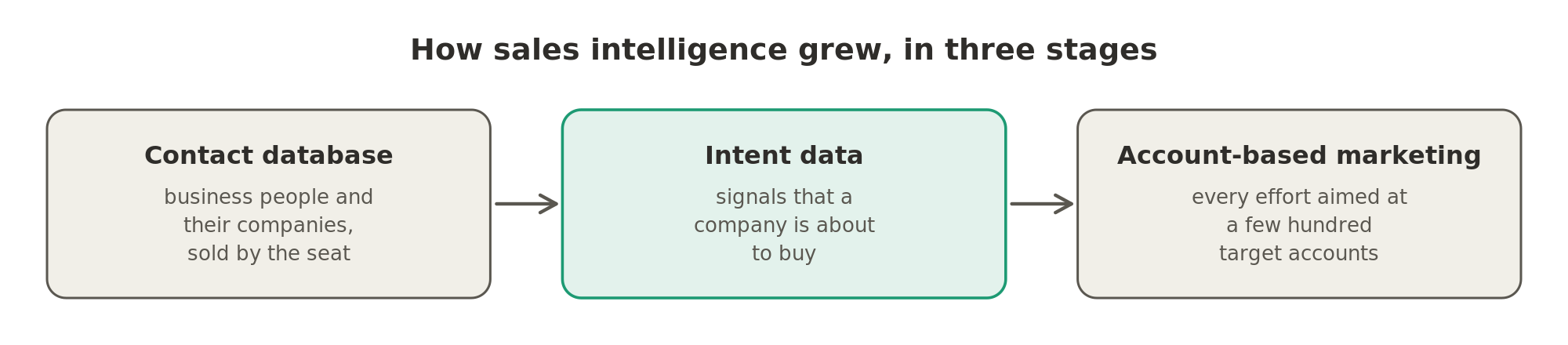
The business grew in three stages:

Sales intelligence began as a contact database sold by the seat, grew into intent data that signals a company is about to buy, and became account-based marketing aimed at a few hundred target accounts.Sales intelligence began as a contact database sold by the seat, grew into intent data that signals a company is about to buy, and became account-based marketing aimed at a few hundred target accounts.

The companies here sell this data and the software around it. Their buyers are the sales and marketing teams of companies that sell to other businesses.

Every company named here has posted software engineering jobs in India. Famous companies that don't actively hire software engineers in India are left out. Two large Bengaluru centres, ZoomInfo's and 6sense's, account for more than two-thirds of the job postings in this Market Segment. There are also a handful of start-ups founded in India. LinkedIn, owned by Microsoft, is covered elsewhere. (More on it in Microsoft, in the big-tech collection.) Its Sales Navigator is the database most B2B sellers actually use.

This Market Segment has two sub-segments, and they follow that history. The first covers the database of buyers. The second covers intent data and the account.

Keep reading, free

Two more sections are on this page: The database of buyers and Intent and the account. Sign in to read them here, in full.

Continue with Google
  • The database of buyers
  • Intent and the account
The database of buyers Contact and company data for B2B sales, data on which software each company uses, and filling in and cleaning the data

Back to the payroll company from the start of this Market Segment. Its first need is a list: the hospitals, and the right person in each one.

ZoomInfowith engineers in Bengaluru and Chennai, made the business contact database the default tool of American sales teams. It holds hundreds of millions of profiles of people and companies. A mix of automatic collection by machines and checking by people keeps them up to date. ZoomInfo also sells Chorus, a conversation-intelligence product that records and analyses sales calls. (More on conversation intelligence in Market Segment 15.3, Conversation intelligence and speech analytics, in Industry Vertical 15, Customer service and CX.) It also sells marketing and operations tools built on the same data. Its Bengaluru centre is among its largest. Apollo.iowith engineers in Bengaluru, is ZoomInfo's younger and cheaper rival. It sells the database and the outreach sequences in one product, for smaller teams. An outreach sequence is a planned series of emails and calls to one contact. (More on outreach sequences in Market Segment 14.3, Sales engagement platforms and AI SDRs.) HG Insightswith engineers in Pune, sells technographics: the record of which software every company runs. With it, a vendor can find the companies that use a competitor's product. In our example, the payroll company could find every hospital that runs a rival's payroll software. Enlyftwith engineers in Delhi and Pune, sells the same kind of data on which technology each company has installed, with account scoring. Scoring ranks each account by how likely it is to buy. Openprisewith engineers in Hyderabad, cleans the data once it arrives. It removes duplicates, fills in missing details (the industry calls this enrichment), scores the leads, and routes each one to the right salesperson. A lead is a possible customer who has shown interest. All this keeps the CRM usable. (More on CRM in Market Segment 14.1, CRM software.) Sprouts.aiwith engineers in Bengaluru, goes a step further and generates the demand itself: it creates the interest, not just the list. It uses contact data, with AI sales agents built on top. An AI agent is software that uses a language model, the kind of AI behind chatbots, to take actions on its own.
Intent and the account Intent data, scoring accounts by how likely they are to buy, account-based marketing and advertising, and content syndication

The list tells the payroll company who could buy. It does not say when. That is the job of this sub-segment.
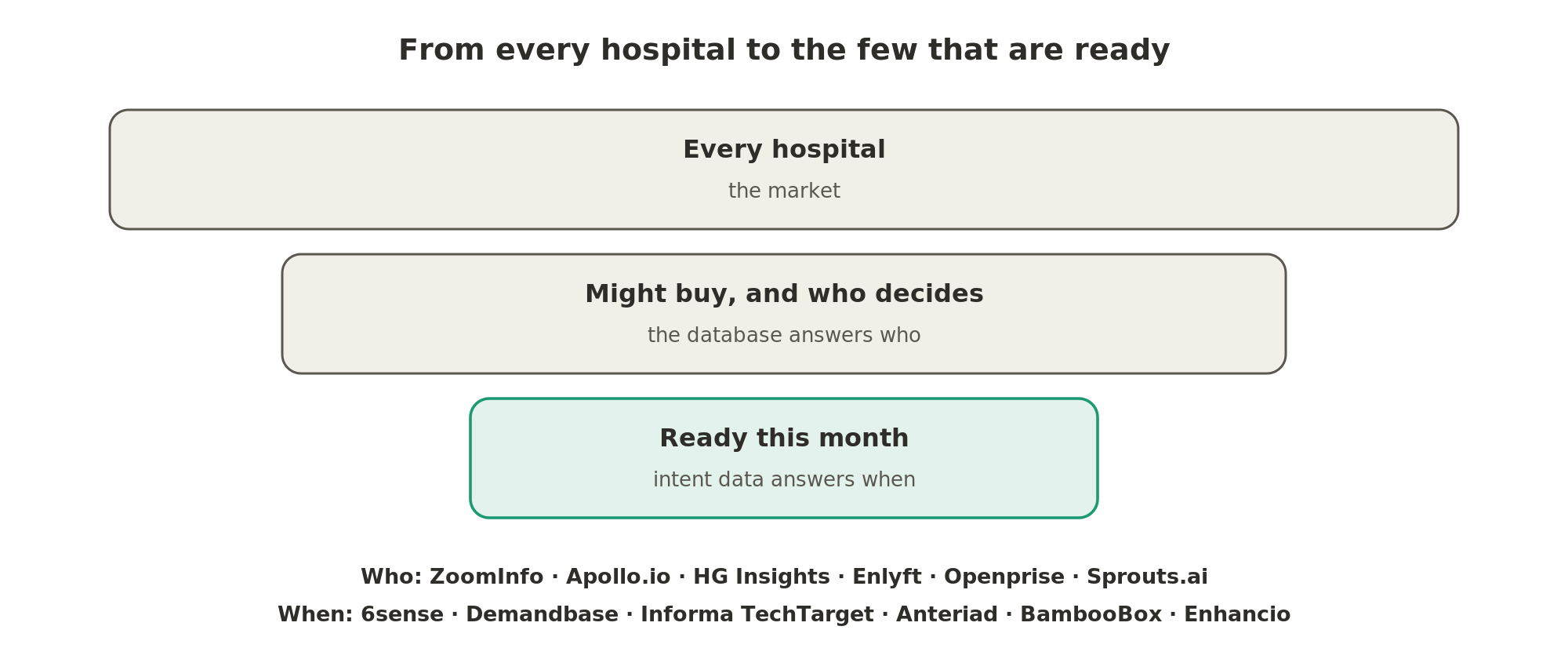
The database narrows every hospital to those that might buy and who decides there, and intent data narrows those to the few that are ready this month.The database narrows every hospital to those that might buy and who decides there, and intent data narrows those to the few that are ready this month. 6sensewith engineers in Bengaluru, has posted more jobs than any other company in this Market Segment. It built its product on the question of timing. It reads anonymous signals from across the web: research, reviews, website visits and hiring. From them, it predicts which accounts are in a buying cycle, the months a company spends deciding what to buy, and at what stage. The sales team can then call the ones that are ready. In our example, 6sense might notice people at one Chennai hospital reading about payroll software, and flag that hospital. Its Bengaluru centre, one of its largest, builds the prediction models. Demandbasewith engineers in Hyderabad, sells the account-based platform. It aims marketing, advertising and sales at the chosen accounts. It has its own B2B demand-side platform (DSP) to buy advertising aimed at them. A DSP is software that buys online ads automatically. (More on DSPs in Market Segment 34.1, Ad buying platforms (DSPs) and ad networks, in Industry Vertical 34, Adtech.) Informa TechTargetwith engineers in Bengaluru, sells purchase intent. It draws the signals from the technology research that readers of its publications do. Informa TechTarget also appears in Market Segment 33.1, News and professional information providers (in Industry Vertical 33, News, publishing and social media), for its publications. Anteriadwith engineers in Bengaluru, sells a B2B intent graph, a connected record of buying signals across companies. It also sells a programmatic advertising engine. Programmatic advertising means ads bought automatically by software, one view at a time.

Two small Indian companies complete this sub-segment:
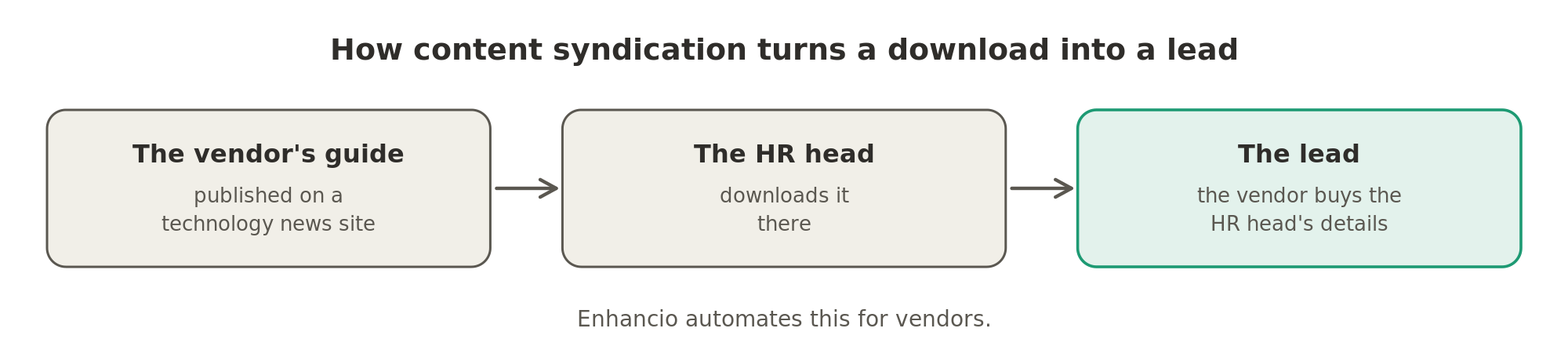
BambooBoxin Bengaluru, sells an account-based marketing platform with scoring and attribution. Attribution works out which marketing effort led to a sale. Enhancioalso in Bengaluru, automates content syndication. In content syndication, a vendor's report is published on another company's website. When a buyer downloads it there, the vendor buys that buyer's details as a lead. In our example, the HR head of a hospital downloads a guide to payroll software from a technology news site, and the payroll company buys the HR head's details. In content syndication the payroll company's guide is published on a news site, the hospital's HR head downloads it there, and the payroll company buys the HR head's details as a lead.In content syndication the payroll company's guide is published on a news site, the hospital's HR head downloads it there, and the payroll company buys the HR head's details as a lead. The account that is ready.

The contact database answered who. Intent data answers when, and AI models make that answer far more accurate. They infer from thousands of faint signals that an account has started looking. 6sense and Demandbase have rebuilt their products around that prediction. The next step is already in their products: the AI agent that acts on it, writing to the right person at the account on the day the signal appears. (More on these agents in Market Segment 14.3, Sales engagement platforms and AI SDRs.)

That is who to sell to: the database that says who might buy, and the intent data that says when. For the payroll company, it turns a list of every hospital into the few that are ready to talk.
Who they hire

Who these companies hire, and for what, is on What CRM and sales tech companies hire for.

Privacy Terms Refunds and cancellation Shipping and delivery © 2026 ingrid.fyi · Payments by Razorpay
You're browsing as a guest. Sign in free to follow links for five minutes, once an hour.