ingrid.fyi India's software hiring trends, explained.
Sign in to ingrid.fyi with Google
Your Google account
name@gmail.com
Continue with Google
Home / Product companies / V · Fintech / Lending and credit / Credit bureaus, scoring and underwriting
On this page
Credit bureaus, scoring and underwriting Deciding who gets credit, and at what price Take a schoolteacher in Lucknow who applies for a personal loan of ₹2 lakh. Before any money moves, the lender has to answer one question: will she repay? To answer it, the lender looks at four kinds of data: Her history with other lendersevery loan and credit card she has had, and whether she paid on time. Her bank statementsthe money coming in and going out. Her salarywhether she really earns what she says. Her identitywhether she is who she says she is.

Then software turns that data into a decision: a yes or a no, and a price, the interest rate she will pay.

Every loan in Market Segments 18.1 and 18.2 begins with such a decision. This Market Segment covers the companies that sell the data and the software behind it. After Market Segment 18.1, it has the most job postings in Industry Vertical 18, because the world's credit bureaus run some of their largest engineering centres in India.

Every company named here has posted software engineering jobs in India. Famous companies that don't actively hire software engineers in India are left out.

This Market Segment has three sub-segments:
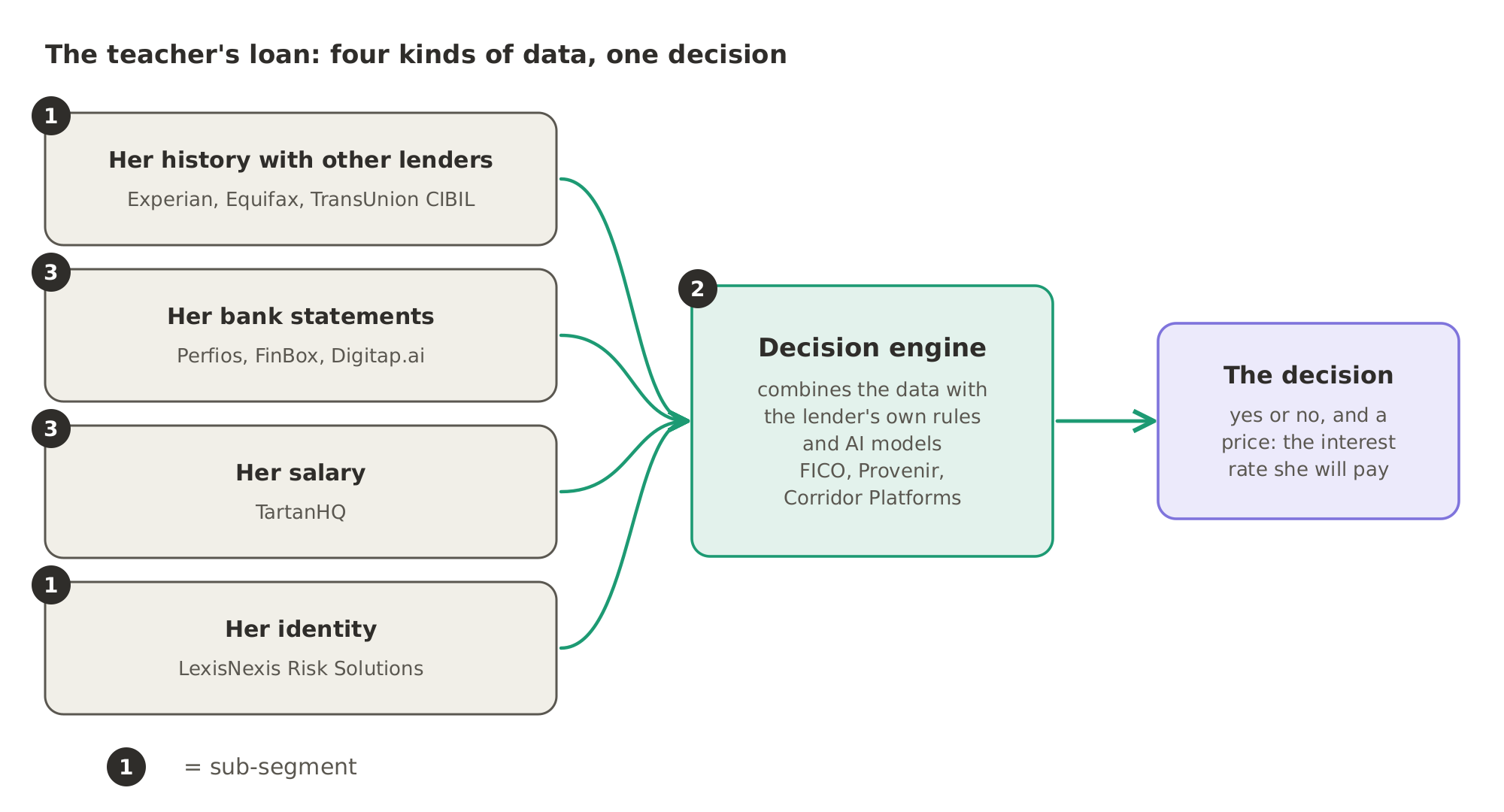
The bureaus and the ratings: the record of who has borrowed and repaid The decision: the engines and AI models that approve the loan The data read for the decision: the bank statement, the salary slip and the income, checked with the borrower's consent Four kinds of data about the teacher, her history with other lenders, her bank statements, her salary and her identity, flow into a decision engine, which combines them with the lender's own rules and AI models and returns a yes or a no and a price. The numbers 1 to 3 show which sub-segment sells each part.Four kinds of data about the teacher, her history with other lenders, her bank statements, her salary and her identity, flow into a decision engine, which combines them with the lender's own rules and AI models and returns a yes or a no and a price. The numbers 1 to 3 show which sub-segment sells each part.

Keep reading, free

Three more sections are on this page: The bureaus and the ratings, The decision, and The data read for the decision. Sign in to read them here, in full.

Continue with Google
  • The bureaus and the ratings
  • The decision
  • The data read for the decision
The bureaus and the ratings Consumer and commercial credit bureaus, credit ratings and risk research, identity and risk data

Take the teacher in Lucknow from the start of this Market Segment. The first thing the lender checks is her credit score: a number that sums up how well she has repaid loans in the past. The score comes from a credit bureau. A credit bureau collects the borrowing and repayment records of people and businesses from many lenders, and sells them back to lenders.
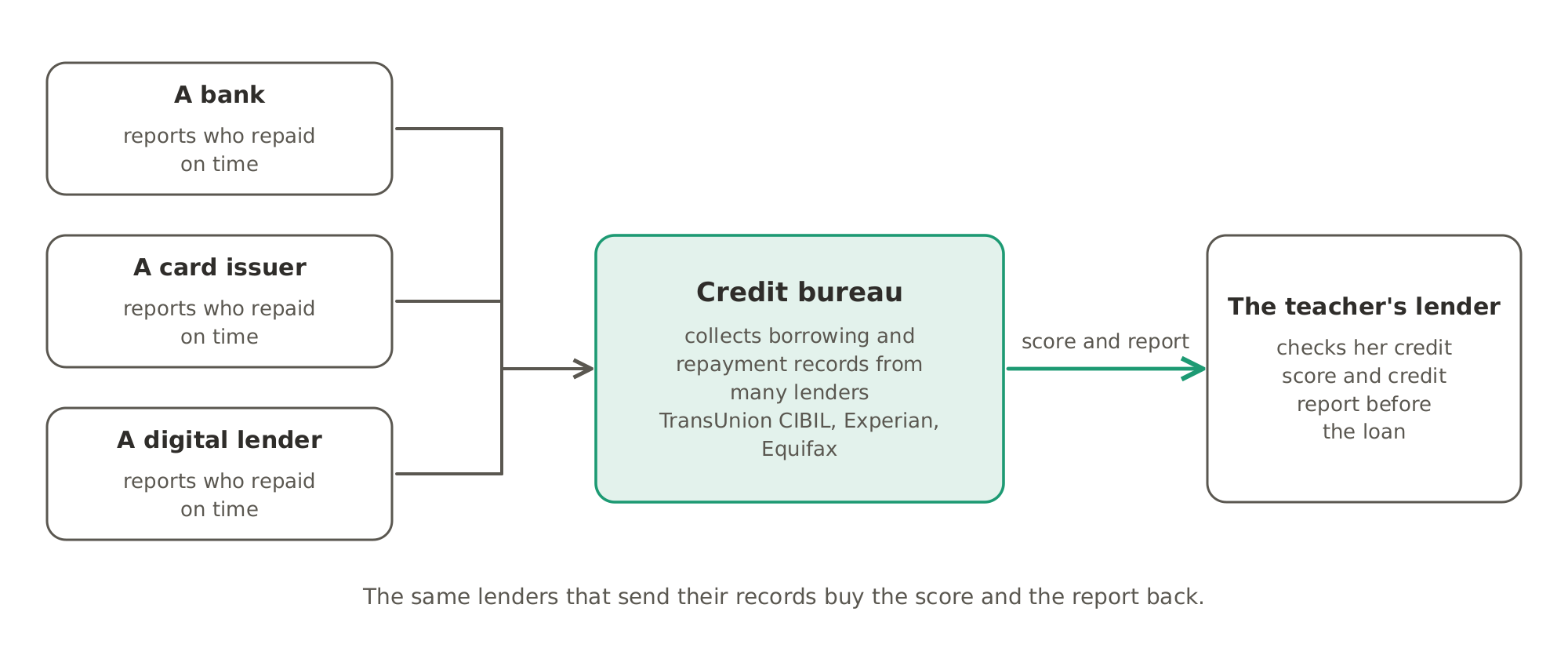
A credit bureau such as TransUnion CIBIL, Experian or Equifax collects borrowing and repayment records from many lenders, such as banks, card issuers and digital lenders. It sells the credit score and the credit report back to lenders, like the teacher's lender, which checks them before the loan.A credit bureau such as TransUnion CIBIL, Experian or Equifax collects borrowing and repayment records from many lenders, such as banks, card issuers and digital lenders. It sells the credit score and the credit report back to lenders, like the teacher's lender, which checks them before the loan. Experian and Equifaxare two of the three global credit bureaus. Experian has engineers in Hyderabad, and the most job postings in this Market Segment. Equifax has engineers in Pune. Together they hold the borrowing and repayment records of hundreds of millions of people and businesses. They sell the score and the credit report that lenders check before every loan. They also sell analytics and fraud checks built on the same data. Their Hyderabad and Pune centres are among the largest they have anywhere. Both also run credit bureaus in India. TransUnionthe third global bureau, has engineers in Bengaluru and Pune. It owns India's oldest and largest consumer bureau, TransUnion CIBIL. When most Indians say "credit score", they mean the CIBIL score. Dun & Bradstreetwith engineers in Hyderabad, is the commercial bureau: it keeps the credit records of businesses. A small business, like the garment maker in Market Segment 18.2, has its record here. (Because of its business data, Dun & Bradstreet also appears in Market Segment 8.3, Market research and market intelligence providers, in Industry Vertical 8, Analytics and data providers.) Crisilwith engineers in Hyderabad, Mumbai and Bengaluru, is India's largest credit rating agency. A credit rating agency grades how likely a company, or a bond it issues, is to repay. Crisil is owned by S&P Global. It also sells risk analytics and research to banks. (Crisil also appears in Market Segment 20.3, Financial data, ratings and research, in Industry Vertical 20, Wealthtech and capital markets.) LexisNexis Risk Solutionswith engineers in Mumbai and Chennai, sells the data that lenders check alongside the credit record. This includes identity data, fraud data and sanctions data. Sanctions data lists the people and companies that the law forbids banks to deal with. (LexisNexis Risk Solutions also appears in Market Segment 4.8, Data security and privacy, in Industry Vertical 4, Cybersecurity.) CredHivewith engineers in Delhi NCR, is a credit-data company that covers businesses.
The decision Credit decisioning engines, scorecards and rules, AI underwriting, loan origination systems

Back to the teacher's loan. The lender now has her credit score and her data. Software combines them with the lender's own rules, and decides. Deciding whether to lend, and at what price, is called underwriting. The software that does it is called a decision engine.

FICOwith engineers in Bengaluru, invented the credit score that most of the world's lenders use. It sells the decision platform built around that score. The platform includes a rules engine, which applies the lender's rules, and scorecards, which turn data into points and add them up. It also includes Falcon, the fraud system that scores most of the world's card transactions. Provenirwith engineers in Bengaluru, and Corridor Platforms sell the decision engine to lenders. It is the place where the bureau data, the lender's own rules and the AI models meet, and the loan is approved. OakNorth in Indiawith engineers in Delhi NCR and Bengaluru, is the Indian centre of OakNorth, a British bank. It builds the credit analysis software that OakNorth uses for its own loans to mid-sized businesses. OakNorth also sells this software to other banks. AbleCreditwith engineers in Bengaluru, uses an AI model to write the credit appraisal memo. This is the note in which an underwriter explains why a loan should be approved or refused. Underwriters used to write it by hand. JazzX AIautomates the underwriting of American mortgages, the loans people take to buy a house. Kaleidofinwith engineers in Chennai, scores borrowers with thin credit histories, meaning little or no record of past loans. Many of them are women and rural households. TVS Digitalthe technology arm of the TVS group, has engineers in Bengaluru. It sells software for loan origination, decisioning and collections. Collections means getting overdue loans repaid.
You're reading as a guest. Sign in free to follow links for five minutes, once an hour. The data read for the decision Bank statement and document analysis, alternative credit data, income and employment verification

Back to the teacher once more. Her credit score says how she repaid in the past. Her bank statement shows what she earns and spends today. The companies here read that kind of data for the lender. They often get it through India's account aggregator, a system that shares a person's bank data with a lender in seconds, with the person's consent.
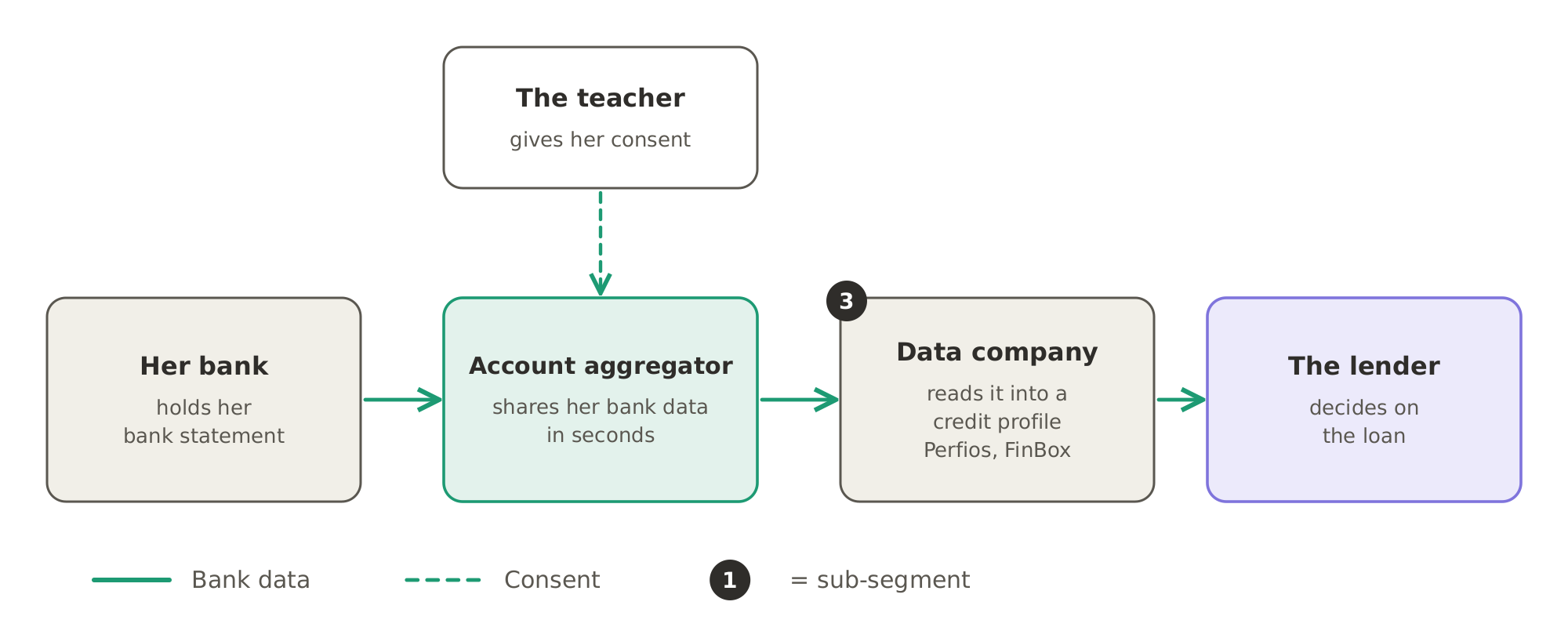
With the teacher's consent, the account aggregator takes her bank data from her bank and shares it in seconds with a data company such as Perfios or FinBox, which reads it into a credit profile for the lender that decides on the loan.With the teacher's consent, the account aggregator takes her bank data from her bank and shares it in seconds with a data company such as Perfios or FinBox, which reads it into a credit profile for the lender that decides on the loan. FinBoxwith engineers in Bengaluru and Delhi NCR, sells the data layer of India's digital lenders. It analyses the bank statement. It produces an alternative credit score from a phone's data, with the owner's consent. An alternative credit score uses data other than past loans. FinBox also sells the whole loan journey, embedded in another company's app. Perfioswith engineers in Bengaluru, is the bank-statement analyser that most Indian lenders use. It reads a statement, or the account aggregator's data, and turns it into a credit profile. The Perfios group also includes Clari5 and IHX. (More on Clari5 in Market Segment 19.2, Fraud prevention, AML and regtech, in Industry Vertical 19, Banking and regtech. More on IHX in Market Segment 23.2, Health payer platforms and prior authorisation, in Industry Vertical 23, Health insurance and billing.) Digitap.aiwith engineers in Bengaluru, sells the same kind of credit data and identity checks. Ocrolusan American company with engineers in Delhi NCR, reads the documents in American loan applications, such as pay stubs and bank statements. A pay stub is the American salary slip. Ocrolus checks each document for tampering. TartanHQwith engineers in Delhi NCR, verifies a borrower's job and income directly from the employer's payroll system. Phyllowith engineers in Bengaluru, verifies the income of creators, from the platforms that pay them. The credit decision without a credit history.

With the account aggregator, a borrower can share their bank data with a lender in seconds, with consent. An AI model can then decide on a person who has never borrowed before. The frontier is lending on that data at a large scale, without the old mistake of lending too easily. Three layers decide how that goes: the bureaus, the decision engines and the data companies in this Market Segment.

That is how a lender decides. The teacher in Lucknow gets her ₹2 lakh for three reasons. A bureau vouched for her past, a data company read her bank statement, and a decision engine said yes, at a price.
Who they hire

Who these companies hire, and for what, is on What lending and credit hires for.

Privacy Terms Refunds and cancellation Shipping and delivery © 2026 ingrid.fyi · Payments by Razorpay
You're browsing as a guest. Sign in free to follow links for five minutes, once an hour.