Take a small garment maker in Tiruppur with forty workers. A large retailer has ordered ten thousand T-shirts. To make them, the garment maker must buy cloth and pay its workers now. But the retailer will pay only ninety days after the T-shirts are delivered. For those ninety days, the garment maker needs cash.
The cash a business needs to buy stock and pay its costs before its customers pay is called working capital. India has tens of millions of small businesses, and most of them cannot borrow it from a bank. They have three problems:
No audited accountsmeaning accounts checked by an outside auditor, which banks ask to see.
No property to pledgeas security for the loan.
Slow customersinvoices that their large customers pay in ninety days.
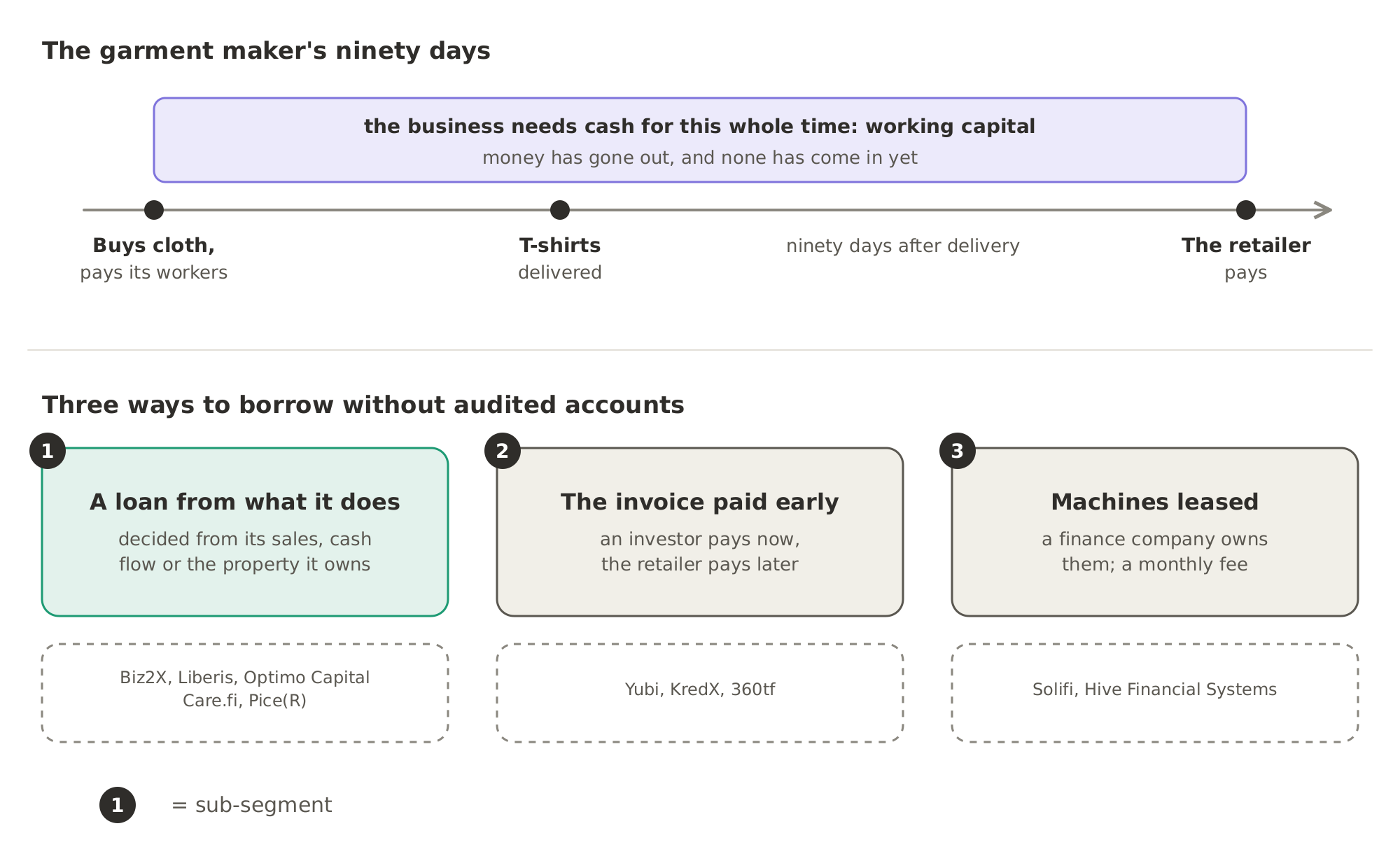 The garment maker pays for cloth and workers first, delivers the T-shirts, and is paid by the retailer only ninety days after delivery; the cash it needs for that whole time is its working capital. The three sub-segments, numbered 1 to 3, are three ways to borrow it without audited accounts: a loan decided from what the business does, the invoice paid early, and machines leased.
This Market Segment covers the companies that lend working capital to such businesses, or build the software through which others lend it.
Every company named here has posted software engineering jobs in India. Famous companies that don't actively hire software engineers in India are left out.
This Market Segment has three sub-segments:
The small business's loan: loans decided from the business's sales and cash flow
Invoices, supply chains and the debt market: lending that follows the goods, and the platforms on which loans are sold on to investors
The lender's software for equipment and vehicles: the systems of the companies that lease machines and finance dealers' stock
The small business's loan
SME loan origination platforms, revenue-based and embedded financing, loans against property, sector lending
Take the garment maker from the start of this Market Segment. A bank would ask for audited accounts. The lenders here look at what the business actually does instead: its sales, the money coming in and going out, and the property it owns.
Biz2Xwith engineers in Delhi NCR and Pune, sells banks a loan origination platform. On it, a small business applies for a loan online, and the loan is scored and approved there too. Origination means everything from the application to the approval. The platform is white-labelled, meaning it appears under the bank's own name.
Liberisa British company with engineers in Mumbai, sells embedded financing. Its loan is built into the software and payment platforms that small businesses already use. The business repays it as a share of its card sales.
Optimo Capitalwith engineers in Bengaluru, lends against property to small business owners. An AI model values the property, and the land records are read digitally.
Care.fiwith engineers in Bengaluru, lends to hospitals against their insurance claims. (Care.fi also appears in Market Segment 23.1, Revenue cycle management (RCM) software, in Industry Vertical 23, Health insurance and billing.)
Pice(R)lets small businesses pay their suppliers by card or on credit.
One company here is covered mainly in another Market Segment:
Power2SMEwith engineers in Bengaluru, buys raw materials for small manufacturers, and finances the purchase. (More on Power2SME in Market Segment 26.5, B2B e-commerce platforms, in Industry Vertical 26, E-commerce and D2C brands.)
Invoices, supply chains and the debt market
Supply chain finance, invoice discounting, co-lending and securitisation platforms, trade finance
Back to the garment maker. It has delivered the T-shirts and sent the retailer an invoice for them. The retailer will pay in ninety days. But the invoice itself is worth something. An investor can pay the garment maker most of it now, and collect the full amount from the retailer later. This is called invoice discounting.
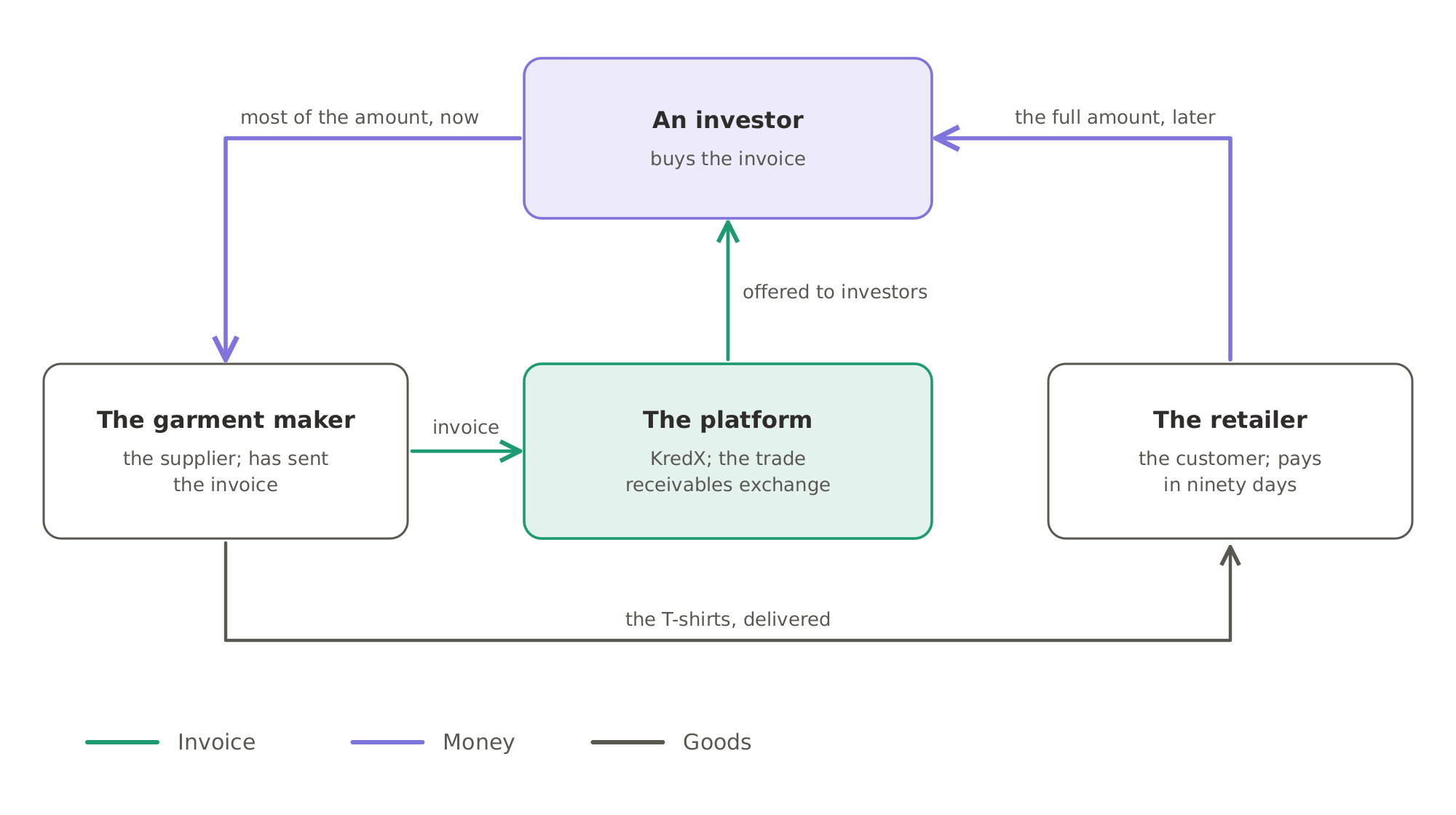 In invoice discounting, the garment maker delivers the T-shirts to the retailer and puts its invoice on a platform such as KredX or the trade receivables exchange. An investor buys the invoice and pays the garment maker most of the amount now, then collects the full amount from the retailer later.
Yubiwas founded in Chennai. It has engineers in Bengaluru and Chennai, and the most job postings of any company covered mainly in this Market Segment. It runs a marketplace on which India's lenders and investors find each other. It covers four kinds of deals:
In invoice discounting, the garment maker delivers the T-shirts to the retailer and puts its invoice on a platform such as KredX or the trade receivables exchange. An investor buys the invoice and pays the garment maker most of the amount now, then collects the full amount from the retailer later.
Yubiwas founded in Chennai. It has engineers in Bengaluru and Chennai, and the most job postings of any company covered mainly in this Market Segment. It runs a marketplace on which India's lenders and investors find each other. It covers four kinds of deals:- supply chain finance, which pays a large company's suppliers early
- co-lending, which splits one loan between a bank and a finance company
- securitisation, which bundles many loans together and sells the bundle to investors
- the bonds of mid-sized companies. A bond is a loan from investors that a company repays over a fixed period.
Yubi Markets, another company of the Yubi group, has engineers in Chennai.
KredXwith engineers in Bengaluru, sells invoice discounting: the supplier is paid now by an investor, who collects from the customer later. KredX also works on India's trade receivables exchange, a regulated platform where such invoices are traded.
360tfwith engineers in Bengaluru and Delhi NCR, sells a platform for trade finance: the money that makes international trade possible. It covers letters of credit and export credit. A letter of credit is a bank's promise to pay the exporter once the goods are shipped. Export credit is a loan to an exporter to fill an order.
You're reading as a guest. Sign in free to follow links for five minutes, once an hour.
Sign in
The lender's software for equipment and vehicles
Lease and asset finance origination and servicing, dealer floorplan finance
Back to the garment maker once more. The order went well, and it wants a new line of sewing machines. It does not buy them. It leases them: it uses the machines and pays a monthly fee to a finance company that owns them. Finance companies like this need their own software.
Solifiwith engineers in Bengaluru, sells software to companies that finance equipment, vehicles and dealers' stock. The software handles three jobs:- originating the lease, from the application to the signed contract
- tracking the asset, the machine or vehicle being financed, across its life
- managing floorplan finance, the loan that pays for the stock on a dealer's floor, such as the cars in a showroom, until each one is sold
Hive Financial Systemswith engineers in Hyderabad, sells software to the same finance companies.
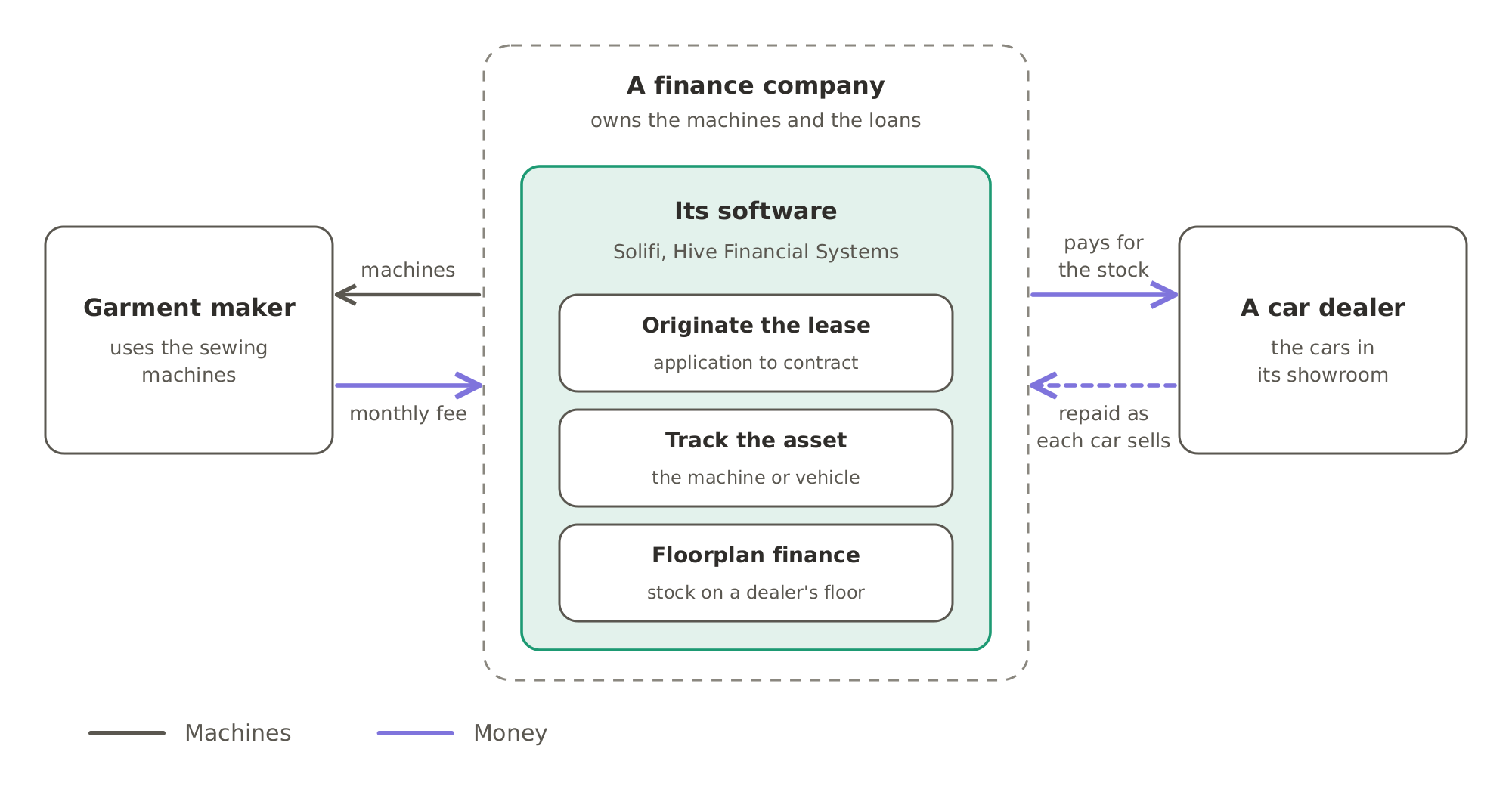 A finance company leases sewing machines to the garment maker for a monthly fee, and pays for the cars in a dealer's showroom until each one is sold. Its software, from Solifi or Hive Financial Systems, originates the lease, tracks the asset and manages the floorplan finance.
One company here is covered mainly in another Market Segment:
ACV Auctionswith engineers in Chennai, runs online auctions of used cars between American dealers. Through ACV Capital, it lends dealers the money to buy the cars they win. (More on ACV Auctions in Market Segment 38.5, Car dealer software and used-car marketplaces, in Industry Vertical 38, Automotive and mobility.)
The loan that follows the goods.
A small business has no balance sheet a bank trusts. But it has invoices, GST returns and payments. India's public data systems now make these visible to a lender, with the business's consent. The frontier is lending against that flow. It includes the invoice paid early, the loan repaid from each day's card sales, and the credit decided from the tax return. It is being built on the same public infrastructure as the consumer loans in Market Segment 18.1, Digital lending and BNPL.
That is how a small business borrows. The Tiruppur garment maker gets a loan decided from its sales, is paid early against its invoice, and leases its new machines. None of these lenders asked for audited accounts. They looked at what the business actually does.