Take a delivery rider in Hyderabad whose bike breaks down. He needs ₹15,000 to repair it, this week. He has no salary slip, and he has never taken a loan, so he has no credit history: no record of borrowing and paying back. A decade ago, no bank would have lent to him.
Today he opens an app on his phone and applies. Within minutes, the loan is approved and the money is in his bank account. No person decided it. An AI model did, by reading his bank statement, the bills he has paid and data from his phone.
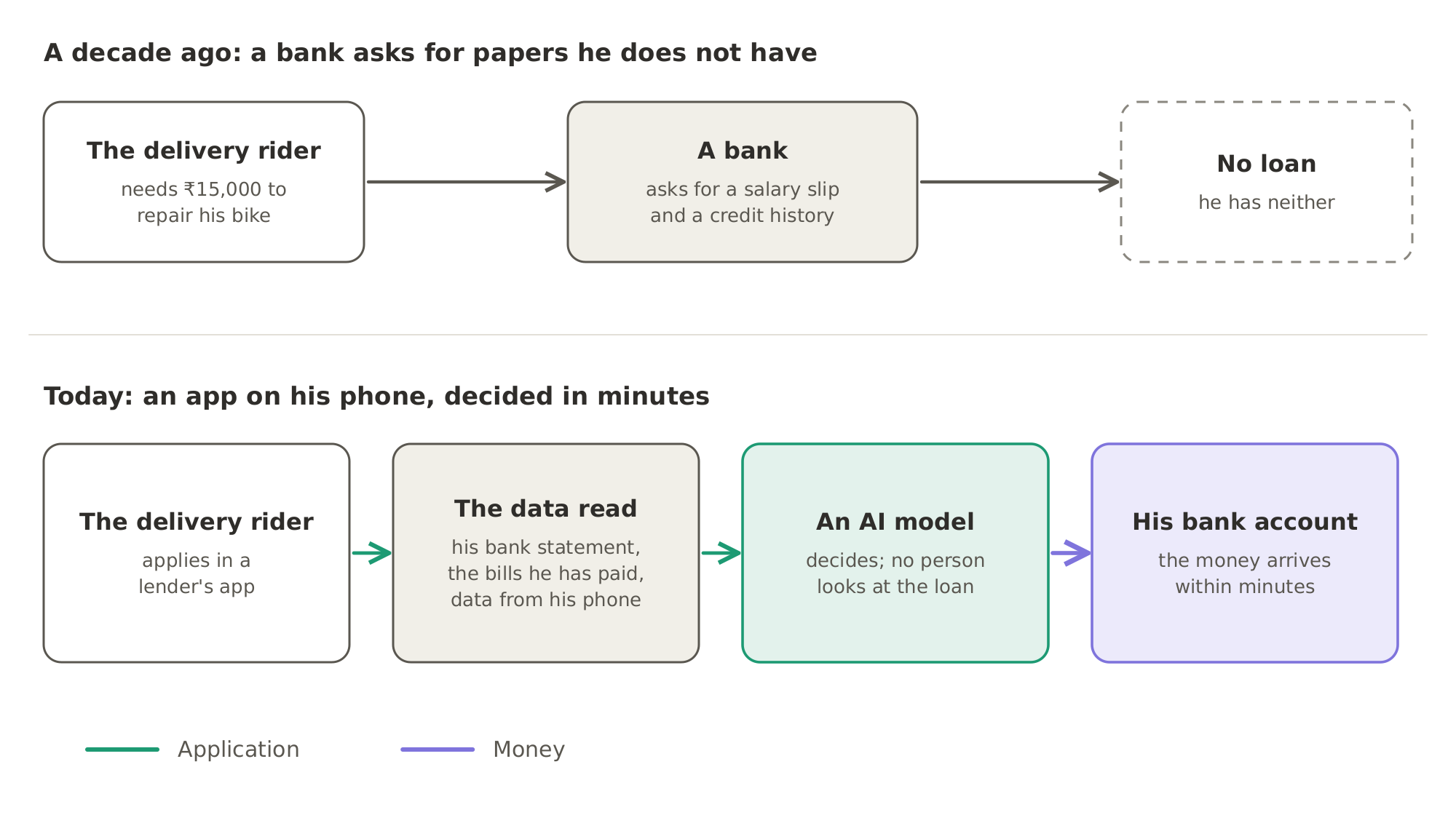 A decade ago, a bank asked the delivery rider for a salary slip and a credit history he did not have, so he got no loan. Today he applies in a lender's app, which reads his bank statement, the bills he has paid and data from his phone, and an AI model decides in minutes and sends the money to his bank account.
This Market Segment covers the companies that lend to people this way. It also covers the companies that sell credit at the checkout, before payday and for study. It is where India's digital lending industry is most visible.
Every company named here has posted software engineering jobs in India. Famous companies that don't actively hire software engineers in India are left out.
This Market Segment has four sub-segments:
India's consumer lenders: the companies that lend to Indians through an app
Credit at the checkout and on the card: credit sold at the moment of buying
The lenders of other countries: lenders abroad that build their product in Bengaluru
Education loans: loans for study, in India and abroad
India's consumer lenders
Digital personal loans, consumer and gold loans, credit lines, earned wage access in India
Take the delivery rider from the start of this Market Segment. His ₹15,000 came from one of these lenders. Most of them sell a small unsecured loan: a loan with nothing pledged against it, decided in minutes.
Bajaj Finservwith engineers in Pune and Bengaluru, has the most job postings in this Market Segment, and in Industry Vertical 18. It is the group behind Bajaj Finance. Bajaj Finance is India's largest consumer lender outside the banks. Lenders like it, which lend but are not banks, are called non-banking financial companies, or NBFCs. Bajaj Finance made the no-cost EMI ordinary across India. An EMI (equated monthly instalment) is a fixed amount paid every month until a loan is repaid. With a no-cost EMI, a shopper pays for a phone or a television in instalments, at no extra cost. Bajaj Finance now sells most of its loans, deposits and insurance through its app. (Bajaj Finserv also appears in Market Segment 21.7, Digital insurers, in Industry Vertical 21, Insurtech.)
Naviwith engineers in Bengaluru, was founded by Flipkart's co-founder. It sells personal loans and home loans from an app, with UPI payments and mutual funds beside them. (Because of its UPI app, Navi also appears in Market Segment 17.5, UPI apps, wallets and neobanks, in Industry Vertical 17, Payments.)
Six companies sell the small unsecured loan, decided in minutes:
KreditBeewith engineers in Bengaluru
Kisshtwith engineers in Mumbai
mPokketwhich lends to students and young earners
Olyv India (SmartCoin)
Zypewith engineers in Mumbai
NIRAwhich sells a credit line to lower-income salaried workers. A credit line is an amount the borrower may draw on whenever they need it.
Four more lenders work in other ways:
Credit Saison Indiais the Indian arm of a Japanese lender. It has engineers in Bengaluru. It lends directly, and also through the checkouts of other apps.
InCred Financial Serviceslends to individuals, small businesses and students.
Rupeekwith engineers in Bengaluru, lends against gold, the asset most Indian families hold. The gold is valued and collected at the borrower's doorstep.
Refyne Indiawith engineers in Bengaluru, lets employees draw the salary they have already earned, before payday. This is called earned wage access.
Credit at the checkout and on the card
Buy now pay later, cardless instalments (EMI), credit on UPI, secured and co-branded credit cards
Back to the delivery rider. His bike is repaired, and now he wants a new phone. He has no credit card. At the checkout of a shopping website, he is offered another way to pay: in monthly instalments. This sub-segment lends at the moment of buying.
Snapmintwith engineers in Delhi NCR and Bengaluru, sells instalments at the online checkout to shoppers without a credit card. This is called a cardless EMI.
axiowith engineers in Bengaluru, sells pay-later at the checkout, together with a money-management app. Pay-later, or buy now pay later (BNPL), lets a shopper take the product now and pay a few weeks later.
Riowith engineers in Bengaluru, builds credit that is spent through a UPI QR code. India's payment system now allows a credit line to be linked to UPI, and spent like money in a bank account.
ZETwith engineers in Bengaluru, sells a credit card backed by a fixed deposit. The customer puts money in a fixed deposit, and the card's limit is set against it. It is the first card for people with no credit history.
Uni Cardssells co-branded cards with their own rewards. A co-branded card is issued by a bank together with another company.
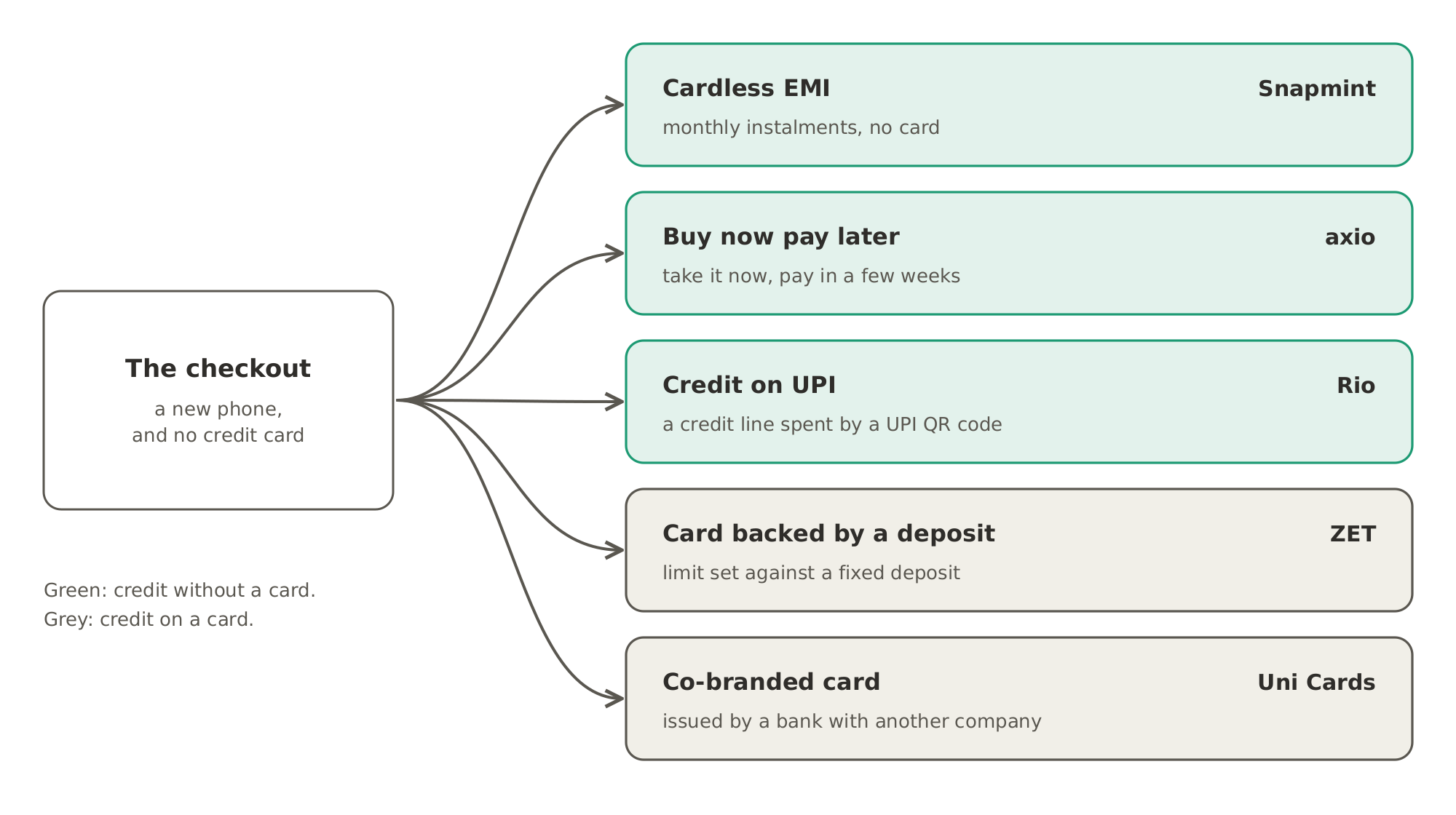 At the checkout, a shopper with no credit card can still buy on credit in five ways: a cardless EMI from Snapmint, buy now pay later from axio, a credit line spent through UPI from Rio, a card backed by a fixed deposit from ZET, or a co-branded card from Uni Cards.
You're reading as a guest. Sign in free to follow links for five minutes, once an hour.
Sign in
The lenders of other countries
Earned wage access and cash advances, consumer credit in South-East Asia, Africa and Latin America, debt consolidation
At the checkout, a shopper with no credit card can still buy on credit in five ways: a cardless EMI from Snapmint, buy now pay later from axio, a credit line spent through UPI from Rio, a card backed by a fixed deposit from ZET, or a co-branded card from Uni Cards.
You're reading as a guest. Sign in free to follow links for five minutes, once an hour.
Sign in
The lenders of other countries
Earned wage access and cash advances, consumer credit in South-East Asia, Africa and Latin America, debt consolidation
The delivery rider borrowed from an Indian app. The same kind of lending exists in other countries. The companies in this sub-segment lend abroad, and build their product in Bengaluru.
EarnInwith engineers in Bengaluru, is an American app. Through it, workers draw their pay as they earn it, instead of waiting for payday.
Tilt (Empower) and Vola Financesell cash advances to Americans between paychecks. A cash advance is a small, short loan against the next pay.
Updraftsells a loan that consolidates a British borrower's expensive debts. Debt consolidation means replacing several costly loans with one cheaper loan.
Kredivo Groupwith engineers in Bengaluru, runs Indonesia's pay-later service and digital credit line, and has its own bank.
Cermati.comis an Indonesian lending marketplace and credit platform. A lending marketplace lets a borrower compare loans from many lenders in one place.
Talawith engineers in Bengaluru, lends small amounts through a phone app in Kenya, the Philippines and Mexico. An AI model reading the phone's data decides each loan. It is the same idea as India's lenders, applied in other countries.
Education loans
Loans for study abroad and in India, school fee instalments, scholarship and loan discovery
Back to the delivery rider one last time. His younger sister has a place at a university in Canada. The tuition and the living costs are far more than the family has. This sub-segment lends for study.
Credila Financial Serviceswith engineers in Bengaluru, is an Indian lender that specialises in loans for students going abroad. It pays for the tuition and living costs of an Indian studying in America, Britain or Canada.
zendawith engineers in Bengaluru, lets parents pay school fees in instalments.
Two companies covered mainly in another Market Segment bring the student to the lender. (More on both in Market Segment 42.6, Campus placement and career platforms, in Industry Vertical 42, Edtech.)
Leapwith engineers in Bengaluru, guides Indian students through admission to universities abroad, and arranges their loans.
WeMakeScholarsfinds scholarships for students, and processes their education loans.
The loan decided before it is asked for.
India's digital lenders built the fastest consumer credit decision in the world. They built it on top of India's public data systems. One is the account aggregator, which shares a bank statement with a lender, with the customer's consent. Another is the digital identity that proves who the borrower is. The next step is the loan offered inside another app, at the moment of need. It is pre-approved by an AI model that has already read the data. The other open question is the regulator's rules on how such loans may be sold.
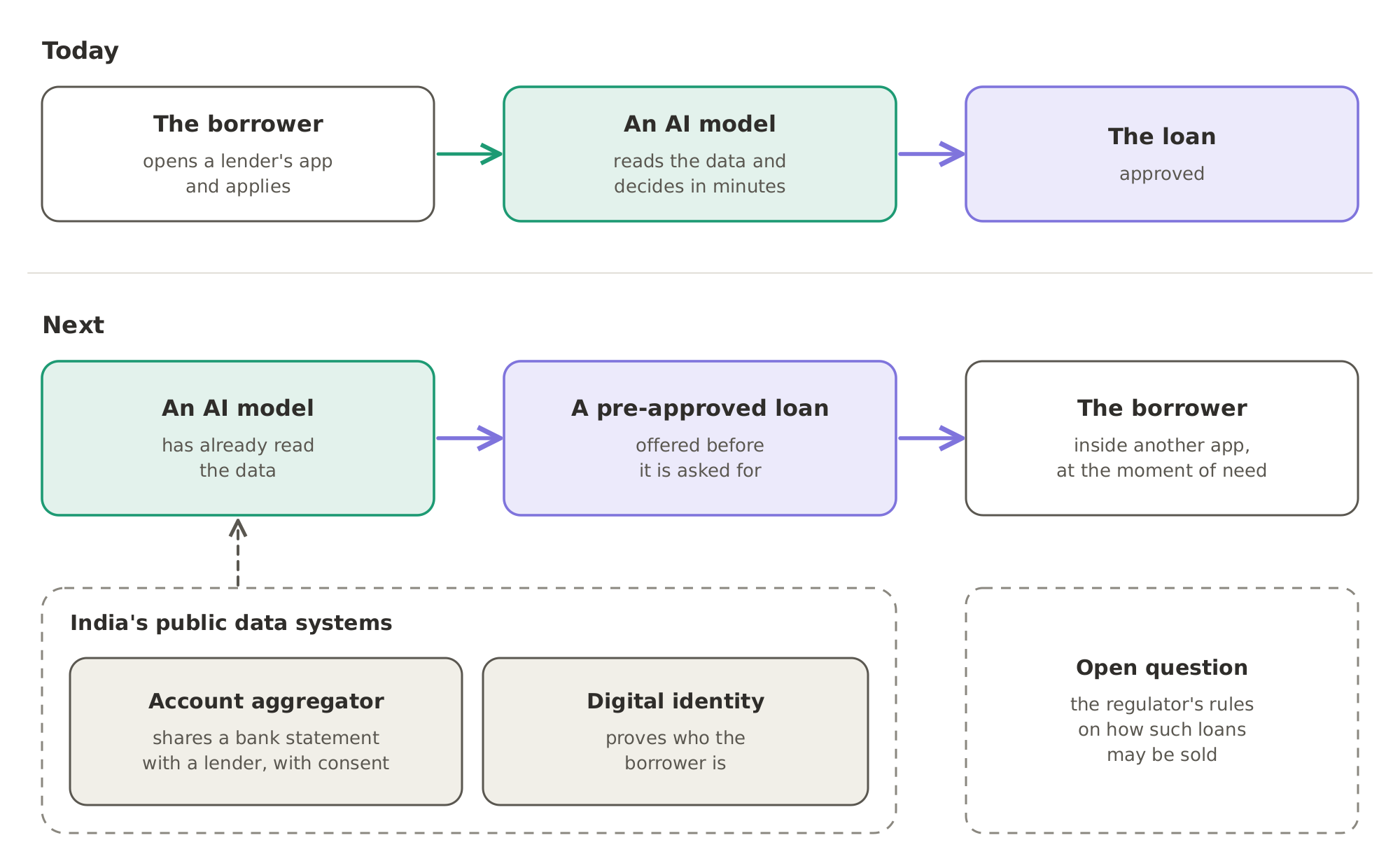 Today a borrower opens a lender's app and applies, and an AI model decides in minutes. Next, an AI model that has already read the data, through India's account aggregator and digital identity, offers a pre-approved loan inside another app at the moment of need, while the regulator's rules on how such loans may be sold remain an open question.
That is how India borrows on a phone. The delivery rider's bike loan, his new phone in instalments and his sister's education loan were all decided by software, much faster than a bank used to take.
Today a borrower opens a lender's app and applies, and an AI model decides in minutes. Next, an AI model that has already read the data, through India's account aggregator and digital identity, offers a pre-approved loan inside another app at the moment of need, while the regulator's rules on how such loans may be sold remain an open question.
That is how India borrows on a phone. The delivery rider's bike loan, his new phone in instalments and his sister's education loan were all decided by software, much faster than a bank used to take.