Financial crime
Enterprise fraud management, anti-money laundering transaction monitoring, sanctions and watchlist screening, identity fraud
Back to the ₹9 lakh that passed through the student's account. The software that flagged it is called transaction monitoring. It watches every payment, and raises an alert when one looks like fraud or money laundering. An investigator at the bank then looks at the alert.
Clari5with engineers in Mumbai and Bengaluru, is an Indian company. Its real-time fraud and money-laundering system watches the transactions of many of India's banks. It scores each payment as it happens. Clari5 belongs to the Perfios group. (More on Perfios in Market Segment 18.3, Credit bureaus, scoring and underwriting, in Industry Vertical 18, Lending and credit.)
Tookitakiwith engineers in Bengaluru, sells FinCense, which monitors transactions for money laundering. It is built on AI models, and on typologies shared between banks. A typology is a known pattern that criminals use to move money.
Flagrightsells the same kind of monitoring to fintechs, with case management for the investigators. Case management is the software in which an investigator works through each alert.
Facctumwith engineers in Bengaluru, sells sanctions and watchlist screening. It checks every customer and every payment against the lists.
Solytics Partnerswith engineers in Pune, sells name screening and transaction monitoring. It also sells the governance of the bank's own risk models: checking that the models the bank uses to measure risk still work as they should.
Digital Harbourwith engineers in Bengaluru, sells KYC and compliance software to banks. KYC (know your customer) is the check a bank must do on who each customer is.
SentiLinkan American company with engineers in Delhi NCR and Bengaluru, detects synthetic identities. A synthetic identity is an invented person, put together from real and fake details, and used to open accounts and borrow money. (SentiLink also appears in Market Segment 4.2, Identity and access management (IAM), in Industry Vertical 4, Cybersecurity.)
Back to the student opening her account. The identity check that begins every account comes from six companies covered mainly in another Market Segment. (More on all six in Market Segment 4.3, KYC, identity verification and fraud prevention, in Industry Vertical 4, Cybersecurity.)
Bureauwith engineers in Bengaluru, reads the device, the phone number and the behaviour of the person opening the account.
SecuredTouchnow part of Ping Identity, detects bots and account takeovers, meaning a criminal taking over a real customer's account. It does this from how a user types and swipes.
AiPriseverifies people and businesses, with AI agents doing the review.
Jumio Corporationchecks a person's face against their identity document.
Signzysells video KYC, where the customer's identity is checked on a video call. It also sells a detector for mule accounts. A mule account is an account used to pass stolen money along, like the one in the student's story.
HyperVergesells the face match and the liveness check used by many Indian lenders. A liveness check proves that the face is a real, live person, not a photo.
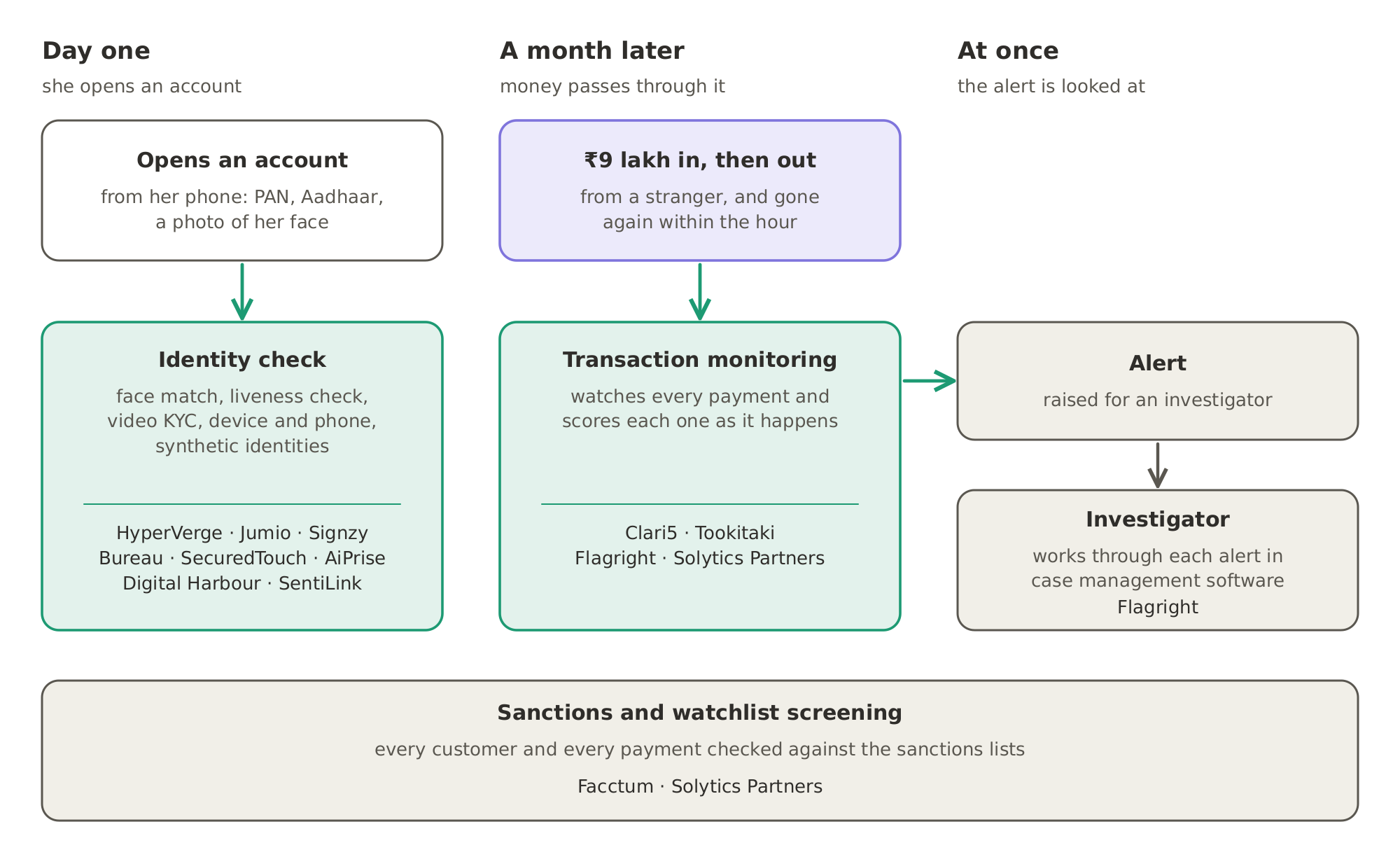 The student's identity is checked when she opens her account, and a month later transaction monitoring scores the ₹9 lakh that passes through it and raises an alert for an investigator. Sanctions and watchlist screening checks every customer and every payment throughout.
Reporting and surveillance
Regulatory and prudential reporting, reconciliation and data integrity, communications recording and archiving, employee compliance
The student's identity is checked when she opens her account, and a month later transaction monitoring scores the ₹9 lakh that passes through it and raises an alert for an investigator. Sanctions and watchlist screening checks every customer and every payment throughout.
Reporting and surveillance
Regulatory and prudential reporting, reconciliation and data integrity, communications recording and archiving, employee compliance
The student's bank also has to report to its regulator. Every day, it must show how much capital it holds, how much cash it could raise quickly, and what risks it is running. And it must watch its own staff.
Regnologywith engineers in Pune, Bengaluru and Delhi NCR, has the most job postings in this Market Segment. It sells the regulatory reporting of banks and insurers across Europe and beyond. These are the capital, liquidity and risk reports that banks send to their supervisors. Liquidity means how much cash a bank can raise quickly. More and more, Regnology also sells the platforms that the supervisors use to receive the reports. (Because of its reporting for insurers, Regnology also appears in Market Segment 21.1, Core insurance software (policy, billing and claims), in Industry Vertical 21, Insurtech.)
Greshamwith engineers in Bengaluru and Delhi NCR, sells reconciliation. It checks that the bank's records match those of its counterparties, the other banks and firms it trades with. It also checks that the data in the bank's reports is right.
Verint Financial Compliancewith engineers in Bengaluru and other cities, records and archives the calls, chats and messages of traders and bankers, as the regulators require. It also analyses them for misconduct. It carries the name of Verint, which is covered in another Market Segment. (More on Verint in Market Segment 15.1, Contact centre software (CCaaS), in Industry Vertical 15, Customer service and CX.)
MCO (MyComplianceOffice)with engineers in Hyderabad, watches the bank's own employees. It tracks their personal trades, their conflicts of interest and the gifts they receive.
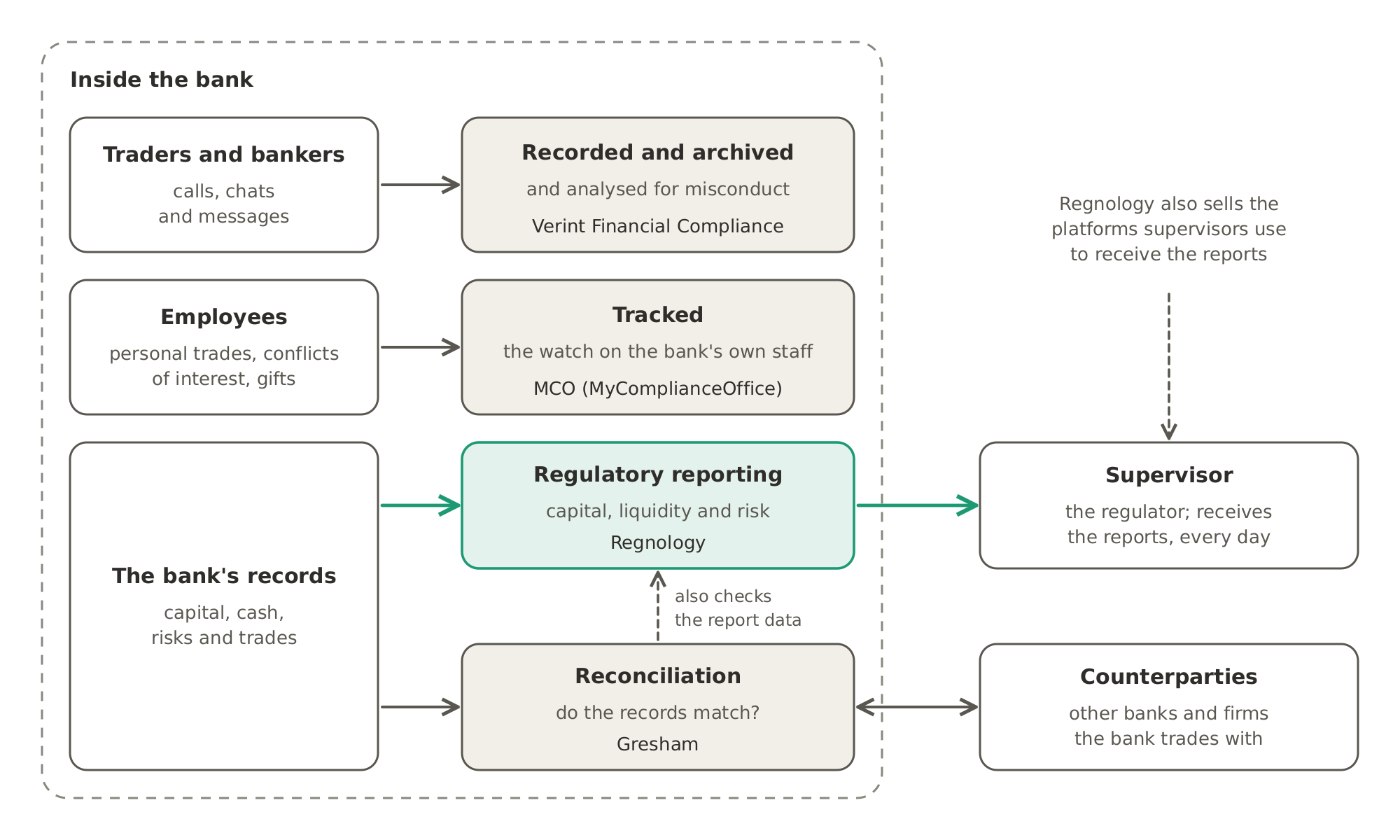 Inside the bank, Verint Financial Compliance records traders' and bankers' calls and messages, MCO tracks employees, Regnology turns the bank's records into capital, liquidity and risk reports for the supervisor, and Gresham reconciles the bank's records with its counterparties and checks the report data.
The investigator's first draft.
Inside the bank, Verint Financial Compliance records traders' and bankers' calls and messages, MCO tracks employees, Regnology turns the bank's records into capital, liquidity and risk reports for the supervisor, and Gresham reconciles the bank's records with its counterparties and checks the report data.
The investigator's first draft.
Financial-crime compliance employs large teams, many of them in India. They review alerts, and most of those alerts turn out to be false. Now AI models read the alert and gather the customer's history. They write the first draft of the investigation, and of the report to the regulator. The investigator then reviews it. The same change is reaching regulatory reporting. There, an AI model reads the regulation itself, and turns it into the rules for the report.
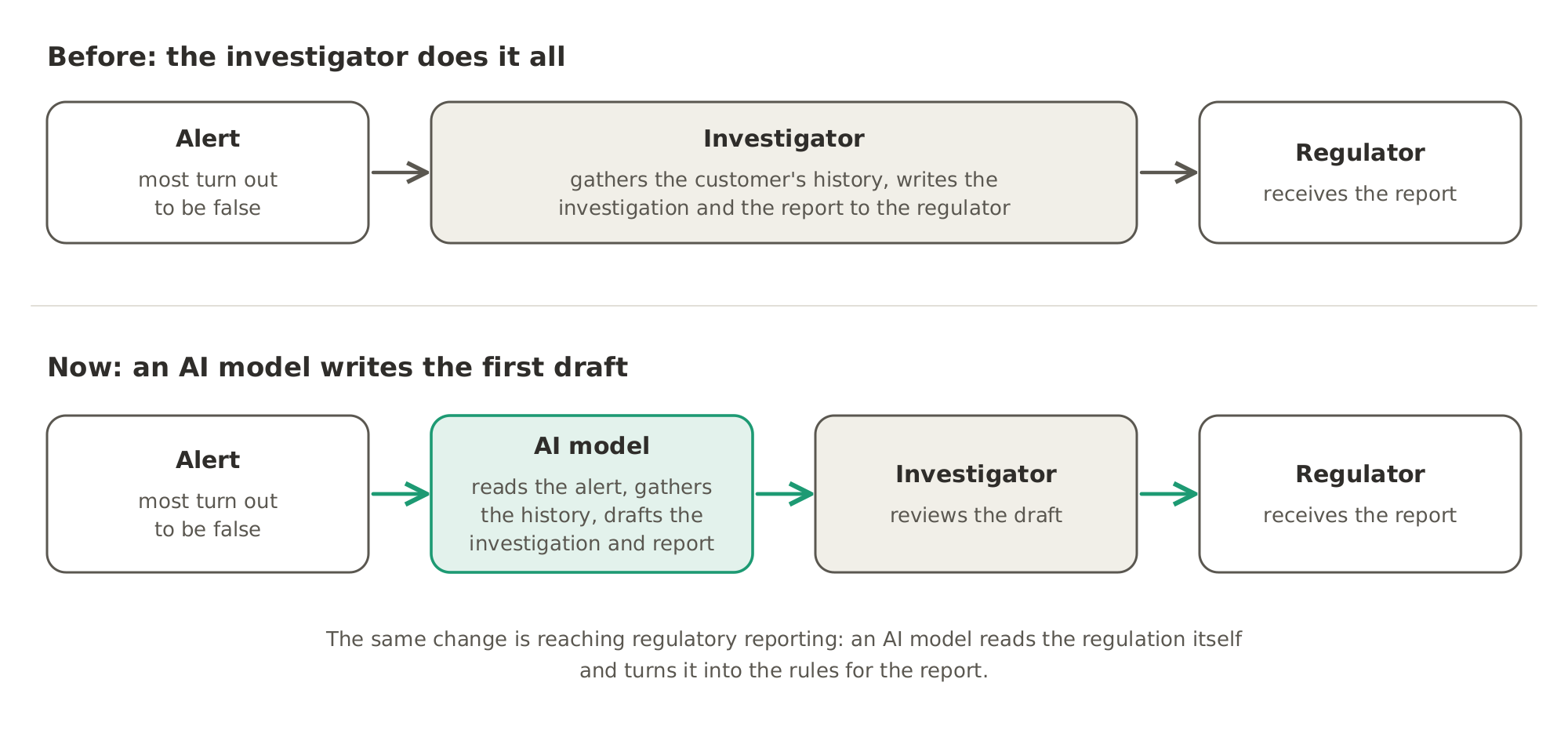 Before, an investigator gathered the history and wrote the investigation and report for each alert. Now an AI model reads the alert, gathers the history and writes the first draft, and the investigator reviews it before the report goes to the regulator.
That is how a bank stops crime and satisfies its regulator. The student's identity was checked when she opened her account. The ₹9 lakh was flagged the moment it moved. And every day, the bank's reports go to the regulator.
Before, an investigator gathered the history and wrote the investigation and report for each alert. Now an AI model reads the alert, gathers the history and writes the first draft, and the investigator reviews it before the report goes to the regulator.
That is how a bank stops crime and satisfies its regulator. The student's identity was checked when she opened her account. The ₹9 lakh was flagged the moment it moved. And every day, the bank's reports go to the regulator.