Your UPI payment has failed, but the money has left your bank account. You call your bank's customer care number. A recorded voice asks you to press 1 or 2. A few minutes later, an agent picks up, with your account already on their screen. The call is recorded, and after it ends, someone may score how well the agent handled it.
In India, the place where this happens is usually called a customer care centre. The industry calls it a contact centre. A large one is a floor of hundreds of agents answering calls, chats, emails and messages. The software behind it does five jobs:
- It routes each contact to the right agent.
- It records the contact.
- It measures how each agent is doing.
- It forecasts how many agents are needed, for example on a Tuesday afternoon.
- More and more, it answers the contact itself, before any agent is involved.
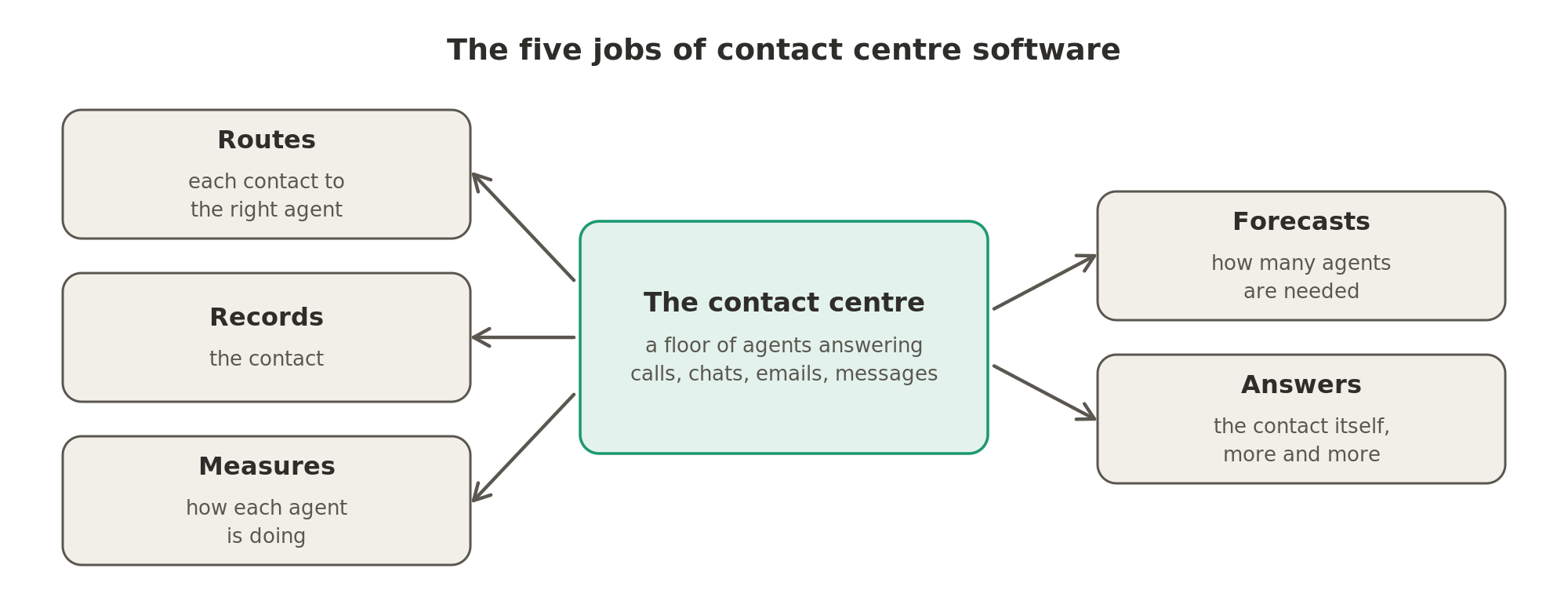 Contact centre software routes each contact to the right agent, records it, measures each agent, forecasts how many agents are needed, and more and more answers the contact itself.
This software used to run on equipment in the company's own building. Over the last decade, the industry moved it to the cloud, and called the result contact centre as a service. The buyers are companies with many customers to talk to, such as banks, airlines and online shops. They usually pay for each agent who uses the software. The industry calls each agent's licence a seat.
Industry Vertical 13 covers the software that finds customers, and Industry Vertical 14 covers the software that closes the sale. This Industry Vertical covers keeping those customers. It begins here, in the contact centre, where most customers meet a company when something has gone wrong. The phone system underneath the contact centre is covered in Market Segment 2.2, UCaaS and cloud phone systems (in Industry Vertical 2, Business communications).
India matters to this Market Segment twice. Its engineering centres build a large share of these platforms. And its outsourcing industry, the companies that run customer care for other companies, runs a large share of the world's contact centres on them.
Every company named here has posted software engineering jobs in India. Famous companies that don't actively hire software engineers in India are left out.
This Market Segment has three sub-segments:
The cloud contact centrethe big platforms that large companies run their contact centres on. The two largest engineering centres in this Market Segment are here.
The workforce and the analyticssoftware for managing the agents on the floor.
The mid-market and India's ownthe contact centre sold together with the phone system, to smaller companies.
The cloud contact centre
Contact centre as a service for large enterprises, omnichannel routing, conversational AI, outbound calling
Take the failed UPI payment from the start of this Market Segment. A large bank runs its contact centre on one of the big cloud platforms. Whether you call, chat, email or send a WhatsApp message, the platform routes it through one system to the right agent. The industry calls this omnichannel routing.
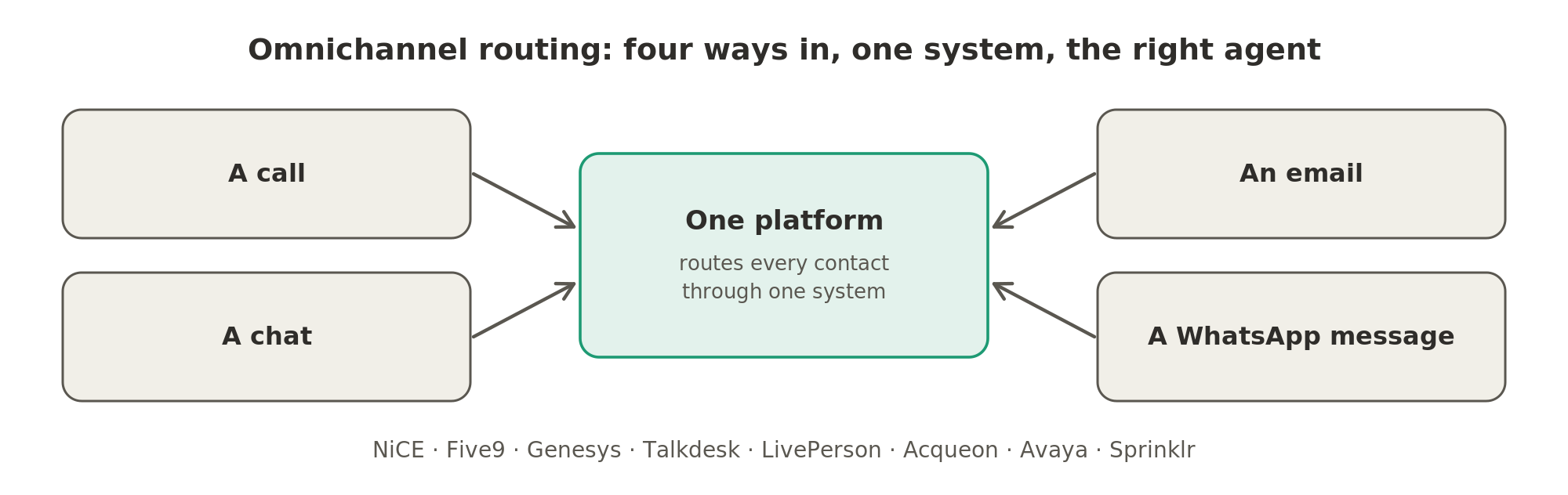 Whether the customer calls, chats, emails or sends a WhatsApp message, one platform routes the contact through one system to the right agent.
NiCEsells CXone, the cloud contact centre of many of the world's largest enterprises. NiCE began in call recording, and CXone grew from there. It includes the recording, the workforce management that plans agents' shifts, and self-service virtual agents. A virtual agent is software that talks with the customer by voice or chat, so the customer can get help without a person. The industry calls this conversational AI. NiCE has engineers in Pune, and more job postings there than any other company in this Market Segment. It is also among the companies with the most job postings in this Industry Vertical. Its Pune centre is among the largest it has anywhere.
Five9is the American cloud contact centre that grew up in the mid-market, meaning medium-sized companies, and then moved up to large ones. Its Bengaluru centre builds much of its AI. It has engineers in Bengaluru and Chennai.
Genesysis the third of the large platforms. For years, its software ran inside a huge number of contact centres, on the customers' own premises. The industry calls such existing customers the installed base. Genesys moved that installed base into Genesys Cloud. It has engineers in Chennai, Hyderabad and Bengaluru.
Whether the customer calls, chats, emails or sends a WhatsApp message, one platform routes the contact through one system to the right agent.
NiCEsells CXone, the cloud contact centre of many of the world's largest enterprises. NiCE began in call recording, and CXone grew from there. It includes the recording, the workforce management that plans agents' shifts, and self-service virtual agents. A virtual agent is software that talks with the customer by voice or chat, so the customer can get help without a person. The industry calls this conversational AI. NiCE has engineers in Pune, and more job postings there than any other company in this Market Segment. It is also among the companies with the most job postings in this Industry Vertical. Its Pune centre is among the largest it has anywhere.
Five9is the American cloud contact centre that grew up in the mid-market, meaning medium-sized companies, and then moved up to large ones. Its Bengaluru centre builds much of its AI. It has engineers in Bengaluru and Chennai.
Genesysis the third of the large platforms. For years, its software ran inside a huge number of contact centres, on the customers' own premises. The industry calls such existing customers the installed base. Genesys moved that installed base into Genesys Cloud. It has engineers in Chennai, Hyderabad and Bengaluru.
Three smaller companies each specialise, by industry, by channel or by direction:
Talkdesksells the cloud contact centre in versions built for one industry: healthcare, banking or retail. It has engineers in Bengaluru.
LivePersoncame from web chat and messaging. It sells the conversational cloud, through which brands talk to customers in messaging apps. It has engineers in Kolkata.
Acqueonsells the outbound half: automated campaigns that call customers, instead of waiting for customers to call. It has engineers in Bengaluru.
Two companies covered mainly in other Market Segments also sell contact centres here:
Avayasells older contact-centre platforms, which still run a large share of the world's installed base. It has engineers in Pune for this work. (More on Avaya in Market Segment 2.2, UCaaS and cloud phone systems, in Industry Vertical 2, Business communications.)
Sprinklrsells a service product that puts social-media conversations and the contact centre on one platform. It has engineers in Gurugram for this work. (More on it in Market Segment 13.4, PR, media monitoring and social listening tools, in Industry Vertical 13, Martech.)
Amazon Connect, Amazon's contact centre, is covered elsewhere. (More on it in Amazon, in the big-tech collection.) Zoom also sells a contact centre, and Zoom is covered mainly in another Market Segment. (More on it in Market Segment 2.2, UCaaS and cloud phone systems, in Industry Vertical 2, Business communications.)
The contact the agent never sees.
Every platform here now sells a virtual agent. It answers the call or the chat itself, and passes to a person only what it cannot handle. The industry has always priced these products by the human seat. Now they are being rebuilt around contacts that no human touches. The companies built for that job alone are covered in Market Segment 15.2, Conversational AI for customer service.
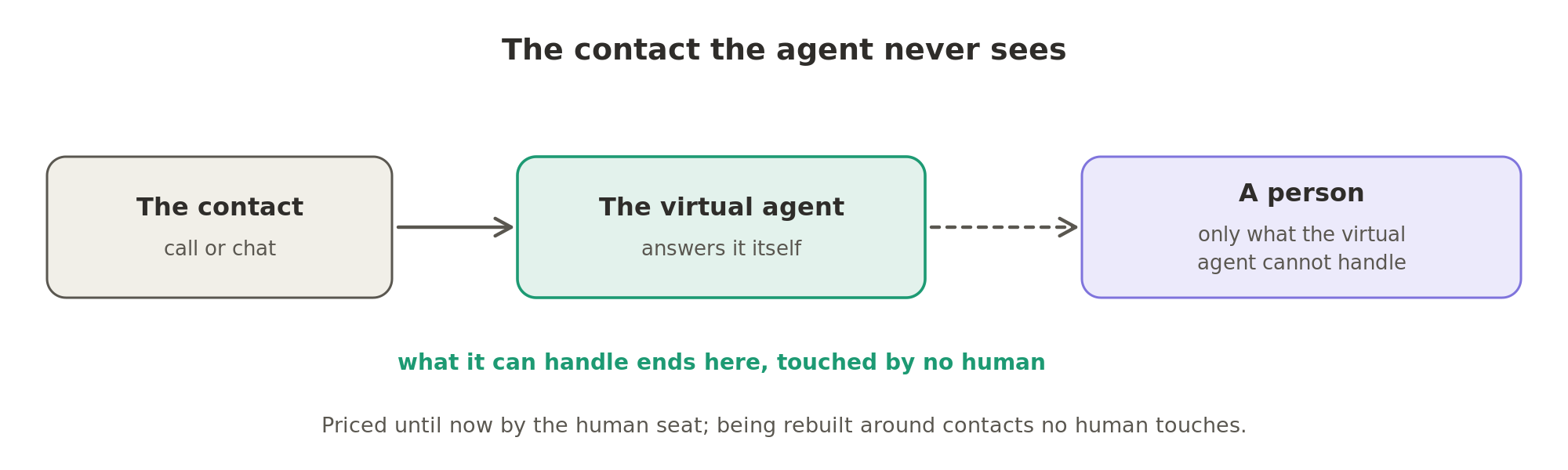 A virtual agent answers the call or chat itself and passes to a person only what it cannot handle, so the products are being rebuilt around contacts no human touches.
The workforce and the analytics
Workforce engagement management, quality management, interaction analytics, digital feedback, contact-centre testing
A virtual agent answers the call or chat itself and passes to a person only what it cannot handle, so the products are being rebuilt around contacts no human touches.
The workforce and the analytics
Workforce engagement management, quality management, interaction analytics, digital feedback, contact-centre testing
Back to the bank's contact centre from the start of this Market Segment. Someone had to decide how many agents to put on shift that morning. After your call, a supervisor may score it. And someone wants to know why so many customers are calling about failed payments this week. Managing the floor like this is a job of its own, with its own software. The industry calls it workforce engagement management.
Verintsells the software that manages the contact-centre floor. It forecasts how many agents are needed and schedules their shifts. It scores the quality of their calls, which the industry calls quality management. It analyses what customers are calling about, which is called interaction analytics. Its newer products are bots that do parts of the agent's job. Verint sells to contact centres whatever platform routes their calls. It has engineers in Bengaluru. (More on its call analytics in Market Segment 15.3, Conversation intelligence and speech analytics.)
Verint Germany, Austria and Switzerlandis a separate Verint company for that region. It sells the digital-feedback and web-analytics products that Verint bought in Europe. Digital feedback means the ratings and comments customers leave on a website or app. It is listed separately because it posts jobs under its own name. It has engineers in Bengaluru.
One company here tests the contact centre instead of managing it. Cyara places synthetic calls and chats through a contact centre, made-up ones sent by software, to check that everything works before real customers call. It has engineers in Hyderabad. Cyara is covered mainly in another Market Segment. (More on it in Market Segment 6.2, Software testing platforms, in Industry Vertical 6, Devtools companies.)
You're reading as a guest. Sign in free to follow links for five minutes, once an hour.
Sign in
The mid-market and India's own
Contact centre with the business phone system, cloud telephony for Indian businesses
Now take a smaller company: an online furniture shop in Jaipur, with ten people answering customers. It does not buy a big platform. It buys the contact centre and the business phone system as one product. The companies in this sub-segment sell exactly that.
Dialpadsells a business phone, meetings and a contact centre in one product, built around AI from the start. It has engineers in Bengaluru. It also posts jobs under Dialpad Japan, a separate company of the same group, which has engineers in Bengaluru too.
Nextivasells phone, meetings and chat in one product, which the industry calls unified communications, together with a contact centre. Its buyers are American small businesses.
Both Dialpad and Nextiva also sell the office phone system on its own. (More on them in Market Segment 2.2, UCaaS and cloud phone systems, in Industry Vertical 2, Business communications.)
Two companies here have Indian roots:
SaaS Labswas founded by Indian entrepreneurs. It sells JustCall and Helpwise, the cloud phone and contact centre for small sales and support teams. It has engineers in Bengaluru.
Exotelfounded in Bengaluru, is India's own. It sells cloud telephony and messaging APIs. Cloud telephony means phone lines and call handling rented over the internet, with no equipment in the office. Indian businesses built their call centres on it. Since Exotel bought Ameyo, it also sells a full contact centre with conversational AI. Its buyers are Indian banks, lenders and e-commerce companies. It has engineers in Bengaluru. (More on its API business in Market Segment 2.1, CPaaS and business messaging, in Industry Vertical 2, Business communications.)
Ozonetel and Knowlarity are not covered in this Market Segment.
That is the software behind your call about the failed payment. A cloud platform routed it to an agent. Other software planned that agent's shift and scored the call. Smaller companies buy all of it in one product, together with the phone system.