Market Segment 2.1 was about businesses sending messages to your phone. This Market Segment is about the phone system inside the business itself.
Call any company's main number. Behind that number, something has to do several jobs. It rings the right person's desk, puts you on hold and forwards the call to their mobile. It records the call and, more and more often, writes down what was said. For decades, that something was a PBX (private branch exchange). A PBX is an office's own telephone switch: a cabinet of hardware in a cupboard, sold together with a room full of desk phones.
Since around 2010, the PBX has moved to the cloud and become a subscription. The same subscription now also offers video meetings, team chat and a softphone, which is a phone app on your laptop. The industry calls this bundle unified communications. This Market Segment is about the companies that sell it. Their buyers are businesses of every size.
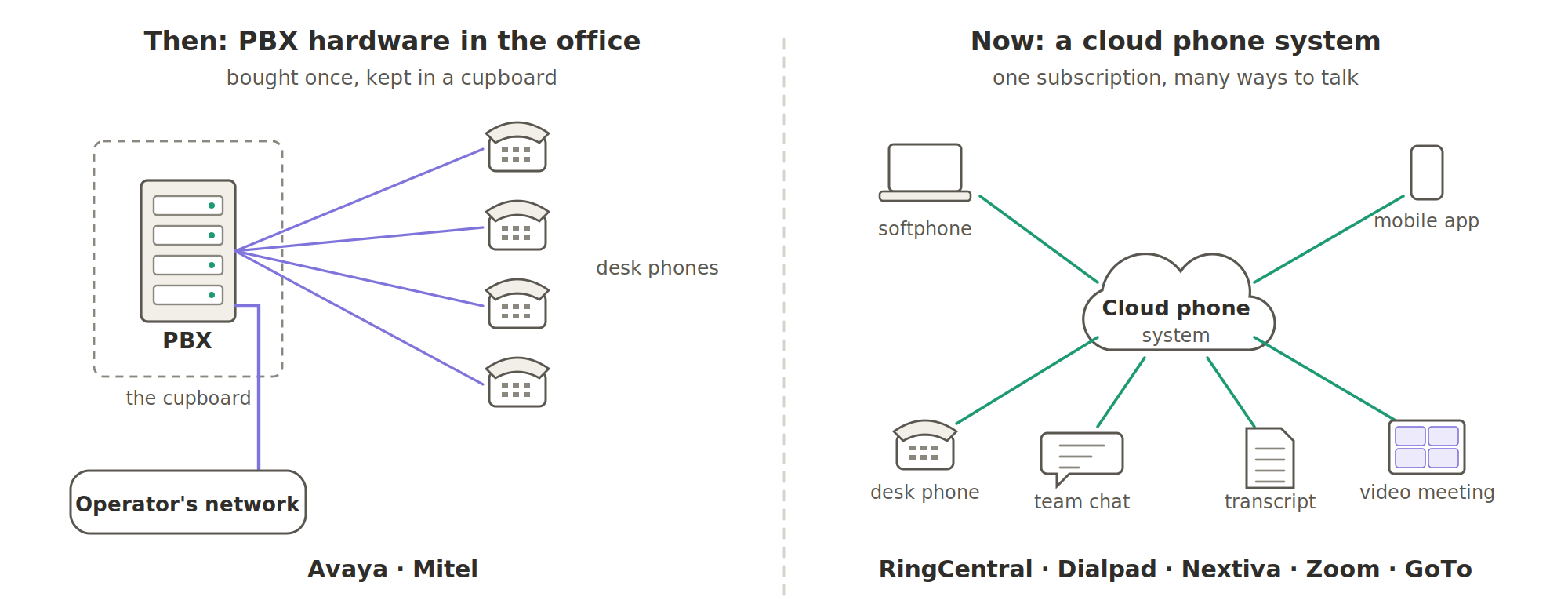 Then and now. Then: PBX hardware kept in a cupboard in the office, wired to desk phones, with one line out to the operator's network; Avaya and Mitel sold it. Now: a cloud phone system on one subscription, reaching a laptop softphone, a mobile app, a desk phone, video meetings, team chat and call transcripts; RingCentral, Dialpad, Nextiva, Zoom and GoTo sell it.
Two facts shape this Market Segment:
The market moves at two speedsAt one end are young cloud companies that never sold PBX hardware. At the other are old telephony companies. Tens of thousands of their buyers still run PBX hardware. These buyers are slow to move. Their old systems, called legacy systems, still work. And switching means buying new equipment, retraining staff, and risking calls failing during the change. The industry calls these switching costs. So the older companies move their buyers to the cloud gradually, a process called legacy migration.
The biggest sellers are not covered hereMicrosoft Teams, Google Meet and Cisco's Webex are products of much larger companies. Cisco is covered in Market Segment 1.2, Enterprise networking. Microsoft and Google are covered elsewhere. (More on them in the big-tech collection.) Zoom is covered here, though it is best known for video meetings.
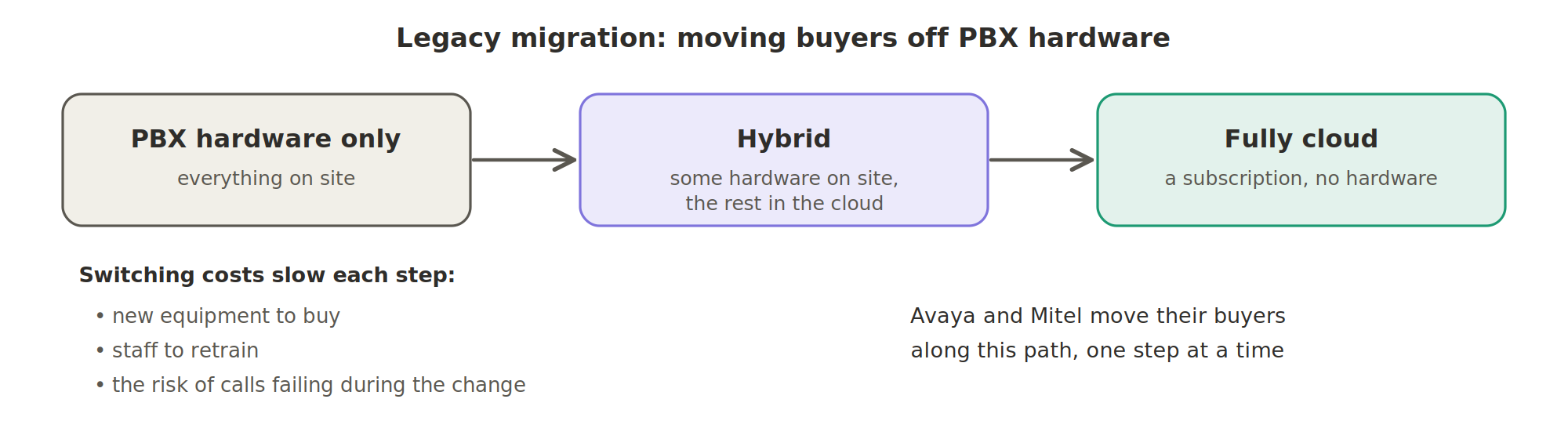 Legacy migration in three stages: PBX hardware only, then hybrid (some hardware on site, the rest in the cloud), then fully cloud. Switching costs slow each step: new equipment to buy, staff to retrain, and the risk of calls failing during the change. Avaya and Mitel move their buyers along this path, one step at a time.
Every company named here has posted software engineering jobs in India. Famous companies that don't actively hire software engineers in India are left out.
This Market Segment has two sub-segments:
The phone system that was born in the cloud: companies that sold the office phone system as a subscription from the start
The older phone-system makers moving to the cloud: the companies that sold PBX hardware, now moving their buyers to the cloud
The customer care centre (the industry calls it a contact centre), where a company's support staff answer customers' calls and chats, runs on top of the phone system, whether cloud or old. It is covered in Market Segment 15.1, Contact centre software (CCaaS) (in Industry Vertical 15, Customer service and CX).
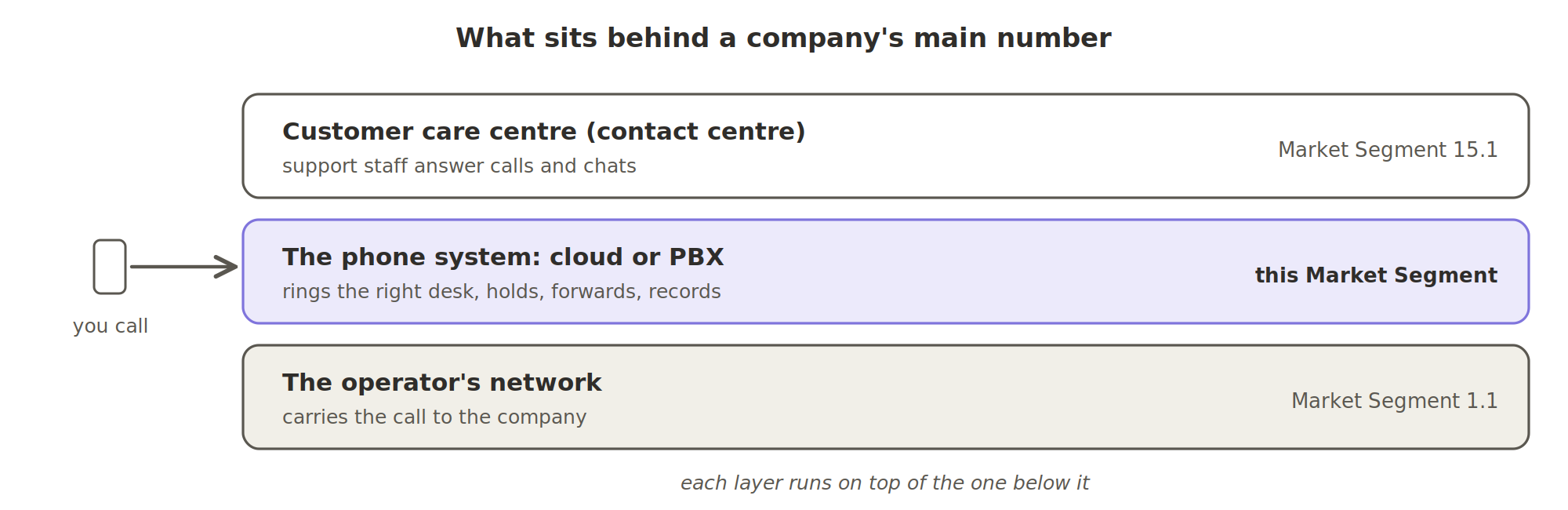 What sits behind a company's main number, in three layers. At the bottom, the operator's network carries the call to the company (Market Segment 1.1). In the middle, the phone system, cloud or PBX, rings the right desk, holds, forwards and records (this Market Segment). On top, the customer care centre, or contact centre, where support staff answer calls and chats (Market Segment 15.1). Each layer runs on top of the one below it.
The phone system that was born in the cloud
Cloud-native UCaaS (unified communications as a service): cloud PBX, meetings, messaging and the compliant second line
What sits behind a company's main number, in three layers. At the bottom, the operator's network carries the call to the company (Market Segment 1.1). In the middle, the phone system, cloud or PBX, rings the right desk, holds, forwards and records (this Market Segment). On top, the customer care centre, or contact centre, where support staff answer calls and chats (Market Segment 15.1). Each layer runs on top of the one below it.
The phone system that was born in the cloud
Cloud-native UCaaS (unified communications as a service): cloud PBX, meetings, messaging and the compliant second line
Take a 200-person company in Pune. It can run its main number on a cloud phone system, like many small and mid-sized companies now do. On one subscription it gets a number, a softphone, video meetings, team chat and, now, a written transcript and summary of every call. It never needs to own and manage PBX hardware.
RingCentralis the largest company in the world that sells only this, and the largest name here. Its India engineering is in Bengaluru. It sells the phone system and, through partners, a customer care centre that runs on the same system.
Dialpadwas built from the start around AI: writing down each call as it happens and analysing it. (More on it in Market Segment 15.1, Contact centre software (CCaaS), in Industry Vertical 15, Customer service and CX.)
Nextivafrom Arizona, serves the same small-business market, and has added a customer care centre to its platform.
Zoomis here for Zoom Phone, the video-meetings company's attempt to be the office phone system too.
GoTois best known for its remote-support tools, the software IT staff use to fix your laptop from far away. Its GoTo Connect phone system grew out of Jive, a company it acquired. (More on GoTo in Market Segment 16.1, IT service management (ITSM) and IT operations software, in Industry Vertical 16, IT management and workplace tools.)
Moviussells something narrower. Banks and brokers must record and keep every business call and message their staff make. But many staff use their personal phones. So Movius sells a second business number on the employee's own phone, which records everything the rules require. No other company here sells this.
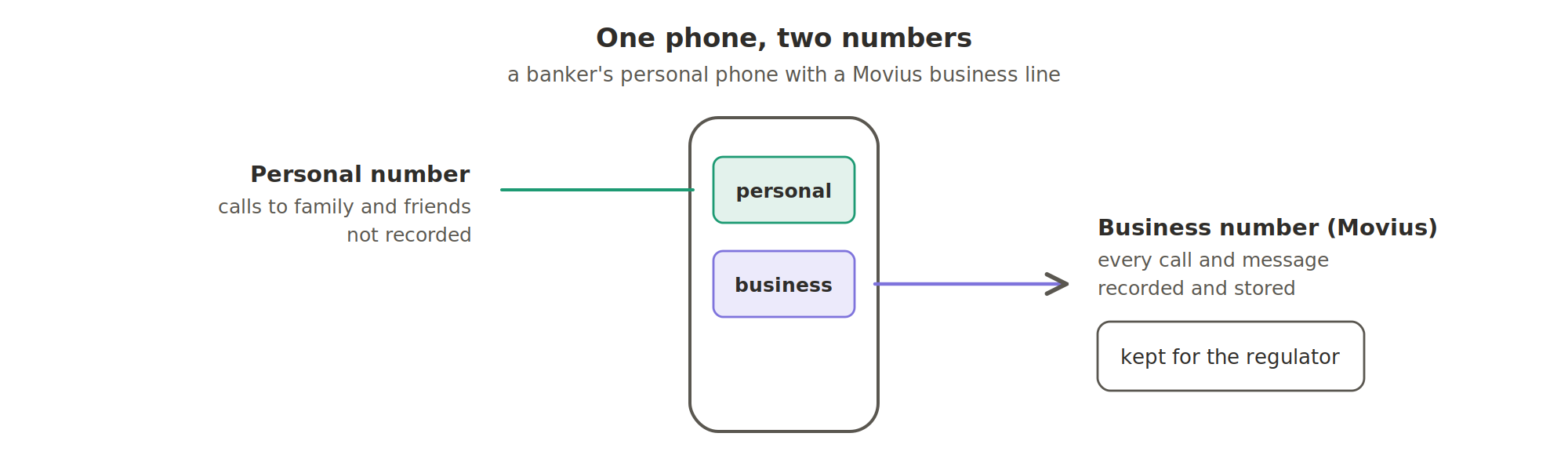 One phone, two numbers. A banker's personal phone has a personal number, for calls to family and friends, which is not recorded, and a Movius business number, where every call and message is recorded and stored and kept for the regulator.
The call that writes itself up.
One phone, two numbers. A banker's personal phone has a personal number, for calls to family and friends, which is not recorded, and a Movius business number, where every call and message is recorded and stored and kept for the regulator.
The call that writes itself up.
The transcript, the summary and the list of follow-up tasks now arrive with the call. The cloud companies compete on how good that write-up is, rather than on the call itself. Dialpad built its business on it, and RingCentral and Nextiva have added it. The engineering work is shifting from the phone call to the AI model that writes it up.
The older phone-system makers moving to the cloud
The PBX makers and the equipment that connects old telephony to new: Avaya, Mitel, the session border controller
Now take a large hospital or a government office. Its calls often still land on PBX hardware it bought years ago. That hardware was very likely sold by one of these two companies:
Avayagrew out of AT&T's old telephone equipment business.
Mitelis from Canada.
Each of these two companies still has tens of thousands of businesses, hospitals and governments running its PBX and desk phones. For a decade, each has been persuading those buyers to move to a cloud or hybrid version of the same system. A hybrid system keeps some hardware on site and runs the rest in the cloud. Along the way, both went through bankruptcy protection. Both had borrowed heavily. As buyers moved away from PBX hardware, their sales fell, and they could not repay their loans on time. Bankruptcy protection let them keep running while a court helped them agree new terms with their lenders, usually by cutting the debt. Avaya went through this twice, and Mitel in 2025.
Both have engineering teams in India: Avaya in Pune and Mitel in Bengaluru. Both now call themselves customer-experience (CX) companies. The customer care business now drives their sales, and the phone system trails behind. (More on Avaya in Market Segment 15.1, Contact centre software (CCaaS), in Industry Vertical 15, Customer service and CX.)
Two companies covered in other Market Segments show how the old and new worlds connect:
Ciscois one of the largest sellers of office phone systems and meeting-room equipment in the world, through Webex and its call-management software. (More on Cisco in Market Segment 1.2, Enterprise networking.)
Ribbon Communicationsmakes the session border controller. This is the equipment that lets a company's phone system connect safely to the operator's network over the internet. Almost every move from PBX hardware to the cloud passes through one. (More on Ribbon in Market Segment 1.1, Telecom equipment and operators.)
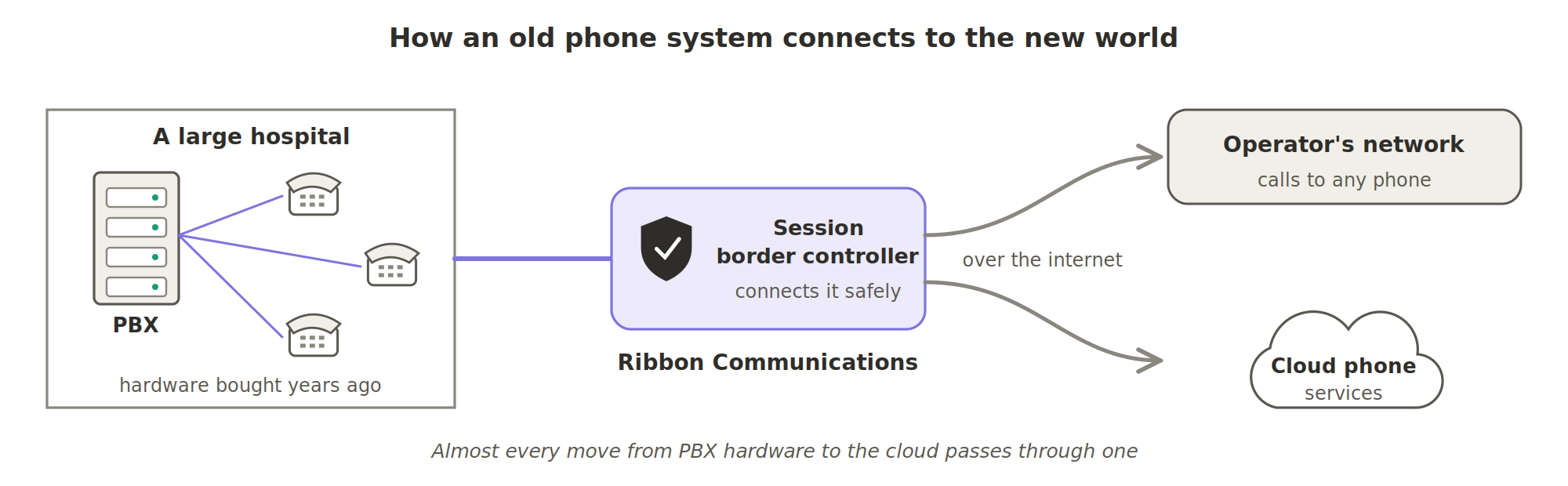 How an old phone system connects to the new world. A large hospital's PBX hardware and desk phones, bought years ago, connect through a session border controller made by Ribbon Communications, which connects them safely over the internet to the operator's network and to cloud phone services. Almost every move from PBX hardware to the cloud passes through one.
That is what sits behind a company's main number: either a cloud phone system bought as a subscription, or PBX hardware slowly moving to the cloud, joined to the operator's network by a session border controller.
How an old phone system connects to the new world. A large hospital's PBX hardware and desk phones, bought years ago, connect through a session border controller made by Ribbon Communications, which connects them safely over the internet to the operator's network and to cloud phone services. Almost every move from PBX hardware to the cloud passes through one.
That is what sits behind a company's main number: either a cloud phone system bought as a subscription, or PBX hardware slowly moving to the cloud, joined to the operator's network by a session border controller.