Picture a 1,000-person pharmaceutical company in Hyderabad. On Monday, a new chemist joins and needs a laptop and a dozen accounts. On Tuesday, a sales manager's laptop will not connect to the office network from home. On Wednesday night, a server goes down. Each of these becomes a ticket, a logged request, at the IT service desk.
Industry Vertical 16 is the last one in Domain IV, Enterprise SaaS and software. It turns to the department whose customers are the company's own employees: IT. The software in this Market Segment does four jobs:
- it holds the employees' tickets
- it keeps track of the company's machines and licences
- it lets a technician fix a computer from the other side of the country
- it watches that the company's systems keep running
The industry calls the first part IT service management, or ITSM, and the rest IT operations. It is the same idea as the customer help desk, turned inwards, and several of the same companies sell both. The buyers are companies' IT departments, and the firms that run IT for smaller companies.
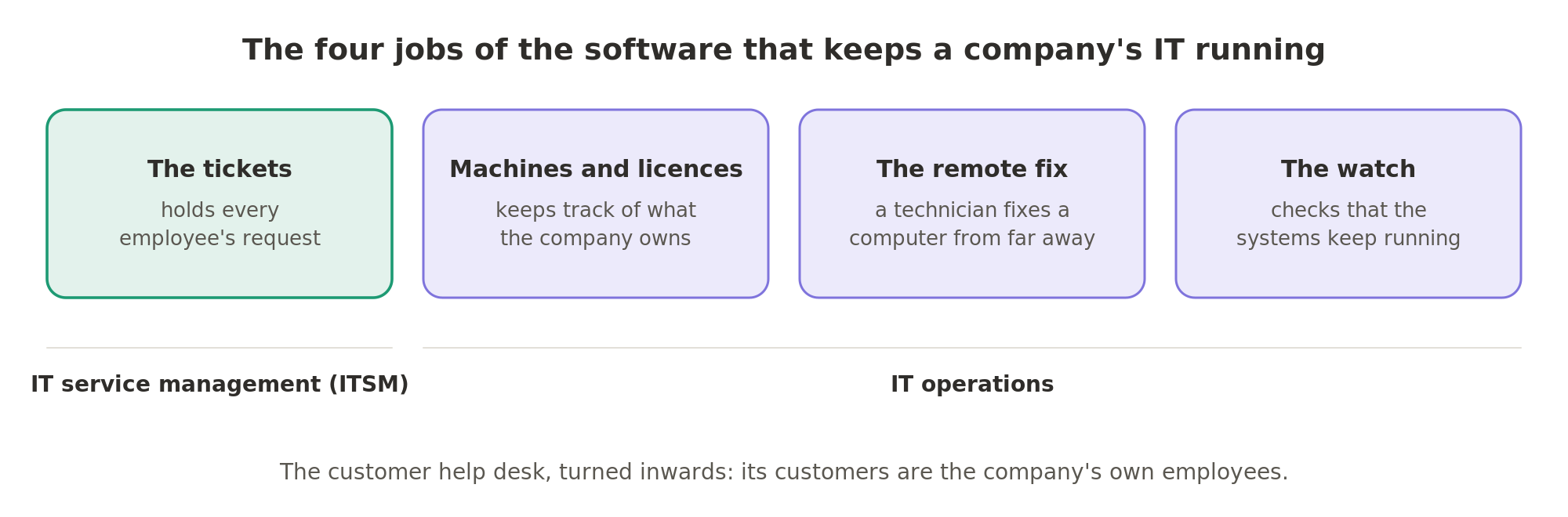 The software holds employees' tickets, keeps track of machines and licences, lets a technician fix a computer from far away and watches that systems keep running; the first job is IT service management and the other three are IT operations.
Every company named here has posted software engineering jobs in India. Famous companies that don't actively hire software engineers in India are left out.
This Market Segment has three sub-segments:
The service desk: where the employee's request is logged and, more and more often, answered by an AI agent.
Managing IT from a distance: remote-support and remote-management tools, for IT teams and for the firms that run IT for smaller companies.
The software estate: the licences, the subscriptions and the old systems the IT department has to keep track of.
The service desk
IT service management, enterprise service management, AI service agents, employee support automation
Back to the pharma company from the start of this Market Segment, and the new chemist who needs a laptop and a dozen accounts. The request goes to the service desk. The service desk logs it as a ticket, routes it to the right team, and tracks it until it is done.
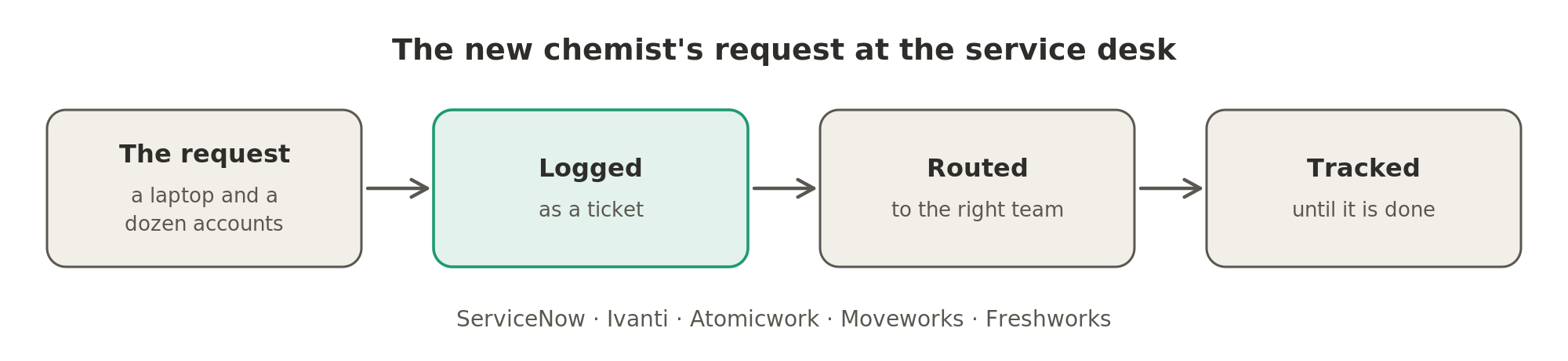 The new chemist's request for a laptop and a dozen accounts is logged as a ticket, routed to the right team and tracked until it is done.
ServiceNowwith engineers in Hyderabad and Bengaluru, turned the IT ticket into a platform. It is the service desk of most of the world's largest companies. The same workflow engine now also runs HR requests, customer service and security incidents. AI agents resolve the common requests themselves. Its Hyderabad centre is among its largest outside America.
Ivantiwith engineers in Bengaluru and Hyderabad, has the most job postings of any company covered mainly in this Market Segment. It was built by merging several older IT-management companies. It sells the service desk together with management of the devices the desk supports: patching, endpoint management, and the Connect Secure VPN through which employees reach the company network. (More on its device management in Market Segment 4.4, Endpoint security and device management, in Industry Vertical 4, Cybersecurity.)
Atomicworkfounded in Bengaluru, with engineers there, sells a service desk rebuilt around an AI agent that answers the employee in chat.
Moveworkswith engineers in Bengaluru, sells an AI assistant that resolves employees' IT and HR requests across the company's systems. ServiceNow agreed to buy it in 2025.
The new chemist's request for a laptop and a dozen accounts is logged as a ticket, routed to the right team and tracked until it is done.
ServiceNowwith engineers in Hyderabad and Bengaluru, turned the IT ticket into a platform. It is the service desk of most of the world's largest companies. The same workflow engine now also runs HR requests, customer service and security incidents. AI agents resolve the common requests themselves. Its Hyderabad centre is among its largest outside America.
Ivantiwith engineers in Bengaluru and Hyderabad, has the most job postings of any company covered mainly in this Market Segment. It was built by merging several older IT-management companies. It sells the service desk together with management of the devices the desk supports: patching, endpoint management, and the Connect Secure VPN through which employees reach the company network. (More on its device management in Market Segment 4.4, Endpoint security and device management, in Industry Vertical 4, Cybersecurity.)
Atomicworkfounded in Bengaluru, with engineers there, sells a service desk rebuilt around an AI agent that answers the employee in chat.
Moveworkswith engineers in Bengaluru, sells an AI assistant that resolves employees' IT and HR requests across the company's systems. ServiceNow agreed to buy it in 2025.
One company covered mainly in another Market Segment belongs here too:
Freshworkswith engineers mostly in Chennai and Hyderabad, is here for Freshservice, the IT service desk it sells to mid-sized companies beside its customer help desk.
Freshworks is covered mainly in Market Segment 15.4, Help desk and customer success software (in Industry Vertical 15, Customer service and CX), which covers the customer help desk. ServiceNow also appears there, for its customer-service product.
The password reset nobody handles.
A large share of IT tickets are the same few requests: the locked account, the new laptop, access to an application. The service desks here now answer them with an AI agent that acts, not just replies. It resets the password, or grants the access, itself. In most companies, the IT department is the first to let an AI agent act on its systems, because its own staff built those systems.
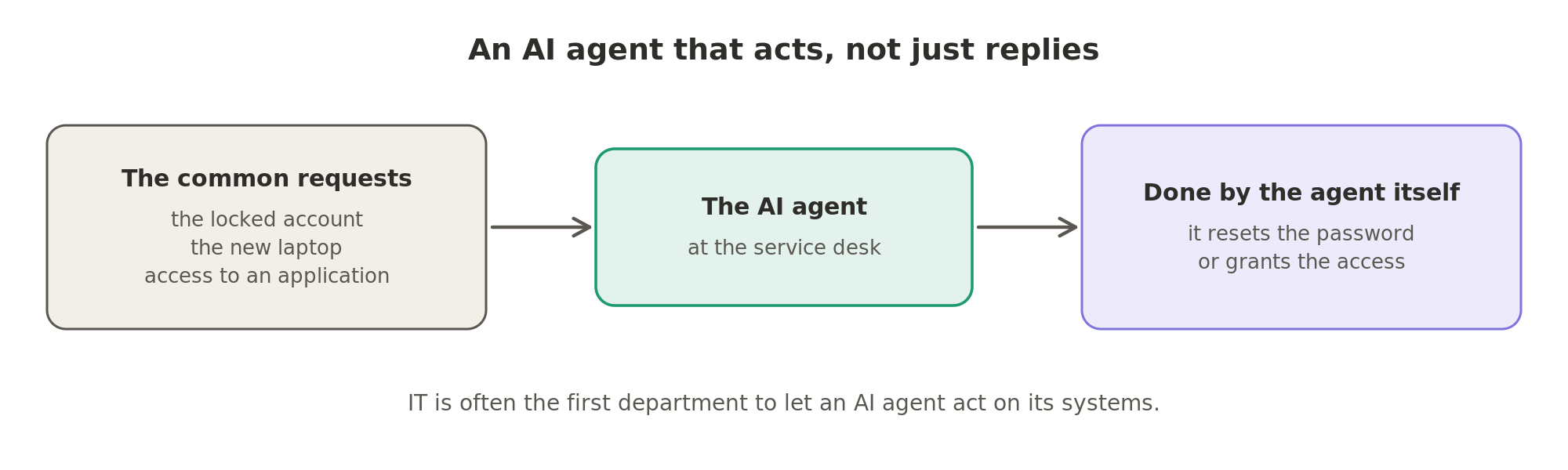 For the common requests, such as a locked account, a new laptop or access to an application, the AI agent at the service desk now does the work itself: it resets the password or grants the access.
Managing IT from a distance
Remote monitoring and management, remote access and support, professional services automation for managed service providers
For the common requests, such as a locked account, a new laptop or access to an application, the AI agent at the service desk now does the work itself: it resets the password or grants the access.
Managing IT from a distance
Remote monitoring and management, remote access and support, professional services automation for managed service providers
Now picture one of the pharma company's distributors: a 40-person firm in Vijayawada. It has no IT department. Like most small companies, it pays an outside firm to be its IT department. Such a firm is called a managed service provider, or MSP. The companies in this sub-segment sell to those providers. They sell three kinds of tool:
Remote monitoring and managementsoftware that watches every client's machines from one screen, and fixes many problems without a visit.
Remote accesssoftware through which a technician takes control of a computer anywhere.
Professional services automationthe ticketing and billing that run the provider's own business.
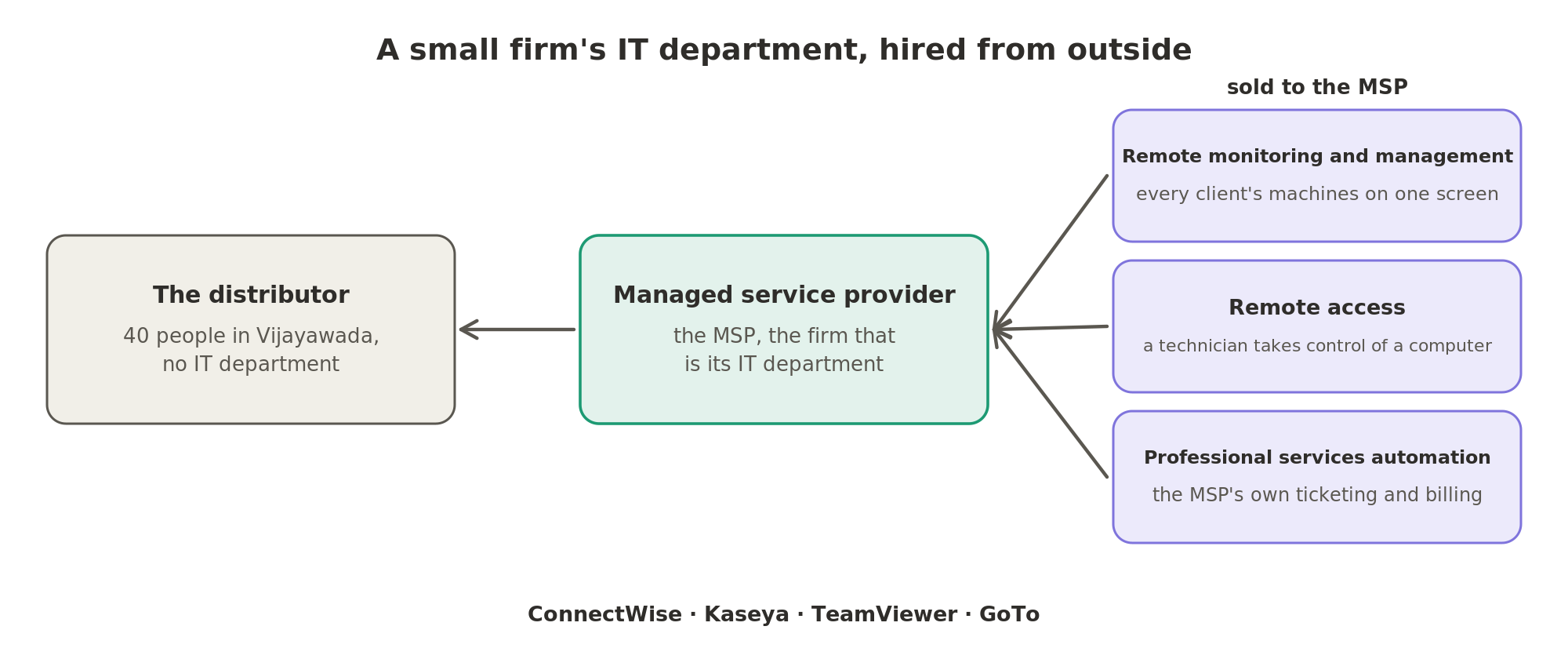 The 40-person distributor has no IT department and pays a managed service provider to be one, and the companies here sell that provider its three kinds of tool.
ConnectWisewith engineers in Pune, Bengaluru and Mumbai, sells managed service providers their whole business. It sells the remote monitoring and management, the ticketing and billing, and the security products the providers resell to their clients. Its Pune centre is one of its largest.
Kaseyawith engineers in Pune and Bengaluru, sells the same to the same buyers. It adds the backup and endpoint protection of Datto, a company it bought.
Kaseya Software Indiais Kaseya's own Indian company, with engineers in Bengaluru.
TeamViewerthe German remote-access company, with engineers in Delhi, makes the tool through which a technician takes control of a computer anywhere. It is used as much for machines in factories as for laptops in offices.
GoToformerly LogMeIn, with engineers in Bengaluru, sells remote support and IT management alongside its meeting and phone products. (More on those in Market Segment 2.2, UCaaS and cloud phone systems, in Industry Vertical 2, Business communications.)
The 40-person distributor has no IT department and pays a managed service provider to be one, and the companies here sell that provider its three kinds of tool.
ConnectWisewith engineers in Pune, Bengaluru and Mumbai, sells managed service providers their whole business. It sells the remote monitoring and management, the ticketing and billing, and the security products the providers resell to their clients. Its Pune centre is one of its largest.
Kaseyawith engineers in Pune and Bengaluru, sells the same to the same buyers. It adds the backup and endpoint protection of Datto, a company it bought.
Kaseya Software Indiais Kaseya's own Indian company, with engineers in Bengaluru.
TeamViewerthe German remote-access company, with engineers in Delhi, makes the tool through which a technician takes control of a computer anywhere. It is used as much for machines in factories as for laptops in offices.
GoToformerly LogMeIn, with engineers in Bengaluru, sells remote support and IT management alongside its meeting and phone products. (More on those in Market Segment 2.2, UCaaS and cloud phone systems, in Industry Vertical 2, Business communications.)
N-able, the other large tool of managed service providers, is covered mainly in Market Segment 4.4, Endpoint security and device management (in Industry Vertical 4, Cybersecurity). SolarWinds, which N-able was separated from, is covered in Market Segment 6.3, Observability and monitoring platforms (in Industry Vertical 6, Devtools companies).
You're reading as a guest. Sign in free to follow links for five minutes, once an hour.
Sign in
The software estate
SaaS management and discovery, IT asset management, software licence optimisation, mainframe software
Back to the pharma company from the start of this Market Segment. It pays for hundreds of cloud applications, called SaaS. Many were bought by teams without the IT department knowing. When the chemist who joined on Monday leaves one day, every one of those accounts must be closed. Everything the IT department owns, from licences to old systems, is called its software estate. The companies in this sub-segment keep count of it.
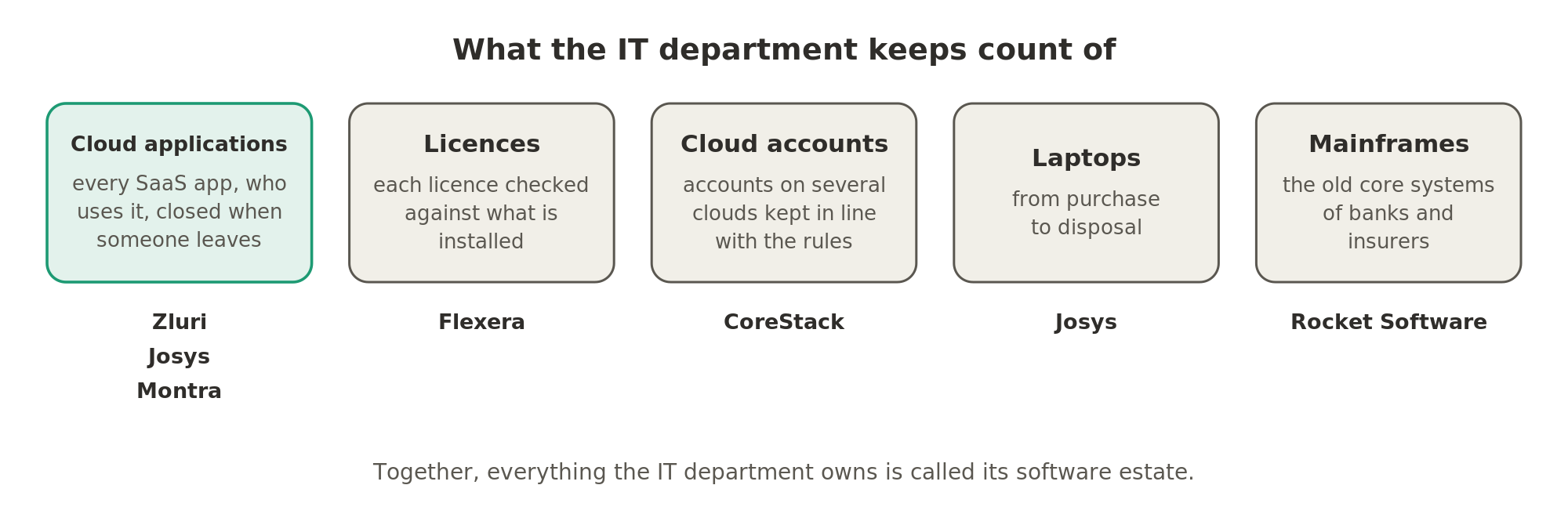 The software estate covers cloud applications, licences, accounts on several clouds, laptops from purchase to disposal, and the old mainframe systems of banks and insurers.
Zlurifounded in Bengaluru, with engineers there, finds every SaaS application a company uses, shows who uses each one, and removes an employee's access when they leave.
Josysthe Japanese company, with engineers in Bengaluru, sells the same, together with managing each laptop from purchase to disposal.
Montrawith engineers in Delhi, sells SaaS management together with managed IT services.
Rocket Softwarewith engineers in Pune, Bengaluru and Chennai, looks after the oldest part of the estate. Banks and insurers still run their core systems on mainframes, large central computers they have used for decades. Rocket sells the software that keeps those mainframes running, and the tools that move applications off them.
The software estate covers cloud applications, licences, accounts on several clouds, laptops from purchase to disposal, and the old mainframe systems of banks and insurers.
Zlurifounded in Bengaluru, with engineers there, finds every SaaS application a company uses, shows who uses each one, and removes an employee's access when they leave.
Josysthe Japanese company, with engineers in Bengaluru, sells the same, together with managing each laptop from purchase to disposal.
Montrawith engineers in Delhi, sells SaaS management together with managed IT services.
Rocket Softwarewith engineers in Pune, Bengaluru and Chennai, looks after the oldest part of the estate. Banks and insurers still run their core systems on mainframes, large central computers they have used for decades. Rocket sells the software that keeps those mainframes running, and the tools that move applications off them.
Two companies covered mainly in other Market Segments bring the licence and the cloud bill:
Flexerais here for software asset management: checking every licence the company holds against the software actually installed. (More on it in Market Segment 11.1, Procurement and source-to-pay software, in Industry Vertical 11, Finance and accounting software.)
CoreStackis here for keeping a company's accounts on several clouds in line with its rules. (More on it in Market Segment 4.6, Cloud and SaaS security, in Industry Vertical 4, Cybersecurity.)
So the pharma company from the start of this Market Segment keeps its IT running three ways. The service desk handles every employee's request. Remote tools let a technician fix a machine without being there. And software keeps count of every application and licence the company pays for.