Picture an 800-person company in Pune that makes water purifiers. Every month it buys steel, plastic, filters and pumps from dozens of suppliers. It also buys software, phone lines and cloud services. Someone has to find each supplier, agree a price, raise the order and pay the invoice. And someone has to keep track of everything already bought.
This is where the finance department's money goes out. It is the least visible software in a company, and one of the most fought over. A large company spends more with its suppliers than on its staff. So saving even a few per cent of that spending is worth a great deal.
This Market Segment is about the companies that sell this software. Their buyers are the purchasing and finance teams of other companies. It has two sub-segments, and ends with a short note:
Buying things: the suites through which a company finds a supplier, runs the tender, agrees the contract, raises the order and pays the invoice. Buying for a company is called procurement. The industry calls the whole chain source-to-pay.
Managing what you own: software that keeps track of the licences, subscriptions, phone lines and data feeds a company has already bought, and is very often paying for twice.
The money leaving: a note on where the payment itself is covered.
Two large centres stand out here, Coupa's in Pune and Flexera's in Bengaluru. Around them is a long list of Indian start-ups. Three procurement companies with customers around the world, Zycus, GEP and Procol, were founded by Indians.
Two companies covered mainly in other Market Segments change the scale of this one:
Ripplingwhose Bengaluru centre has more job postings than all the other companies here together. It is here because its spend-management product sits beside its payroll product.
Parspecwhich sells bidding software for the construction supply chain.
SAP Ariba, the largest procurement suite, is not covered in this Market Segment. (More on SAP, its owner, in Market Segment 10.1, ERP and business accounting software, in Industry Vertical 10, ERP and business automation.)
Every company named here has posted software engineering jobs in India. Famous companies that don't actively hire software engineers in India are left out.
Buying things
Procurement and source-to-pay suites, strategic sourcing, supplier management, tender and bid management
Back to the purifier maker from the start of this Market Segment. It needs 50 tonnes of steel sheet. Its buyer asks several suppliers for prices, which is called a request for quotation, or a tender when it is a formal contest. The buyer picks a supplier, agrees a contract, raises a purchase order, receives the steel and pays the invoice. Finding and choosing the supplier is called sourcing. A source-to-pay suite runs every one of these steps in one product.
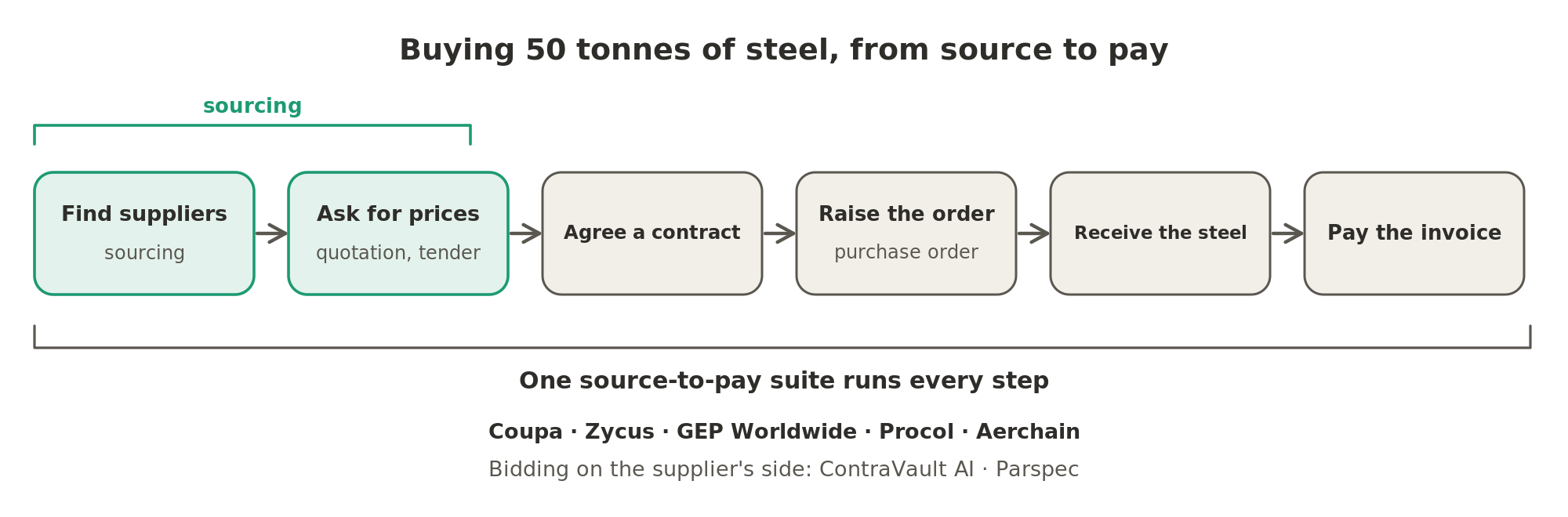 Buying steel runs through six steps, from finding suppliers and asking for prices to receiving the steel and paying the invoice; the first two are sourcing, and a source-to-pay suite runs all six in one product.
Coupahas engineers in Pune, Hyderabad and Bengaluru, and the most job postings of any company covered mainly in this Market Segment. Its cloud suite runs the whole chain, from sourcing to payment, for large companies. Underneath, it holds a decade of its customers' spending data, with the names removed. It now sells that data as a benchmark, so a company can compare what it pays with what others pay. Its Pune centre is one of its largest engineering sites.
Buying steel runs through six steps, from finding suppliers and asking for prices to receiving the steel and paying the invoice; the first two are sourcing, and a source-to-pay suite runs all six in one product.
Coupahas engineers in Pune, Hyderabad and Bengaluru, and the most job postings of any company covered mainly in this Market Segment. Its cloud suite runs the whole chain, from sourcing to payment, for large companies. Underneath, it holds a decade of its customers' spending data, with the names removed. It now sells that data as a benchmark, so a company can compare what it pays with what others pay. Its Pune centre is one of its largest engineering sites.
Three Indian-founded companies compete in the same market:
Zycusfounded in Mumbai in 1998, sells a source-to-pay suite to large companies around the world. It has engineers in Bengaluru.
GEP Worldwidewas founded in New Jersey by Indian entrepreneurs, and is run in large part from Mumbai. It sells procurement software together with procurement outsourcing, where GEP's own staff do the buying for the customer. It has engineers in Mumbai.
Procolfrom Gurugram, with engineers in Delhi, is the younger one. It sells a source-to-pay suite to Indian manufacturers and mid-sized companies.
Three smaller Indian companies:
Aerchainin Bengaluru, sells a procurement platform built around AI from the start. Its AI agents run the request for quotation, and the work of signing up a new supplier.
ProQsmarta seven-person Bengaluru company, sells procurement software for small businesses.
SmartDocsin Hyderabad, builds the procurement and invoice workflow on top of SAP, for companies that run SAP.
Two companies here work on the supplier's side of the same deal instead, the side that bids:
ContraVault AIa ten-person Bengaluru start-up, reads the tender documents a supplier is bidding on. It finds the risks and the requirements buried in them.
Parspecsolves the same bidding problem for construction. Its software reads the specification of a building, and produces the quote for the electrical and mechanical products that match.
Parspec is covered mainly in Market Segment 41.1, Construction tech (in Industry Vertical 41, Proptech), where many of these tenders are issued. ContraVault AI also appears there.
The buyer as an agent.
Aerchain, and the newest products of Coupa and Zycus, share one belief. An AI agent can run the sourcing, answer the suppliers' questions and negotiate routine purchases, with the human buyer approving the result. The supplier's side is arriving at the same time, in ContraVault's reading of the tender.
Managing what you own
Software asset management, SaaS management, technology spend management, market-data and telecom expense management
Back to the purifier maker from the start of this Market Segment. Over the years it has bought design software for 40 engineers, though only 25 still use it. It pays for 300 phone lines, and for subscriptions that nobody remembers ordering. The companies in this sub-segment track what has been bought.
Flexerawith engineers in Bengaluru, made software asset management a business. Its product finds every application a company runs, on servers, on laptops and in the cloud. It matches them against the licences the company holds. Then it tells the finance department two things: what the company is paying too much for, and what it is using without a licence. Software makers such as Oracle and Microsoft audit their customers' licences, and that made the second question expensive to get wrong. Flexera bought its main rival, Snow Software, in 2024. Its Bengaluru centre is among its largest. (The same product serves the IT team. More in Market Segment 16.1, IT service management (ITSM) and IT operations software, in Industry Vertical 16, IT management and workplace tools.)
Spendflofounded in Chennai, with engineers there, does the same for the subscriptions a company buys. It negotiates the renewals of SaaS products for its customers. SaaS is software rented over the internet.
Two companies manage a narrower kind of spending:
TRG Screenwith engineers in Bengaluru, tracks market-data subscriptions, such as Bloomberg terminals and price feeds from stock exchanges. These are a bank's second-largest technology cost. (More on market data in Market Segment 20.3, Financial data, ratings and research, in Industry Vertical 20, Wealthtech and capital markets.)
Sakonwith engineers in Pune, manages the telecom and mobile spending of large companies: the thousands of phone lines and network connections whose bills nobody has checked.
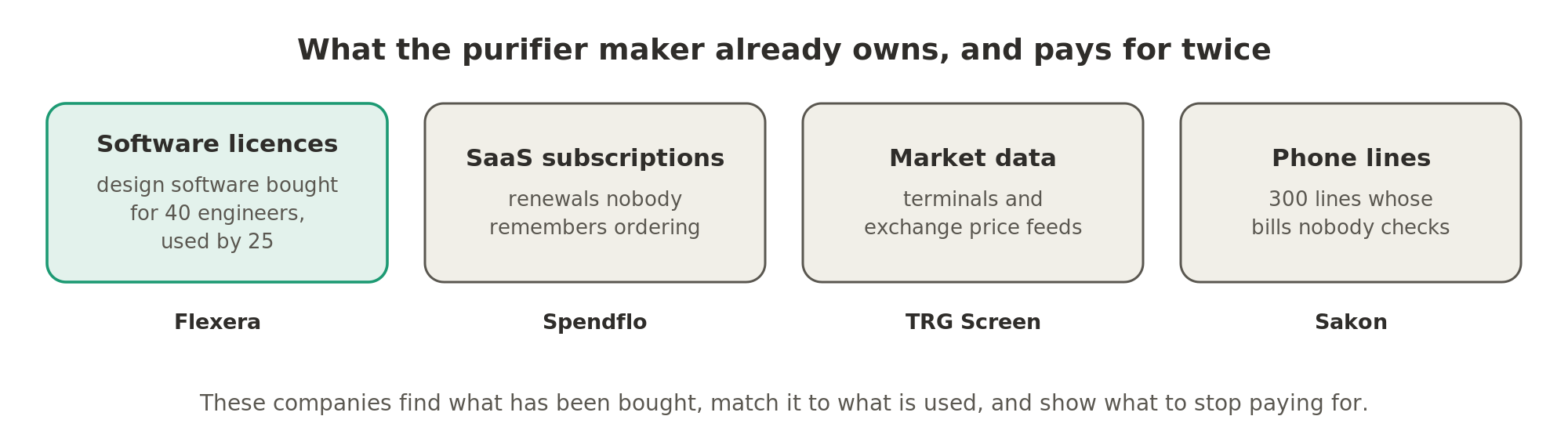 The purifier maker pays for software licences, subscriptions, market data and phone lines it no longer uses, and each company here tracks one kind of what has already been bought.
One company covered mainly in another Market Segment belongs here too:
Ripplingbuilds a platform in which the employee's record drives everything else. Its spend-management product covers company credit cards, expense claims and paying bills. (More on it in Market Segment 12.1, HR, payroll and workforce management software, in Industry Vertical 12, HR tech.)
You're reading as a guest. Sign in free to follow links for five minutes, once an hour.
Sign in
The money leaving
Connector to Market Segment 17.6, B2B payments and spend management
This Market Segment is where the order is raised. The money it commits leaves somewhere else. The company credit card, the expense claim, and the supplier invoice that is approved and paid are covered in Market Segment 17.6, B2B payments and spend management (in Industry Vertical 17, Payments). So is the software that reads and routes those invoices, called accounts-payable automation. Checking the payment against the books afterwards is covered in Market Segment 11.3, Financial close, FP&A and tax software.
 The order is raised in this Market Segment, the money leaves in Market Segment 17.6, B2B payments and spend management, and the payment is checked against the books in Market Segment 11.3.
So the purifier maker from the start of this Market Segment uses two kinds of software before any money leaves. One runs the buying, from the first quotation to the approved invoice. The other keeps track of what it already owns, so it stops paying twice.