Picture a fan maker in Coimbatore. A dealer orders 200 ceiling fans. The sales team records the order. The warehouse checks whether the fans are in stock. The purchasing team orders more motors from a supplier. Finance raises the invoice and records the payment. All four teams must look at the same numbers, or the company ships fans it does not have and bills for fans it never sent.
The software that keeps those numbers is called the system of record. It is the one database in which a company's orders, stock, purchases, invoices and accounts are kept and agreed. The industry calls it enterprise resource planning, or ERP. It is the software a company changes least often, and fears changing most.
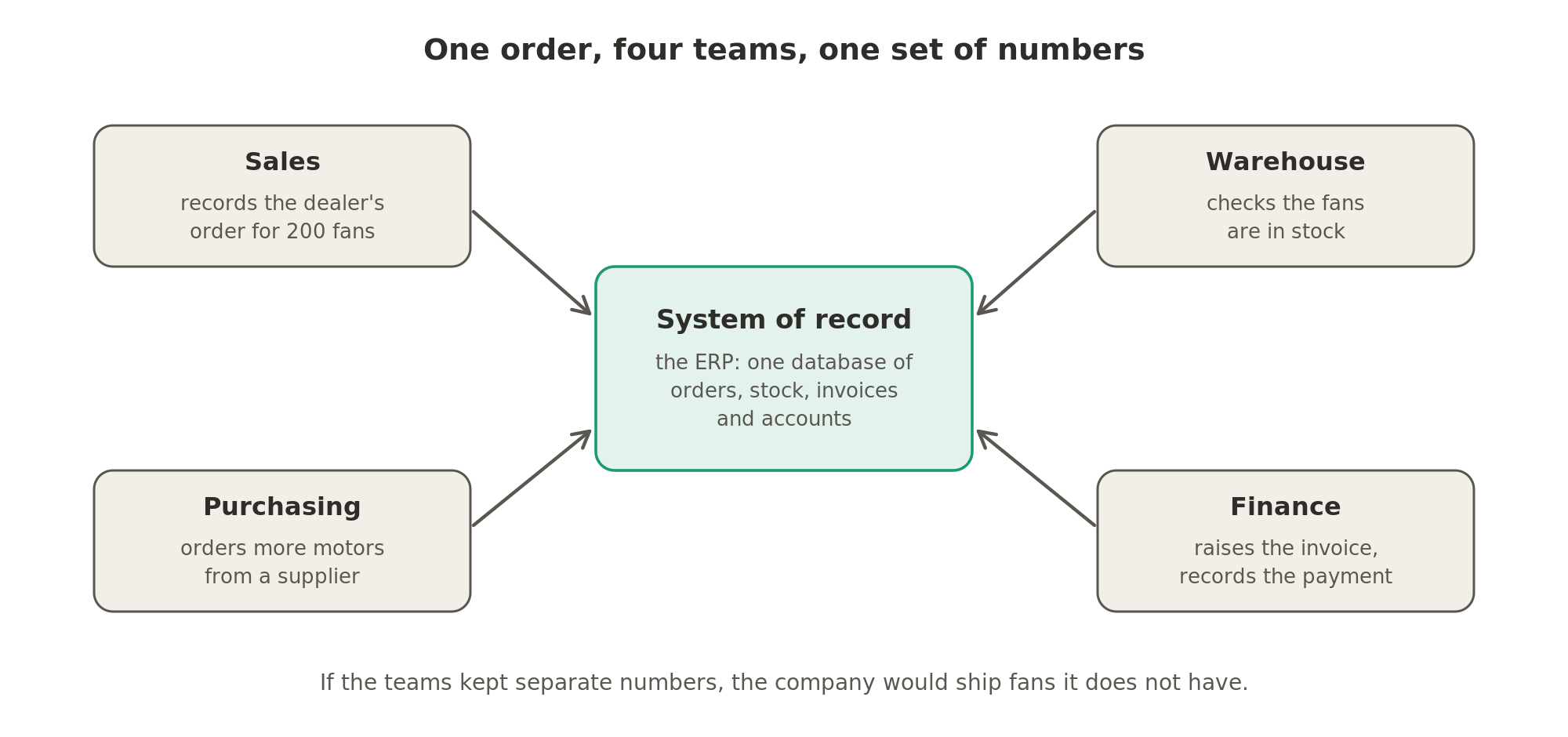 One order touches four teams: sales records it, the warehouse checks the stock, purchasing orders more motors and finance raises the invoice, and all four read and write the same system of record, the ERP.
This Market Segment opens Domain IV, Enterprise SaaS and software. ERP is the oldest and heaviest piece of that software. Its buyers are companies of every size, from a global manufacturer to a shop with three staff. (More on the finance tools that close the books on top of ERP in Market Segment 11.3, Financial close, FP&A and tax software, in Industry Vertical 11, Finance and accounting software.)
Every company named here has posted software engineering jobs in India. Famous companies that don't actively hire software engineers in India are left out.
This Market Segment follows the customer downward by size, in three sub-segments:
The suite for the large company: ERP suites for large and mid-sized companies, sold by the biggest ERP makers and their rivals.
The specialist and the roll-up: ERP built for one industry, and the holding companies that buy dozens of such products.
The small business's books: the billing and accounting apps that are the system of record for a small shop.
The suite for the large company
Enterprise and mid-market ERP suites
Back to the fan maker from the start of this Market Segment. It has factories in three states, thousands of dealers and hundreds of suppliers. It runs on an ERP suite: one product with modules for sales, stock, purchasing, manufacturing and finance. The suites here are sold to large companies, and to mid-sized ones, which the industry calls the mid-market.
Inforhas engineers in Hyderabad and Bengaluru, and the most job postings in this Market Segment. It is the third-largest ERP company in the world, and is owned by Koch Industries. It sells suites built for particular industries, such as manufacturing, distribution, healthcare and hospitality, instead of one product for all. Its Hyderabad centre is one of its largest.
SAPis the largest ERP company in the world. It has only a few job postings in Bengaluru. That says little about its Bengaluru labs, a site of many thousands of people.
Epicorwith engineers in Bengaluru, sells ERP to mid-sized manufacturers, distributors and retailers.
Sageis the British accounting and ERP company. Its products run a large share of the world's small and mid-sized businesses. Bengaluru is one of its engineering sites.
OneAdvancedalso with engineers in Bengaluru, is a British business-software group. Its suites run law firms, schools and health services in the United Kingdom.
Some of the best-known names in ERP are not here:
The specialist and the roll-up
Vertical ERP, project-based ERP, the software holding companies
Back to the fan maker from the start of this Market Segment. When it built its new factory, it hired an engineering consultancy to design it. The consultancy does not sell fans. It sells hours of work, and bills by the hour and by the milestone. A general suite fits it badly, so it runs on an ERP built for project-based businesses.
ERP built for one trade is called vertical ERP. Much of this industry's money now goes here, in two ways:
The specialista company that builds an ERP for one trade, such as project businesses or food makers.
The roll-upa holding company that buys such products by the dozen, and runs them for decades.
The specialists:
Deltekhas engineers in Bengaluru, and the second most job postings in this Market Segment. It sells ERP for project-based businesses: government contractors, architects and consultancies. Its Bengaluru centre is one of its largest.
ECIwith engineers in Bengaluru, sells ERP to small manufacturers, builders and office-equipment dealers.
Apteansells ERP to food, manufacturing and distribution companies.
ABAS Ibericathe Spanish arm of the German manufacturing ERP company abas, has engineers in Bengaluru.
Accessgroupthe British company Access Group, has engineers in Pune.
The roll-ups:
Harris Computerhas engineers across Pune and Mumbai. It is one of the operating groups of Constellation Software, the Canadian company that has bought hundreds of vertical software businesses and never sells them. Its Indian centres serve many of those businesses at once.
Aspire Softwarewith engineers in Bengaluru, follows the same model under its owner, Valsoft.
Trilogyfollows the same model under ESW Capital. It runs the products it buys on one shared engineering base.
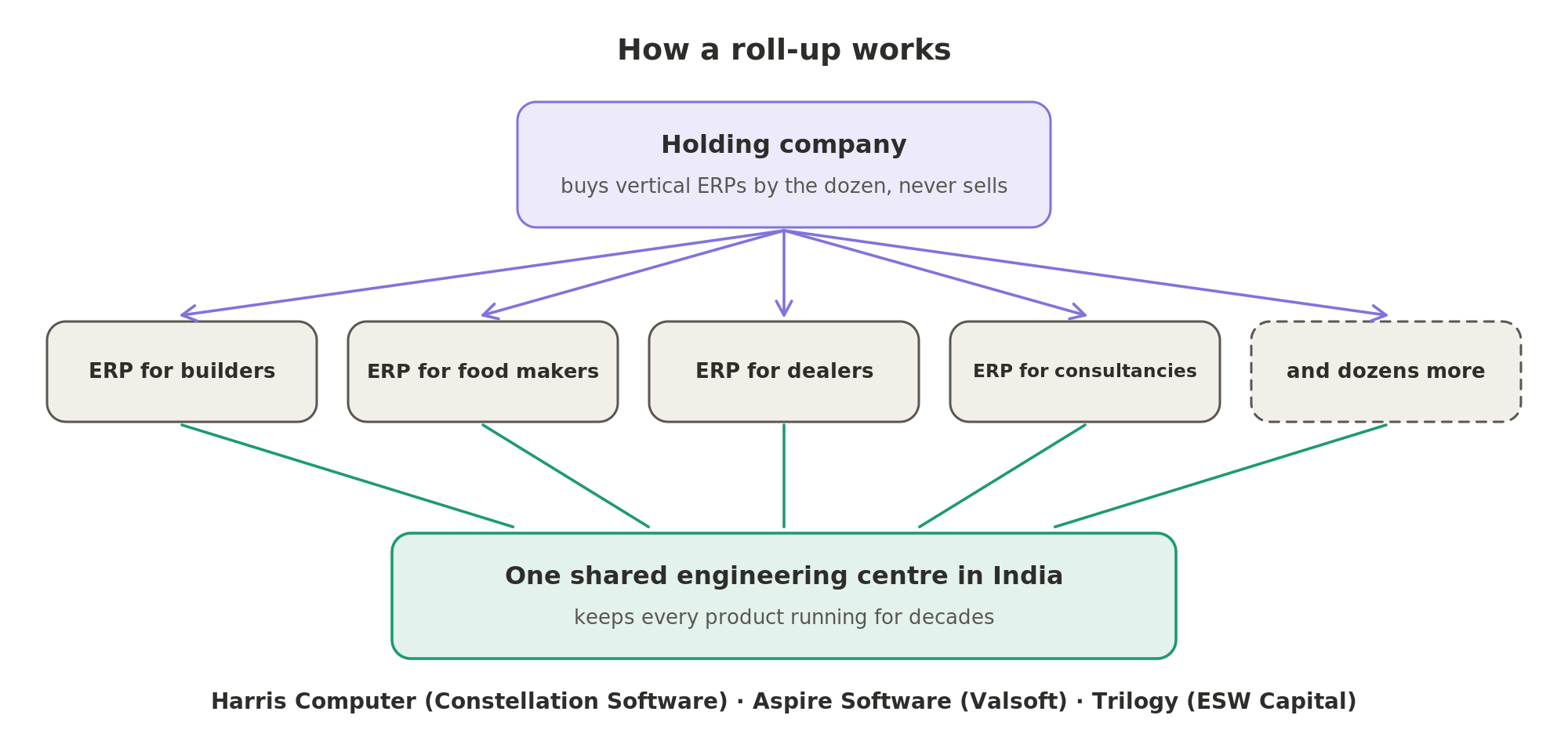 A roll-up buys vertical ERP products by the dozen and never sells them, and one shared engineering centre in India keeps all of them running; Harris Computer, Aspire Software and Trilogy each work this way.
One company covered mainly in another Market Segment belongs here too:
QADsells ERP built for manufacturers. Its Pune centre has more job postings than most companies covered mainly in this Market Segment. (More on it in Market Segment 30.1, Supply chain planning software, in Industry Vertical 30, Supply chain and logistics.)
The software that is never replaced.
The roll-ups exist because a vertical ERP, once installed, is rarely removed. The Indian centres of Harris, Aspire and Trilogy are where that software is kept running for decades. AI does not replace this software. It adds a new layer on top: an AI agent that reads the system of record and acts on it. Every company in this sub-segment is now adding one.
You're reading as a guest. Sign in free to follow links for five minutes, once an hour.
Sign in
The small business's books
Billing, invoicing and accounting for small businesses
Back to the fan maker from the start of this Market Segment, and one of its dealers: a small electrical shop in Madurai with three staff. When a customer buys a fan, the shop prints a GST bill on a phone app. That app is the shop's system of record. This is where the Indian companies are.
Vyaparin Bengaluru, is the billing, invoicing and stock app that millions of Indian small businesses use on a phone, with GST compliance built in. It has few job postings, but more users than any other company in this Market Segment.
GreeneStep Technologiesalso in Bengaluru, sells a cloud ERP for small and mid-sized Indian businesses.
Fact Software Groupfrom Kolkata, sells FACT, the accounting and ERP software that has run Indian and South-East Asian companies for three decades.
So one ceiling fan passes through three systems of record. The fan maker tracks it in an ERP suite. The consultancy that built the factory billed its hours in a vertical ERP. And the shop in Madurai bills the customer on a phone app.
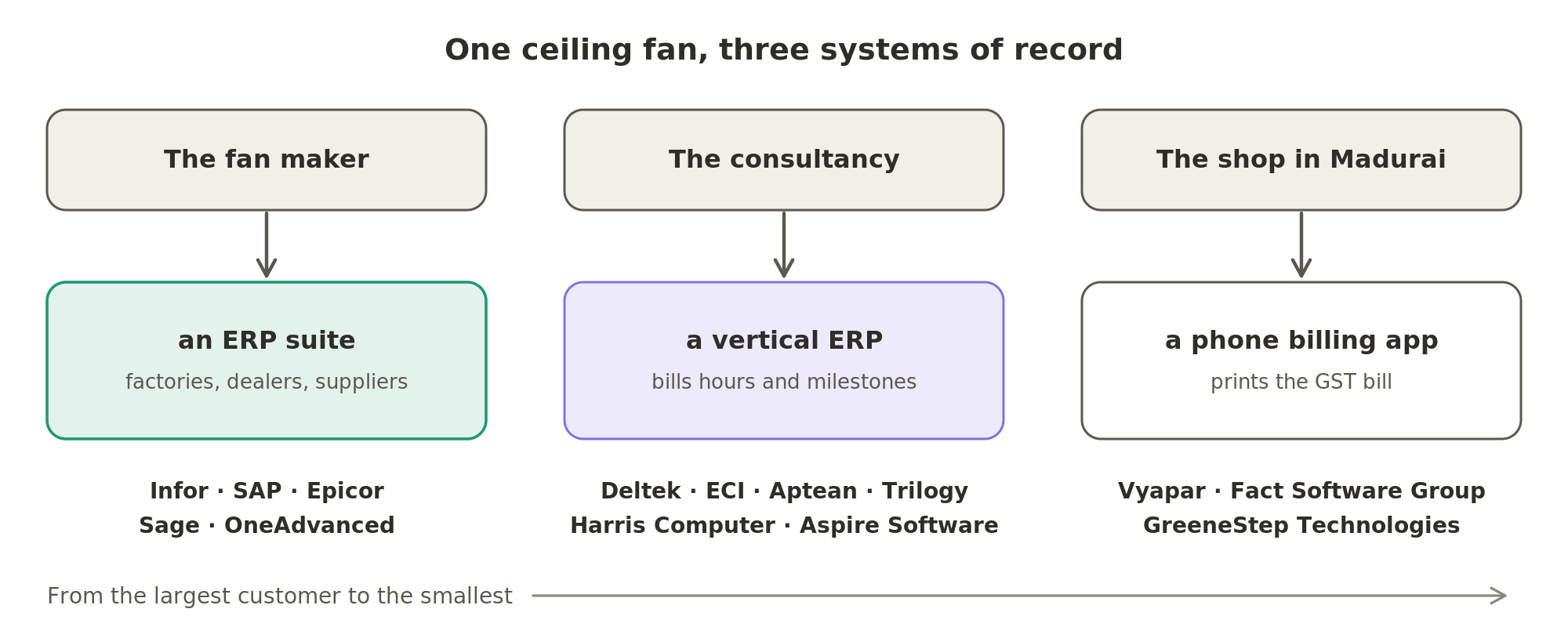 One ceiling fan passes through three systems of record: the fan maker runs an ERP suite, the consultancy that built its factory runs a vertical ERP, and the shop in Madurai bills on a phone app.