Take the water-purifier maker in Pune from Market Segment 11.1, Procurement and source-to-pay software. At the end of every month, its finance department has to agree with itself:
- Every line in the bank statement is matched to an entry in the ledger, the company's book of accounts.
- The numbers of every subsidiary, a smaller company the group owns, are added into the group's numbers.
- Every difference is explained.
- The result is signed off in time for the board and the regulator.
The industry calls this the close. Matching two sets of records and explaining the differences is called reconciliation. The close was a spreadsheet exercise until the companies in this Market Segment turned it into software. Their buyers are companies' finance teams.
This Market Segment follows the finance department's calendar, in three sub-segments:
Closing the books: the platforms that do the month-end reconciliation and manage the close.
Planning and reporting: the systems in which the budget is built, the forecast is revised, and the numbers are combined and explained.
Paying the tax: the software that turns the closed books into what the government is owed, including tax filing and GST reconciliation.
Four large companies covered mainly in other Market Segments have more job postings between them than the 21 companies covered mainly here:
Wolters Kluwer and Thomson Reuterswhose tax and accounting products are as large as their legal and news products
Intuitwhose Bengaluru centre builds the accounting and tax software of half of America's small businesses
Workdaywhose finance product sits beside its HR product
Among the companies covered mainly here, the largest centres are Anaplan's in Delhi and BlackLine's in Bengaluru. The Indian-founded companies are mostly at the tax end, where India's GST created a compliance industry of its own.
Every company named here has posted software engineering jobs in India. Famous companies that don't actively hire software engineers in India are left out.
Closing the books
Account reconciliation, financial close management, transaction matching, finance automation
Back to the purifier maker's month-end from the start of this Market Segment. Its bank statement shows 40,000 rental payments. Each one has to match an entry in the ledger. Its service subsidiary has billed the parent company for repairs, and both sets of books must show the same amount. Accounting between companies of the same group is called intercompany accounting.
BlackLinemade the close a product. It has engineers in Bengaluru. Its platform matches transactions and reconciles every account on the balance sheet, the statement of what a company owns and owes. It also tracks the tasks of the close, and handles intercompany accounting. Its Bengaluru centre is its largest engineering site outside the United States.
BlackLine Indiais a second name of the same company, with its own job postings.
Trintechwith engineers in Bengaluru and Delhi, is BlackLine's long-standing rival, with the same reconciliation and close products.
FloQastwith engineers in Pune, is the younger one. It was built by accountants, for mid-sized finance teams.
Three Indian companies work on the same problem for smaller or narrower customers:
Osfin.aiin Bengaluru, sells a reconciliation engine and payouts management to fintechs and banks that settle millions of transactions. (It also appears in Market Segment 17.1, Card networks and payment processing, in Industry Vertical 17, Payments.)
SaasAntin Chennai, copies payments into QuickBooks and Xero, two accounting products for small businesses.
Numeroalso in Chennai, sells AI agents that run the finance workflows. The industry names three of them:- quote-to-cash, from the price quote to the money received
- procure-to-pay, from the purchase to the payment
- record-to-report, from the ledger entry to the financial report
One company covered mainly in another Market Segment belongs here too:
Workdaysells a financial management product. It closes the books for the same companies that manage their staff on Workday. Its Chennai centre is among its largest. (More on it in Market Segment 12.1, HR, payroll and workforce management software, in Industry Vertical 12, HR tech.)
The close that closes itself.
Every company in this sub-segment is heading for the same place: the continuous close. Reconciliation happens as each transaction arrives, not at month-end, and an AI model explains the exceptions. Numero's agents and Osfin's engine are the Indian versions. A large share of BlackLine's version is built at its Bengaluru centre.
Planning and reporting
Financial planning and analysis, connected planning, consolidation and reporting, enterprise performance management, deal management
Back to the purifier maker from the start of this Market Segment. Its finance team is building next year's budget. If the sales team plans to rent out 30,000 more purifiers, the factory must plan to build them, and finance must plan the money for the steel. This work is called financial planning and analysis. Adding up the numbers of all the group's companies into one set of accounts is called consolidation.
Anaplanwith engineers in Delhi, has the most job postings of any company covered mainly in this Market Segment. It sells connected planning. The finance, sales and supply-chain plans of a large company are built on one engine, so a change in one plan moves the others. Its Delhi centre is its largest engineering site anywhere.
insightsoftwarewith job postings in Hyderabad and Bengaluru, was built by buying many smaller companies. It sells tools for financial reporting, consolidation, budgeting and tax provisioning, which estimates the tax a company will owe. Mid-sized finance teams buy these tools piece by piece.
Three small companies serve narrower needs:
MergerWarein Bengaluru, sells software for buying another company. It covers finding and tracking deals, due diligence, which means checking the company before buying it, and joining the two companies afterwards.
Quantum Phinancein Mumbai, presents itself as a financial-analytics company.
TreasuryProa one-person Bengaluru company, presents itself as a treasury tool. Treasury is the team that manages a company's cash.
You're reading as a guest. Sign in free to follow links for five minutes, once an hour.
Sign in
Paying the tax
Tax compliance and filing, sales tax and e-invoicing, GST reconciliation, small-business accounting, property tax
Back to the purifier maker from the start of this Market Segment. It paid GST on the steel it bought. It can claim that GST back, as input credit, against the GST it collects from its customers. But the claim works only if its suppliers reported the same invoices in their own filings. Checking this, invoice by invoice, is GST reconciliation.
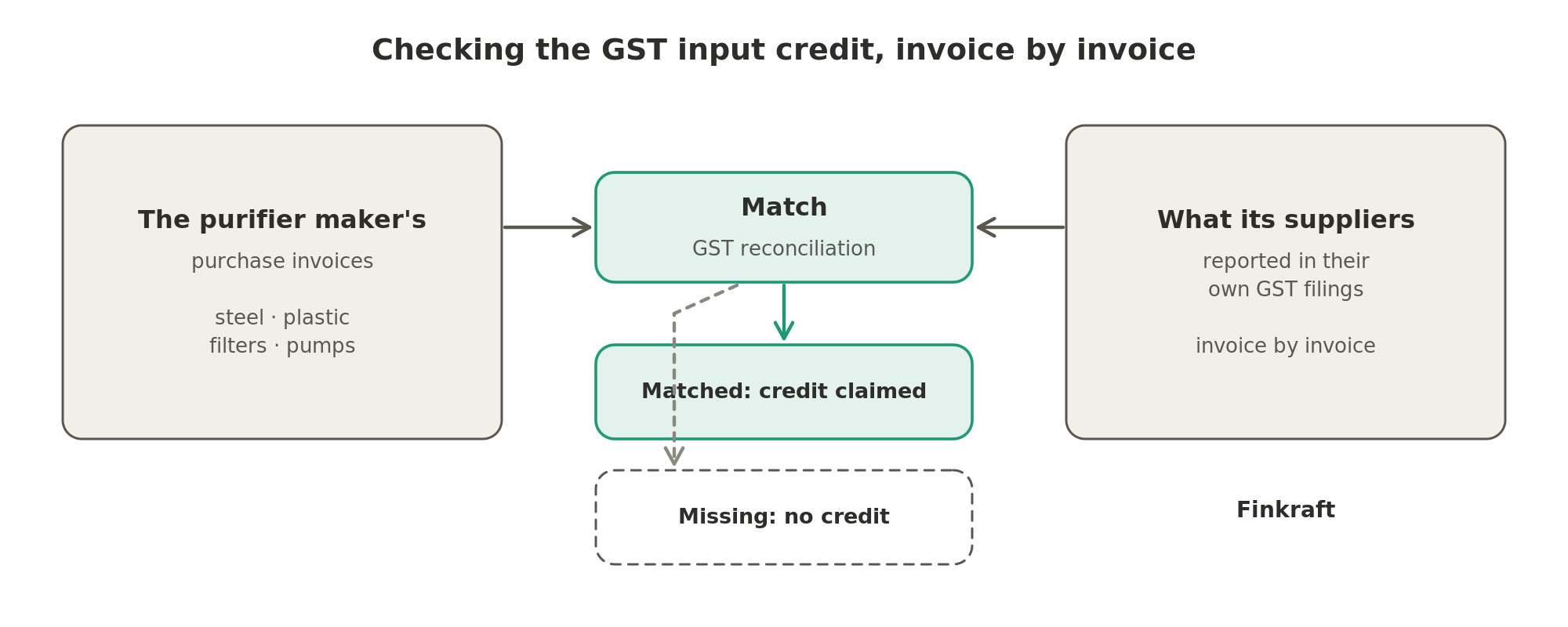 GST reconciliation matches each of the purifier maker's purchase invoices against what its suppliers reported in their own filings; a matched invoice lets it claim the input credit, and a missing one does not.
Tax is where every country's software is its own. So this sub-segment is where most of this Market Segment's Indian companies are.
Finkraftin Bengaluru, reconciles GST. It matches a company's purchase invoices against what its suppliers filed, so the company can claim its input credit. India's tax reform created this compliance problem.
Zampfounded by Indian engineers, with engineers in Bengaluru, sells managed sales-tax compliance to American online sellers. They owe tax in every state they ship to.
Zenworkfrom Hyderabad, files American tax forms in bulk, and sells a compliance API around them.
Filedin Bengaluru, sells an AI assistant that prepares tax returns for accounting firms.
Inklealso in Bengaluru, does American bookkeeping and tax filing for start-ups founded by Indians.
Sovoswith engineers in Mumbai, and Sovos Latinoamerica, with one, are two parts of one global company. It sells tax compliance and e-invoicing, where each invoice is reported to the tax office electronically. Its products file the transaction taxes of large companies in dozens of countries.
Money Forward Indiain Chennai, is the development centre of a Japanese cloud-accounting company.
tax.comin Hyderabad, presents itself as a tax-software company.
Four companies covered mainly in other Market Segments are here too. Three of them are the largest companies in this sub-segment.
Intuithas engineers in Bengaluru, at one of its largest centres. It is here for QuickBooks and TurboTax, the accounting and tax software of America's small businesses and households. (More on it in Market Segment 20.6, Stock trading apps and personal finance, in Industry Vertical 20, Wealthtech and capital markets.)
Thomson Reutershas engineers in Bengaluru and Hyderabad. Its tax and accounting products, ONESOURCE among them, are as large as Reuters, its news business. (More on it in Market Segment 33.1, News and professional information providers, in Industry Vertical 33, News, publishing and social media.)
Wolters Kluwerhas engineers in Pune and Chennai, and the most job postings of the four. Its Pune centre builds, in large part, its CCH tax software and its corporate-performance products. (More on it in Market Segment 43.2, Legal research and legal AI, in Industry Vertical 43, Legaltech.)
Ownwellwith engineers in Delhi, sells software that appeals a homeowner's property tax. (More on it in Market Segment 41.4, Real estate portals and mortgage tech, in Industry Vertical 41, Proptech.)
So the purifier maker from the start of this Market Segment ends each month in three steps. It closes its books, it checks the result against its plan, and it works out the tax it owes and the credit it can claim.
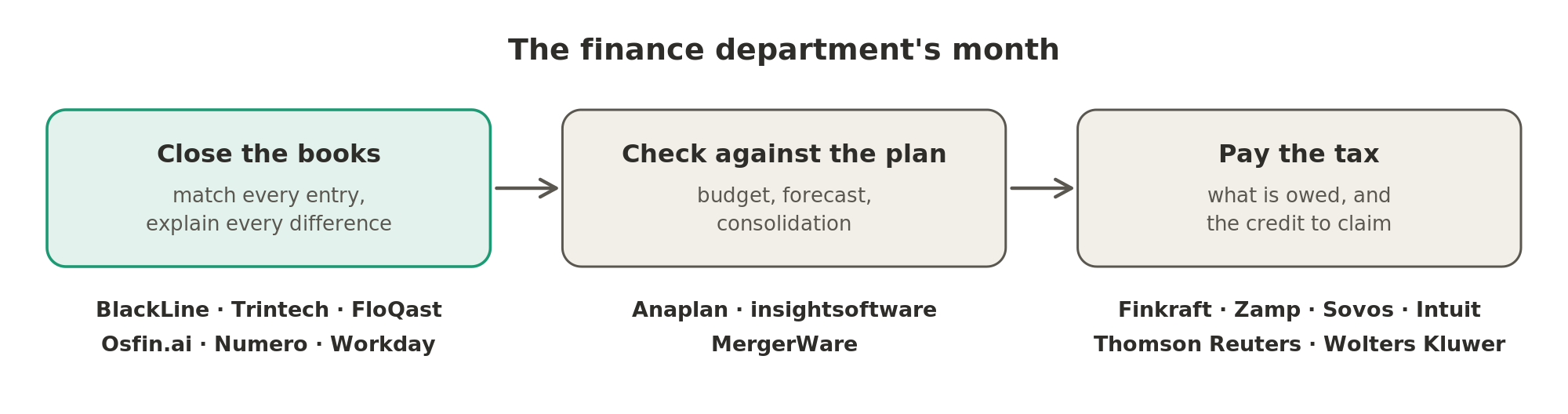 The purifier maker ends each month in three steps: it closes its books, checks the result against its plan, and works out the tax it owes and the credit it can claim.