You buy a coffee at a café in Pune and tap your debit card on the card machine. Two seconds later, the machine beeps: approved. In those two seconds, a request travelled a long way:
The café's card machine, called a terminal, sent the request to a processor. A processor is a company that handles card payments for shops.
The processor passed it to a card network, such as Visa or Mastercard.
The card network passed it to the bank that gave you the card. This bank is called the issuer.
Your bank checked your balance and said yes. The answer travelled back the same way.
This check is called authorisation. No money has moved yet. At the end of the day, the money itself moves between the banks, from your bank to the café's bank. This is called settlement.
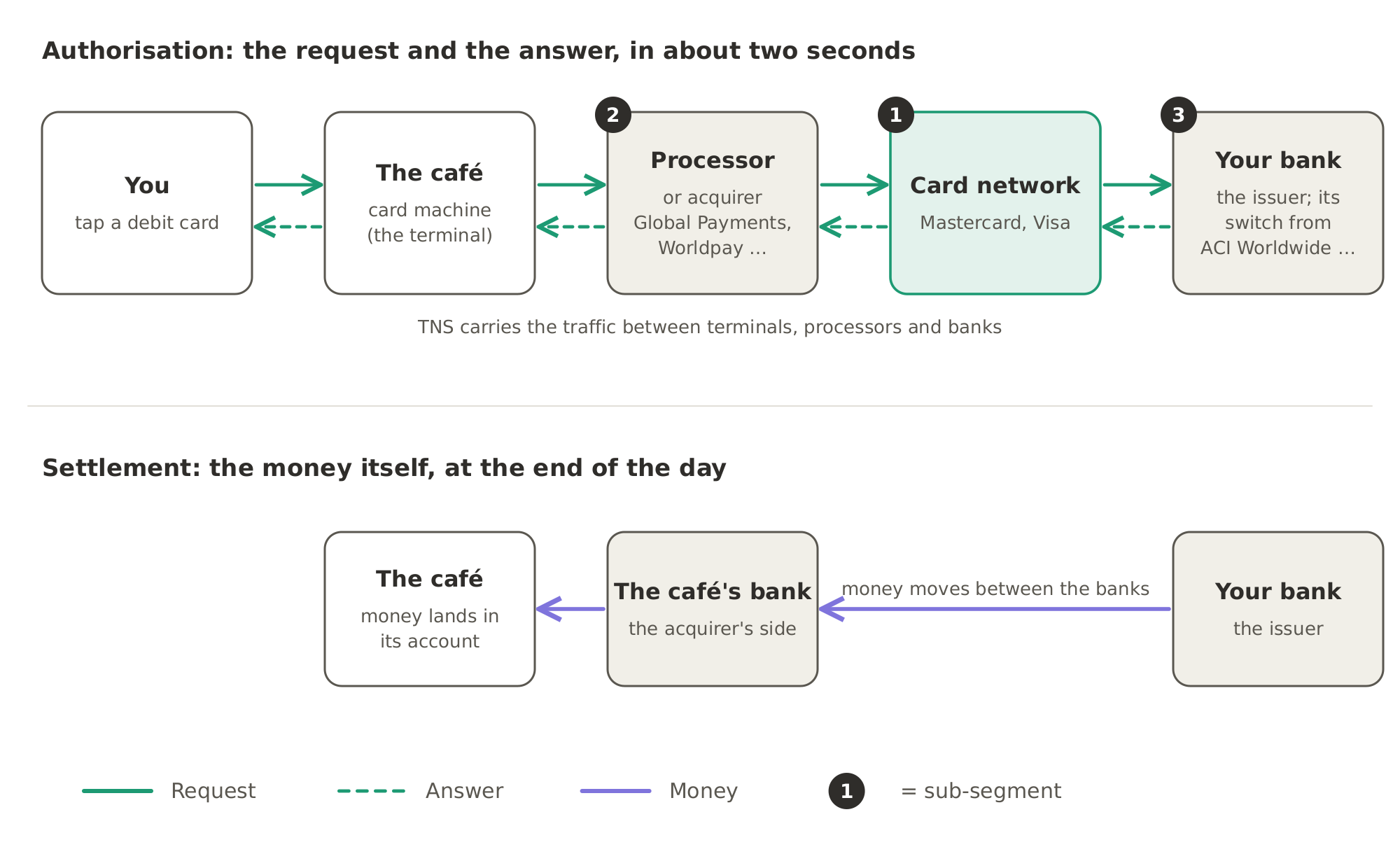 The two seconds of a card payment: the request goes from the café's terminal to the processor or acquirer, then to the card network and on to your bank, the issuer, and the answer comes back the same way. The money itself moves later, at the end of the day, from your bank to the café's bank. The numbers 1 to 3 match the three sub-segments below.
Three kinds of companies make this work:
The card networksown the rails: the network that every card payment travels on.
The processors and acquirersconnect the shops and the banks to those rails. An acquirer is the bank or company that signs up the shop and collects its card payments. In payments, a shop or any other business that accepts payments is called a merchant.
Specialist software companiessell the software that switches, routes and settles each transaction. Switching means passing each transaction to the right bank or network.
Domain V, Fintech, begins with Industry Vertical 17, Payments. And Industry Vertical 17 begins here, with the plumbing that every card payment passes through. This Market Segment has more engineering jobs than any other in Industry Vertical 17, because two of the world's card networks run some of their biggest engineering centres in India.
Every company named here has posted software engineering jobs in India. Famous companies that don't actively hire software engineers in India are left out.
This Market Segment has three sub-segments:
The card networks: the two networks that carry most card payments
The processors and acquirers: the companies that connect the merchant
The bank's switch and the specialist rails: the payments software inside banks, and payments built for particular industries
The card networks
Card payment networks, authorisation and switching, network fraud scoring, tokenisation
Take the coffee payment from the start of this Market Segment. The card network is the middle of its journey. It connects the café's side to your bank's side, and it does more than pass the message along.
Mastercardruns a network that connects tens of thousands of banks with the merchants that accept their cards. The network does several jobs:- the authorisation that approves each payment
- the fraud scoring that runs on every payment, giving each one a score for how likely it is to be fraud
- the tokens that replace the card number on a phone. A token is a stand-in number, so the real card number is never stored on the phone or shared with the shop. This is called tokenisation.
- the cross-border payments and account-to-account payments that it has added. An account-to-account payment moves money straight from one bank account to another, with no card involved.
Most of Mastercard's engineering jobs in India are in Pune. Its Pune centre is one of the largest it has anywhere, and it has more engineering jobs than any other company in Industry Vertical 17.
Visaruns VisaNet, the other network of the same size. It hires in Bengaluru. Its products include:- Authorize.Net, its payment gateway for merchants. A payment gateway is the service that takes a customer's card details on a website and sends them on for approval.
- Visa Advanced Authorization, which scores every transaction for fraud
- the business-payments network it sells to companies
Between them, the two networks carry most of the world's card payments outside China. Much of their software is written in India.
American Express is a card network that is also its own bank. (More on it in the GCC collection.)
The processors and acquirers
Merchant acquiring and processing, payment gateways and routing, payment connectivity
Back to the café in Pune. The café did not connect its terminal to Visa or Mastercard by itself. A processor or an acquirer did that. It gave the café a way to accept cards, and it makes sure the money reaches the café's bank account.
Global Paymentsis one of the largest merchant processors in the world. It takes card payments for shops, restaurants and software platforms. In 2025, it agreed to buy Worldpay. Global Payments hires in Pune.
Worldpayis the processor of large retailers and online merchants. It also sells payouts across borders. And it sells embedded payments, meaning payments built into other companies' software. Worldpay hires in Pune and Bengaluru.
Worldlineis a French processor. It sells acquiring, payment gateways and terminals, mostly in Europe. It hires in Pune, and so does Worldline Global Services, another company of the same group.
Ntt Data Paymentsis an Indian payment gateway. It began as Atom Technologies. It hires in Mumbai.
TNS (Transaction Network Services)carries the payment traffic itself. It runs a private network that connects terminals, processors and banks, and routes each transaction between them. TNS hires in Bengaluru, Delhi NCR and Kolkata.
PayHuddlea small Bengaluru company, sells payments software for banks and acquirers.
You're reading as a guest. Sign in free to follow links for five minutes, once an hour.
Sign in
The bank's switch and the specialist rails
Bank payment hubs, real-time payments, bill payment, ATM and prepaid networks, industry payments
Back to the coffee payment once more. When the request reached your bank, software inside the bank received it, checked it and answered. Banks buy much of this software from specialist companies.
ACI Worldwidesells the software inside the bank that moves the money. Its main product is a payments hub: one system through which the bank sends and receives every kind of payment. These include real-time payments, which reach the other account within seconds, as well as card transactions and wire transfers. A wire transfer is the older way of sending money from bank to bank, often large amounts. ACI also sells a bill-payment service, used by billers such as electricity companies. And it sells fraud detection for all of these payments. ACI Worldwide hires in Pune and Bengaluru.
Euronetruns three businesses:- ATMs across Europe and Asia
- a prepaid top-up network in shops, where a customer pays cash at the counter to recharge a phone or a card
- remittances, the money people send to family in another country, through its brand Ria
Euronet hires in Mumbai. (More on remittances in Market Segment 17.4, Cross-border payments and remittances.)
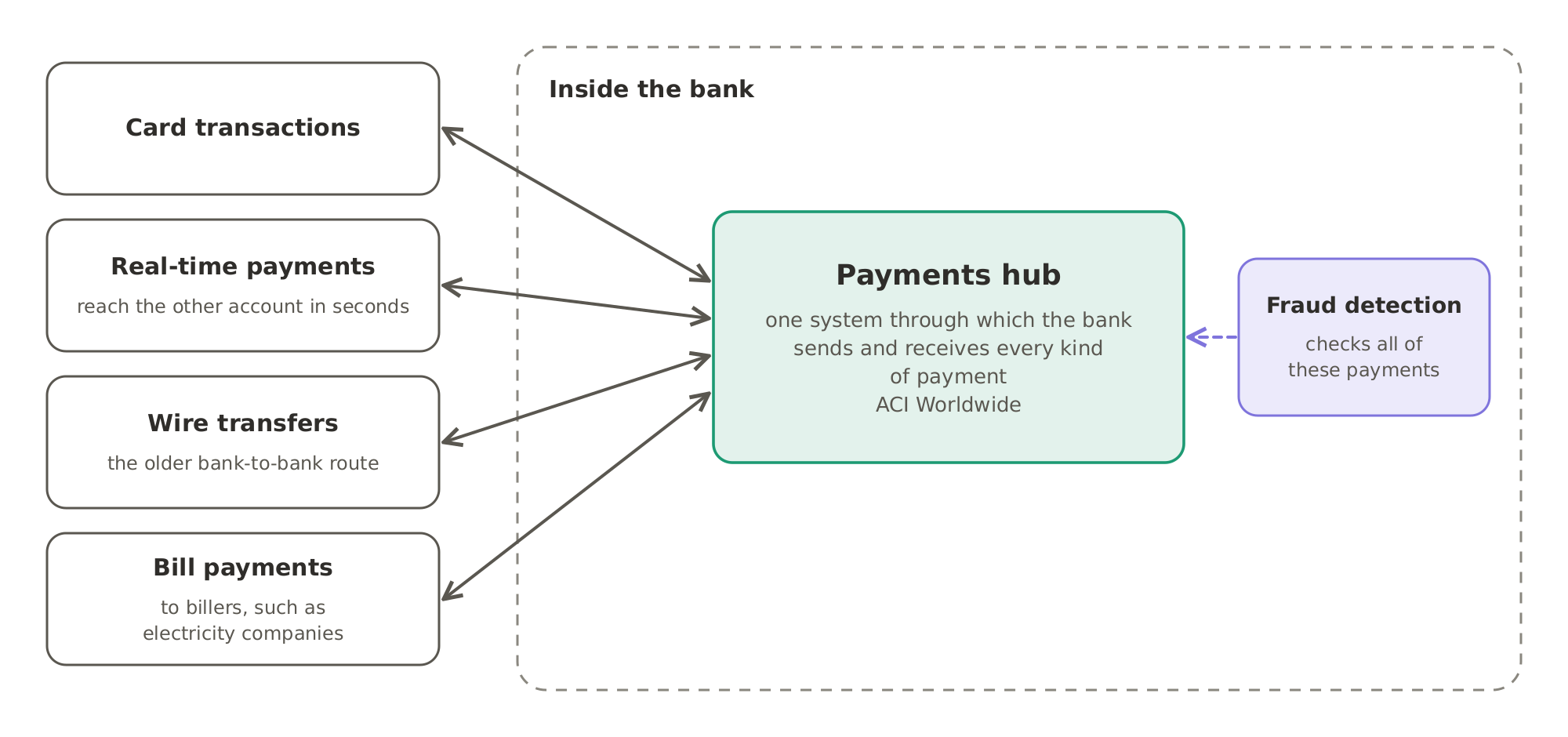 A bank's payments hub, such as the one ACI Worldwide sells, is one system through which the bank sends and receives card transactions, real-time payments, wire transfers and bill payments, with fraud detection checking all of them.
Four companies here are covered mainly in other Market Segments. Each one runs payments built for one industry.
Alegeusruns the debit cards and payments of American health-benefit accounts. It hires in Bengaluru. (More on Alegeus in Market Segment 12.3, Benefits administration software, in Industry Vertical 12, HR tech.)
Cubic Transportation Systemsbuilds fare collection for public transport, such as the metro ticket you pay for by tapping a bank card at the gate. It hires in Hyderabad. (More on it in Market Segment 38.10, Fare collection and tolling systems, in Industry Vertical 38, Automotive and mobility.)
Zelishandles the payments between American health insurers and doctors. It hires in Hyderabad. (More on Zelis in Market Segment 21.6, Health plan claims and care management, in Industry Vertical 21, Insurtech.)
Osfin.aisells reconciliation: checking what was paid against what actually arrived. It hires in Bengaluru. (More on Osfin.ai in Market Segment 11.3, Financial close, FP&A and tax software, in Industry Vertical 11, Finance and accounting software.)
The payment that skips the card.
The card networks were built for a world in which a payment needed a card. Real-time account-to-account payments need neither the card nor the card network. India's UPI (Unified Payments Interface) is the largest example anywhere. Mastercard and Visa are both building for that world. They are adding account-to-account payments, and the tokens and fraud scoring that follow the money wherever it moves. (More on UPI in Market Segment 17.5, UPI apps, wallets and neobanks.)
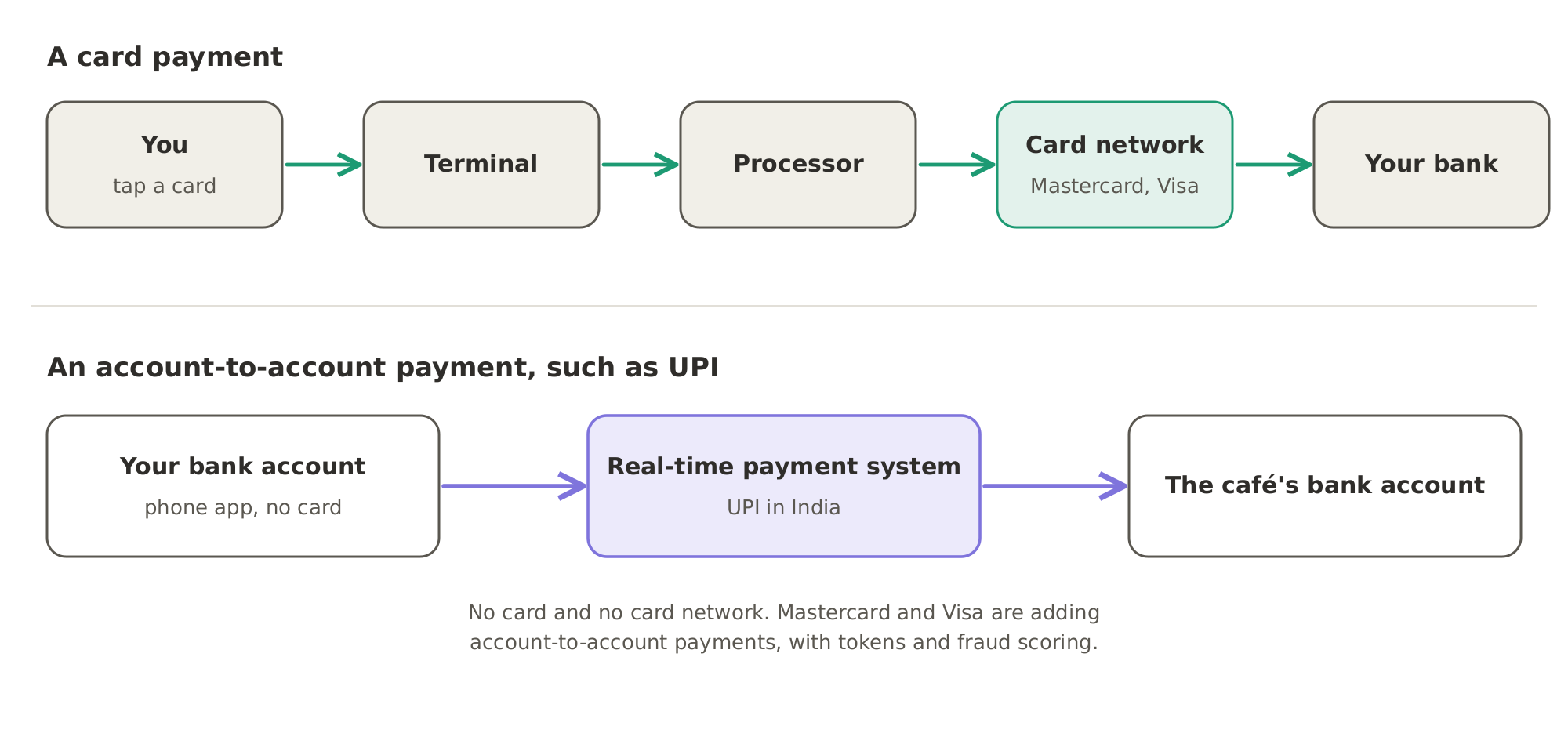 A card payment passes through the terminal, the processor and the card network before it reaches your bank. An account-to-account payment, such as UPI, moves money from your bank account through a real-time payment system straight to the café's bank account, with no card and no card network.
That is the journey of the coffee payment. The café's processor sent the request to the card network, the network passed it to your bank, and the bank's software answered, all in two seconds. The money itself followed at the end of the day.
A card payment passes through the terminal, the processor and the card network before it reaches your bank. An account-to-account payment, such as UPI, moves money from your bank account through a real-time payment system straight to the café's bank account, with no card and no card network.
That is the journey of the coffee payment. The café's processor sent the request to the card network, the network passed it to your bank, and the bank's software answered, all in two seconds. The money itself followed at the end of the day.