In Market Segment 17.1, you tapped your card on a café's card machine. A shop on the internet cannot do that. It cannot take a card in its hand.
Take a small online shop in Jaipur that sells handmade bags. You pick a bag, go to the checkout and choose how to pay: by card, by wallet, by UPI (Unified Payments Interface) or by bank transfer. A few seconds later, the shop's website says: payment received. The shop did not build any of this. It uses a payment gateway.
A payment gateway is the checkout screen, or the few lines of code, that accepts the payment on a website or in an app. It passes the payment to the processor, the company that handles card payments for shops. (More on processors in Market Segment 17.1, Card networks and payment processing.) Within seconds, it tells the shop whether it was paid. On the way, it handles several other jobs:
The fraud checkis this payment likely to be fraud?
The refundwhen a customer sends the bag back.
The subscriptioncharging the same customer every month.
The split between sellerson a marketplace, dividing one payment between the sellers and the marketplace itself.
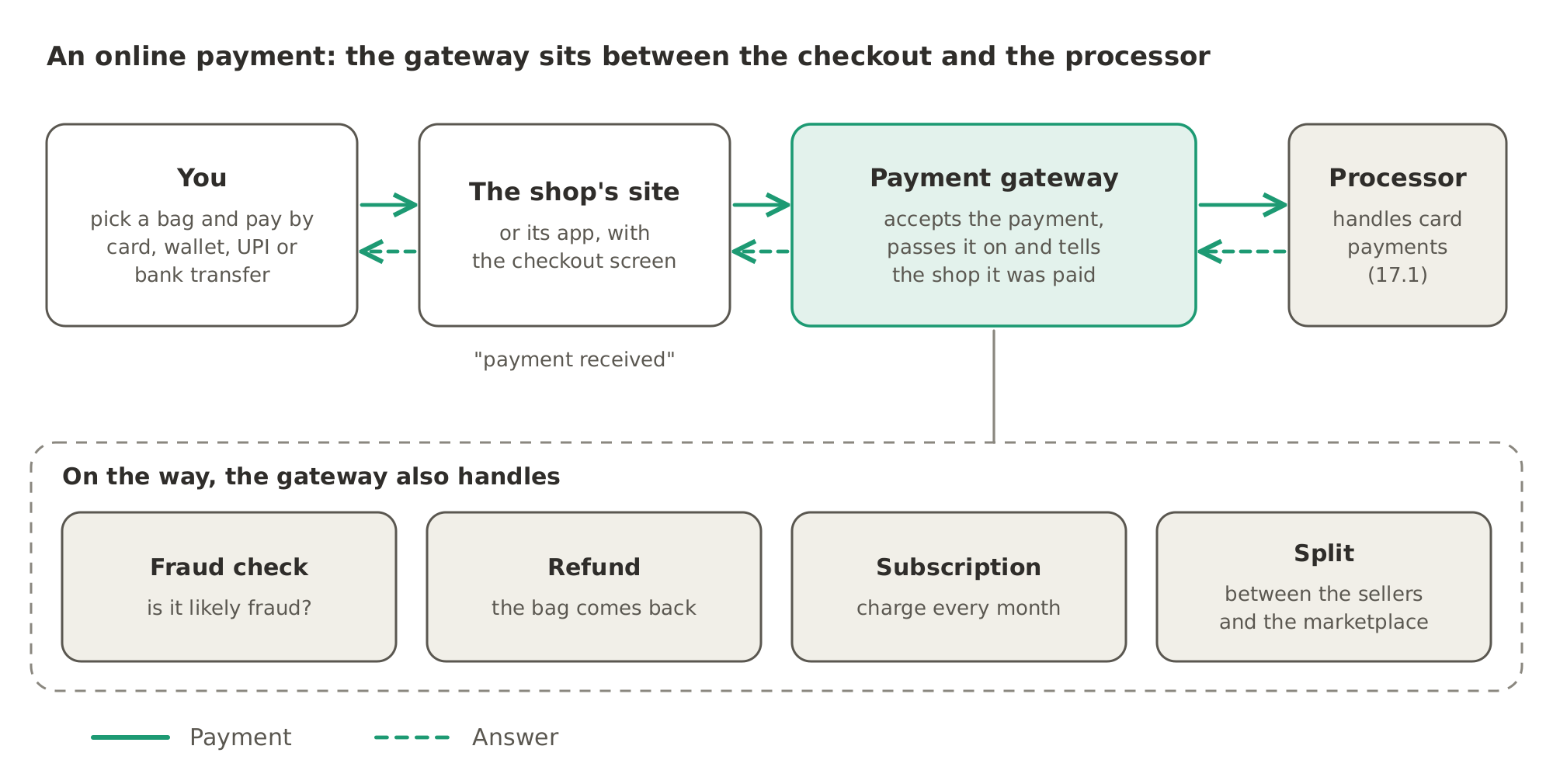 An online payment goes from your choice at the shop's checkout to the payment gateway, which passes it to the processor and tells the shop it was paid. On the way, the gateway also handles the fraud check, refunds, subscriptions and the split between sellers on a marketplace.
The companies here fall into two main groups. The first is the global gateways, most of which build a large share of their product in Bengaluru and Chennai. The second is India's own gateways, which grew up processing the payments of India's online businesses.
Every company named here has posted software engineering jobs in India. Famous companies that don't actively hire software engineers in India are left out.
This Market Segment has three sub-segments:
The global gateways: the gateways used by online businesses around the world
India's gateways: the gateways built for Indian businesses
Payments built into the business: payments that sit inside a bill, a restaurant's system or another product, and gateways for merchants in other countries
The global gateways
Online payment gateways, digital wallets, payment APIs, merchant of record, local payment methods
Take the Jaipur bag shop from the start of this Market Segment. Say it starts selling to customers in the United States and Europe. Those customers expect to pay the way they usually pay in their own country. A global gateway lets the shop accept those payments.
PayPalis the wallet and the checkout button of online shopping. A wallet, or digital wallet, stores a customer's payment details, so they can pay without typing them in each time. PayPal hires more engineers in India than any other company here, in Bengaluru and Chennai. It also owns:- Braintree, the gateway behind many large apps
- Venmo, the American payments app
- Xoom, for money sent abroad
PayPal stopped processing payments within India in 2021. Its two Indian centres build for the rest of the world.
Stripesells the payments of internet businesses as software. Its products include:- the API that takes the payment
- Connect, which splits a payment between the sellers of a marketplace
- Radar, which scores each payment for fraud
- a growing set of banking and billing products around them
Stripe hires in Bengaluru.
Adyena Dutch company, sells one platform for payments online and in stores to the world's largest merchants. A merchant is any business that accepts payments. Adyen hires in Bengaluru.
Bokuconnects merchants to the payment methods people use where cards are rare. Two examples are a charge added to the customer's mobile phone bill, and a local wallet. Boku hires in Mumbai.
Dodo Paymentsa small Bengaluru company, acts as the merchant of record for software sold abroad. The merchant of record is the company that legally sells to the customer. Dodo Payments takes the payment and handles the tax in each country, so the seller does not have to.
One company here is covered mainly in another Market Segment:
Codasells payments that let players in Asia buy games and top-ups without a card. It hires in Bengaluru. (More on Coda in Market Segment 31.2, Game payments and player services, in Industry Vertical 31, Gaming.)
India's gateways
Payment gateways and payouts for Indian businesses
Back to the Jaipur bag shop. Most of its customers are in India, and most of them pay by UPI, by card or by net banking. Net banking means paying by logging in to your bank's website. For these payments, the shop uses an Indian gateway. This sub-segment is India's own online payments industry.
Razorpaywas founded in Bengaluru, and hires there and in Delhi NCR. A large share of India's online businesses take cards, UPI and net banking through its gateway. It also sells RazorpayX, for a business's own banking and payouts, and a point-of-sale product for a business's physical shops. (More on point of sale in Market Segment 17.3, Point of sale (POS).)
PayUis the gateway of many of India's largest online merchants. It is owned by Prosus. It also offers instalments and pay-later options at the checkout. With these, the customer pays in parts, or pays after some weeks. PayU hires in Bengaluru.
Cashfree Paymentssells a gateway and, above all, payouts. Payouts are the payments a business sends out in bulk: refunds, salaries and payments to its vendors. Cashfree Payments hires in Bengaluru.
Paywizeis a small payments company. It hires in Bengaluru.
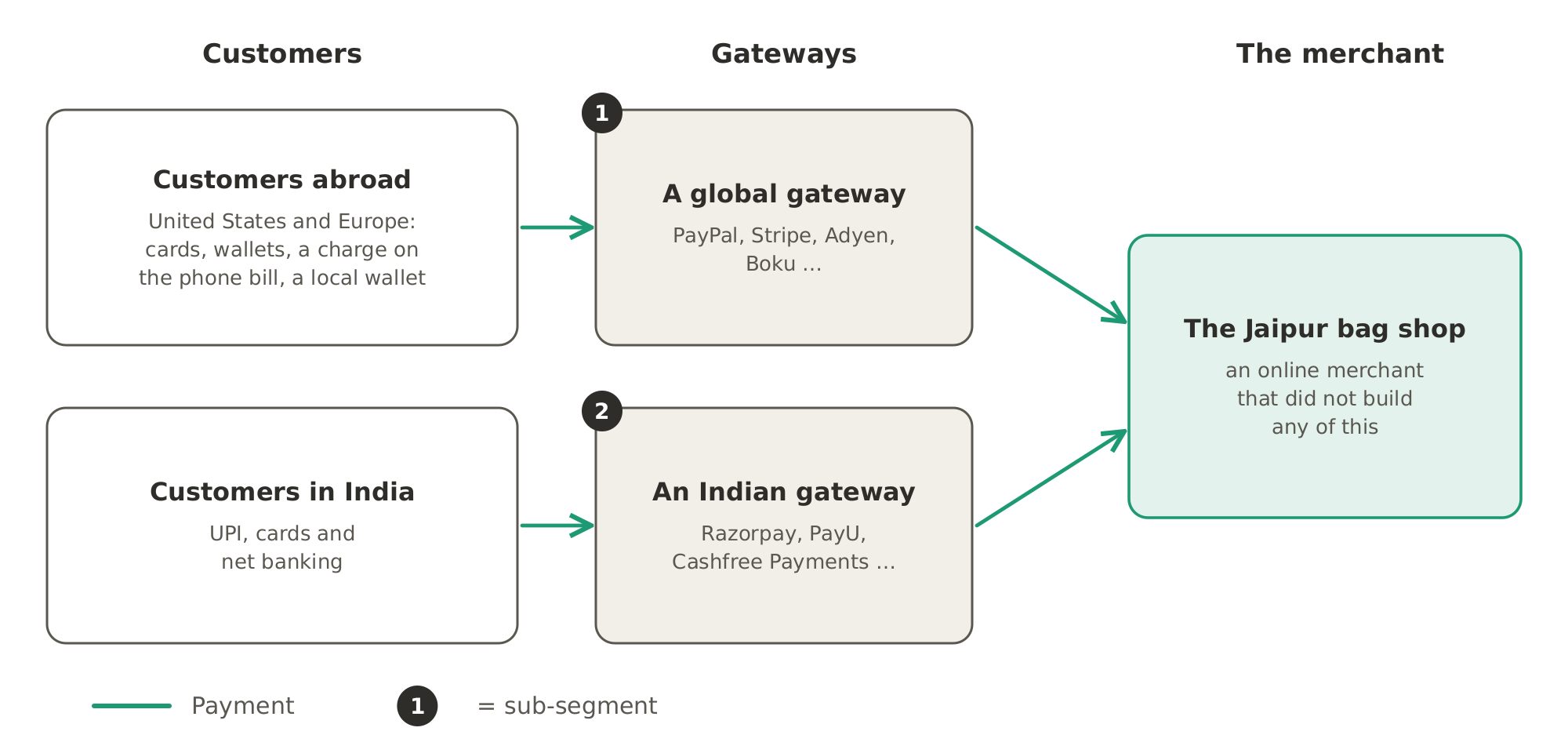 The Jaipur bag shop takes payments from customers abroad through a global gateway, such as PayPal, Stripe, Adyen or Boku, and from customers in India, who pay by UPI, card or net banking, through an Indian gateway, such as Razorpay, PayU or Cashfree Payments. The numbers 1 and 2 match the first two sub-segments.
You're reading as a guest. Sign in free to follow links for five minutes, once an hour.
Sign in
Payments built into the business
Bill presentment and payment, payments embedded in business software, acquiring in other markets
The Jaipur bag shop takes payments from customers abroad through a global gateway, such as PayPal, Stripe, Adyen or Boku, and from customers in India, who pay by UPI, card or net banking, through an Indian gateway, such as Razorpay, PayU or Cashfree Payments. The numbers 1 and 2 match the first two sub-segments.
You're reading as a guest. Sign in free to follow links for five minutes, once an hour.
Sign in
Payments built into the business
Bill presentment and payment, payments embedded in business software, acquiring in other markets
In the first two sub-segments, the customer paid at a checkout. In this sub-segment, the payment sits inside something else: a bill, an accounting system, a restaurant's software.
Deluxeis an American company that printed cheques for a century. It now sells merchant processing, and payments for businesses. It also sells the lockbox, a service that receives payments sent by post and turns them into data. Deluxe hires in Bengaluru.
InvoiceCloud Inc.sells the bill and the payment to utilities, local governments and insurers. Its customers' customers pay their bills online, often by AutoPay, where the amount is taken automatically each month. InvoiceCloud hires in Hyderabad. (It also appears in Market Segment 11.2, Subscription billing software, in Industry Vertical 11, Finance and accounting software.)
EBizChargesells a gateway built into accounting and ERP systems. ERP (enterprise resource planning) is the software a company runs its accounts, orders and stock on. EBizCharge hires in Pune.
Three companies here serve merchants in other countries. The first two build part of their product in India:
geideais a Saudi acquirer, with terminals and online payments across the Middle East. An acquirer is the company that signs up a merchant and collects its card payments. geidea hires in Bengaluru.
Moniepoint Groupis a Nigerian merchant acquirer and digital bank for small businesses.
Datmanis a British company that processes payments for small and mid-sized businesses in the United Kingdom and Europe. A business can accept cards and digital wallets through it, online, in its shop or on a phone. Datman also gives the business reports on its sales and refunds. It hires in Bengaluru.
Three companies covered mainly in other Market Segments take payments inside their own industries:
Toasttakes payments inside its restaurant system. It hires in Bengaluru and Chennai. (More on Toast in Market Segment 28.3, Restaurant management and workplace dining software, in Industry Vertical 28, Foodtech and quick commerce.)
BlinkRxhandles prescriptions that are paid for and delivered to American patients. It hires in Bengaluru. (More on BlinkRx in Market Segment 22.7, Pharmacy automation and online pharmacies, in Industry Vertical 22, Digital health.)
Prestohandles the payment for charging an electric vehicle across different charging networks. It hires in Mumbai. (More on Presto in Market Segment 38.8, EV charging networks and battery swapping, in Industry Vertical 38, Automotive and mobility.)
The checkout without a checkout.
The payment is disappearing into the product. It is paid inside the restaurant's system, by the bill's AutoPay, or as the game's top-up. Next comes the AI agent that buys on the customer's behalf. The gateways are building for payments that no person starts at a checkout. Such a payment needs proof that the agent was allowed to pay.
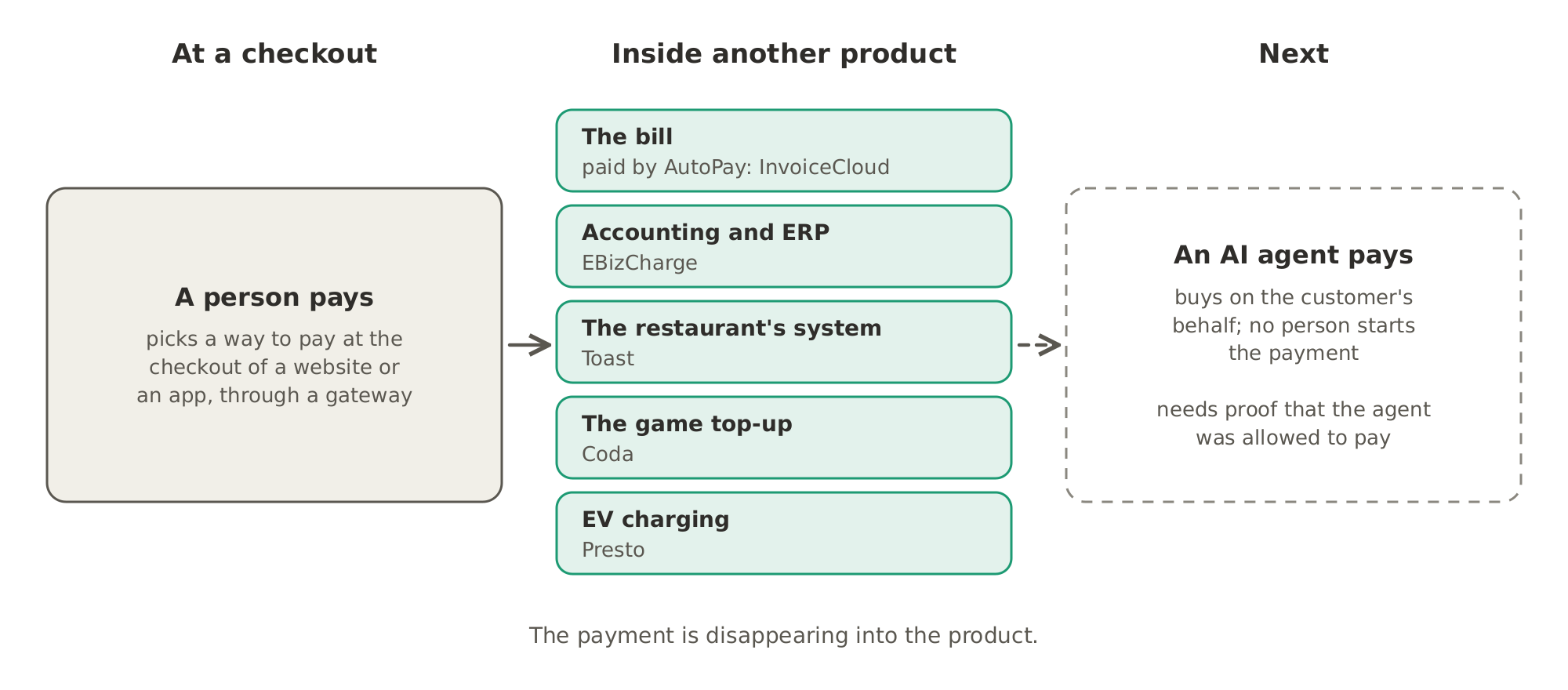 Payments are moving from a checkout, where a person chooses how to pay, into other products: the bill paid by AutoPay, accounting and ERP systems, the restaurant's system, the game top-up and EV charging. Next comes the AI agent that pays on the customer's behalf and needs proof that it was allowed to pay.
That is how a shop takes payments online. The Jaipur bag shop uses an Indian gateway for its customers in India, and a global gateway for its customers abroad. And more and more payments are made inside another product, with no checkout at all.
Payments are moving from a checkout, where a person chooses how to pay, into other products: the bill paid by AutoPay, accounting and ERP systems, the restaurant's system, the game top-up and EV charging. Next comes the AI agent that pays on the customer's behalf and needs proof that it was allowed to pay.
That is how a shop takes payments online. The Jaipur bag shop uses an Indian gateway for its customers in India, and a global gateway for its customers abroad. And more and more payments are made inside another product, with no checkout at all.