Back to the skin doctor's claim from Market Segment 23.2, Health payer platforms and prior authorisation, which arrived at the patient's health plan. Before a cent is paid, the claim is checked in three ways:
- against the patient's plan: what it covers
- against the plan's contract with the clinic: what the clinic may charge
- against the medical rules: whether the codes billed make sense together
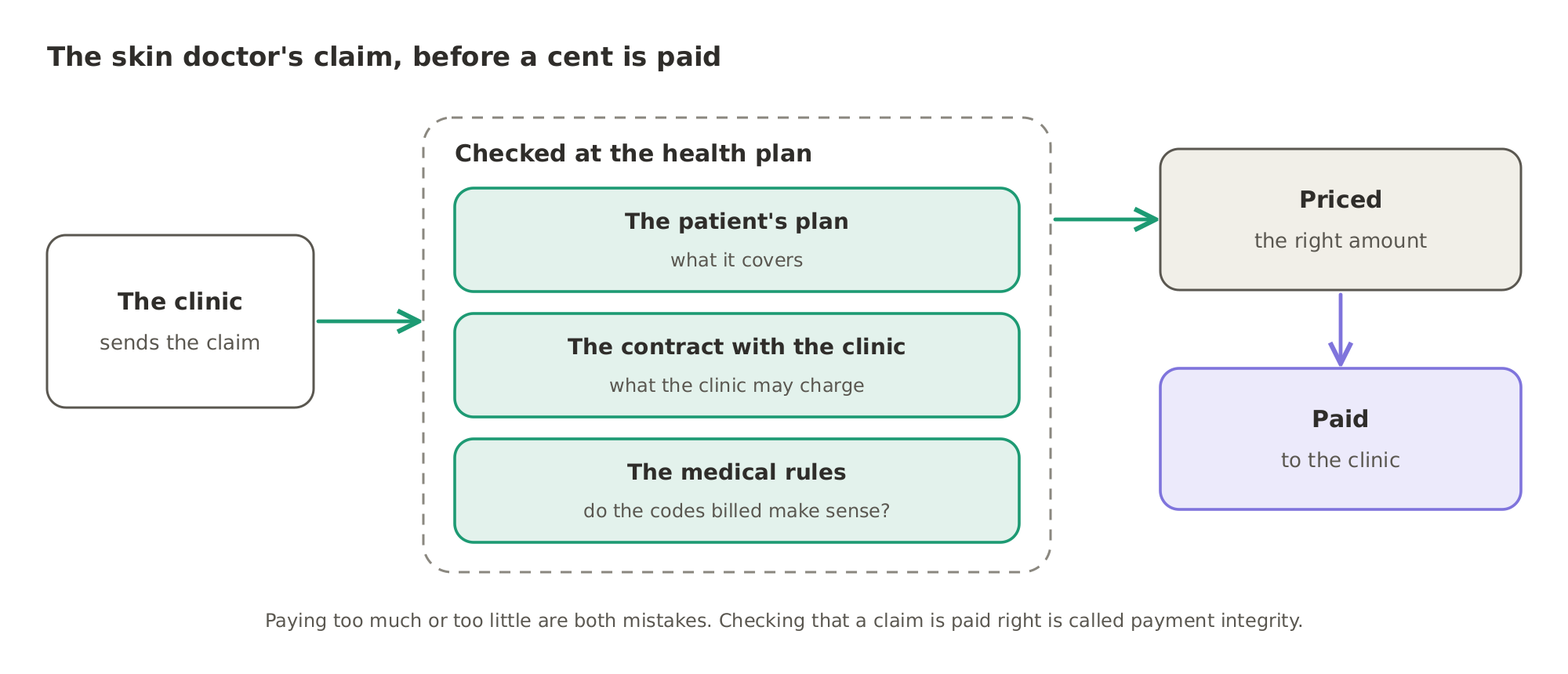 A clinic's claim is checked at the health plan in three ways, against the patient's plan, the plan's contract with the clinic and the medical rules, before it is priced and paid to the clinic.
Then the claim is priced, and paid. Health insurance is the largest kind of insurance in America, and this back office is enormous. It handles billions of claims a year. Mistakes in both directions, paying too much or too little, are worth hundreds of billions of dollars.
A large share of this back-office work is done in India. Some is done by the software companies in this Market Segment. Some is done by the services firms that run health plans' operations for them. The buyers of the software are American health plans, the firms that administer claims for them, and state governments. Two neighbours are covered in Industry Vertical 23, Health insurance and billing. The health plan's core system is in Market Segment 23.2, Health payer platforms and prior authorisation. The clinic's side of the same claims is in Market Segment 23.1, Revenue cycle management (RCM) software.
Every company named here has posted software engineering jobs in India. Famous companies that don't actively hire software engineers in India are left out.
This Market Segment has two sub-segments:
The claim checked and paid: the software that checks each claim, and pays it correctly.
The plan and the care: the software that manages members' care, and the new health plans built for employers.
The claim checked and paid
Claims payment accuracy and integrity, claims rules and configuration, provider payments, claims administration for payers and TPAs
Back to the skin doctor's claim from the start of this Market Segment. Checking that a claim should be paid, and paid at the right amount, is called payment integrity. Deciding the claim is called adjudication. A company that administers claims for a health plan is called a third-party administrator, or TPA.
Lyricwith engineers in Hyderabad, sells the claims-editing rules that American health plans run on every claim before paying it. The rules check that the codes billed are consistent, and allowed.
Zeliswith engineers in Hyderabad, sells payment integrity, checking of bills, and the electronic payment from health plan to provider. (For that payment, it also appears in Market Segment 17.1, Card networks and payment processing, in Industry Vertical 17, Payments.)
Cotivitiwith engineers in Hyderabad, sells payment accuracy, and risk adjustment for Medicare plans: the calculation that pays a plan more for sicker members.
CoverSelfwith engineers in Bengaluru, sells a cloud platform for the same payment-integrity rules.
LightSpunautomates the adjudication of dental claims.
Simplify Healthcarewith engineers in Pune, sets up each plan's benefits and claims rules inside its core system.
MDI NetworXsells claims administration to health plans and third-party administrators.
Acentra Healthwith engineers mostly in Chennai, processes claims, and runs pharmacy and care programmes, for American state Medicaid agencies. (For that, it also appears in Market Segment 44.1, Government software, in Industry Vertical 44, Govtech and nonprofits.)
Lyric and MDI NetworX also appear in Market Segment 23.1, Revenue cycle management (RCM) software (in Industry Vertical 23, Health insurance and billing).
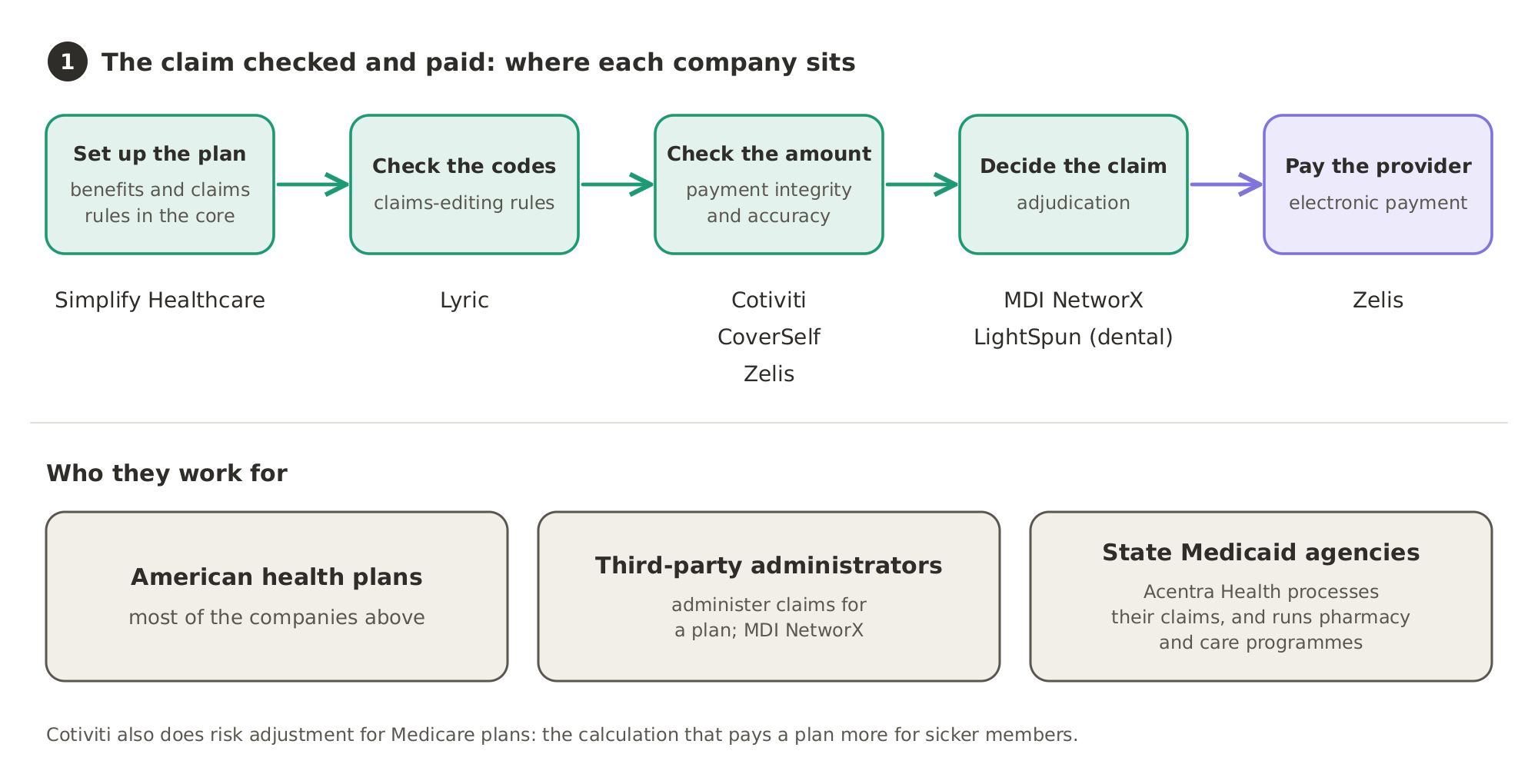 Where each company sits on a claim's path: Simplify Healthcare sets up the plan's rules, Lyric checks the codes, Cotiviti, CoverSelf and Zelis check the amount, MDI NetworX and LightSpun decide the claim, and Zelis makes the payment to the provider. Most of them work for American health plans, MDI NetworX also for third-party administrators, and Acentra Health for state Medicaid agencies.
The plan and the care
Population health and care management, value-based employer health plans, group health with primary care, benefit accounts
Where each company sits on a claim's path: Simplify Healthcare sets up the plan's rules, Lyric checks the codes, Cotiviti, CoverSelf and Zelis check the amount, MDI NetworX and LightSpun decide the claim, and Zelis makes the payment to the provider. Most of them work for American health plans, MDI NetworX also for third-party administrators, and Acentra Health for state Medicaid agencies.
The plan and the care
Population health and care management, value-based employer health plans, group health with primary care, benefit accounts
Now picture a member of the same health plan who has cancer. Specialist care like this costs the plan the most. So the plan manages the member's care closely, and decides which treatments it will pay for.
Evolentwith engineers in Pune, manages the care of health plans' members with complex illnesses, such as cancer and heart disease. It also sets the clinical pathways: the agreed treatment plans that decide which treatment is paid for.
XO Healthwith engineers in Bengaluru, builds value-based health plans for employers that insure their own staff. A value-based plan is paid for keeping people healthy, not for each treatment given.
Loopwith engineers in Bengaluru, sells Indian companies group health insurance, with its own primary-care doctors.
One company covered mainly in another Market Segment belongs here too:
Alegeuswith engineers in Bengaluru, is here for the health savings and spending accounts of American employees.
Alegeus is covered mainly in Market Segment 12.3, Benefits administration software (in Industry Vertical 12, HR tech), and XO Health and Loop also appear there.
The claim adjudicated by a model.
Most American health claims are already processed without a person. The rest are reviewed by people, many of them in India: the complex claims, the denied ones and the appealed ones. AI models now read the medical record and the claim together, and draft the decision. Regulators and courts are asking how a health plan uses an AI model to deny care.
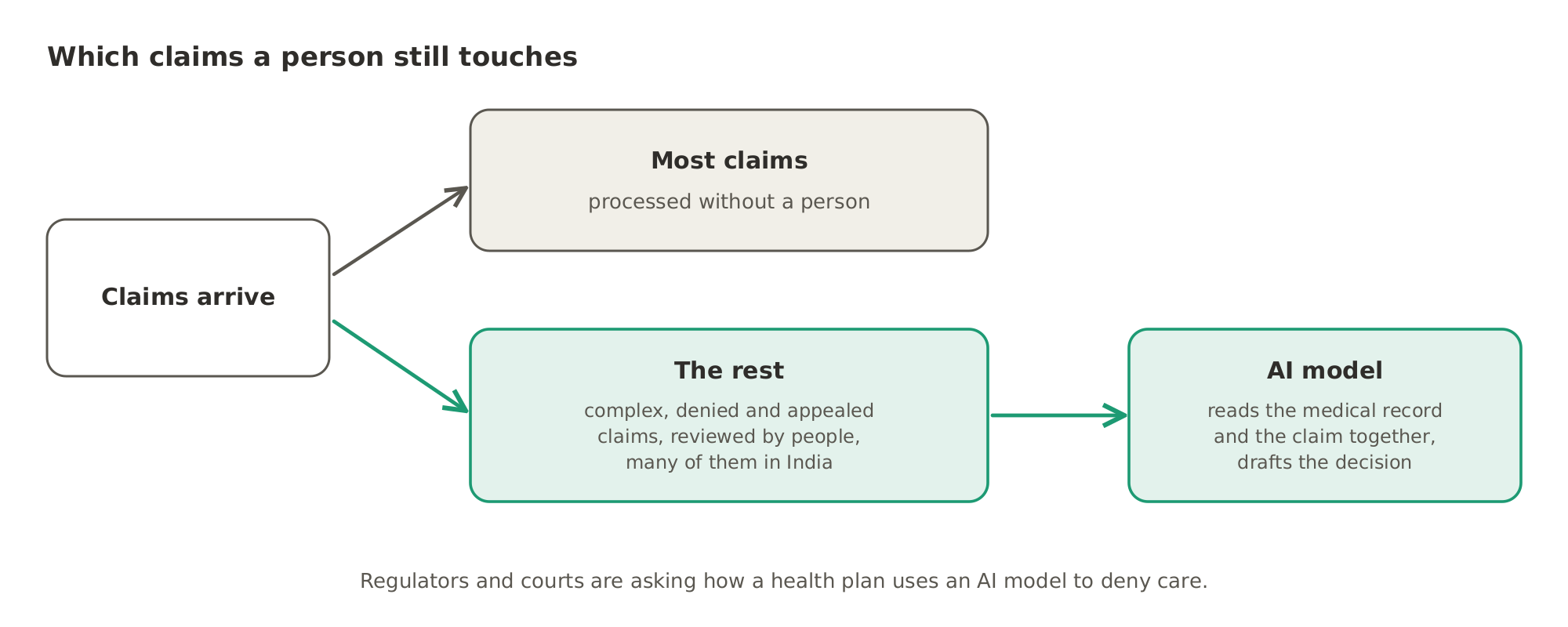 Most American health claims are processed without a person. The rest, the complex, denied and appealed claims, are reviewed by people, many of them in India, and AI models now read the medical record and the claim together to draft the decision.
So the skin doctor's claim from the start of this Market Segment was checked against the plan, the contract and the rules. Then it was paid, most likely without a person touching it. And for a member with cancer, the same back office decides which treatment the plan will pay for.
Most American health claims are processed without a person. The rest, the complex, denied and appealed claims, are reviewed by people, many of them in India, and AI models now read the medical record and the claim together to draft the decision.
So the skin doctor's claim from the start of this Market Segment was checked against the plan, the contract and the rules. Then it was paid, most likely without a person touching it. And for a member with cancer, the same back office decides which treatment the plan will pay for.