Take the fan maker in Coimbatore from Market Segment 10.1, ERP and business accounting software. Its ERP is never the only system it runs. A mid-sized company runs a few hundred applications:
- the ERP
- the CRM, short for customer relationship management, where the sales team tracks customers and deals
- the payroll system
- the warehouse system
- the bank's system
- the supplier's website, where orders are placed
Every one of them holds a piece of the same order or the same customer. When a dealer places an order for 200 fans, the CRM, the ERP and the warehouse system all need to know. Something has to carry the record between them whenever it changes.
This Market Segment is about the companies that do that carrying between applications. (Market Segment 8.1, Data integration and governance platforms, in Industry Vertical 8, Analytics and data providers, covers the same job between databases.) Their buyers are companies' IT teams. The work comes in two layers:
The integration platformit connects one application's API to another's, with rules that a business analyst can set without writing code.
The older, heavier plumbing underneaththe file that has to reach the bank by midnight, and the batch job that has to run after it. This plumbing is older than the API, and it has not gone away.
Two large companies covered mainly in other Market Segments outweigh the rest. One is Salesforce, with centres in Hyderabad and Bengaluru. The other is Cloud Software Group, which owns TIBCO. Among the companies covered mainly here, the two biggest Indian centres are Boomi's in Bengaluru and Celigo's in Hyderabad. Each is among the largest its company has.
Every company named here has posted software engineering jobs in India. Famous companies that don't actively hire software engineers in India are left out.
This Market Segment follows the connection from the API down to the file, in two sub-segments:
The integration platform: connecting applications through their APIs.
Moving the file and running the batch: file transfers, business-to-business orders and overnight jobs.
The integration platform
Integration platform as a service, application connectors, embedded and AI-driven integration
Back to the fan maker from the start of this Market Segment. A dealer places the order for 200 fans on the fan maker's website. An integration platform passes the order to the CRM, then to the ERP, then to the warehouse system. The platform is sold as a cloud service, called integration platform as a service, or iPaaS. It comes with ready-made connectors: pre-built links to popular applications.
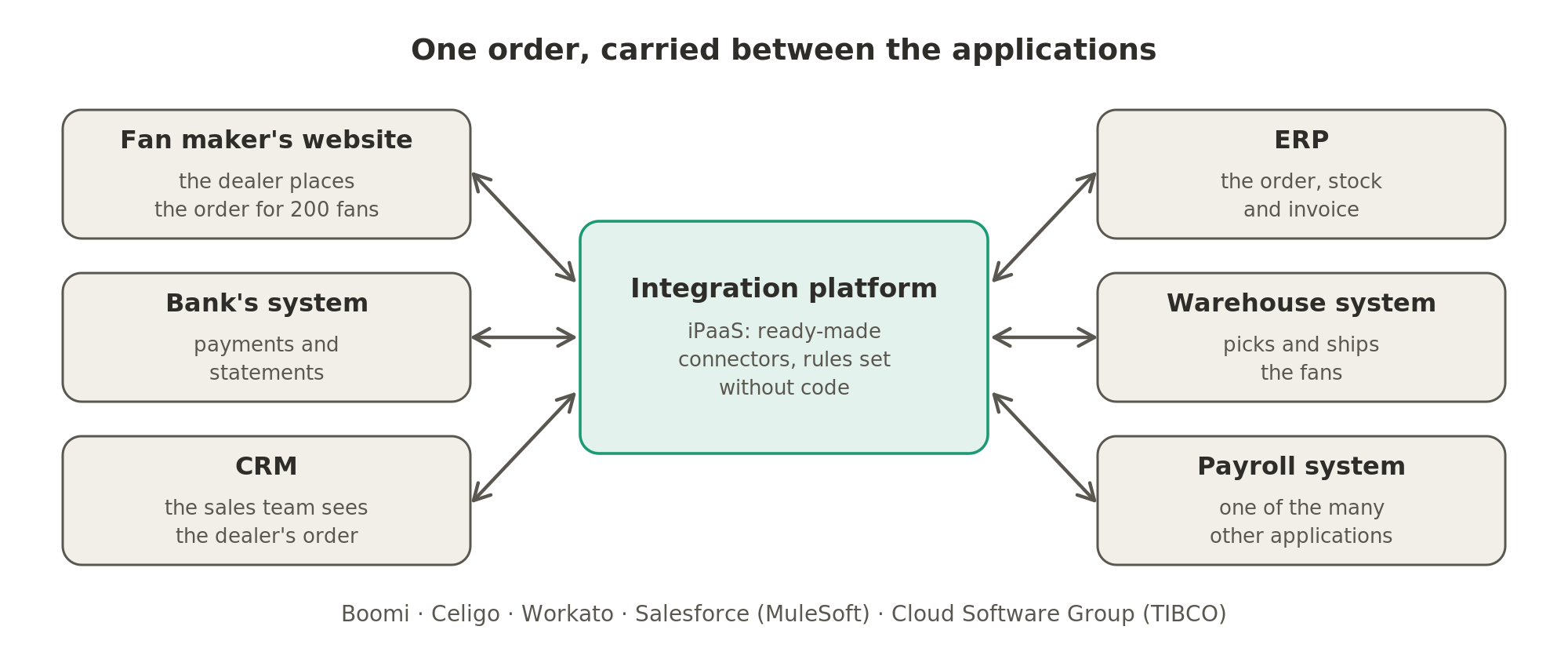 An integration platform sits between the fan maker's applications, so that one order placed on the website reaches the CRM, the ERP and the warehouse system without anyone typing it again.
Boomihas engineers in Bengaluru, Pune and Hyderabad, and the most job postings in this Market Segment. Dell spun it out as a separate company in 2021. It sells an integration platform as a service: a visual canvas on which the connections between a company's applications are drawn, run and monitored, with hundreds of ready-made connectors. Its Bengaluru centre is its largest outside the United States.
Celigowith engineers in Hyderabad, sells the same idea built around the applications mid-sized companies use, above all NetSuite, Salesforce and Shopify. Its Hyderabad centre is a large share of the company.
Workatowith engineers in Hyderabad, brought automation into the same product. So the connection between two systems also runs the workflow between them. It has rebuilt itself around AI agents.
An integration platform sits between the fan maker's applications, so that one order placed on the website reaches the CRM, the ERP and the warehouse system without anyone typing it again.
Boomihas engineers in Bengaluru, Pune and Hyderabad, and the most job postings in this Market Segment. Dell spun it out as a separate company in 2021. It sells an integration platform as a service: a visual canvas on which the connections between a company's applications are drawn, run and monitored, with hundreds of ready-made connectors. Its Bengaluru centre is its largest outside the United States.
Celigowith engineers in Hyderabad, sells the same idea built around the applications mid-sized companies use, above all NetSuite, Salesforce and Shopify. Its Hyderabad centre is a large share of the company.
Workatowith engineers in Hyderabad, brought automation into the same product. So the connection between two systems also runs the workflow between them. It has rebuilt itself around AI agents.
Four small Indian companies complete this sub-segment:
DBSyncin Bengaluru, sells connectors between accounting, CRM and e-commerce systems.
UnifyAppsfounded in 2023, with engineers in Bengaluru, sells an integration and agent platform for large companies, built around AI from the start.
Harns Technologiesin Bengaluru, and TEBillion, in Mumbai, present themselves as integration and automation companies.
Two companies covered mainly in other Market Segments are the giants of this sub-segment:
Salesforcebought MuleSoft in 2018. MuleSoft is the integration platform most large companies run. Some of Salesforce's job postings in Hyderabad and Bengaluru are for MuleSoft. (More on Salesforce in Market Segment 14.1, CRM software, in Industry Vertical 14, CRM and sales tech.)
Cloud Software Groupwith engineers in Pune, owns TIBCO. TIBCO's messaging and integration software has connected banks and telecom companies for three decades. (More on Cloud Software Group in Market Segment 16.2, Virtual desktops (VDI) and digital employee experience, in Industry Vertical 16, IT management and workplace tools.)
The connection made by an agent.
Workato and UnifyApps show where this sub-segment is going. The integration is no longer drawn on a canvas. It is described in plain language. And the AI agent that runs the workflow also decides which systems to call. The integration platform is becoming the place where a company's AI agents live.
Moving the file and running the batch
Managed file transfer, B2B and EDI integration, workload automation
Back to the fan maker from the start of this Market Segment. Three jobs still run the old way:
- Every evening, a file of payments to suppliers has to reach the bank by midnight.
- A large retail chain sends its orders for fans as electronic documents, in a format retailers have used since before the web.
- Every night, a chain of jobs closes the day's books, in the right order.
This older plumbing still carries much of the world's business.
Moving the file. Managed file transfer is software that moves a payment file or a statement between a company and its bank or partners. It adds the security and the record of every transfer, called an audit trail, that a regulator expects.
Axwaynow part of 74Software, has engineers in Delhi. It sells managed file transfer, and the API management that has grown up beside it: software to publish, secure and track a company's APIs.
74Softwarewith engineers in Delhi, is the group formed in 2024 when Axway merged with Sopra's banking software business. It shares Axway's Delhi centre.
The business-to-business order. Exchanging orders, invoices and shipping notices electronically with trading partners is called B2B integration. The standard formats for these documents are called electronic data interchange, or EDI.
Cleowith engineers in Bengaluru, sells B2B integration. It handles the formats that retail and logistics companies have used since before the web.
Running the batch. A batch is a set of jobs that runs on a schedule, usually at night. Running them is called workload automation.
Redwood Softwarewith engineers in Hyderabad, sells the scheduler that runs a company's overnight batches. These include the end-of-day close, sending out reports, and the file that has to be ready at six in the morning. The scheduler runs them in the right order, and tells someone if one fails.
So one order for 200 fans travels in two ways. The integration platform carries it between the fan maker's applications as it happens. And the older plumbing carries the payment file to the bank and closes the day's books overnight.
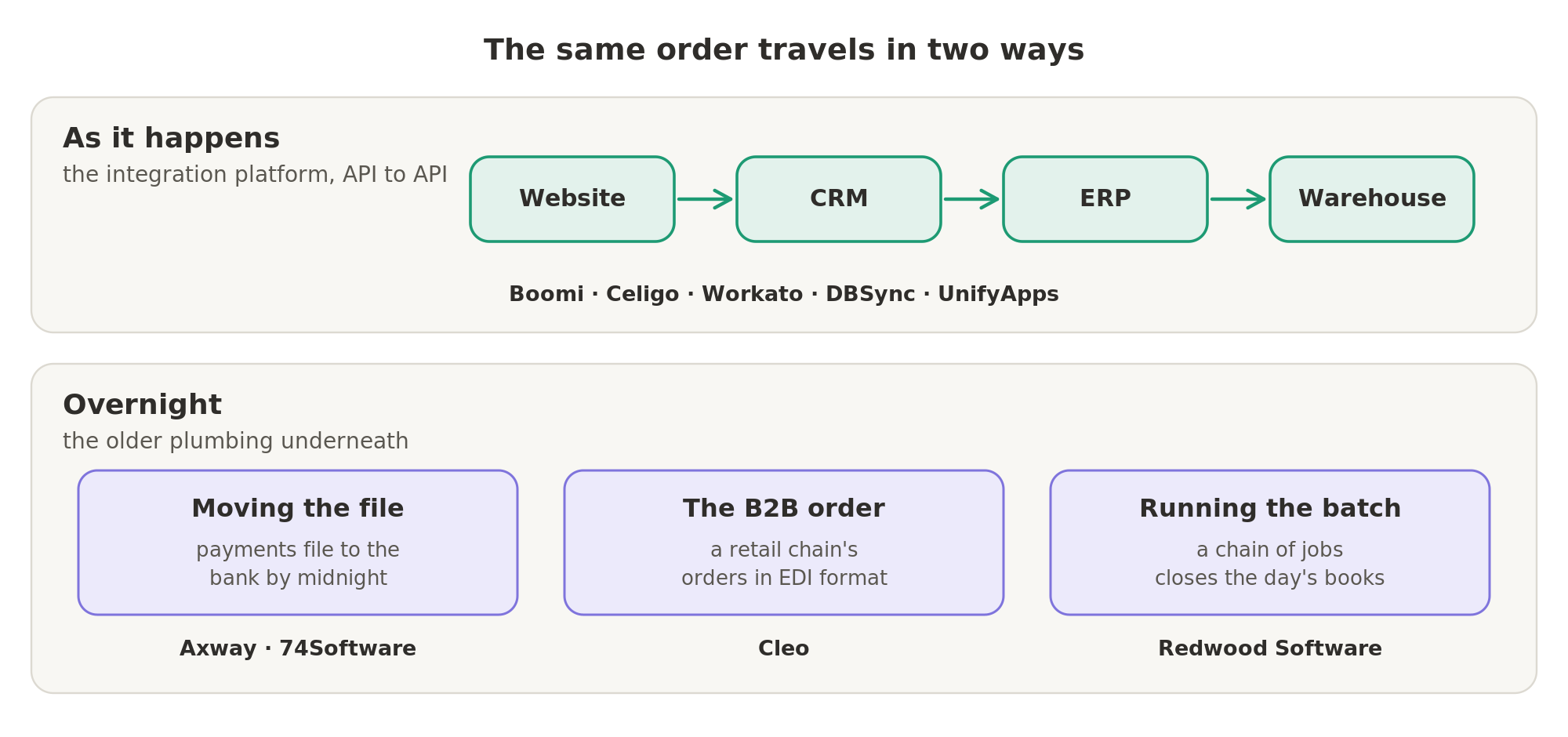 The same order travels in two ways: the integration platform carries it between applications as it happens, and overnight the older plumbing moves the payment file, the retail chain's EDI orders and the batch that closes the books.