Market Segment 1.1 followed a message across the public network run by operators like Jio and Airtel. This Market Segment is about the private networks that every organisation runs for itself.
Walk into an office. Your laptop joins the Wi-Fi, finds the printer, reaches the company's internal tools and gets out to the internet. None of that belongs to Airtel or Jio. Your employer bought the equipment and runs it. So does every bank, hospital, college, factory, hotel and data centre. Enterprise networking is the business of selling them that equipment (switches, routers and Wi-Fi access points) and the software that manages it.
In Market Segment 1.1, the equipment buyers were a handful of telecom operators. Here, they are hundreds of thousands of organisations, from a one-branch clinic to a global bank. So the equipment makers mostly sell through partners. Resellers sell the equipment, and system integrators install it and set it up. A large ring of these firms surrounds every big equipment maker.
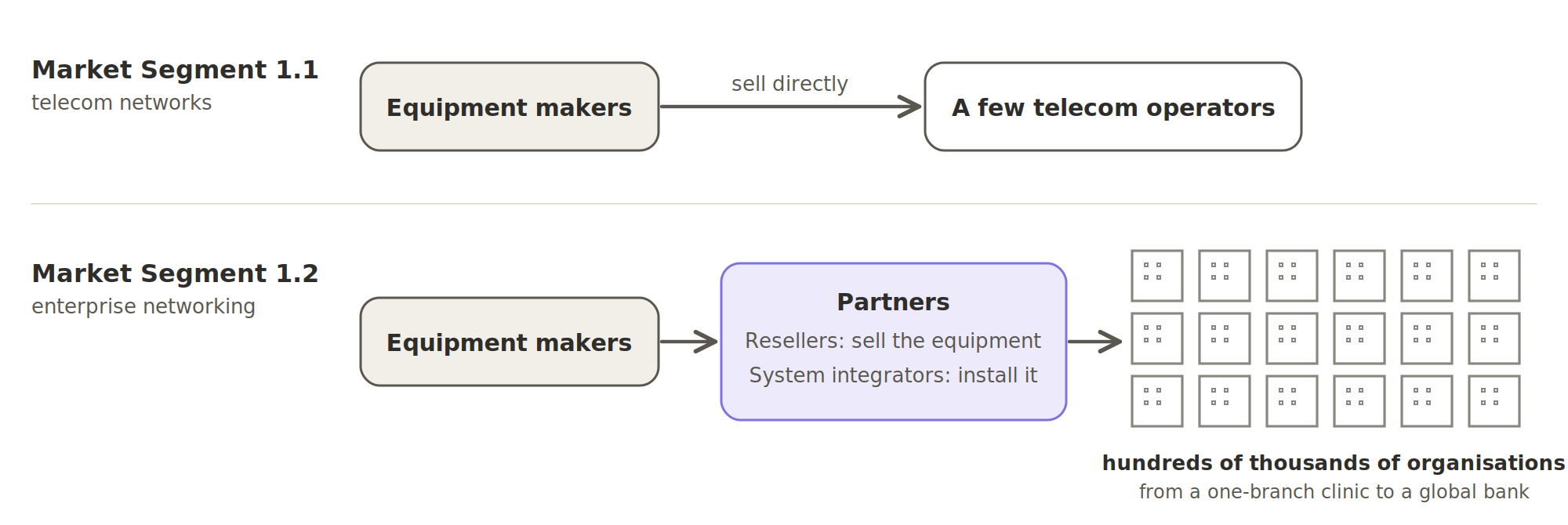 In Market Segment 1.1, equipment makers sell directly to a few telecom operators. In Market Segment 1.2, equipment makers sell through partners (resellers that sell the equipment and system integrators that install it) to hundreds of thousands of organisations, from a one-branch clinic to a global bank.
One company has led this market for thirty years. Cisco is still the default choice. Every other company competes by being better at one thing: the data centre, Wi-Fi, managing the network from the cloud, or price.
Every company named here has posted software engineering jobs in India. Famous companies that don't actively hire software engineers in India are left out.
Follow the same laptop and you meet this Market Segment in order. It has five sub-segments:
The office floor: the Wi-Fi and switches the laptop connects to
Inside the data centre: the high-capacity equipment its requests travel to
The invisible services: the services that give every device a name and an address
The network inside the cloud: networking that runs as software across several clouds
The seam with security: where networking and security meet
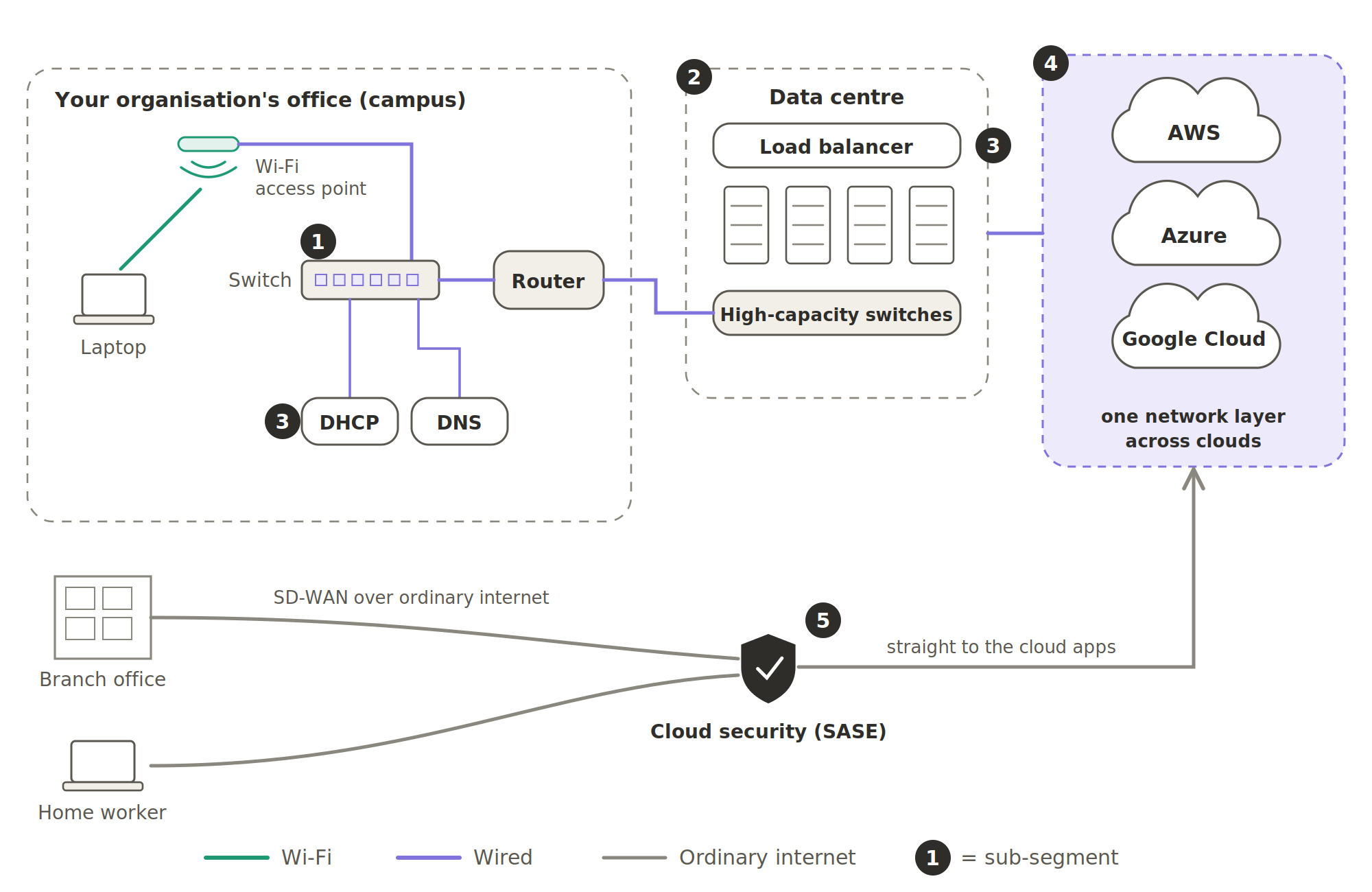 The laptop's journey through this Market Segment. In the office (campus): laptop to Wi-Fi access point to switch to router, with DHCP and DNS alongside. In the data centre: high-capacity switches, servers and a load balancer. Beyond: AWS, Azure and Google Cloud joined by one network layer. Below: a branch office and a home worker reach the cloud apps over ordinary internet through cloud security (SASE). The numbers 1 to 5 match the five sub-segments.
The office floor
Campus and branch networks: switches, routers and Wi-Fi for offices, campuses and branches
The laptop's journey through this Market Segment. In the office (campus): laptop to Wi-Fi access point to switch to router, with DHCP and DNS alongside. In the data centre: high-capacity switches, servers and a load balancer. Beyond: AWS, Azure and Google Cloud joined by one network layer. Below: a branch office and a home worker reach the cloud apps over ordinary internet through cloud security (SASE). The numbers 1 to 5 match the five sub-segments.
The office floor
Campus and branch networks: switches, routers and Wi-Fi for offices, campuses and branches
The laptop's first stop is a Wi-Fi access point on the ceiling. A switch connects that access point to the rest of the office. A router connects the office to the outside world. An organisation's main site is called its campus network. Its smaller offices are called branches.
This is the largest and most familiar part of the market. Every office floor, college campus, hospital ward, shop and hotel lobby runs on it. The equipment itself is mature. What has changed is how it is managed.
Engineers used to set up each device by hand. Now equipment makers sell a cloud dashboard that manages thousands of devices at once. It increasingly spots and fixes problems before anyone notices. When an organisation picks an equipment maker today, the dashboard matters as much as the hardware. This is called cloud-managed networking. It has also changed how buyers pay. They used to pay once for the equipment. Now they also pay every year to use the dashboard and its software, which is called subscription licensing. Some go further and rent everything, the equipment included, as one monthly or yearly bill. This is called network as a service (NaaS).
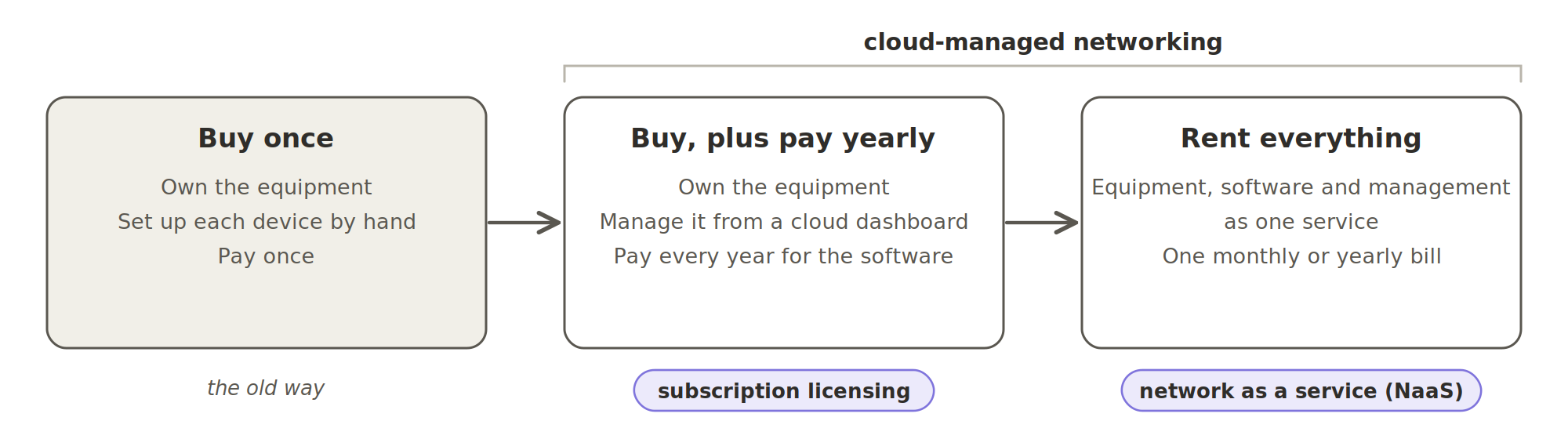 How organisations pay. Buy once: own the equipment, set up each device by hand, pay once. Buy, plus pay yearly: own the equipment, manage it from a cloud dashboard, pay every year for the software (subscription licensing). Rent everything: equipment, software and management as one service and one monthly or yearly bill (network as a service). The last two are both cloud-managed networking.
The main companies:
Ciscoleads. Its Bengaluru campus is one of its largest engineering sites outside the United States.
HPE Arubais the second big name, strongest in Wi-Fi. HPE bought Juniper in 2025, which makes HPE the second-largest supplier in this Market Segment. HPE appears here through these two brands. (More on HPE in Market Segment 3.2, Server and storage hardware, in Industry Vertical 3, Data centres and servers.)
Extreme Networkscompetes on managing networks from the cloud. It is strong in schools, hospitals and stadiums.
RUCKUS Networksspecialises in Wi-Fi and switching for hotels, apartment buildings and public venues.
Cambium Networksserves smaller organisations and internet providers that want cheaper, reliable equipment. (More on it in Market Segment 1.1, Telecom equipment and operators.)
India is a large and fast-growing buyer. The demand comes from new offices and campuses, government digitisation and new data centres. Most of the big equipment makers run engineering centres here. These centres design the equipment and write its software. Very little of it is manufactured in India, and few Indian companies make it. MRO-TEK Networks, a Bengaluru company whose shares are traded on the stock market, is one of the few. It makes modems and routers.
Inside the data centre
Data centre and backbone networking: high-capacity switches and routers, white-box hardware
When the laptop opens an internal app, the request travels to a data centre. Inside, thousands of servers must talk to each other at very high speed. AI training needs enormous amounts of data moved between servers at once. That has made this the fastest-growing sub-segment of this Market Segment.
The largest cloud and AI companies, Google, Microsoft, Amazon and Meta, buy networking at a scale no ordinary buyer can match. They also get prices and terms no one else gets. That has changed who wins.
Arista Networksis the name most tied to this boom. It grew from a small newcomer into a major supplier by selling to these buyers. It does a good part of its software engineering in India.
Cisco and Juniperremain major here too, especially with telecom operators and large enterprises. Juniper's move into HPE in 2025 is the biggest change this market has seen in years.
The very largest buyers go one step further for part of their networks. They buy plain hardware from a manufacturer and run their own software on it. This is called white-box hardware. Several manufacturers make it, many of them in Taiwan. Edgecore Networks is the one in this Market Segment. Everyone else still buys branded equipment from Arista, Cisco and Juniper. So do the giants, for the rest of their networks. The software side of the white-box idea is the fourth sub-segment.
Ethernet for the AI cluster.
An AI cluster links thousands of AI accelerators, the GPUs and other chips that train AI models. Many of these clusters have been networked with InfiniBand, a specialist technology from NVIDIA. Arista, Cisco and the white-box makers want to do the same job with ordinary Ethernet at much higher speeds. Broadcom, which makes the chips inside many Ethernet switches, is on the same side, and NVIDIA now sells Ethernet networking too. This is where most of the growth in this Market Segment is. (More on the chip makers in Market Segment 35.5, Connectivity and wireless chips, in Industry Vertical 35, Semiconductors and chip design.)
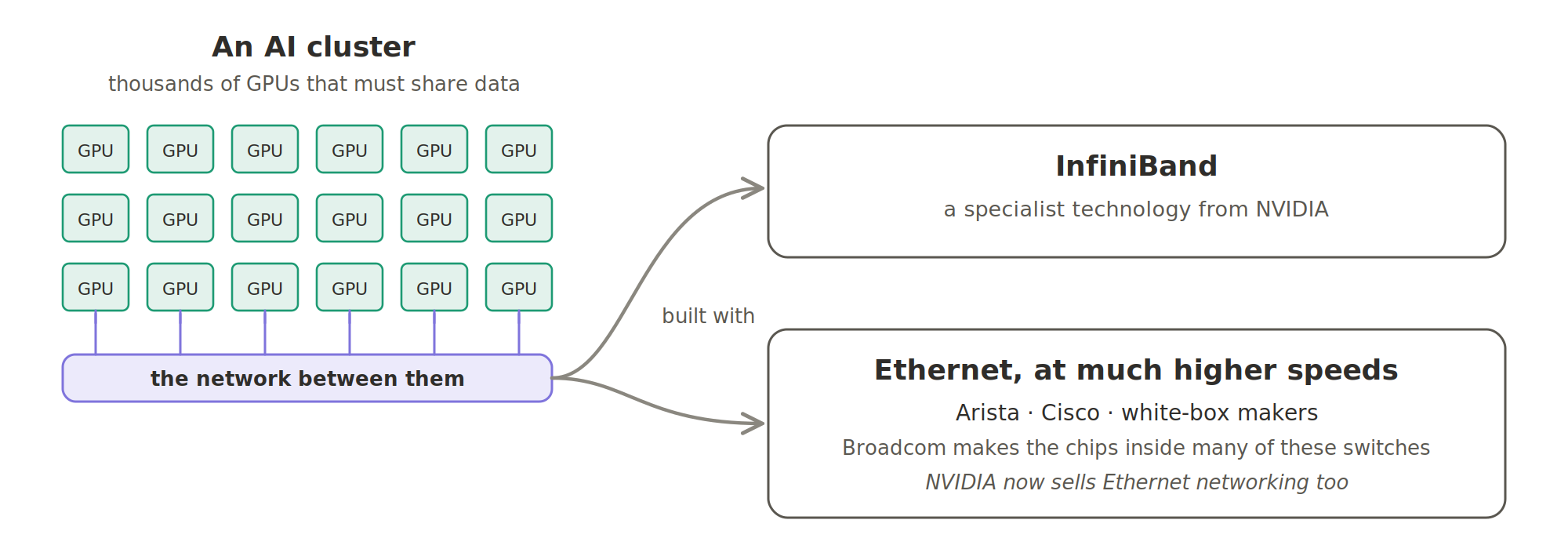 An AI cluster: thousands of GPUs joined by a network. That network has often been built with InfiniBand, a specialist technology from NVIDIA. The alternative is Ethernet at much higher speeds, from Arista, Cisco and the white-box makers, with Broadcom making the chips inside many of these switches. NVIDIA now sells Ethernet networking too.
You're reading as a guest. Sign in free to follow links for five minutes, once an hour.
Sign in
The invisible services
Core network services: DNS, DHCP and application delivery
An AI cluster: thousands of GPUs joined by a network. That network has often been built with InfiniBand, a specialist technology from NVIDIA. The alternative is Ethernet at much higher speeds, from Arista, Cisco and the white-box makers, with Broadcom making the chips inside many of these switches. NVIDIA now sells Ethernet networking too.
You're reading as a guest. Sign in free to follow links for five minutes, once an hour.
Sign in
The invisible services
Core network services: DNS, DHCP and application delivery
Every network depends on a few services nobody sees. When the laptop joins, DHCP gives it an IP address. DNS turns a name like mail.company.com into an IP address. And a load balancer spreads traffic across many servers so that no single server is overloaded. This last job is called application delivery.
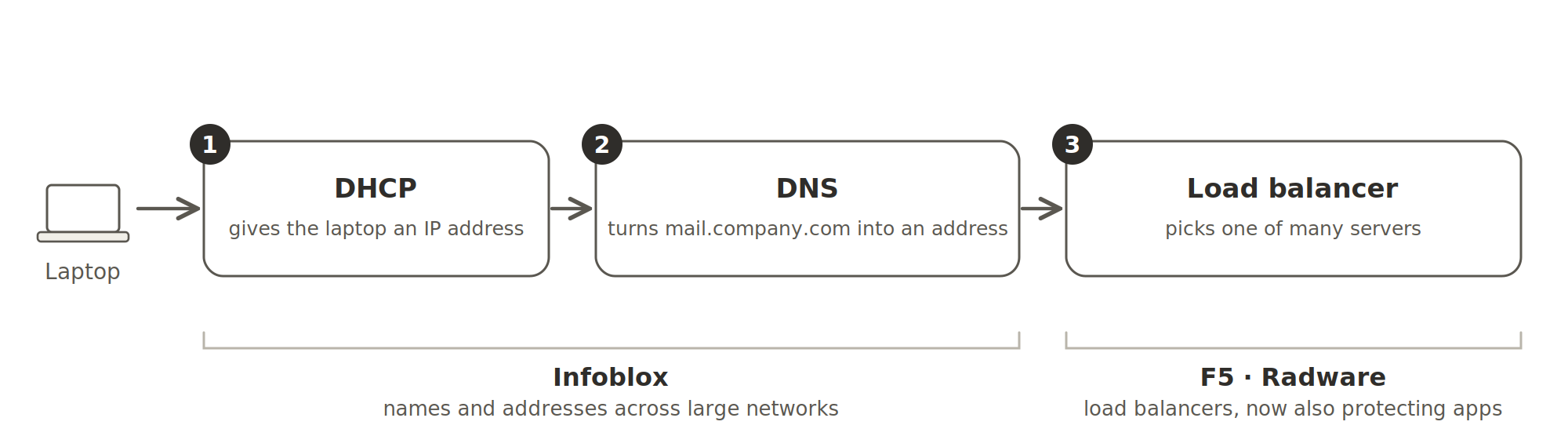 What happens when the laptop joins: 1, DHCP gives the laptop an IP address. 2, DNS turns mail.company.com into an address. 3, a load balancer picks one of many servers. Infoblox handles names and addresses across large networks. F5 and Radware make load balancers and now also protect applications.
Nobody notices these services until they fail. Then everything fails at once. That is why these small niches have long-lived specialists.
Infobloxleads in managing names and addresses across large networks. It has grown into security, because a company that sees every DNS lookup can spot many attacks early.
F5 and Radwaremake load balancers that sit in front of applications and keep them running. Both have grown far into protecting those applications from attack. (More on them in Market Segment 4.5, Network security, firewalls and SASE, in Industry Vertical 4, Cybersecurity.)
The network inside the cloud
Multi-cloud routing, cloud network-as-a-service (networking sold as a subscription), disaggregated network OS (switch software sold separately from the switch)
The apps the laptop uses may now live in several clouds at once. This is the newest sub-segment, and it exists for two reasons.
First, most large organisations now run on more than one cloud, plus their own data centres. A bank might use AWS, Azure and its own data centre. Each one comes with its own networking tools. Connecting all of them securely is harder than it looks.
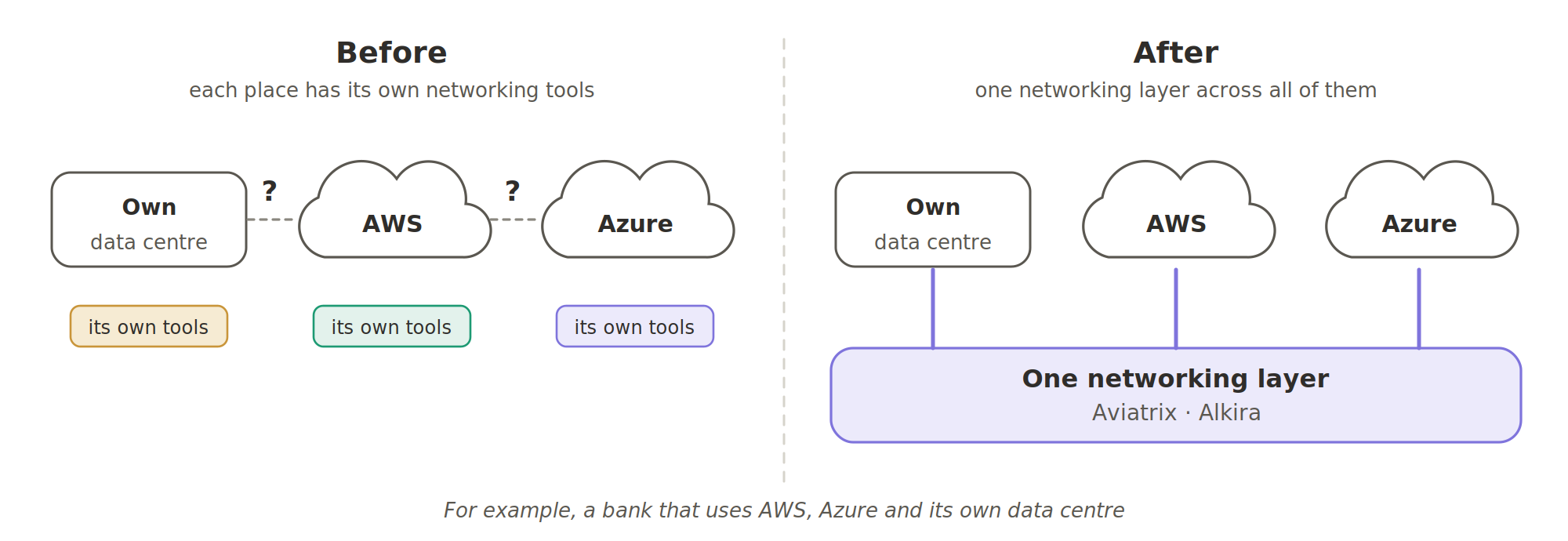 Before: a bank's own data centre, AWS and Azure each have their own networking tools, and connecting them is hard. After: one networking layer from Aviatrix or Alkira runs across all three.
Second, many buyers no longer want a switch's software to come from the company that made the switch. Every switch runs a network operating system, the software that decides where each packet goes. These buyers want to choose it separately.
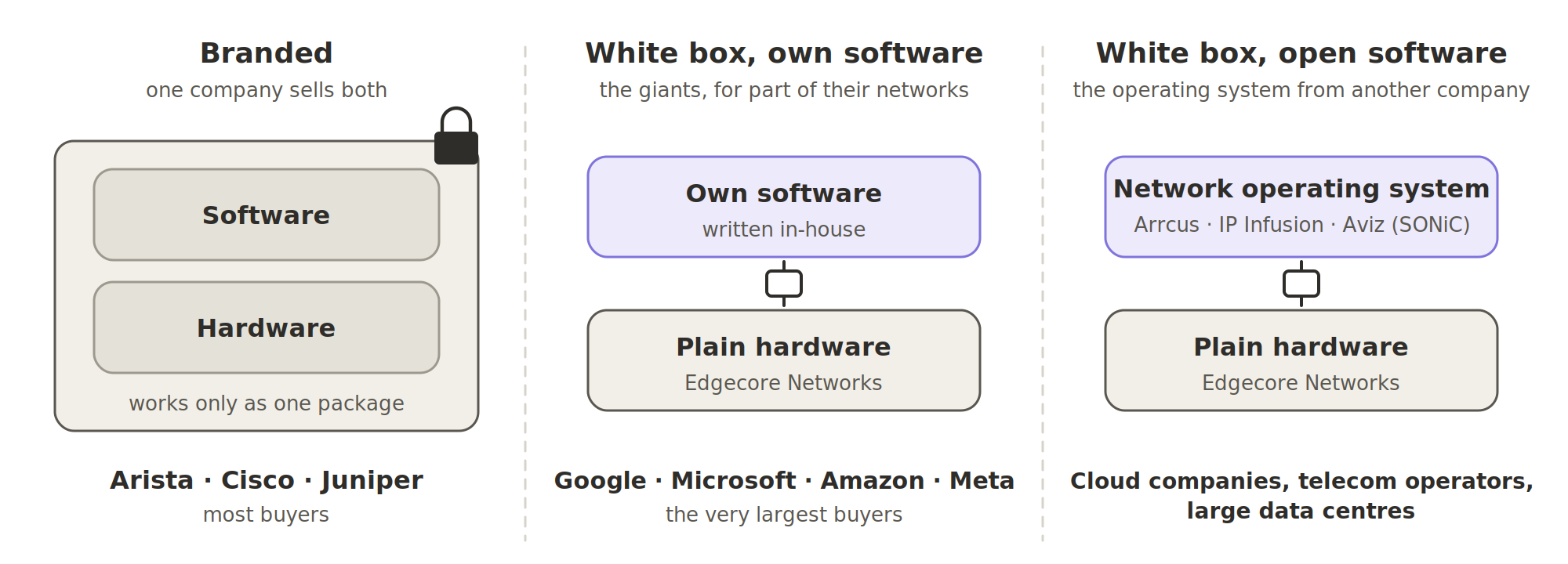 Three ways to buy a switch. Branded: one company sells the hardware and software as one locked package (Arista, Cisco, Juniper), which is what most buyers do. White box with own software: plain hardware from Edgecore Networks running software written in-house, which the very largest buyers do for part of their networks. White box with open software: plain hardware running a network operating system from Arrcus, IP Infusion or Aviz (SONiC), bought by cloud companies, telecom operators and large data centres.
Two kinds of companies meet these needs:
One network across many cloudsAviatrix and Alkira sell a single networking layer that sits across AWS, Azure, Google Cloud and the buyer's own data centres and offices, usually as a subscription. Their buyers are large enterprises that use the cloud heavily.
Switch software, separate from the switchArrcus, IP Infusion and Aviz Networks sell or support the network operating system that runs on white-box hardware, like Edgecore's from the previous sub-segment. Aviz supports SONiC, the open-source network operating system Microsoft wrote for its own data centres and then released to everyone. Their buyers are cloud companies, telecom operators and large data centres. (More on IP Infusion in Market Segment 1.1, Telecom equipment and operators.)
These are younger companies, funded by investors, and far smaller than the big names in the first two sub-segments. They face competition from two sides. Big equipment makers like Cisco are building similar products. And AWS, Azure and Google Cloud keep adding better networking tools of their own, which reduces the need for a separate layer. So this is a live contest, not a settled market.
The switch as a software choice.
Open network operating systems like SONiC are doing to the switch what Open RAN is trying to do to the cell tower (Market Segment 1.1): separating the software from the hardware. Arrcus, IP Infusion and Aviz are the names here. So far, this is mostly happening in the largest data centres. It has not reached the office floor.
The seam with security: SD-WAN and SASE
SD-WAN (software-defined wide area network), SASE (secure access service edge)
The laptop may not even be in the office. This sub-segment is where networking and security meet.
In the old setup, a branch office sent all its traffic to head office first, over expensive private lines. Head office checked it for security and then sent it on to the internet. That made sense when the applications lived at head office. Now staff work from anywhere and the applications live in the cloud. So the network and its security can no longer be handled separately.
Two ideas replace the old setup:
SD-WANconnects branches and remote staff over ordinary internet links, managed centrally by software.
SASEadds security on top, delivered from the cloud. Traffic is checked wherever the user is, without a trip through head office.
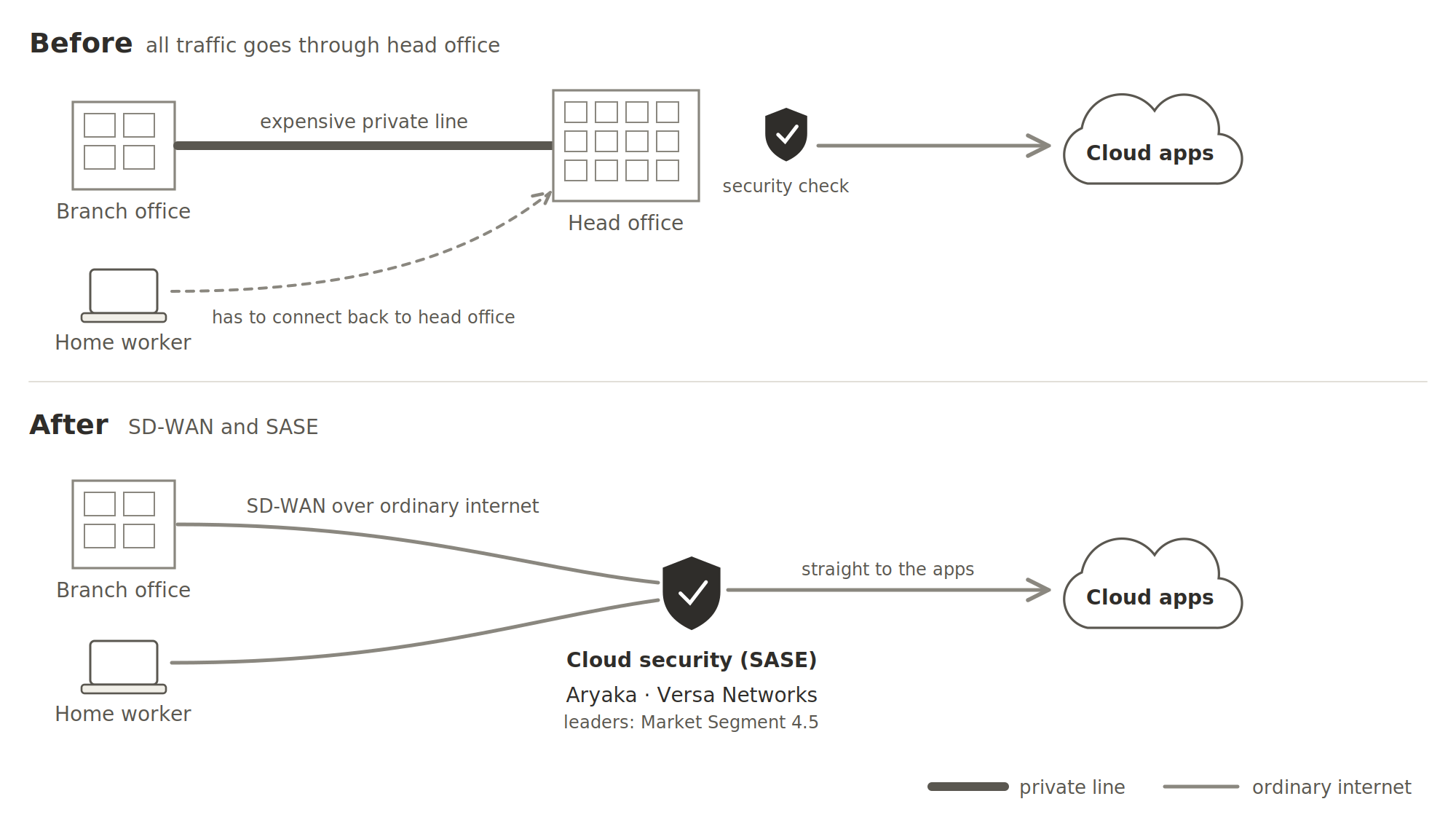 Before: a branch office sends all traffic over an expensive private line to head office, which checks it for security and then sends it on to the cloud apps. A home worker has to connect back to head office. After: the branch office and the home worker go over ordinary internet (SD-WAN) to cloud security (SASE) and then straight to the cloud apps. Aryaka and Versa Networks are named here. The leaders are in Market Segment 4.5, Network security, firewalls and SASE, in Industry Vertical 4, Cybersecurity.
Networking companies and security companies are both fighting for this market. Its leaders, including Zscaler, Palo Alto Networks, Netskope and Fortinet, are covered in Market Segment 4.5, Network security, firewalls and SASE (in Industry Vertical 4, Cybersecurity).
Two SD-WAN and SASE companies appear here:
Aryakadelivers SD-WAN and SASE as a managed service, which means it runs the network for the buyer. It has a large engineering team in India.
Versa Networksis a major SD-WAN and SASE vendor, often sold through telecom operators. (More on it in Market Segment 4.5, Network security, firewalls and SASE, in Industry Vertical 4, Cybersecurity.)
That is the whole private network: the Wi-Fi and switches on the office floor, the high-capacity equipment in the data centre, the services that name and address every device, the software that joins many clouds, and the security wrapped around all of it.