A server is not very different from the laptop you use. It is built from the same basic parts: a processor, memory, a disk to store files, and a network connection. But a server is built to run all day, every day, and to serve many users at once. So it has far more of each part, and it keeps working even when one of them fails. Storage hardware is a kind of specialised server. It is packed mostly with disks, and its software keeps extra copies of the data, so nothing is lost when a disk fails. The industry calls it a storage system.
Every server also has a second, much smaller computer built into its main board, called the baseboard. It has its own network connection, and it is called the baseboard management controller (BMC). Think of it as a caretaker who stays on duty even when the server is switched off or has crashed. It switches the server on, watches its temperature and fans, and lets an administrator reach the server from far away. That matters when the server sits in a data centre hundreds of kilometres from the people who run it.
The companies in this Market Segment make these servers. Much of their engineering in India is software. Some of it is firmware, the software built into the hardware that starts it and controls it. The rest is management software, which lets a company run thousands of servers as if they were one machine. Most of this work happens in Bengaluru and Pune.
This Market Segment has two sub-segments. The first covers the big brands that sell servers to companies of every size. The second covers smaller companies that build AI clusters: thousands of servers wired together to work as one machine for AI. After them comes a supplier of the supporting equipment around the servers, the power and cooling that both sub-segments depend on. The industry calls this data-centre infrastructure, and
Every company named here has posted software engineering jobs in India. Famous companies that don't actively hire software engineers in India are left out.
Keep reading, free
Two more sections are on this page: The server makers and Built for the AI cluster. Sign in to read them here, in full.
Continue with Google- The server makers
- Built for the AI cluster
Most companies buy their servers from a brand, the same way you might buy a laptop. The three biggest server brands in the world are all here:
Two other big server makers are not covered in this Market Segment: Supermicro, one of the largest, especially for AI servers, and Cisco, which also sells servers alongside its networking equipment.
The biggest buyers of all, the hyperscalers from Market Segment 3.1 (such as Amazon, Microsoft and Google), mostly skip these brands. They buy so many servers that it is cheaper to design their own and have them built to order. The manufacturers that build them are called ODMs, short for original design manufacturers. Most are Taiwanese, such as Foxconn, Quanta and Wiwynn. It is the same idea as the white-box switches in Market Segment 1.2. The ODMs are not covered in this Market Segment.
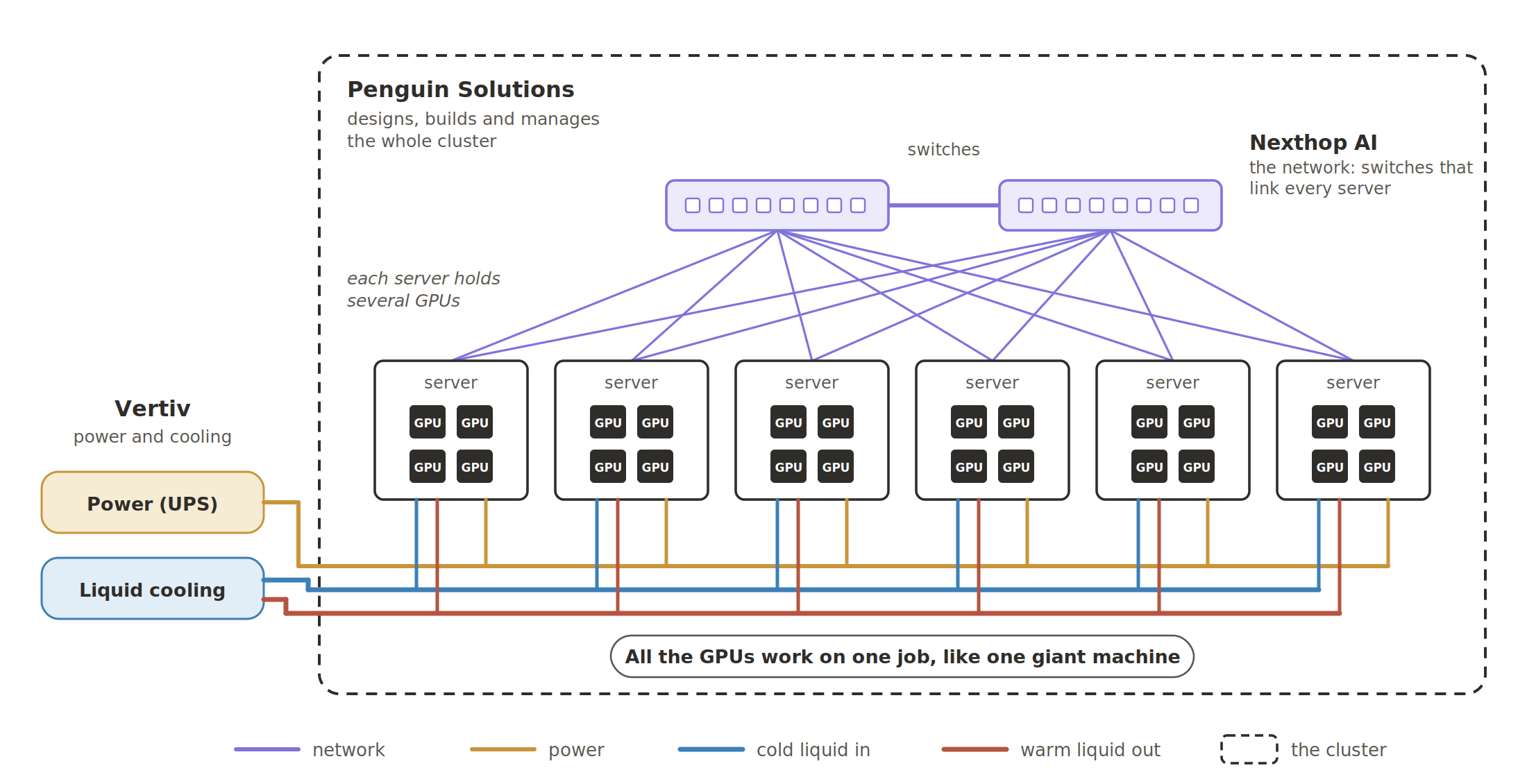
Training an AI model takes thousands of AI accelerators, chips built to do the maths behind AI very fast. The best known are the graphics chips (GPUs) from the Frontier in Market Segment 3.1. Each server in a cluster holds several of them. All of them work on the same job, and linked together they form an AI cluster. The accelerators swap data with each other all the time. So a cluster behaves less like a room of separate servers and more like one giant machine. Such clusters are also used for weather forecasts and scientific simulations. That use is called high-performance computing.
Building a cluster is a different job from selling servers. The hard parts are the network between the servers, the cooling, and the software that shares the work across the whole cluster. Two small companies do this job:
The supporting equipment: power and cooling. Every server in both sub-segments needs steady power and cooling.
Servers used to be sold one box at a time. For AI, the industry now sells whole racks, and even whole rows of racks. They arrive already wired, cooled and networked, ready to switch on. These are called rack-scale systems.
Who these companies hire, and for what, is on What data centres and servers hire for.