ingrid.fyi India's software hiring trends, explained.
Sign in to ingrid.fyi with Google
Your Google account
name@gmail.com
Continue with Google
Home / Product companies / I · Networking, infrastructure and security / Data centres and servers / Data centre and colocation providers
On this page
Data centre and colocation providers The building that houses other companies' servers, with its power, cooling and connections Every app on your phone has two parts. The part you see runs on your phone. The rest, called the backend, manages the data and does the server-side processing. It runs code that carries out the app's business logic, like managing login and security, storing information in a database, and talking to the front end through APIs. A popular app's backend handles millions of requests a day, and it cannot stop when the power goes out or a cable is cut. So it cannot run on an ordinary computer at home or in an office. It runs on powerful servers in special buildings called data centres.

A data centre is a building made for one job: housing thousands of servers and keeping them running. The servers are stacked one above another in racks, tall metal frames that each hold dozens of servers. Many data centres rent out space by the rack, by a locked cage of several racks, or by a whole room. The companies renting it bring their own servers, so the servers of many different apps sit in the same building. The building is connected to many telecom operators by fibre links of high bandwidth, meaning a lot of data can flow at once, and low latency, meaning very little delay. There are several links, so if one is cut, the others keep the traffic flowing. This is called redundancy. The building runs round the clock. It draws a lot of electricity from the grid, and keeps batteries and diesel generators ready to take over the moment the grid fails. All those servers turn electricity into heat, so large air-conditioning systems, and now liquid cooling, stop them from overheating. Guards, cameras and locked cages let many companies share one building without anyone reaching another company's machines. This sharing is called multi-tenancy.
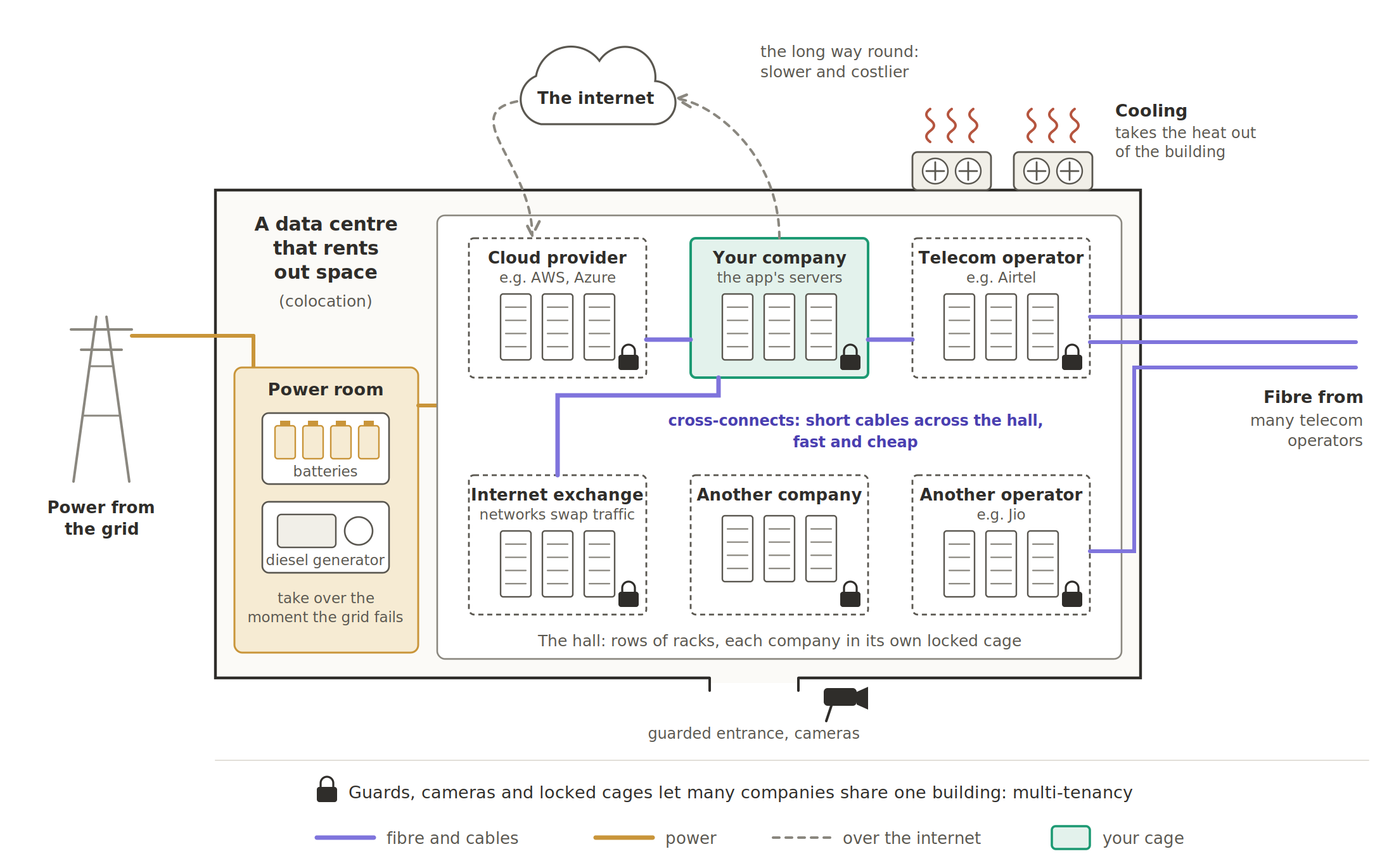
A data centre that rents out space, which is called colocation. Power comes from the grid, with batteries and a diesel generator ready to take over the moment it fails. Cooling units take the heat out. Fibre comes in from many telecom operators. In the hall, each company has its own locked cage of racks. Your company's cage sits next to a cloud provider, telecom operators and an internet exchange, the place where networks swap traffic. Short cables across the hall, called cross-connects, link them quickly and cheaply, instead of the long way round over the internet. The text on Equinix below explains why these neighbours matter. Guards, cameras and locked cages let many companies share one building, which is called multi-tenancy.A data centre that rents out space, which is called colocation. Power comes from the grid, with batteries and a diesel generator ready to take over the moment it fails. Cooling units take the heat out. Fibre comes in from many telecom operators. In the hall, each company has its own locked cage of racks. Your company's cage sits next to a cloud provider, telecom operators and an internet exchange, the place where networks swap traffic. Short cables across the hall, called cross-connects, link them quickly and cheaply, instead of the long way round over the internet. The text on Equinix below explains why these neighbours matter. Guards, cameras and locked cages let many companies share one building, which is called multi-tenancy.

Owning and running a data centre is a business of its own. It is separate from making the servers and equipment inside, which is covered in Market Segment 3.2, Server and storage hardware. It is also separate from renting out computing power, which is the cloud. That is covered in Market Segment 5.1, Cloud infrastructure and web hosting providers (in Industry Vertical 5, Cloud providers and OS makers). This Market Segment is about the building itself.

Keep reading, free

Three more sections are on this page: India's data-centre boom, Renting space in a shared building, and A data centre that travels. Sign in to read them here, in full.

Continue with Google
  • India's data-centre boom
  • Renting space in a shared building
  • A data centre that travels
India's data-centre boom

Data centres in India. India is one of the fastest-growing data-centre markets in the world. Three things drive it:

  • more Indian businesses and apps moving to the cloud
  • rules that require some data, like payment data, to be stored inside India
  • the rush to build computing for AI

Mumbai is the largest hub, partly because many undersea internet cables land there. Chennai, where many cables also land, is another major hub. Hyderabad, Delhi NCR, Pune and Bengaluru are growing fast.

Two kinds of companies build these data centres. Data-centre operators, such as Sify, CtrlS, Yotta, AdaniConneX, STT GDC and NTT's India business, build buildings that other companies rent space in. These operators are not covered in this Market Segment, since most of their engineering jobs are in building and running the data centres, not in software. The biggest cloud companies, called hyperscalers, such as Amazon, Microsoft and Google, also build their own data centres. They are covered elsewhere. (More on them in Amazon, Microsoft and Google, in the big-tech collection.)

This Market Segment covers two companies, each with a different angle: a global operator with an engineering team in India, and a start-up that puts a whole data centre in a shipping container.

Renting space in a shared building

Equinix: renting space next to the right neighbours. Take the app from the start of this Market Segment. The company behind it may own its servers but not want to own a building. So it rents space in someone else's data centre: a rack or a room, with power, cooling and security included. This is called colocation.

Equinixis the world's largest colocation operator, meaning it rents out space, power and cooling in its data centres to other companies. What it really sells is the neighbours. Cloud providers, telecom operators and internet exchanges, the places where networks swap traffic, already have their equipment in Equinix buildings. A cable across the hall to them is faster and cheaper than anything over the internet. The diagram at the start of this Market Segment shows these cables, called cross-connects. In India, Equinix runs data centres in Mumbai and Chennai. Its engineering office is in Bengaluru, where the work is mostly on the software Equinix uses to sell and manage its space.
You're reading as a guest. Sign in free to follow links for five minutes, once an hour. A data centre that travels

Armada: a data centre in a shipping container. Now take a mine, a port, a military base or a factory that is too remote for a fibre link.

Armadabuilds data centres that fit inside a shipping container. It drops them at sites like these, connects them by satellite, and sells the computing inside as a service. It is a young American company with a small team in Bengaluru. What it sells is the building and the computing together: a piece of the cloud, delivered where the cloud cannot normally reach. The building designed around AI.

A rack of AI accelerators, the graphics chips (GPUs) that train and run AI models, uses many times the power of an ordinary rack. It also gives off so much heat that air cannot cool it. It needs liquid cooling, with cold liquid piped right up to the chips. So data centres are being redesigned from the floor up. Operators used to look first for sites near fibre. Now they look first for sites with plenty of electricity. Equinix is the company here going through this change. The cooling and power equipment it buys is covered in Market Segment 3.2, Server and storage hardware, and in Market Segment 37.9, Building technology and HVAC (in Industry Vertical 37, Manufacturing tech). (More on the chips themselves in Market Segment 35.1, Processor and GPU makers, in Industry Vertical 35, Semiconductors and chip design.)
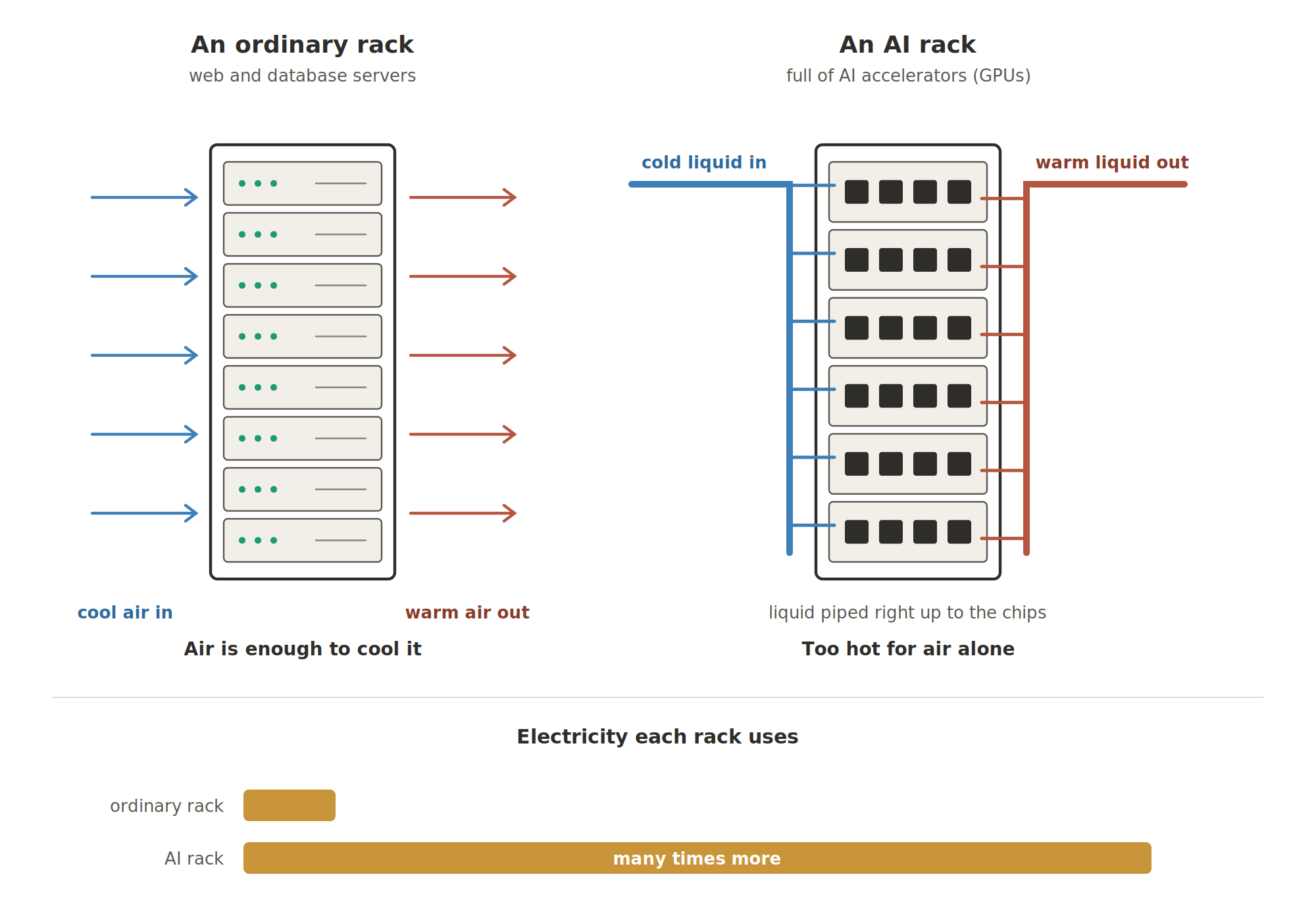
An ordinary rack of web and database servers is cooled by air: cool air in, warm air out. An AI rack full of AI accelerators is too hot for air alone, so cold liquid is piped right up to the chips and warm liquid flows out. The AI rack also uses many times more electricity.An ordinary rack of web and database servers is cooled by air: cool air in, warm air out. An AI rack full of AI accelerators is too hot for air alone, so cold liquid is piped right up to the chips and warm liquid flows out. The AI rack also uses many times more electricity. That is the physical half of the cloud: the buildings that hold the servers, whether a large rented data centre in Mumbai or a container at a remote mine.
Who they hire

Who these companies hire, and for what, is on What data centres and servers hire for.

Privacy Terms Refunds and cancellation Shipping and delivery © 2026 ingrid.fyi · Payments by Razorpay
You're browsing as a guest. Sign in free to follow links for five minutes, once an hour.