Market Segments 1.1 and 1.2 were about the companies that build networks, public and private. This Market Segment is about the companies that watch them.
Say an app suddenly slows down for its users in Chennai. Someone has to find out why. Is it the code, the servers, the cloud, a misconfigured router, or a fibre cut on the highway? A large network is invisible and changes all the time. So the first problem is simply seeing what is happening inside it. A whole industry exists for that.
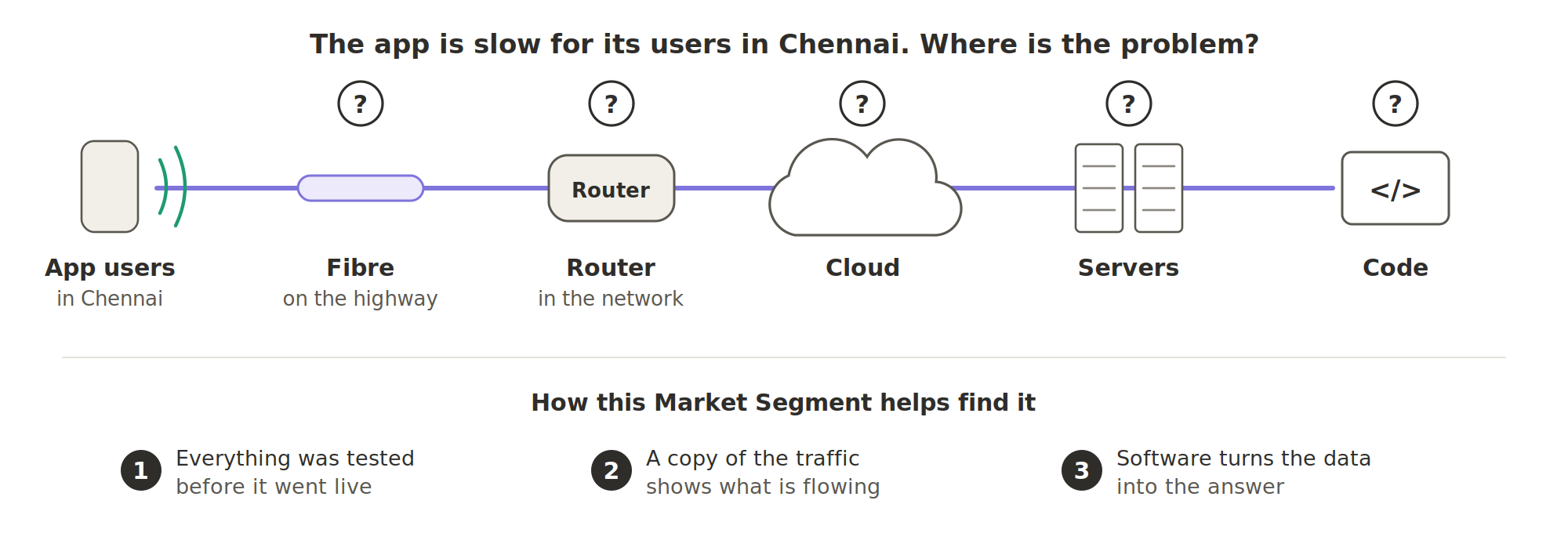 The app is slow for its users in Chennai. Where is the problem? The path runs from the users, over fibre on the highway, through a router, the cloud and the servers, to the code, and any of them could be at fault. This Market Segment helps find it in three ways: everything was tested before it went live, a copy of the traffic shows what is flowing, and software turns the data into the answer.
One rule holds this Market Segment together: these products observe the network without changing it. They measure it, copy its traffic, map it and analyse it. But they never carry the traffic or decide what to do with it. That is what separates them from the equipment makers in Market Segments 1.1 and 1.2. It also separates them from security companies, which block traffic.
Every company named here has posted software engineering jobs in India. Famous companies that don't actively hire software engineers in India are left out.
This Market Segment follows the life of a network, in three sub-segments:
Testing it before it goes live: instruments that measure new equipment and links
Copying the traffic: taking a copy of everything that flows, without slowing it down
Turning the data into answers: software that finds what is wrong, and why
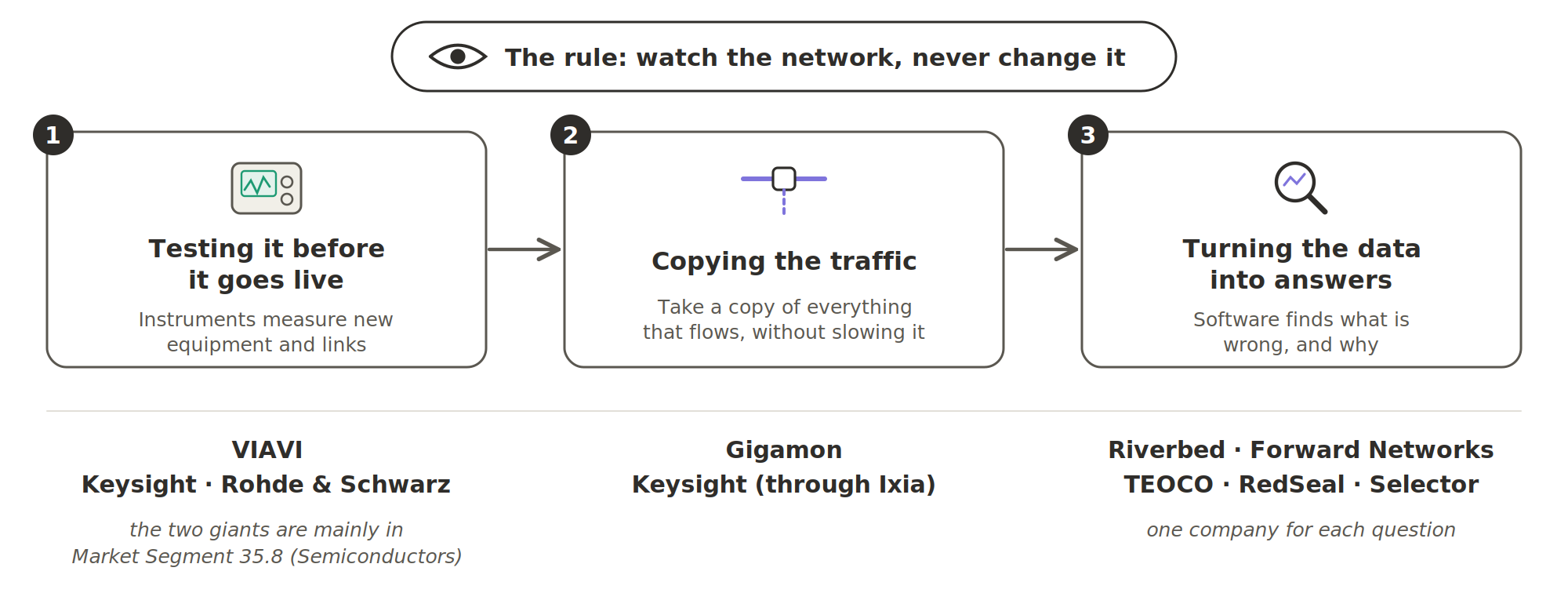 The rule: watch the network, never change it. Three steps. 1, testing it before it goes live: VIAVI, plus Keysight and Rohde & Schwarz, who are mainly in Market Segment 35.8 (Semiconductors). 2, copying the traffic: Gigamon and Keysight (through Ixia). 3, turning the data into answers: Riverbed, Forward Networks, TEOCO, RedSeal and Selector, one company for each question.
Two related areas are covered elsewhere. The largest test and measurement companies are in Market Segment 35.8, Chip manufacturing and test equipment (in Industry Vertical 35, Semiconductors and chip design), because most of what they measure is electronics. Software that watches applications, rather than the network, is called observability. It is in Market Segment 6.3, Observability and monitoring platforms (in Industry Vertical 6, Devtools companies). This Market Segment covers the tools that watch the network itself.
Testing it before it goes live
Test instruments: handheld, lab and in-network instruments for fibre, radio and network equipment
Take the slow app in Chennai from the start of this Market Segment. Long before it launched, every link and device it runs on was tested. Every new fibre link, 5G site or network device is measured before it goes into service. It is measured again whenever something breaks. The engineer uses a purpose-built instrument. Some are handheld, for work in the field. Some sit in a rack in a lab. Some are built permanently into the network. This business is called test and measurement.
It is the oldest and most hardware-heavy part of this Market Segment. Its buyers are telecom operators, the equipment makers from Market Segments 1.1 and 1.2, chip and device makers, and defence. So its demand rises and falls with telecom spending. It rises most when a new generation of mobile technology, like 5G, is being rolled out.
The companies:
VIAVIis the main instrument maker in this Market Segment. It is strongest in fibre and operator networks. It also sells the monitoring software that reads what its instruments measure.
Keysight and Rohde & Schwarzare the two giants of test and measurement. Both are large in mobile network testing. Most of their business is measuring electronics, so they are covered mainly in Market Segment 35.8, Chip manufacturing and test equipment (in Industry Vertical 35, Semiconductors and chip design). Keysight also appears in this Market Segment for its network-testing and traffic-copying businesses.
In 2025, the number of big companies in this industry shrank again. Keysight bought Spirent, the other big network-test company. To get regulators to approve the deal, Keysight sold two of Spirent's businesses to VIAVI: high-speed Ethernet testing and network-security testing. So both Keysight and VIAVI grew that year.
Copying the traffic
Traffic visibility: taps, packet brokers and the copy of the traffic fed to monitoring and security tools
Back to the slow app in Chennai. To find out why it is slow, engineers first need to see the traffic going to it. The same is true for monitoring or securing any network: you first need a copy of what is flowing through it. This is called traffic visibility.
Two devices do this job. A tap copies the traffic off a network link. A packet broker takes those copies and sends each one to the right monitoring or security tool. At data-centre speeds, doing this reliably, without slowing the network down, is a specialist job.
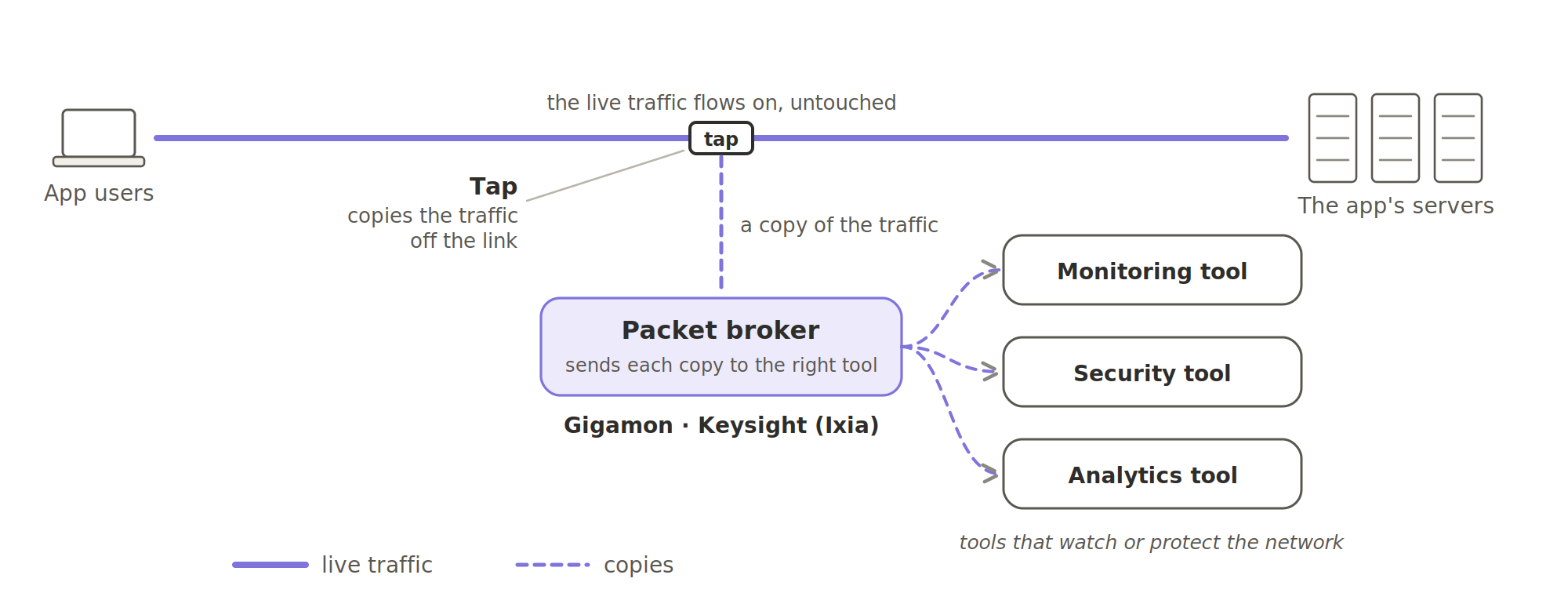 A tap on the link between app users and the app's servers copies the traffic, while the live traffic flows on untouched. The copy goes to a packet broker (Gigamon, Keysight through Ixia), which sends each copy to the right monitoring, security or analytics tool.
Gigamonis the specialist. Copying traffic at high speed and feeding it to monitoring and security tools is its whole business.
Keysightcompetes here too, through Ixia, the traffic-visibility company it bought in 2017.
You're reading as a guest. Sign in free to follow links for five minutes, once an hour.
Sign in
Turning the data into answers
Monitoring, mapping and analytics: performance monitoring, network modelling and verification, operator analytics
A tap on the link between app users and the app's servers copies the traffic, while the live traffic flows on untouched. The copy goes to a packet broker (Gigamon, Keysight through Ixia), which sends each copy to the right monitoring, security or analytics tool.
Gigamonis the specialist. Copying traffic at high speed and feeding it to monitoring and security tools is its whole business.
Keysightcompetes here too, through Ixia, the traffic-visibility company it bought in 2017.
You're reading as a guest. Sign in free to follow links for five minutes, once an hour.
Sign in
Turning the data into answers
Monitoring, mapping and analytics: performance monitoring, network modelling and verification, operator analytics
This is the largest sub-segment, and the one that looks most like ordinary software. A running network produces far more data than any team can read. These companies turn that data into answers to a few questions. For the slow app in Chennai, that question is simple: why is it slow?
Each company here answers one question:
Why is this application slow?Riverbed Technology was once known for speeding up traffic between offices. It now monitors how applications perform for their users.
What will this change do?Forward Networks builds a complete software copy of an organisation's network, called a digital twin. Engineers can search it, and test a change on it before making the change on the real network.
Is the operator's network serving its subscribers well?TEOCO does analytics and service-quality monitoring for telecom operators. Its products watch the operator's network rather than run it, unlike the operator software in Market Segment 1.1.
Where is the network exposed to attack?RedSeal maps a network to show where attackers could get in. It does not block anything itself. (More on it in Market Segment 4.11, Vulnerability management and penetration testing, in Industry Vertical 4, Cybersecurity.)
What is the real cause of all these alarms?Selector uses machine learning to connect warning signals from across a network and point at the likely cause. It has engineers in Bengaluru. (More on it in Market Segment 6.3, Observability and monitoring platforms, in Industry Vertical 6, Devtools companies.)
Several of these companies, including Riverbed and Gigamon, are owned by private investment firms. Their shares are not traded on the stock market. The monitoring market has also seen many companies bought, merged and renamed. So company names and owners change more often than the products themselves.
The network that explains itself.
Two newer ideas are taking hold. The first is the digital twin (Forward Networks): a copy of the network that engineers can query and test like code. The second is AI that reads all the signals at once and names the cause, instead of raising a hundred separate alarms (Selector). Larger monitoring companies are adding the same features to their own products. It is not yet clear whether the young companies or the big established ones will end up leading.
That is how a network is watched: tested before it goes live, its traffic copied while it runs, and that data turned into answers, like why an app in Chennai is slow.