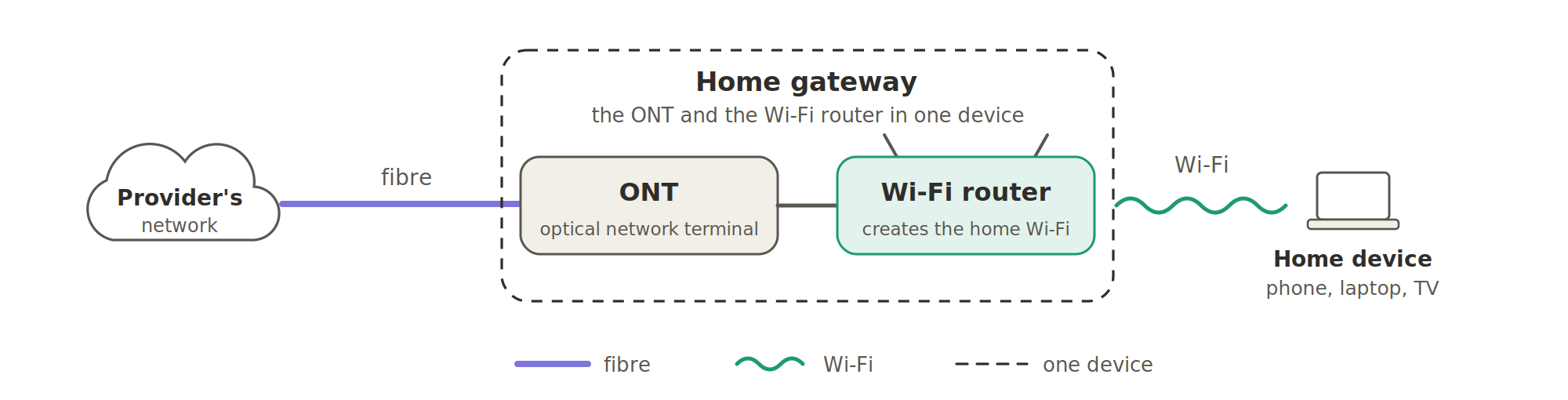
A quick word on names. An internet provider is any company that sells you broadband at home. That includes operators like Jio and Airtel, and smaller local broadband companies. The person paying for the connection at home is the subscriber.
Only a few companies make up this Market Segment. But what they sell matters to internet providers far more than their number suggests. When a subscriber says "the internet is slow", the problem is very often the Wi-Fi inside the house, not the provider's network. And the home is where the subscriber feels the service and decides whether to switch providers.
Every company named here has posted software engineering jobs in India. Famous companies that don't actively hire software engineers in India are left out.
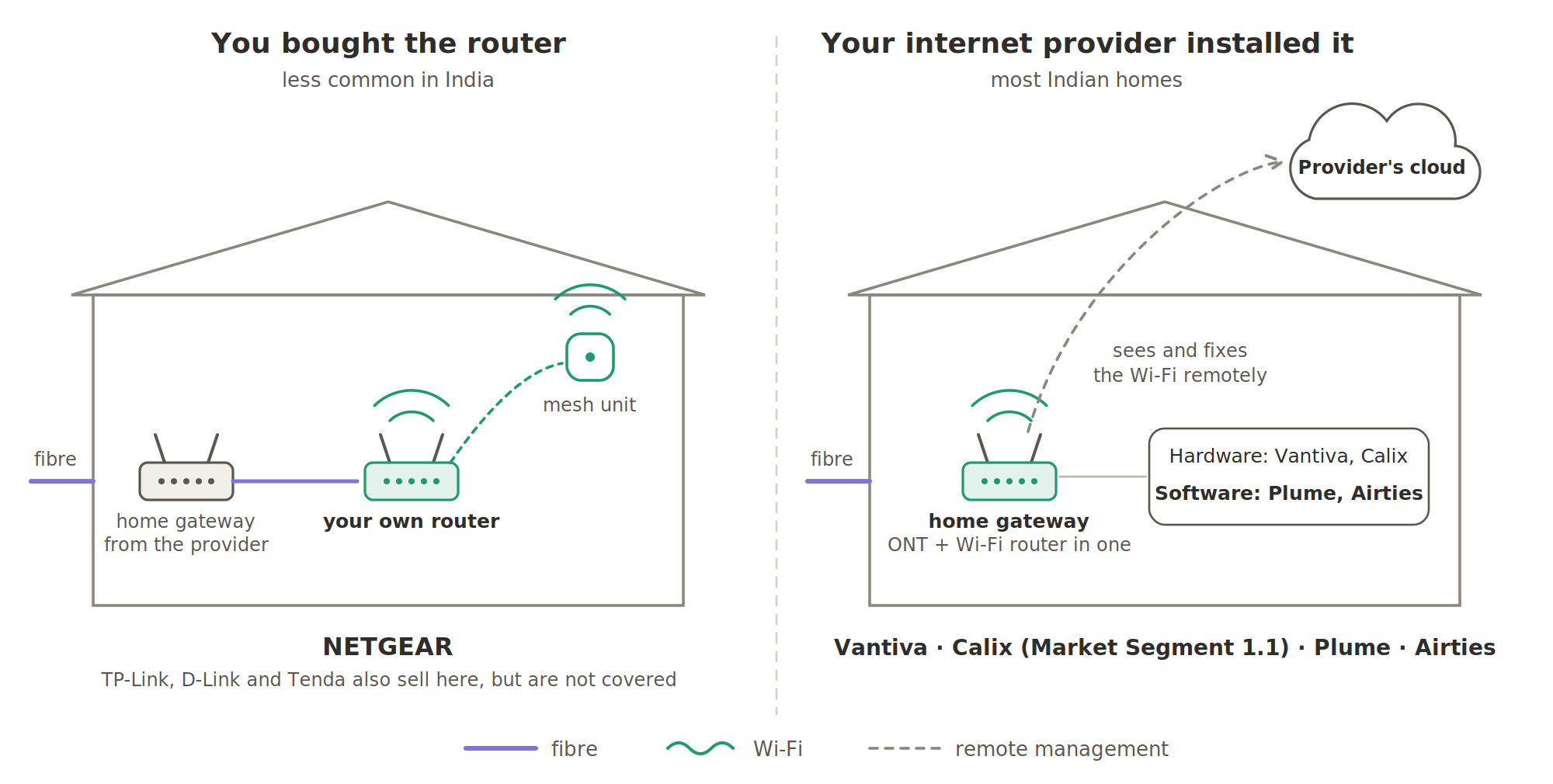
This Market Segment splits along one question: who put the Wi-Fi router in your home, you or your internet provider? It has two sub-segments:
Keep reading, free
Two more sections are on this page: The router you bought and The operator inside your home. Sign in to read them here, in full.
Continue with Google- The router you bought
- The operator inside your home
Take the Wi-Fi that doesn't reach the bedroom, from the start of this Market Segment. One fix is to buy your own equipment. That could be a stronger router, or a mesh Wi-Fi system: several small units placed around the home that work together as one network.
When people buy their own router, in a shop or online, this is a consumer-electronics business. Brands compete on speed, range and price. Most of the units are made by large Asian manufacturers that earn very little on each one sold.
TP-Link, D-Link and Tenda also sell routers in India. But they don't actively hire software engineers here, so they are not covered.
In India, buying your own router is less common. Most homes use the home gateway Jio or Airtel installed, and never buy a router of their own. Those home gateways are made by companies like Vantiva and Calix.
Back to the Wi-Fi that doesn't reach the bedroom. When that subscriber calls to complain, it costs the internet provider money. One support call can cost more than the subscriber pays for a month. And most of these calls are about the Wi-Fi inside the house, not the provider's network.
So internet providers want to see and manage the Wi-Fi inside their subscribers' homes. That created a market for software the provider loads onto the home gateway and runs from the cloud. The software:
- maps how far the Wi-Fi reaches in each room
- moves devices between the 2.4 GHz and 5 GHz bands to keep them well connected
- fixes problems before the subscriber calls
- gives the provider extra services to sell, like parental controls, security and a guest network
This is where the two sub-segments connect. The home gateway in most Indian homes is made by a hardware company like Vantiva or Calix. The software running on it can come from a different company.
Both sell software that runs on a device made by another company. Their business is the software, not the hardware. In this Market Segment, more and more of the value is moving from the device to the software on it.
Wi-Fi 7, the newest Wi-Fi standard, is arriving in new routers. But the bigger change is the internet provider treating the whole home as one service it runs remotely: its Wi-Fi coverage, its devices and its security.
Who these companies hire, and for what, is on What networking and telecom hires for.