Market Segments 1.1 to 1.4 all assumed a network nearby: a tower, a fibre cable, an office Wi-Fi. This Market Segment is about connecting things where there is no such network. Think of four places:
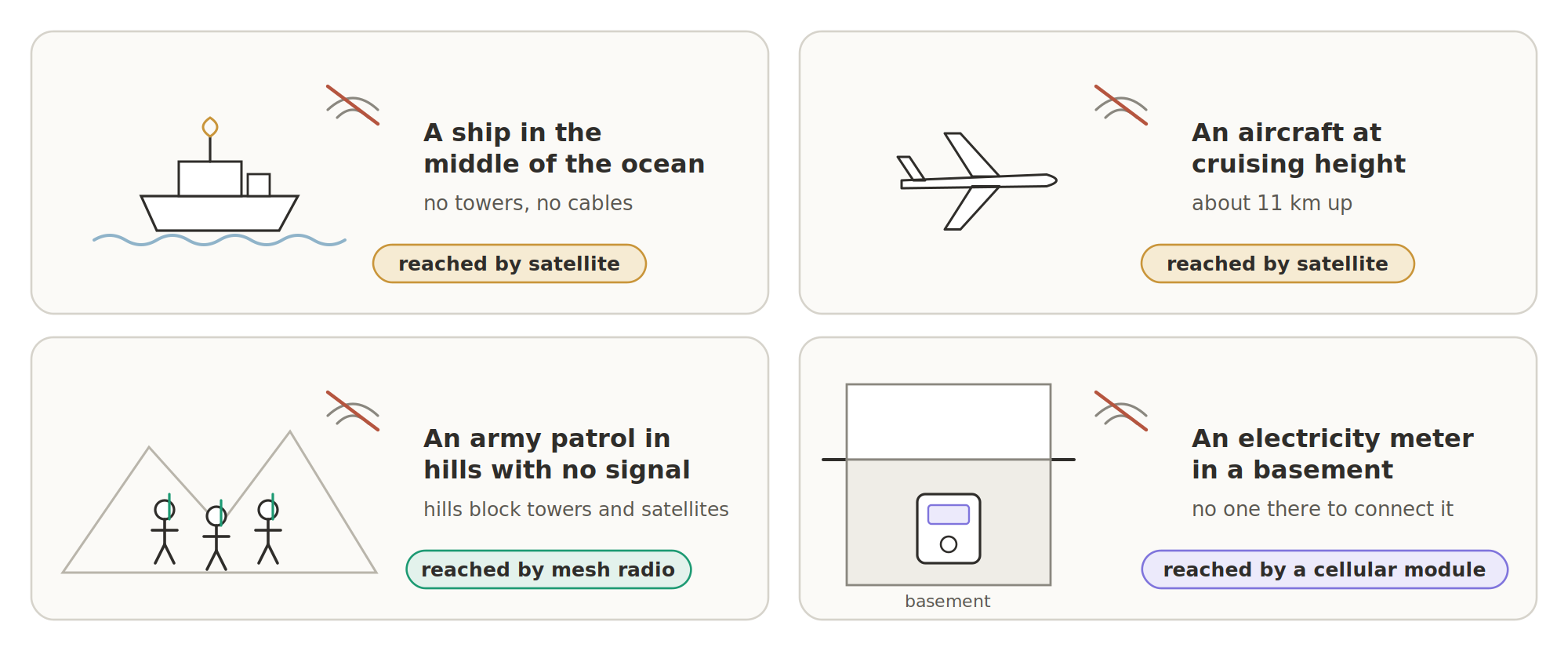 Four places with no nearby network. A ship in the middle of the ocean, with no towers or cables, reached by satellite. An aircraft at cruising height, about 11 km up, reached by satellite. An army patrol in hills with no signal, where hills block towers and satellites, reached by mesh radio. An electricity meter in a basement, with no one there to connect it, reached by a cellular module.
The companies here use three separate technologies, each suited to different places. They are not steps of one system:
Satellitesfor the ship and the aircraft.
Mesh radiosfor the patrol.
Cellular modulesfor the meter.
They sometimes work together, like a device's module that can also reach a satellite. But each is its own business.
In Market Segment 1.1, "radio" meant the wireless link between a phone and a tower. Here, a radio is a device that sends and receives those signals, like a rugged walkie-talkie. Normally, every phone talks to a tower. Mesh radios skip the tower. They talk to each other directly, and each one passes messages on for the others. So a group of them forms its own network.
For decades, satellite internet was slow, expensive and used only where nothing else worked. Large groups of satellites in low orbit, called constellations, have changed that in recent years. India also opened its space sector to private companies around 2020. So much of this Market Segment, both global and Indian, is new.
Every company named here has posted software engineering jobs in India. Famous companies that don't actively hire software engineers in India are left out. Starlink, Eutelsat OneWeb and Jio-SES hold licences to sell satellite broadband in India. But they don't post software engineering jobs in India under their own names, so they are not covered.
This Market Segment has three sub-segments:
Connectivity from space: satellites that reach ships, aircraft and, now, ordinary phones
Radios that make their own network: two-way radios that pass messages to each other, so a group of them works as a network with no tower
The modules inside connected devices: cellular modules, the small circuit boards that connect machines to the mobile network
Connectivity from space
Satellite operators, direct-to-device (phones that connect straight to a satellite), in-flight connectivity, and the Indian start-ups building satellite communication systems
Take the ship and the aircraft from the start of this Market Segment. Only a satellite can reach them.
Two kinds of satellite matter here. A geostationary satellite sits very far from Earth, about 36,000 km up, more than 3,000 times higher than a plane. It stays over one spot. A few of them can cover most of the planet, but the signal takes longer to make the trip. A low-orbit satellite is much closer, typically between 160 and 2,000 km up. Many fly at around 500 to 600 km, about 50 times higher than a passenger plane, which cruises at about 11 km. Low-orbit satellites move fast across the sky. So you need hundreds or thousands of them working together, as a constellation. In return, the signal is much quicker.
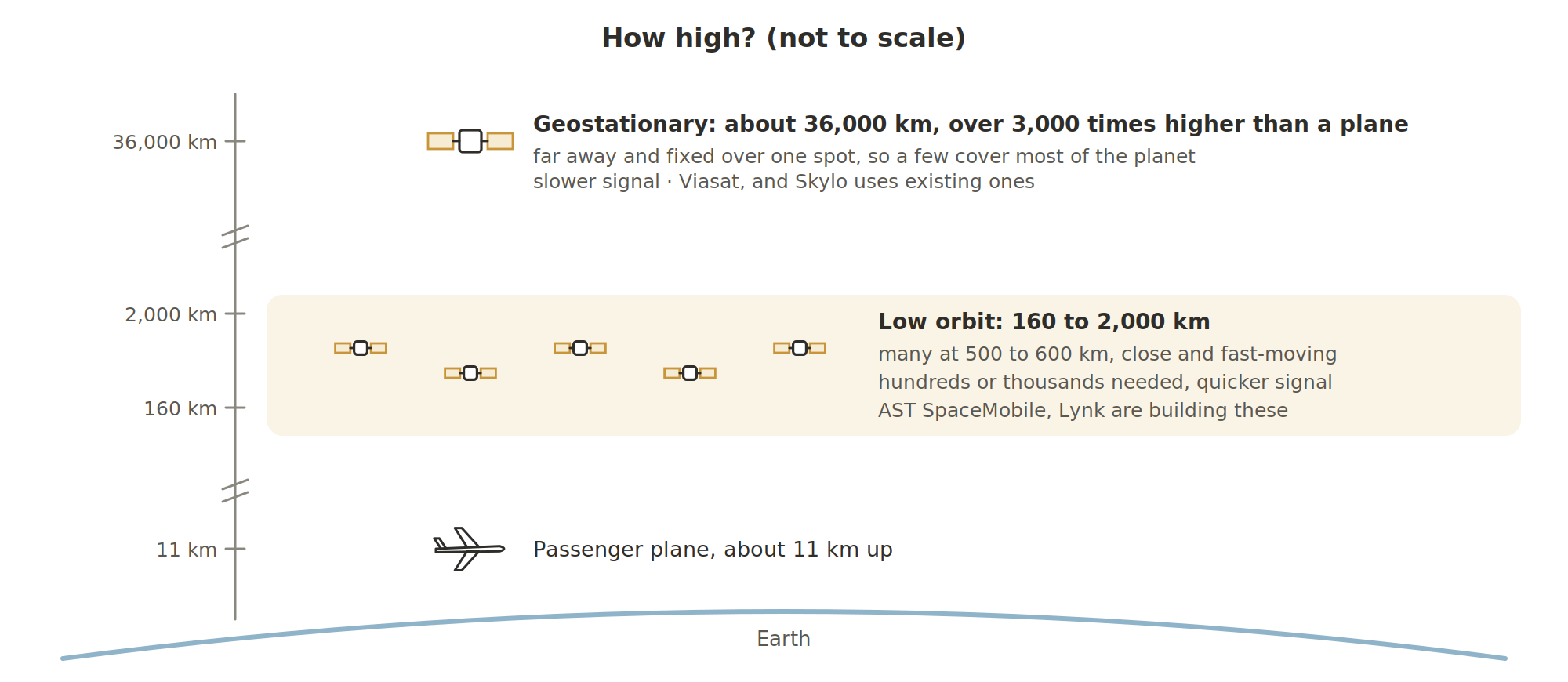 How high satellites fly, not to scale. A passenger plane cruises at about 11 km. Low-orbit satellites fly between 160 and 2,000 km, many at 500 to 600 km: close and fast-moving, so hundreds or thousands are needed, with a quicker signal; AST SpaceMobile and Lynk are building these. Geostationary satellites sit at about 36,000 km, over 3,000 times higher than a plane: fixed over one spot, so a few cover most of the planet, with a slower signal; Viasat operates them and Skylo uses existing ones.
The established business. Long before phones could reach space, ships, airlines, governments and armies paid for connectivity that worked anywhere.
Viasatis the satellite operator that sells it. It became much bigger after buying Inmarsat in 2023. Its teams in Chennai and Hyderabad work on the modems and terminals at the customer's end: the equipment on a ship or aircraft that talks to the satellite. They also work on tactical radios, the rugged radios armies use, which the same customers buy. (More on Viasat in Market Segment 39.2, Drones and defence tech, in Industry Vertical 39, Aerospace, defence and space.)
Panasonic Avionicsputs the screens and the Wi-Fi into aircraft cabins. The part of its business that belongs here is the satellite antenna on top of the aircraft, which can connect to satellites in different orbits. Its team is in Pune. (More on it in Market Segment 39.1, Aircraft and aerospace systems makers, in Industry Vertical 39, Aerospace, defence and space.)
The newest idea: phones that reach a satellite. An ordinary smartphone, with no special antenna, can now reach a satellite when there is no tower in range. This is called direct-to-device. It began as an emergency button: several phones can already send an SOS by satellite. It is moving toward ordinary texting, then calls and data. The satellite companies don't compete with mobile operators or replace them. They sell the service through the operators. It fills the gaps where an operator has no towers. And the service usually carries the operator's name on your phone, not the satellite company's.
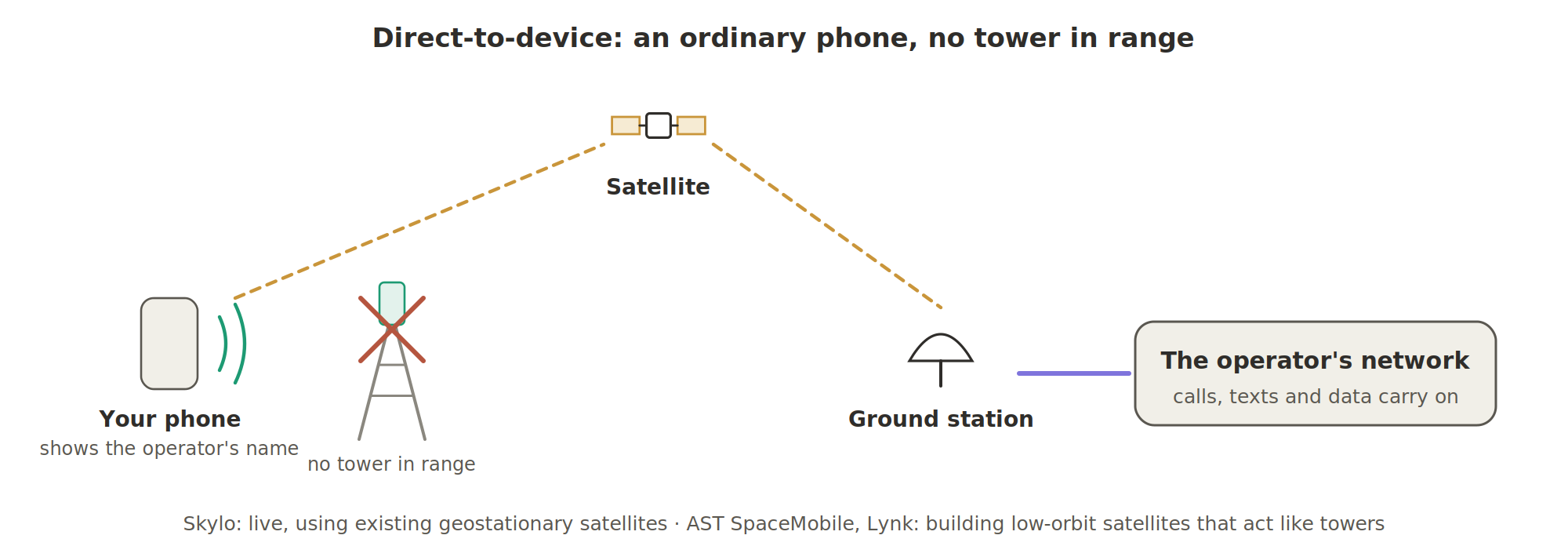 Direct-to-device: an ordinary phone with no tower in range connects to a satellite, which relays to a ground station and on to the operator's network, so calls, texts and data carry on. The phone shows the operator's name. Skylo is live using existing geostationary satellites; AST SpaceMobile and Lynk are building low-orbit satellites that act like towers.
Skylois already live. It uses existing geostationary satellites and standard phone chips to carry messages for phones and connected devices. It powers the satellite SOS on several phones, and does a large share of its engineering from Bengaluru.
AST SpaceMobilewith a team in Hyderabad, and Lynk, in Chennai, are building their own low-orbit constellations for the same job. Their satellites act like mobile towers in space. Both are at an early stage.
Direct-to-device: an ordinary phone with no tower in range connects to a satellite, which relays to a ground station and on to the operator's network, so calls, texts and data carry on. The phone shows the operator's name. Skylo is live using existing geostationary satellites; AST SpaceMobile and Lynk are building low-orbit satellites that act like towers.
Skylois already live. It uses existing geostationary satellites and standard phone chips to carry messages for phones and connected devices. It powers the satellite SOS on several phones, and does a large share of its engineering from Bengaluru.
AST SpaceMobilewith a team in Hyderabad, and Lynk, in Chennai, are building their own low-orbit constellations for the same job. Their satellites act like mobile towers in space. Both are at an early stage.
India's own start-ups. A wave of Indian companies has formed since the space sector opened.
Astrogate Labsin Bengaluru, builds laser communication terminals for small satellites, and the ground stations that receive their light signals. Lasers can carry far more data than radio signals. That matters once a constellation carries a lot of traffic.
Satlabs Space Systemsin Chennai, is building a network of small satellites that relay data. The equipment each satellite carries can be changed by updating its software. Customers reach the whole network through one API.
Astromeanother Indian start-up, makes high-capacity wireless links that connect mobile towers back to the network. (More on it in Market Segment 1.1, Telecom equipment and operators.)
The phone that reaches a satellite, and light instead of radio.
Satellite SOS on phones has been available since 2022. Skylo is live, while AST SpaceMobile and Lynk are still launching their satellites. Next, the new constellations will use laser links between satellites. These let them pass traffic across space without sending it down to the ground and back up. Astrogate is the Indian name working on this.
Radios that make their own network
Tactical and mesh radios for defence, drones and places without towers
Here, a radio means a two-way communication device, like a rugged walkie-talkie, not FM radio.
Take the army patrol from the start of this Market Segment. It needs communication that keeps working with no satellite and no tower at all. The hills may block both. And an enemy may be trying to jam the signal, which means drowning it out with noise.
The answer is the mesh radio. Every radio passes messages on for the others. So a patrol, a convoy or a swarm of drones carries its own network with it. The network reshapes itself as they move.
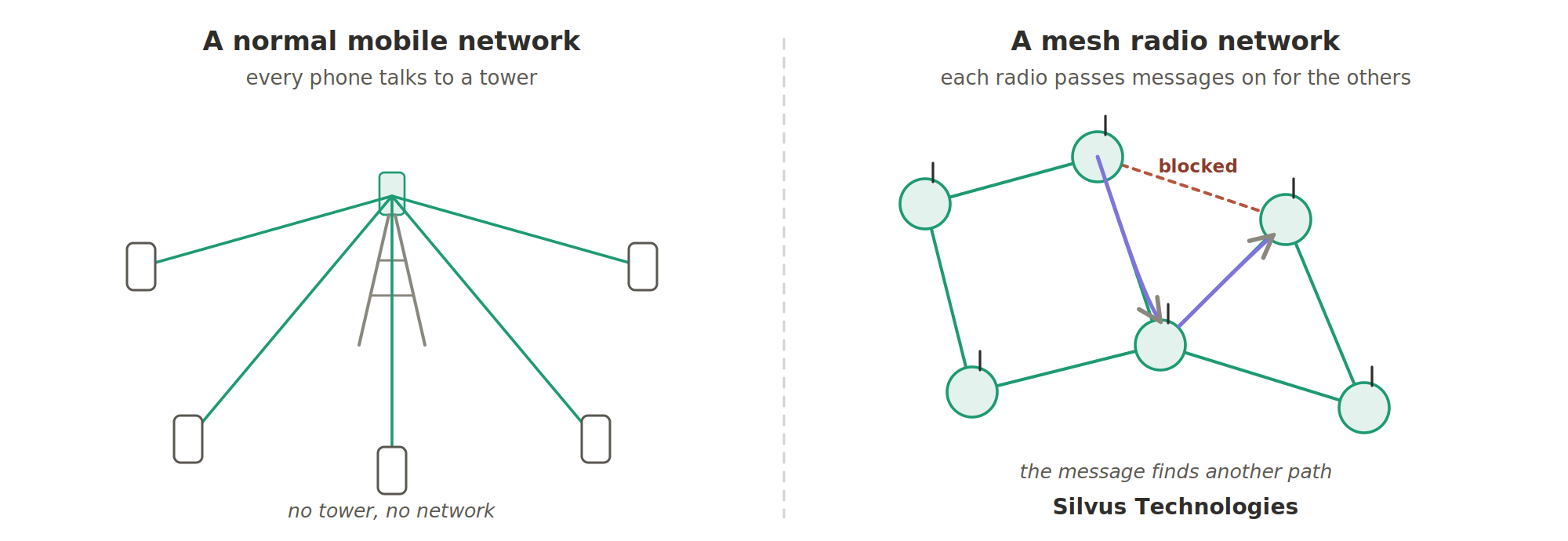 Left, a normal mobile network: every phone talks to a tower, and with no tower there is no network. Right, a mesh radio network: each radio passes messages on for the others, so when one link is blocked the message finds another path. Silvus Technologies makes these radios.
Silvus Technologiesmakes these radios. They are software-defined: much of how the radio works is set by software, not fixed in hardware. They use many antennas at once to push a signal through where a single antenna would fail. Silvus has an engineering team in Bengaluru. Demand has grown fast with the use of drones in war, and Motorola Solutions bought Silvus in 2025. (More on Silvus in Market Segment 39.2, Drones and defence tech, in Industry Vertical 39, Aerospace, defence and space.)
You're reading as a guest. Sign in free to follow links for five minutes, once an hour.
Sign in
The modules inside connected devices
The cellular and IoT modules that put a device on the mobile network
Left, a normal mobile network: every phone talks to a tower, and with no tower there is no network. Right, a mesh radio network: each radio passes messages on for the others, so when one link is blocked the message finds another path. Silvus Technologies makes these radios.
Silvus Technologiesmakes these radios. They are software-defined: much of how the radio works is set by software, not fixed in hardware. They use many antennas at once to push a signal through where a single antenna would fail. Silvus has an engineering team in Bengaluru. Demand has grown fast with the use of drones in war, and Motorola Solutions bought Silvus in 2025. (More on Silvus in Market Segment 39.2, Drones and defence tech, in Industry Vertical 39, Aerospace, defence and space.)
You're reading as a guest. Sign in free to follow links for five minutes, once an hour.
Sign in
The modules inside connected devices
The cellular and IoT modules that put a device on the mobile network
Take the electricity meter in the basement from the start of this Market Segment. Every connected meter, car, tracker and card machine contains a small radio module. It lets the device connect to a mobile network, the same way your phone does. These are called cellular or IoT (Internet of Things) modules.
Hundreds of millions of them are made every year. It is a high-volume business where makers earn very little on each module, and Chinese suppliers lead it.
Quectel Wireless Solutionsone of the largest Chinese module makers, is the one in this Market Segment. It has teams in Pune and Bengaluru.
That is how networks reach where towers and cables can't: satellites for the ship and the aircraft, mesh radios for the patrol, and modules for the meter in the basement.