Drones now film Indian weddings. They also survey fields and pipelines, inspect bridges and deliver parcels. On battlefields, they watch the enemy and strike targets. A drone is an aircraft with no pilot on board. It is flown from the ground, or flies itself.
What a drone system is made of
The drone itselfthe frame, motors, battery and a small flight computer. Some drones have rotors, like a small helicopter, and can hover. Others have fixed wings, like a plane, and fly farther.
The payloadwhat the drone carries to do its job, such as a camera, a sensor, or a parcel. On a military drone it may be a weapon.
The ground control stationthe screen and controls from which an operator plans and watches a flight.
The data linkthe radio connection between the drone and the ground.
The softwarethe autopilot, the mission planning, and the tools for running many drones at once.
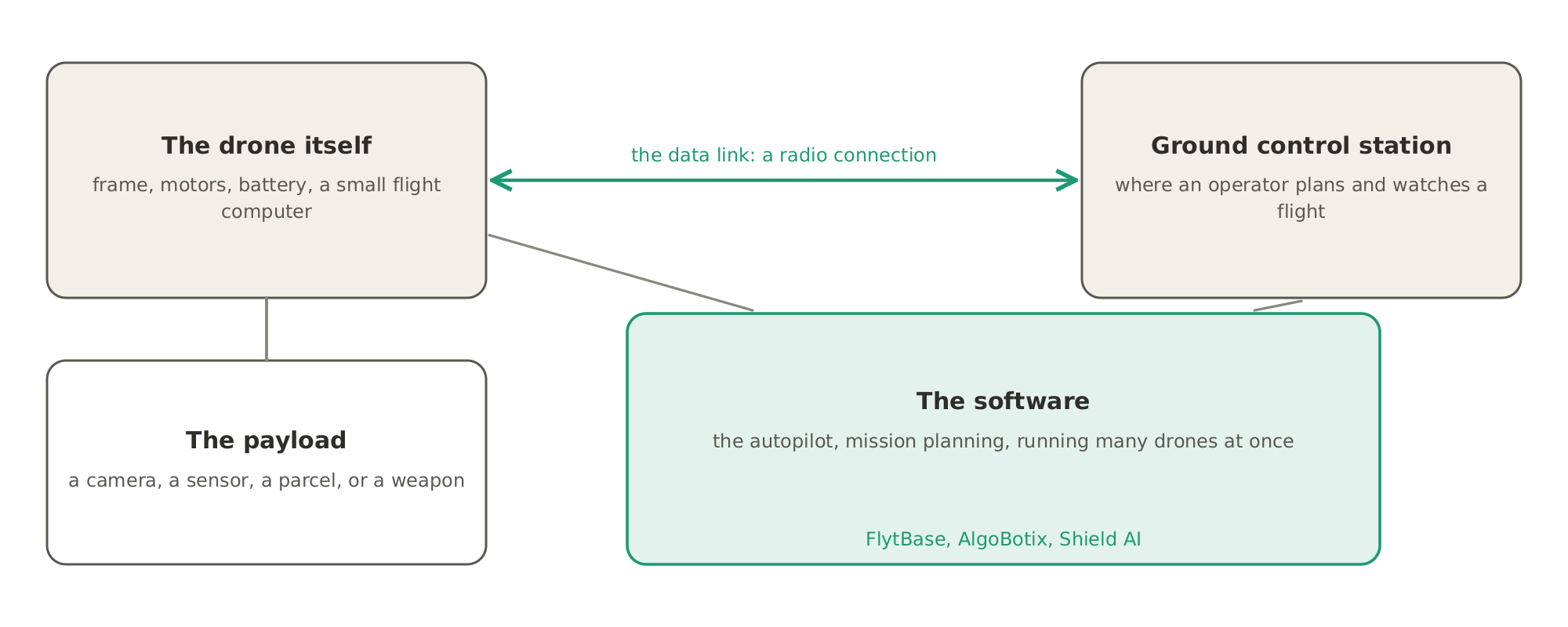 What a drone system is made of: the drone itself and its payload, a ground control station linked to it by radio, and the software that flies it, plans its mission and runs many drones at once.
From remote control to autonomy. At first, a person flew each drone by remote control. Then drones learned to follow a planned route by GPS. Now they are becoming autonomous: they fly, find their way and work together without a pilot, even when GPS is jammed. A group of drones that coordinate with each other is called a swarm.
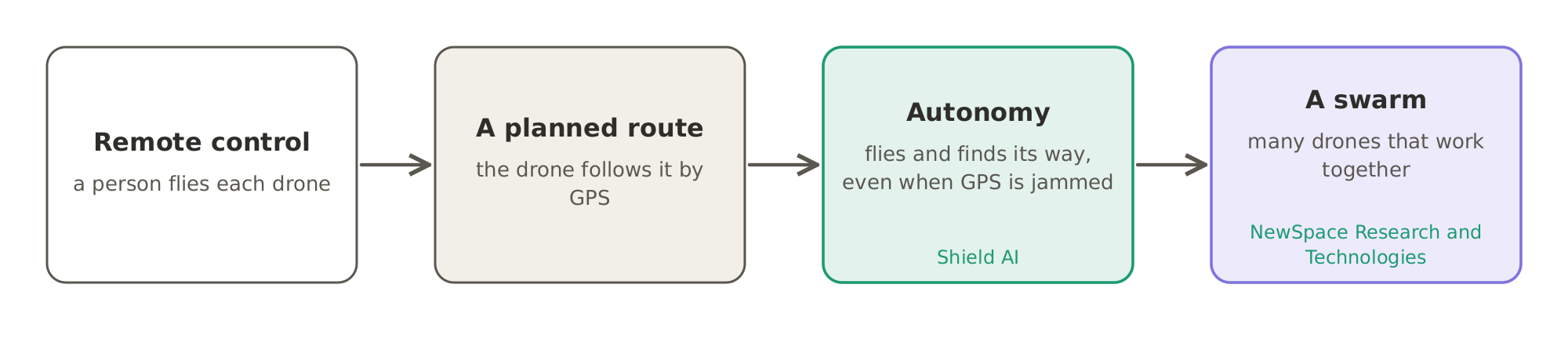 From remote control to autonomy: from a person flying each drone, to a planned route followed by GPS, to drones that fly and find their way on their own, and finally swarms of drones that coordinate with each other.
Defence. Armies use drones to watch, to strike and to carry supplies. A loitering munition is a drone that circles over an area until it finds a target, then dives into it. Armies also buy counter-drone systems, which detect hostile drones and stop them. At sea, navies are adding unmanned boats and underwater vehicles.
Who buys, and India's rules. The buyers are armed forces, police and border forces. Civilian buyers include farmers, mapping companies and the owners of power lines and pipelines. India has built a drone industry quickly. The government has placed large orders, and it has banned the import of foreign drones for most uses. Drones need their own traffic rules too. India's airspace map for drones marks green, yellow and red zones, which set where drones may fly freely, with permission, or not at all.
Most of the companies here are small Indian ones.
Every company named here has posted software engineering jobs in India. Famous companies that don't actively hire software engineers in India are left out.
This Market Segment has two sub-segments:
Drones and their software: the drone makers, and the software that flies and manages drones
Radios, radar, the sea and the smaller makers: the links, test equipment, unmanned vessels and robots around them
Drones and their software
Drone makers, autonomy software, fleet orchestration, ground control and traffic management, swarms, loitering munitions
Drone makers
ideaForgewith engineers in Bengaluru, is India's largest drone maker. Its shares are traded on the stock market. It makes the SWITCH and NETRA drones, used by the armed forces and the police.
NewSpace Research and Technologieswith engineers in Bengaluru, builds swarms of drones that operate together. It also builds high-altitude aircraft that stay in the air for days.
ADASIwith engineers in Bengaluru, Pune and Hyderabad, is the drone maker of the UAE's EDGE group. It makes tactical drones and loitering munitions.
Shield AIan American company with engineers in Delhi, makes Hivemind, an AI pilot. Hivemind flies aircraft without GPS, and without a link to an operator. Shield AI also makes the V-BAT drone.
Software for drone fleets
FlytBasefounded in Pune, with engineers there, sells software that runs fleets of drones kept in boxes on site. Each drone launches from its box, lands back in it and charges there, with no one present.
AlgoBotixwith engineers in Bengaluru, sells ground-control software, and software for managing drone traffic.
Seeing with AI
Auric AI Labswith engineers in Bengaluru, and Skylark Labs, with engineers in Pune, build AI models that recognise what a camera sees. They are used for surveillance and on military unmanned systems.
Three more companies work in this area: TelebortiX, in Delhi, Optiemus Unmanned Systems and AccelUAV, in Hyderabad.
One company covered mainly in another Market Segment also works here:
Applied Intuitionwith engineers in Bengaluru, sells autonomy software to defence forces. (More on it in Market Segment 38.2, Autonomous driving and ADAS, in Industry Vertical 38, Automotive and mobility.)
Radios, radar, the sea and the smaller makers
Telemetry and radar test equipment, tactical and mesh radios, satellite terminals, unmanned surface and underwater vessels, defence robotics
Testing radars and receiving telemetry. Telemetry is the data that a drone or a missile sends to the ground while it flies.
Constelliwith engineers in Hyderabad and Bengaluru, makes telemetry receivers, radar simulators and counter-drone systems for India's defence laboratories. Constelli has the most job postings of any company covered mainly in this Market Segment.
At sea
Ci4 - Autonomous Defensewith engineers in Bengaluru, and Rekise Marine build unmanned vessels that sail on the surface or under water. (More on Rekise Marine in Market Segment 38.2, Autonomous driving and ADAS, in Industry Vertical 38, Automotive and mobility.)
Defence robots
DEFENCE MASTER INDIAwith engineers in Chennai, makes robotic defence systems and unmanned vehicles.
Four more companies work in this area: Big Bang Boom Solutions Private Limited, in Chennai, Algoforge Aerospace, in Bengaluru, PSYC Aerospace & Defence Industries and Unnayan Defence Technologies, in Hyderabad.
Two companies covered mainly in another Market Segment make the radios that link drones and soldiers:
Viasatwith engineers in Chennai and Hyderabad, makes satellite terminals and tactical radios. Viasat has more job postings than any company covered mainly in this Market Segment.
Silvus Technologieswith engineers in Bengaluru, makes mesh radios. In a mesh, each radio passes messages on for the others, so drones and army units can talk without any mobile network.
(More on both in Market Segment 1.5, Satellite and wireless communications, in Industry Vertical 1, Networking and telecom.)
The swarm that decides.
The war in Ukraine showed cheap drones changing the battlefield. Armies are now buying drones that fly, find targets and coordinate on their own, and systems that counter them. AI models are the pilot. How much a machine may decide on its own in war is being argued while the systems are being built.
That is the drone industry: the drones, the software that flies and manages them, and the radios, radars and vessels around them. In India, it grew quickly on government orders, and most of its companies are small and young.