ingrid.fyi India's software hiring trends, explained.
Sign in to ingrid.fyi with Google
Your Google account
name@gmail.com
Continue with Google
Home / Product companies / X · Industrial tech and mobility / Aerospace, defence and space / Aircraft and aerospace systems makers
On this page
Aircraft and aerospace systems makers Building and equipping the aircraft, from the airframe and engines to the cabin Most flights inside India are on one of two aircraft: the Airbus A320 or the Boeing 737. Neither is built by one company alone. Each aircraft is assembled from thousands of parts and systems, made by hundreds of suppliers. Today, much of what those systems do is done by software.

How the industry is organised. Aerospace works in layers, often called tiers:
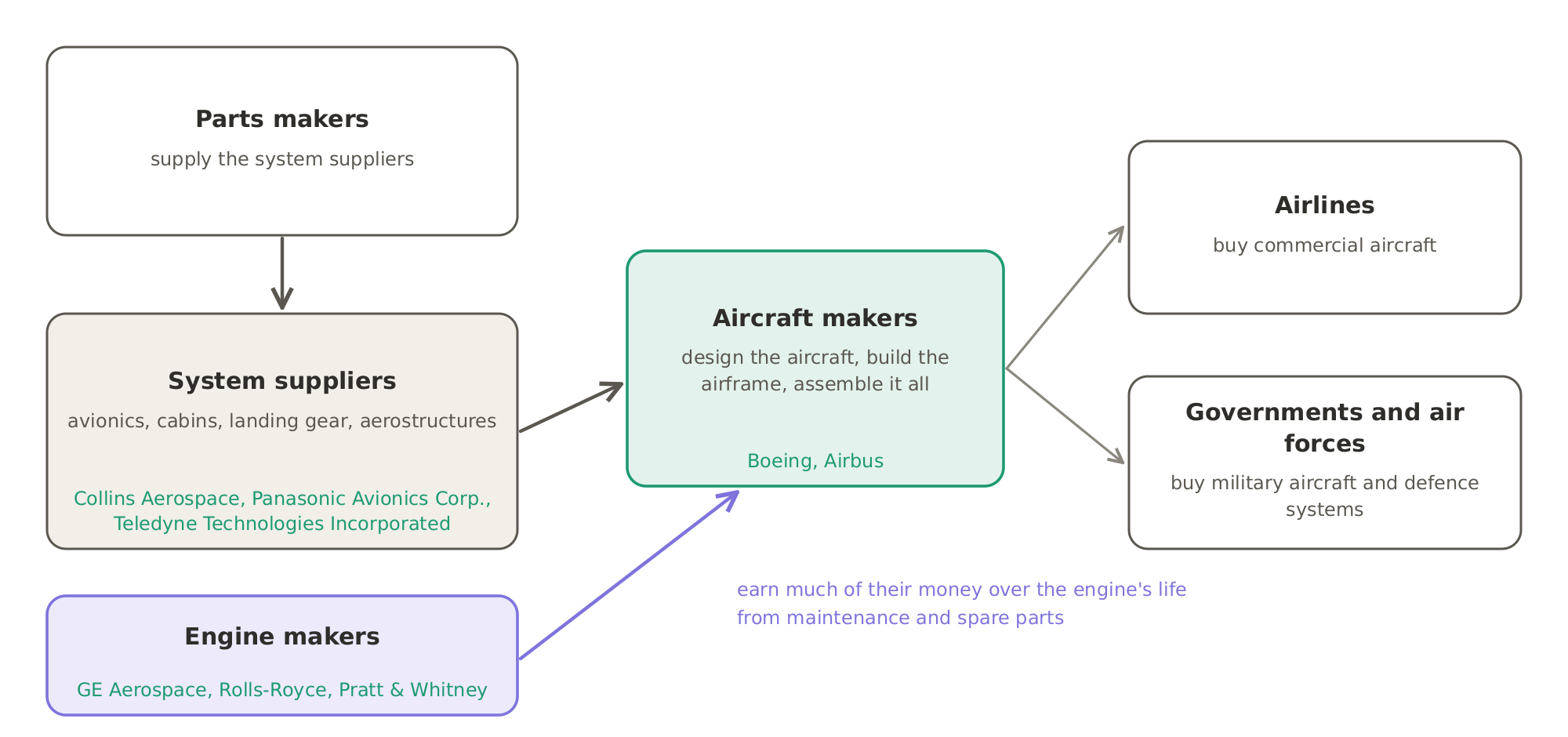
The aircraft makersalso called airframers or, in defence, prime contractors. They design the whole aircraft, build the airframe (the body and wings), and assemble everything else into it. Boeing and Airbus are the two largest makers of airliners. The engine makersOnly a handful of companies make jet engines. An engine maker earns much of its money over the engine's life, from maintenance and spare parts, not only from the sale. The system suppliersThey make whole systems for the aircraft, such as avionics, cabins, landing gear and aerostructures. Avionics are the electronics for navigation, communication and flight control. Aerostructures are large parts of the airframe. The parts makerswho supply the system suppliers. How aerospace is organised: parts makers supply the system suppliers, system suppliers and engine makers supply the aircraft makers, which assemble the aircraft and sell it to airlines, or to governments and air forces.How aerospace is organised: parts makers supply the system suppliers, system suppliers and engine makers supply the aircraft makers, which assemble the aircraft and sell it to airlines, or to governments and air forces.

Two kinds of buyer. Airlines buy commercial aircraft. Governments and air forces buy military aircraft and defence systems. Defence is tightly controlled: countries restrict who may see a weapon's designs. So defence engineering is harder to move abroad than commercial work.

Why it moves slowly. Every new aircraft, and every change to one, must be certified by aviation regulators before it may fly. The software on board must meet strict safety standards. A new airliner can take ten years to develop, and is then built and flown for decades.

Where India fits. The world's aircraft and engine makers run some of their largest engineering centres outside their home countries in Bengaluru. They work on design, software and data. India is also building a small aerospace industry of its own, from defence electronics to electric air taxis.

Every company named here has posted software engineering jobs in India. Famous companies that don't actively hire software engineers in India are left out.

This Market Segment has two sub-segments:

The airframers and the engines: the aircraft makers, the engine makers and a new kind of aircraft The cabin, the electronics and the defence systems: the systems built into aircraft, and defence equipment

Keep reading, free

Two more sections are on this page: The airframers and the engines and The cabin, the electronics and the defence systems. Sign in to read them here, in full.

Continue with Google
  • The airframers and the engines
  • The cabin, the electronics and the defence systems
The airframers and the engines Aircraft makers, jet engines, avionics and aerostructures, electric air taxis

The aircraft makers

Boeingwith engineers in Bengaluru and Chennai, runs one of its largest engineering centres outside America in Bengaluru. It works on the software, design and data of Boeing's aircraft. Boeing has the most job postings in this Industry Vertical. Airbusalso runs a large centre in Bengaluru. It has only a few job postings here, which says little about the size of that centre.

The engine makers

GE Aerospacewith engineers in Bengaluru, makes the engines of many of the world's airliners and military aircraft. It does much of its engineering at its Bengaluru technology centre. Rolls-Roycewith engineers in Bengaluru, makes engines for wide-body airliners: the large aircraft with two aisles, used for long flights.

The system suppliers

RTXwith engineers in Bengaluru, owns two of the companies here. Collins Aerospace makes avionics, flight controls, cabins and aerostructures. Pratt & Whitney makes engines.

A new kind of aircraft

Sarla Aviationfounded in Bengaluru, with engineers there, is building an electric air taxi that takes off and lands vertically, like a helicopter. It is meant for short flights across India's crowded cities. The industry calls such aircraft eVTOLs, for electric vertical take-off and landing.

Parkcontrols is another company in this area.

The cabin, the electronics and the defence systems In-flight entertainment and connectivity, defence electronics, air-traffic and counter-drone systems, military training, imaging sensors, batteries, supply-chain security

The cabin

Panasonic Avionics Corp.with engineers in Pune, makes the seat-back screens and the internet connection in airline cabins. (More on it in Market Segment 1.5, Satellite and wireless communications, in Industry Vertical 1, Networking and telecom.)

Defence electronics and systems

Centum Electronics Ltdan Indian company with engineers in Bengaluru, makes electronics for missiles, radars and satellites. Rohde & Schwarz Australiawith engineers in Bengaluru, is part of Rohde & Schwarz, the German electronics group. (More on Rohde & Schwarz in Market Segment 35.8, Chip manufacturing and test equipment, in Industry Vertical 35, Semiconductors and chip design.) It makes communication systems for air-traffic control, and counter-drone systems, which detect hostile drones and stop them. (More on drones in Market Segment 39.2, Drones and defence tech.) Cubic Corporationwith engineers in Hyderabad, makes military training systems and battlefield communications. Teledyne Technologies Incorporatedwith engineers in Pune, makes imaging sensors and avionics. Its FLIR brand makes thermal cameras, which see heat and so work in the dark.

Two companies covered mainly in other Market Segments supply the aircraft makers:

Saftwith engineers in Bengaluru, makes batteries for aircraft and satellites. (More on it in Market Segment 40.1, Renewable energy and battery storage, in Industry Vertical 40, Energy and climate tech.) Exostarwith engineers in Bengaluru, runs a secure network through which aerospace companies share designs with their suppliers. (More on it in Market Segment 4.2, Identity and access management (IAM), in Industry Vertical 4, Cybersecurity.) The aircraft designed as software.

New aircraft and engines are designed, tested and certified more and more in simulation. Their software is updated throughout their lives. Their data is used to predict when each part will wear out. The industry calls this linked record, from design to maintenance, the digital thread. India's aerospace centres long did design and documentation work, and are now moving to the digital thread. India's own programmes, from defence electronics to air taxis, draw on the same engineers.

That is how an aircraft is built: aircraft makers and engine makers at the top, and system suppliers beneath them, each now as much software as metal. Many of them do much of their engineering in Bengaluru.
Who they hire

Who these companies hire, and for what, is on What aerospace, defence and space companies hire for.

Privacy Terms Refunds and cancellation Shipping and delivery © 2026 ingrid.fyi · Payments by Razorpay
You're browsing as a guest. Sign in free to follow links for five minutes, once an hour.