Switch on a fan, and the electricity comes from a power plant somewhere: a coal or gas plant, a dam, a wind farm or a solar park. India is building wind and solar power faster than almost any other country. This Market Segment is about the companies that make the equipment that generates electricity, and the equipment that stores it.
Who makes, who buys. Equipment makers build the turbines, solar panels and batteries. Their buyers are power producers, the companies that own and run power plants. A power producer sells its electricity to the grid. (More on the grid in Market Segment 40.2, Smart grid and smart meter technology.) For rooftop solar, the buyers are home owners and businesses.
Why equipment makers hire software engineers. Power equipment is now run by software.
- Every wind turbine carries sensors and is watched from a control centre far away.
- Every solar inverter reports how much power it is producing.
- Every large battery is charged and discharged by software that decides the best moment.
So an equipment maker sells software along with the machine. It also earns from long service contracts, under which it monitors and maintains the equipment for years. Much of this software is written in India.
Why storage matters. Solar panels produce power only when the sun shines, and wind turbines only when the wind blows. Demand does not follow the weather. So power has to be stored when there is too much, and released when there is too little.
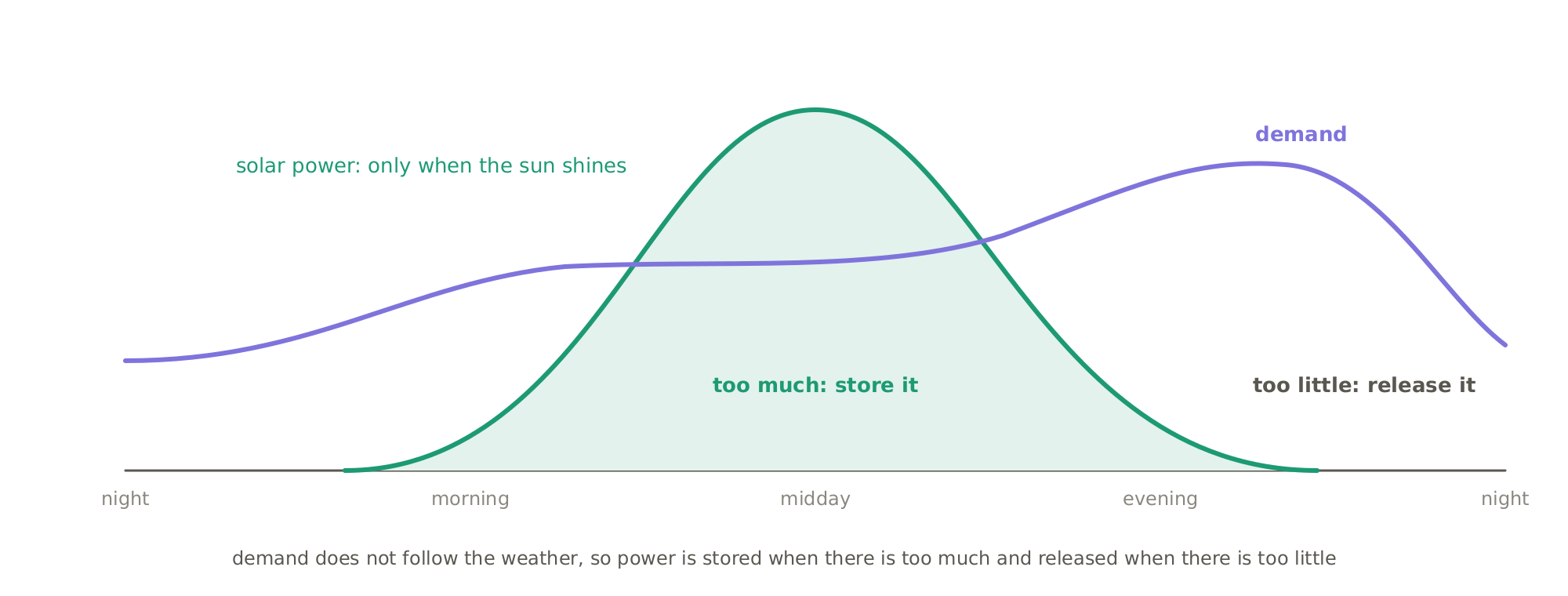 Why storage matters: solar panels produce power only when the sun shines, but demand does not follow the weather, so power is stored when there is too much and released when there is too little.
Every company named here has posted software engineering jobs in India. Famous companies that don't actively hire software engineers in India are left out.
This Market Segment has two sub-segments:
Making the power: turbines, solar equipment, generators and reactor design
Storing it: batteries and hydrogen
Making the power
Wind and gas turbines, solar inverters and microinverters, solar modules and trackers, generators, reactor design
Turbines. A turbine is a machine that spins to drive a generator. Wind spins a wind turbine. Burning gas spins a gas turbine.
GE Vernovawhich separated from GE in 2024, has engineers in Bengaluru, Hyderabad and Chennai. It makes wind turbines, gas turbines, and grid equipment and software. Gas turbines generate much of the world's electricity. Its Indian centres do engineering for all three. GE Vernova has by far the most job postings in this Industry Vertical.
Nordex Groupwith engineers in Chennai, makes wind turbines. It makes some of them in Chennai.
Solar equipment. A solar plant has three main parts. Modules, also called panels, turn sunlight into electricity. Inverters convert that electricity from direct current (DC) into the alternating current (AC) that the grid and home appliances use. Trackers turn the panels through the day to follow the sun, so that they produce more.
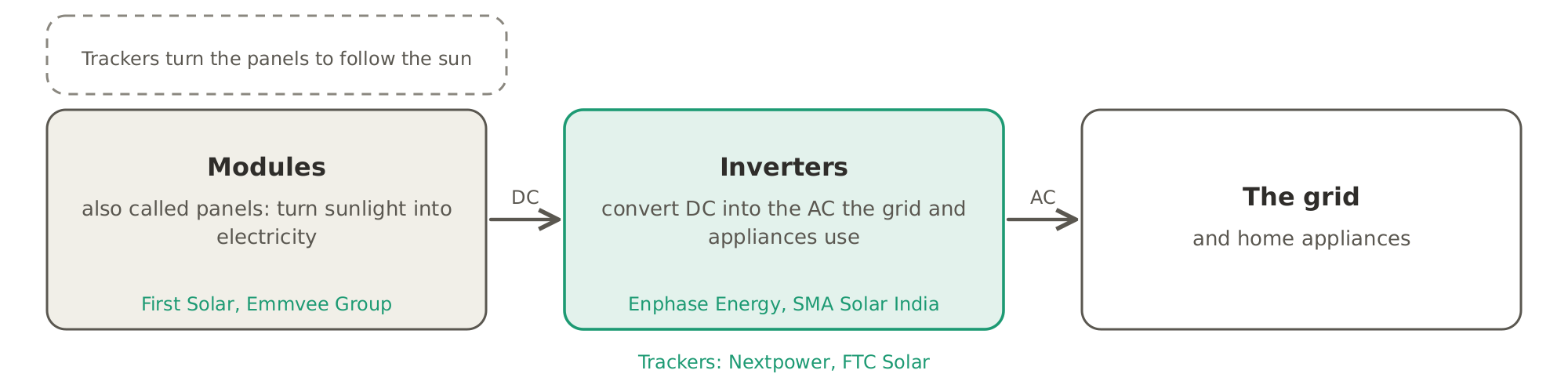 The three main parts of a solar plant: modules turn sunlight into electricity, inverters convert it from DC into AC for the grid and home appliances, and trackers turn the panels through the day to follow the sun.
Enphase Energywith engineers in Bengaluru, makes microinverters and batteries for home solar systems. A microinverter is a small inverter fitted to each panel, instead of one large inverter for the whole roof.
SMA Solar Indiamakes inverters for rooftop solar and for utility solar plants, the large solar parks that feed the grid.
Emmvee Groupwith engineers in Bengaluru, makes solar modules. (More on it in Market Segment 37.7, On-demand manufacturing and 3D printing, in Industry Vertical 37, Manufacturing tech.)
First Solarwith engineers in Chennai, makes solar modules at its thin-film factory in Tamil Nadu. Thin-film modules use a very thin layer of material on glass, instead of silicon cells. (More on it in Market Segment 37.8, Advanced materials and specialty chemicals, in Industry Vertical 37, Manufacturing tech.)
Nextpowerformerly Nextracker Inc., with engineers in Hyderabad, makes trackers. (More on it in Market Segment 37.4, Predictive maintenance and industrial IoT platforms, in Industry Vertical 37, Manufacturing tech.)
FTC Solarwith engineers in Bengaluru, also makes trackers.
The three main parts of a solar plant: modules turn sunlight into electricity, inverters convert it from DC into AC for the grid and home appliances, and trackers turn the panels through the day to follow the sun.
Enphase Energywith engineers in Bengaluru, makes microinverters and batteries for home solar systems. A microinverter is a small inverter fitted to each panel, instead of one large inverter for the whole roof.
SMA Solar Indiamakes inverters for rooftop solar and for utility solar plants, the large solar parks that feed the grid.
Emmvee Groupwith engineers in Bengaluru, makes solar modules. (More on it in Market Segment 37.7, On-demand manufacturing and 3D printing, in Industry Vertical 37, Manufacturing tech.)
First Solarwith engineers in Chennai, makes solar modules at its thin-film factory in Tamil Nadu. Thin-film modules use a very thin layer of material on glass, instead of silicon cells. (More on it in Market Segment 37.8, Advanced materials and specialty chemicals, in Industry Vertical 37, Manufacturing tech.)
Nextpowerformerly Nextracker Inc., with engineers in Hyderabad, makes trackers. (More on it in Market Segment 37.4, Predictive maintenance and industrial IoT platforms, in Industry Vertical 37, Manufacturing tech.)
FTC Solarwith engineers in Bengaluru, also makes trackers.
Generators and reactors
Generacwith engineers in Pune, makes standby generators, which supply power when the grid fails. (More on it in Market Segment 37.9, Building technology and HVAC, in Industry Vertical 37, Manufacturing tech.)
PolyEnergeticswith engineers in Bengaluru, uses AI to design nuclear reactors.
One company covered mainly in another Market Segment also works here:
Delta Electronics Indiawith engineers in Bengaluru, makes power electronics: equipment that converts and controls electric power. (More on it in Market Segment 37.1, Industrial automation and control software, in Industry Vertical 37, Manufacturing tech.)
Storing it
Grid-scale batteries, industrial batteries, sodium-ion storage, hydrogen electrolysers and fuel cells
Batteries. A grid-scale battery is a very large battery system connected to the grid, often the size of several shipping containers. Software decides when it charges and when it supplies power. The industry calls this dispatch.
Fluencewith engineers in Bengaluru, makes grid-scale battery systems. It also makes the software that offers their power for sale in electricity markets. (More on these markets in Market Segment 40.4, Energy market analytics and trading software.)
Saftpart of TotalEnergies, with engineers in Bengaluru, makes industrial batteries. (More on it in Market Segment 39.1, Aircraft and aerospace systems makers, in Industry Vertical 39, Aerospace, defence and space.)
Peak Energywith engineers in Bengaluru, builds grid storage on sodium-ion cells. Most batteries today use lithium. Sodium-ion cells use sodium, which is far more plentiful and cheaper.
Ampd Energymakes battery systems that replace the diesel generators on construction sites.
Hydrogen. Electricity can also be stored as hydrogen. An electrolyser uses electricity to split water into hydrogen and oxygen. When the electricity comes from renewable power, the result is called green hydrogen. A fuel cell does the reverse: it turns hydrogen back into electricity.
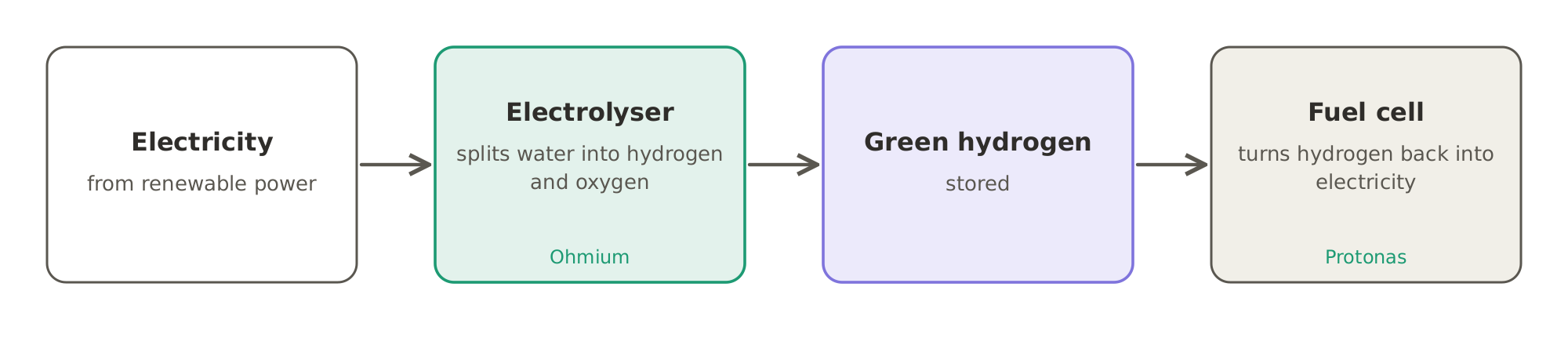 Storing electricity as hydrogen: an electrolyser uses electricity to split water into hydrogen and oxygen, and a fuel cell turns the hydrogen back into electricity.
Ohmiumwith engineers in Bengaluru, makes electrolysers. (More on it in Market Segment 37.8, Advanced materials and specialty chemicals, in Industry Vertical 37, Manufacturing tech.)
Protonasmakes hydrogen fuel cells.
Storing electricity as hydrogen: an electrolyser uses electricity to split water into hydrogen and oxygen, and a fuel cell turns the hydrogen back into electricity.
Ohmiumwith engineers in Bengaluru, makes electrolysers. (More on it in Market Segment 37.8, Advanced materials and specialty chemicals, in Industry Vertical 37, Manufacturing tech.)
Protonasmakes hydrogen fuel cells.
Two companies covered mainly in another Market Segment bring battery cells and battery software:
Agratas and EMO.energyboth with engineers in Bengaluru. (More on both in Market Segment 38.7, Auto components and EV batteries, in Industry Vertical 38, Automotive and mobility.)
The grid that stores the sun.
At midday, solar power is now the cheapest electricity in India. At night, it produces nothing. Batteries make solar power usable round the clock. Software dispatches them, using forecasts of prices and demand. India now invites bids for large battery-storage projects. These tenders are turning that software, much of it written in Bengaluru, into a business in India as well as an export.
That is the equipment side of energy: machines that make electricity and machines that store it, each run by software. Much of that software is written in Bengaluru, Hyderabad and Chennai.