A car carries the carmaker's badge, but most of its parts are made by other companies. The carmaker designs the car, assembles it and sells it. The brakes, the wiring, the airbags, the motor and, in an electric vehicle, the battery usually come from suppliers.
How the supply chain is organised. Car parts come in tiers:
Tier 1 suppliersmake whole systems, such as the brakes or the electronics, and sell them straight to the carmaker.
Tier 2 suppliersmake the components inside those systems, and sell them to the Tier 1 suppliers.
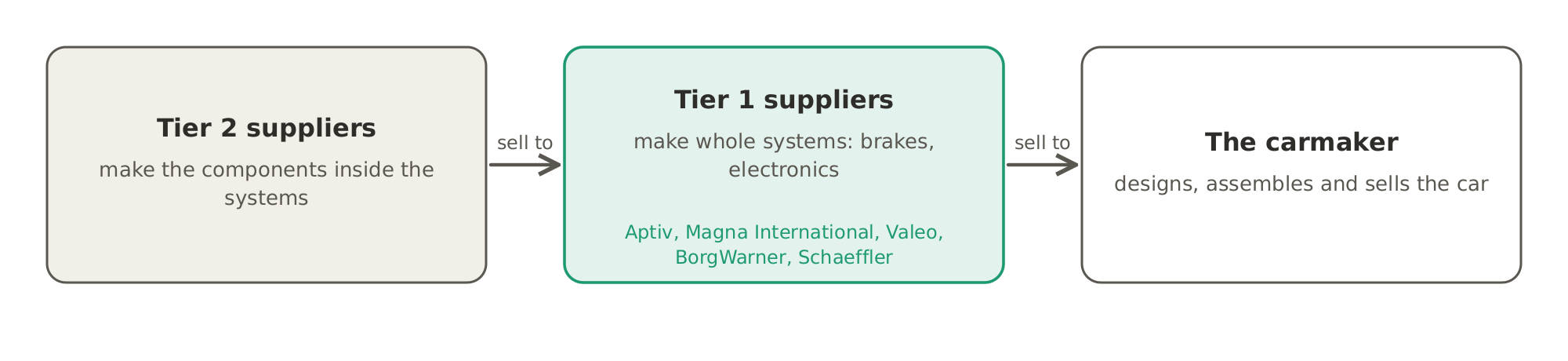 How the supply chain is organised: Tier 2 suppliers sell components to Tier 1 suppliers, which make whole systems and sell them straight to the carmaker.
What the suppliers make
The electrical architecturethe wiring that runs through the car, the connectors, and the computers that control each system. A modern car has dozens of these small computers. Carmakers are now replacing them with fewer, more powerful ones, so that more of the car can be run and updated by software.
The powertrainthe parts that make the car move, such as the engine or electric motor and the gearbox.
Safety systemsairbag controllers and braking systems.
Sensors and actuatorsSensors measure things like pressure or position. An actuator moves something when a computer tells it to, such as applying a brake.
The battery. In an electric vehicle, the battery is usually the most expensive part. It is built up in layers. Many small cells are grouped into modules, and the modules into a pack. A battery-management system watches the voltage and temperature of every cell, keeps them balanced, and stops the battery from overheating. Cells are made in very large factories, often called gigafactories. The government pays incentives to companies that build cell factories in India.
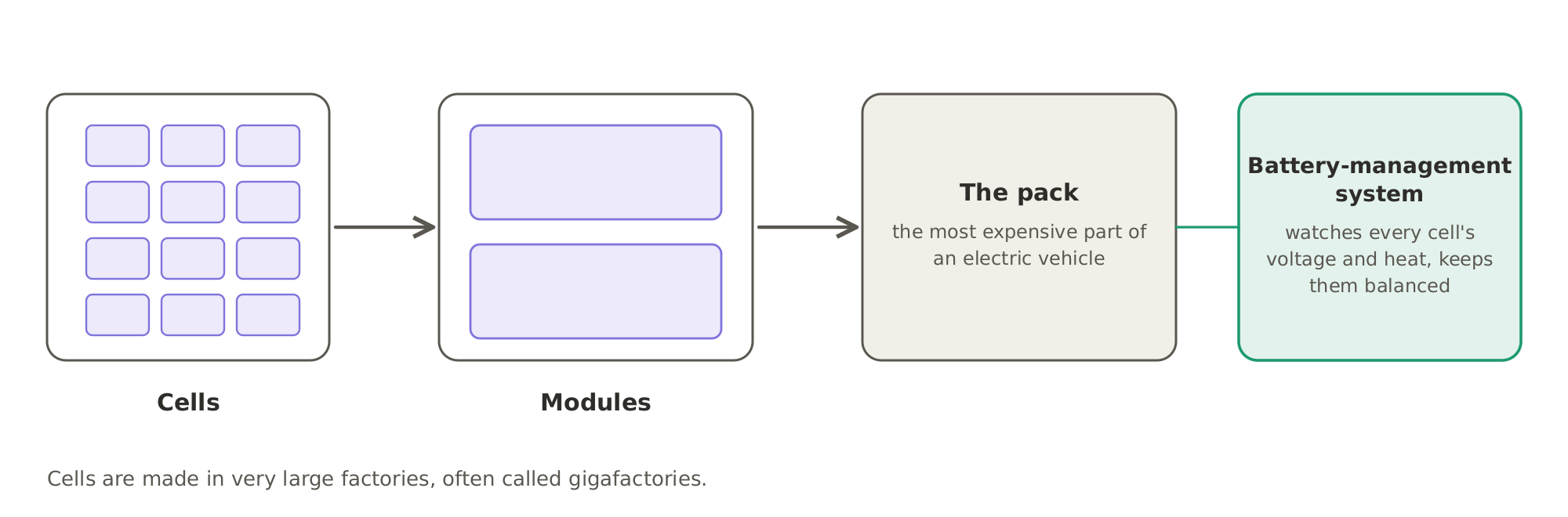 The battery is built up in layers: many small cells are grouped into modules, and the modules into a pack, with a battery-management system watching every cell.
In India, electric two- and three-wheelers are the fastest-selling electric vehicles. A new group of Indian companies builds batteries, battery management and fast charging for them.
Where it is built. The global parts suppliers run large engineering centres in India.
Every company named here has posted software engineering jobs in India. Famous companies that don't actively hire software engineers in India are left out.
This Market Segment has two sub-segments:
The suppliers' parts and electronics: the wiring, computers, powertrains and safety systems that suppliers make for carmakers
The battery: battery cells, battery management and fast charging
The suppliers' parts and electronics
Electrical architecture, vehicle computers, braking and safety electronics, powertrain, sensors and actuators
The car's wiring and computers
Aptivwith engineers in Bengaluru and Chennai, makes the electrical architecture of cars: the wiring, connectors and computers on which a software-defined vehicle is built. Aptiv has the most job postings in this Market Segment.
Powertrains, motors, lighting and sensors. Four large suppliers make powertrains, electric motors, lighting, sensors and bearings between them:
Magna Internationalwith engineers in Bengaluru, is a Canadian group that builds whole cars for other carmakers, as well as their parts.
Valeowith engineers in Chennai and Pune.
BorgWarnerwith engineers in Bengaluru.
Schaefflerwith engineers in Bengaluru and Pune.
Safety and braking
Veoneerwith engineers in Bengaluru, makes airbag control units.
AUMOVIOthe automotive business that Continental separated from itself in 2025, makes braking systems and vehicle computers.
Other parts
MinebeaMitsumiwith engineers in Bengaluru, makes motors and sensors for steering.
OPmobilitymakes exterior parts, lighting and hydrogen systems.
One company here makes gear for riders instead
Aptener Mechatronicsmakes cooling systems for motorcycle helmets.
One company covered mainly in another Market Segment also works here:
Sensata Technologieswith engineers in Pune, makes pressure and position sensors. (More on it in Market Segment 37.6, Connectors and industrial sensors, in Industry Vertical 37, Manufacturing tech.)
The battery
Battery cells and gigafactories, battery management systems, fast-charging packs, battery testing
Battery cells
Agrataswith engineers in Bengaluru, is the battery company set up by the Tata group. It is building cell gigafactories in Gujarat and in Britain.
Enovix Corp.with engineers in Hyderabad, makes lithium-ion cells with silicon anodes. The anode is one of the two electrodes in a cell. Silicon can hold more lithium than the usual graphite, so the cell stores more energy.
Battery management and software
EMO.energywith engineers in Bengaluru, sells battery management and battery-intelligence software.
Vecmocon Technologieswith engineers in Delhi, and Maxwell Energy Systems, with engineers in Bengaluru, make battery-management systems for electric two- and three-wheelers. (More on Vecmocon in Market Segment 38.3, Connected car platforms.)
Agratas and EMO.energy also serve the market for storing electricity. (More on both in Market Segment 40.1, Renewable energy and battery storage, in Industry Vertical 40, Energy and climate tech.)
Fast charging
Exponent Energyfounded in Bengaluru, with engineers there, makes batteries and chargers that fill an electric three-wheeler in fifteen minutes.
Arbin Instruments, in Pune, is another company in this area.
One company covered mainly in another Market Segment also works here:
Yuma Energywith engineers in Bengaluru, runs a battery-swapping network. (More on it in Market Segment 38.8, EV charging networks and battery swapping.)
The battery that knows itself.
A battery's health decides an electric vehicle's range, its safety and its resale value. AI models now estimate that health from the battery's own data. They predict fires before they start, and decide how fast each cell can charge. In India, electric two- and three-wheelers are selling fastest. So battery software from Bengaluru start-ups is where much of the value lies.
That is the parts business: suppliers that make most of a car, and a new battery industry for electric vehicles. The global suppliers run large engineering centres in India, and Indian start-ups build the batteries and battery software for its two- and three-wheelers.