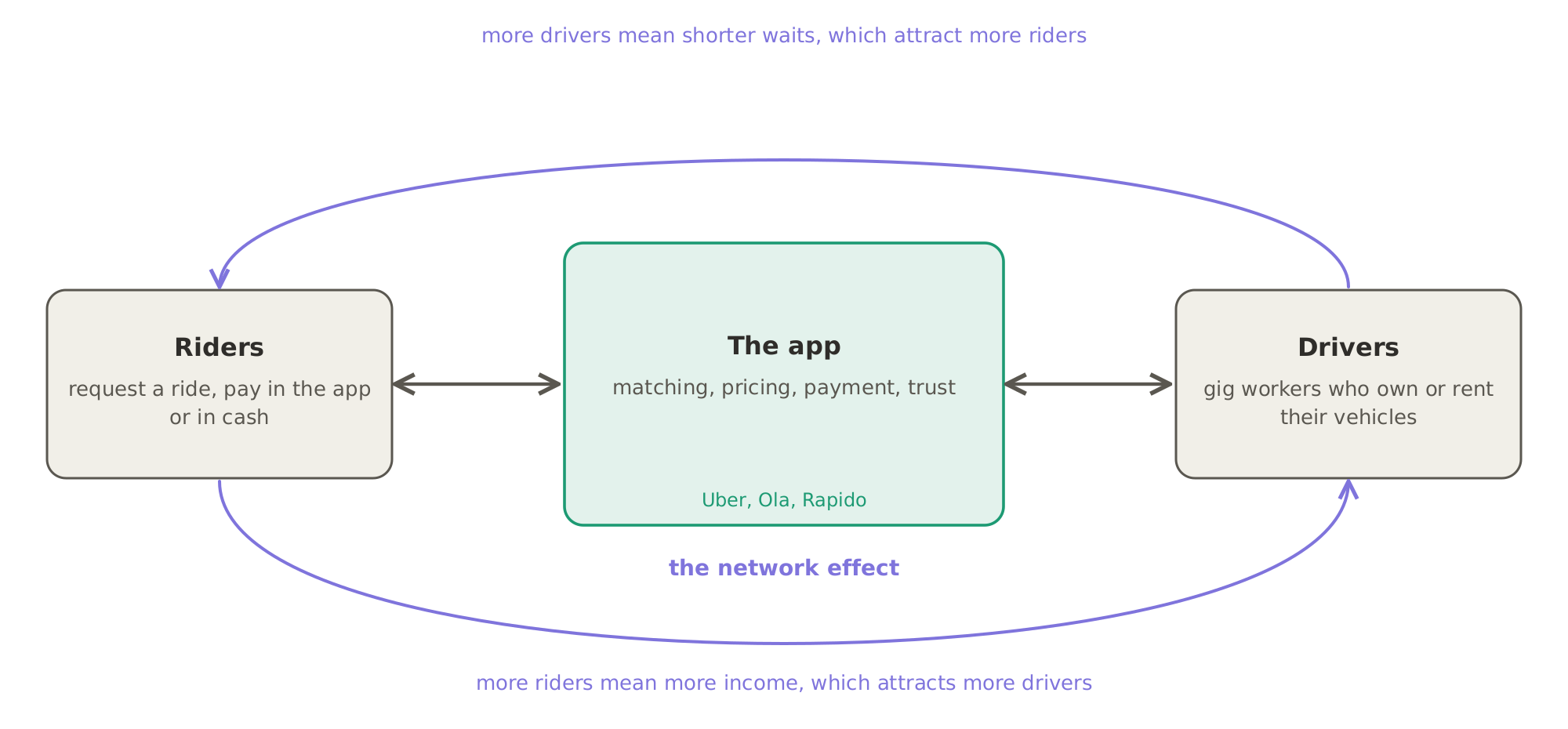
How ride-hailing works. A ride-hailing app is a marketplace with two sides: riders and drivers. The app does four jobs:
The drivers are usually not employees. They are independent workers, often called gig workers, who own or rent their vehicles.
How the money flows. Most apps keep a share of each fare, called a commission. Some charge drivers a fixed daily or monthly fee instead, and let them keep the whole fare. This is the subscription model.
Why a few large apps win. More drivers mean shorter waits, which attract more riders. More riders mean more income for drivers, which attracts more drivers. The industry calls this a network effect. It is why each city tends to have only a few large apps.
Other ways to get around. A driver-on-demand service sends a driver to drive your own car. Shared electric scooters and bicycles, rented by the minute, are called micromobility.
Parking. Software is also removing the parking ticket and the barrier. Cameras read a car's number plate as it enters and leaves, and the fee is charged to the driver's account.
The large ride-hailing companies do much of their engineering in India.
Every company named here has posted software engineering jobs in India. Famous companies that don't actively hire software engineers in India are left out.
Keep reading, free
One more section is on this page: Ride-hailing, drivers, scooters and parking. Sign in to read it here, in full.
Continue with Google- Ride-hailing, drivers, scooters and parking
Ride-hailing
Other ways to get around
Parking
Ride-hailing runs on AI models that set prices, match riders with drivers and predict demand minute by minute. India has added a question those models must answer: how to pay drivers fairly. States are passing laws on the pay and rights of gig workers. Rajasthan was the first, in 2023. The next change is the driverless taxi, already running in some American cities and still far off on Indian roads.
Who these companies hire, and for what, is on What automotive and mobility companies hire for.