ingrid.fyi India's software hiring trends, explained.
Sign in to ingrid.fyi with Google
Your Google account
name@gmail.com
Continue with Google
Home / Product companies / X · Industrial tech and mobility / Manufacturing tech / Advanced materials and specialty chemicals
On this page
Advanced materials and specialty chemicals What things are made of, the glass, fabrics and coatings that took years to develop The glass on a phone's screen survives most drops. A rain jacket keeps water out but lets sweat escape. Neither happens by chance. Each depends on a material that some company spent years developing. Before anything is made, there are materials.

Two kinds of chemicals and materials
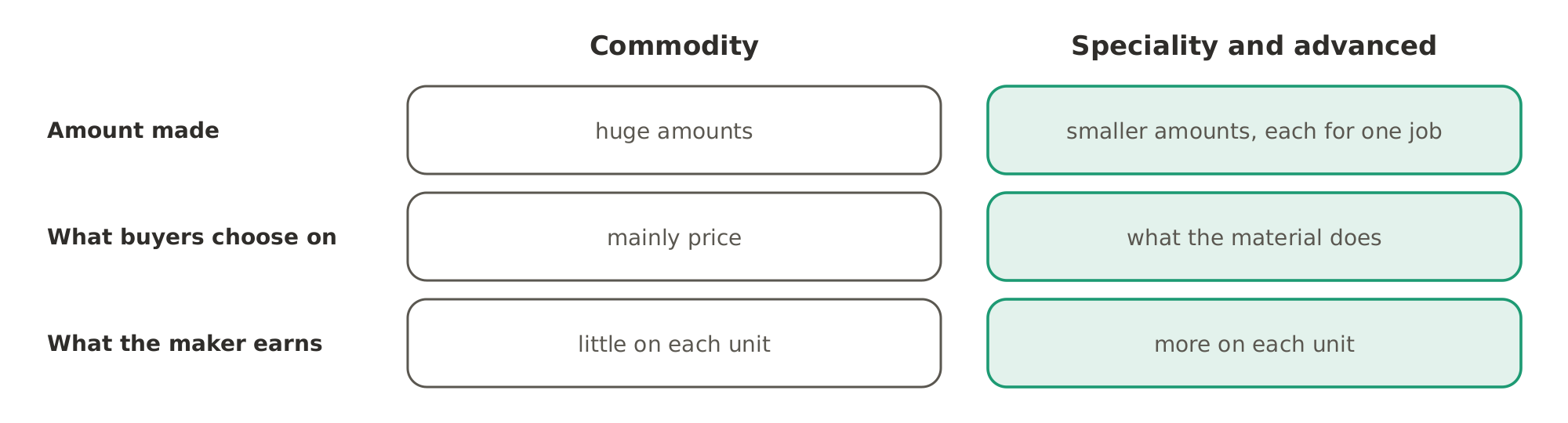
Commodity chemicals and materialsare made in huge amounts, and are the same whoever makes them. Buyers choose mainly on price. Speciality chemicals and advanced materialsare made in smaller amounts, each for one job. Buyers choose them for what they do. They cost more, and the maker earns more on each unit sold. Commodity chemicals are made in huge amounts and bought mainly on price; speciality chemicals and advanced materials are made in smaller amounts for one job, bought for what they do, and earn the maker more on each unit.Commodity chemicals are made in huge amounts and bought mainly on price; speciality chemicals and advanced materials are made in smaller amounts for one job, bought for what they do, and earn the maker more on each unit.

This Market Segment is about the second kind.

How the business works. A materials company sells to manufacturers, not to the public. A phone maker buys the glass. A paper mill buys the chemicals that treat its pulp. A refinery buys catalysts. A new material takes years to develop, and is protected by patents and by knowledge of how to make it. Once a manufacturer has built a product around a material, it rarely changes supplier.
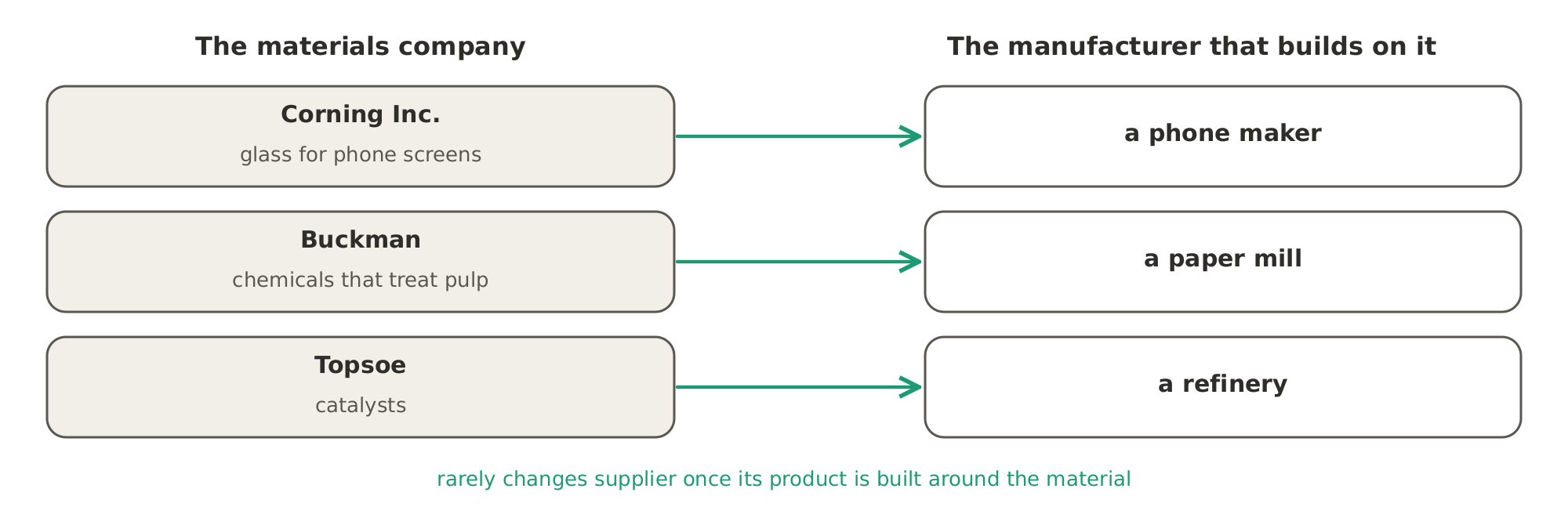
A materials company sells to manufacturers, not to the public: Corning Inc. sells glass to phone makers, Buckman sells chemicals to paper mills and Topsoe sells catalysts to refineries, and a manufacturer rarely changes supplier once its product is built around the material.A materials company sells to manufacturers, not to the public: Corning Inc. sells glass to phone makers, Buckman sells chemicals to paper mills and Topsoe sells catalysts to refineries, and a manufacturer rarely changes supplier once its product is built around the material.

Where software comes in. These companies employ scientists more than software engineers. But more and more, they use data and AI models to discover new materials and test them. They also sell software and services along with their materials, for example to monitor how a customer's plant uses their chemicals.

Every company named here has posted software engineering jobs in India. Famous companies that don't actively hire software engineers in India are left out.

Keep reading, free

One more section is on this page: Speciality chemicals and advanced materials. Sign in to read it here, in full.

Continue with Google
  • Speciality chemicals and advanced materials
Speciality chemicals and advanced materials

Glass, membranes and optical materials

Corning Inc.with engineers in Pune and Delhi, makes Gorilla Glass for phones, optical fibre, and the ceramics in car exhausts. (More on it in Market Segment 1.1, Telecom equipment and operators, in Industry Vertical 1, Networking and telecom.) W. L. Gore & Associateswith engineers in Bengaluru, makes GORE-TEX, and the membranes used in filters, medical implants and cables. A membrane is a very thin sheet that lets some things pass and stops others. Coherent Corp.with engineers in Hyderabad, makes compound semiconductor materials, lasers, and the optical parts inside fibre networks. Most chips are made of silicon. Compound semiconductors are made of two or more elements, and suit lasers and high-power electronics.

Speciality chemicals

Buckmanwith engineers in Chennai, makes speciality chemicals for paper mills, water treatment and leather. It has the most job postings in this Market Segment. (More on it in Market Segment 40.7, Carbon accounting and sustainability software, in Industry Vertical 40, Energy and climate tech.) Momentivewith engineers in Bengaluru, makes silicones, the rubbery materials used in seals and coatings. It is a different company from Momentive Software. Element Solutionsmakes the chemicals used to make circuit boards and chips. Kluber Lubricationmakes speciality lubricants, the oils and greases that reduce wear in machines. Topsoewith engineers in Delhi, makes catalysts for refineries and fertiliser plants. A catalyst speeds up a chemical reaction without being used up. Topsoe also makes the electrolysers that produce green hydrogen.

Two companies covered mainly in another Market Segment make materials for clean energy:

Ohmiumwith engineers in Bengaluru, makes hydrogen electrolysers. First Solarwith engineers in Chennai, makes thin-film solar modules at its plant in Tamil Nadu.

(More on both in Market Segment 40.1, Renewable energy and battery storage, in Industry Vertical 40, Energy and climate tech.)

The material found by AI.

Discovering a new material has always taken years of trial in the lab. AI models now predict which mixtures will have the properties that are wanted. Robotic labs then test them round the clock. Batteries, catalysts and semiconductor materials are the first fields in which materials found this way are reaching production.

That is the materials business: companies that spend years developing a glass, a membrane or a catalyst, and sell it to the manufacturers that build on it. They hire scientists more than software engineers, but data and AI are changing how materials are found.
Who they hire

Who these companies hire, and for what, is on What manufacturing tech companies hire for.

Privacy Terms Refunds and cancellation Shipping and delivery © 2026 ingrid.fyi · Payments by Razorpay
You're browsing as a guest. Sign in free to follow links for five minutes, once an hour.