ingrid.fyi India's software hiring trends, explained.
Sign in to ingrid.fyi with Google
Your Google account
name@gmail.com
Continue with Google
Home / Product companies / X · Industrial tech and mobility / Manufacturing tech / On-demand manufacturing and 3D printing
On this page
On-demand manufacturing and 3D printing Making parts on demand, in ones or in thousands An engineering student who needs one metal bracket for a project can take a drawing to a local workshop and have it made. Companies need custom parts all the time, in ones and in thousands. A growing share of manufacturing is done this way, to order.

Three ways to make a part
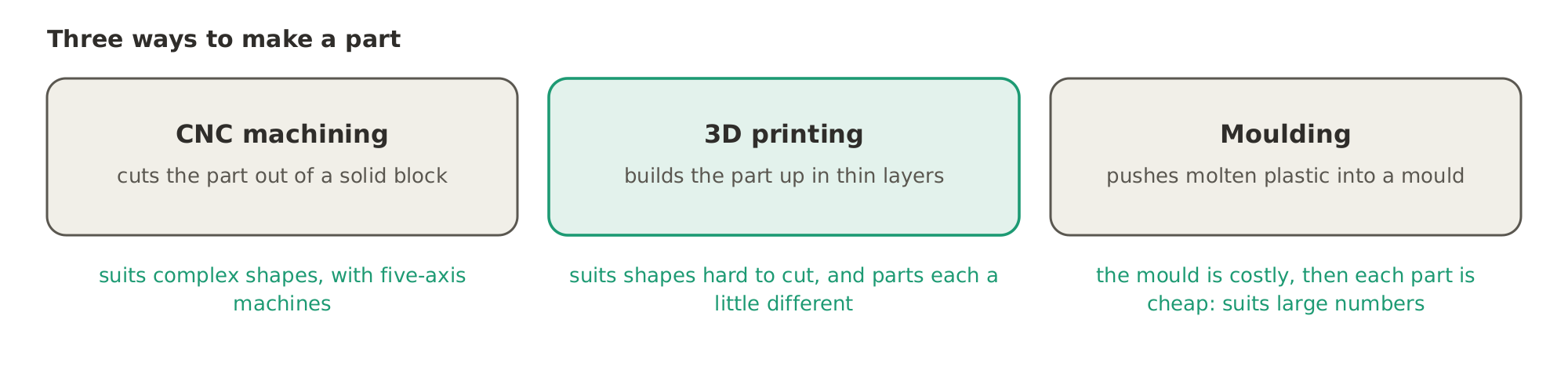
CNC machiningcuts the part out of a solid piece of metal or plastic, using a cutting machine controlled by a computer. A five-axis machine can turn the part and the tool in five directions, so it can cut complex shapes. 3D printingbuilds the part up in thin layers, from plastic or metal powder. It suits shapes that are hard to cut, and parts that are each a little different. Mouldingpushes molten plastic into a mould. The mould costs a lot to make, but after that each part is cheap. It suits large numbers. Three ways to make a part: CNC machining cuts it out of a solid block, 3D printing builds it up in layers, and moulding pushes molten plastic into a mould, which suits large numbers.Three ways to make a part: CNC machining cuts it out of a solid block, 3D printing builds it up in layers, and moulding pushes molten plastic into a mould, which suits large numbers.

From prototypes to production. A prototype is a first sample, made to test a design. 3D printing began as a way to make prototypes quickly. It is now used for production too. Dental aligners are the best example. Each patient's teeth are different, so every aligner is printed to fit one person, and millions are made.

Parts ordered online. Ordering a custom part used to mean phone calls, drawings and weeks of waiting. On an on-demand manufacturing platform, an engineer uploads the design. Software reads it, and quotes a price and a delivery date within seconds. The part is then made in one of two ways:
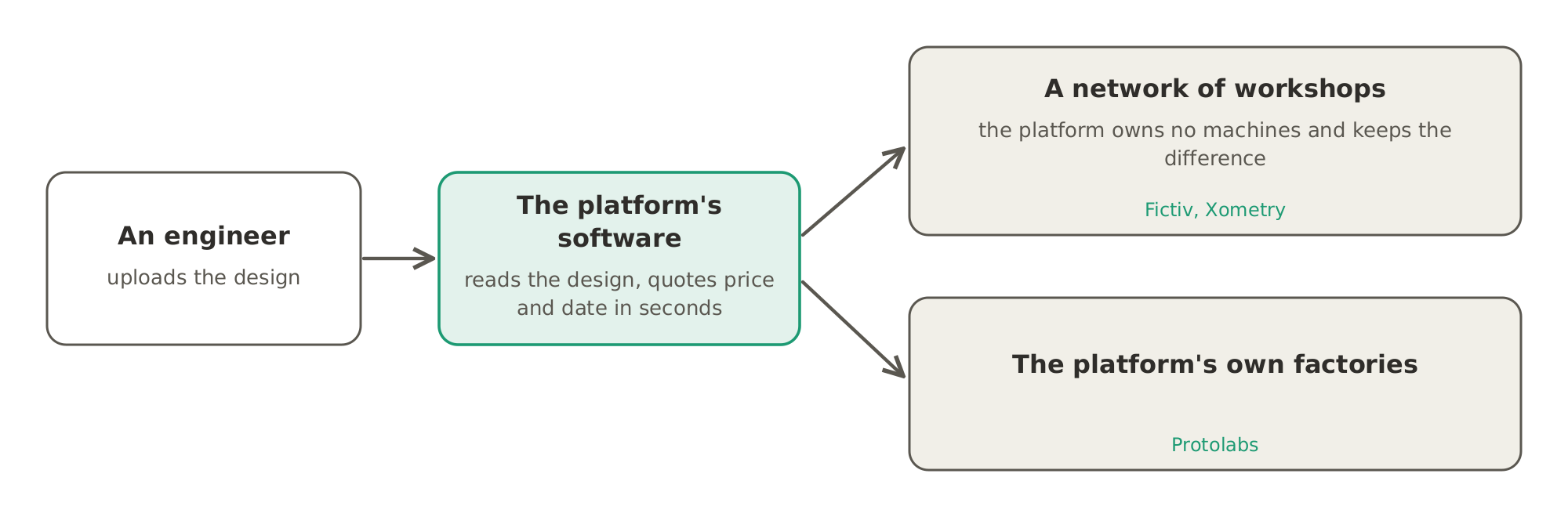
In a network of workshopsThe platform owns no machines. It passes each order to a workshop that has spare capacity, and keeps the difference between what the buyer pays and what the workshop is paid. In the platform's own factories Ordering a part online: the engineer uploads a design, the platform's software quotes a price and a date in seconds, and the part is made either in a network of workshops, as with Fictiv and Xometry, or in the platform's own factories, as with Protolabs.Ordering a part online: the engineer uploads a design, the platform's software quotes a price and a date in seconds, and the part is made either in a network of workshops, as with Fictiv and Xometry, or in the platform's own factories, as with Protolabs.

Making things for others. Many brands do not make the products they sell. They hire a contract manufacturer, which builds electronics or devices to the brand's design. The largest contract manufacturers are not covered in this Market Segment.

Every company named here has posted software engineering jobs in India. Famous companies that don't actively hire software engineers in India are left out.

Keep reading, free

One more section is on this page: Platforms, machines and parts made to order. Sign in to read it here, in full.

Continue with Google
  • Platforms, machines and parts made to order
Platforms, machines and parts made to order

Platforms for ordering parts

Fictivwith engineers in Pune and Bengaluru, and Xometry, with engineers in Bengaluru, run platforms that quote a part instantly from its design. The part is then made in a network of workshops. Fictiv has the most job postings of any company covered mainly in this Market Segment. Protolabswith engineers in Hyderabad, does the same, but makes the parts in its own factories.

The machines that make the parts

Ethereal Machinesfounded in Bengaluru, with engineers there, makes machines that combine five-axis CNC cutting and 3D printing in one. Stratasyswith engineers in Pune, makes 3D printers for prototypes and for production. Gleason Corporationwith engineers in Bengaluru, makes the machines that cut and grind gears.

Parts for medical devices

Motherson Health & Medicalwith engineers in Bengaluru, moulds plastic parts for medical devices. (More on it in Market Segment 24.4, Medical device makers, in Industry Vertical 24, Hospitals, diagnostics and medical devices.)

Three companies covered mainly in other Market Segments also make things to order:

Align Technologywith engineers in Hyderabad, Pune and Bengaluru, makes Invisalign, the clear aligners that are 3D-printed to fit each patient. It has more job postings than any company covered mainly in this Market Segment. Glidewell Dental, with engineers in Chennai, makes dental crowns that are milled and printed to order. (More on both in Market Segment 24.4, Medical device makers, in Industry Vertical 24, Hospitals, diagnostics and medical devices.) Emmvee Groupwith engineers in Bengaluru, runs factories that make solar modules and solar water heaters. (More on it in Market Segment 40.1, Renewable energy and battery storage, in Industry Vertical 40, Energy and climate tech.) The factory as a service.

Ordering a machined part used to mean phone calls, drawings and weeks. The platforms now quote in seconds. They use AI models that read the design and estimate what it will cost to make. India has a large base of small machine shops. So India is a supplier to these platforms, and also a market for Indian platforms of the same kind.

That is manufacturing to order: platforms that quote a part in seconds, machines that cut and print it, and factories that make products for other companies' brands.
Who they hire

Who these companies hire, and for what, is on What manufacturing tech companies hire for.

Privacy Terms Refunds and cancellation Shipping and delivery © 2026 ingrid.fyi · Payments by Razorpay
You're browsing as a guest. Sign in free to follow links for five minutes, once an hour.