Every WhatsApp message you send leaves your phone and travels through a telecom network to reach the internet. So does every video you watch on the metro, and every UPI payment you make. Let's follow one message. On the way, the whole Market Segment becomes clear.
First, your message reaches a cell tower as a wireless signal. From the tower, it travels over fibre optic cables to the operator's core network, and from there to the internet. Along the way, software checks who you are, what plan you are on and how much balance you have left.
Behind all of it are the operators, like Jio and Airtel, who sell mobile and broadband plans to millions of customers. Almost everything in this Market Segment is built for operators or sold to them.
One more thing before we start. Every company named here has posted software engineering jobs in India. Famous companies that don't actively hire software engineers in India are left out.
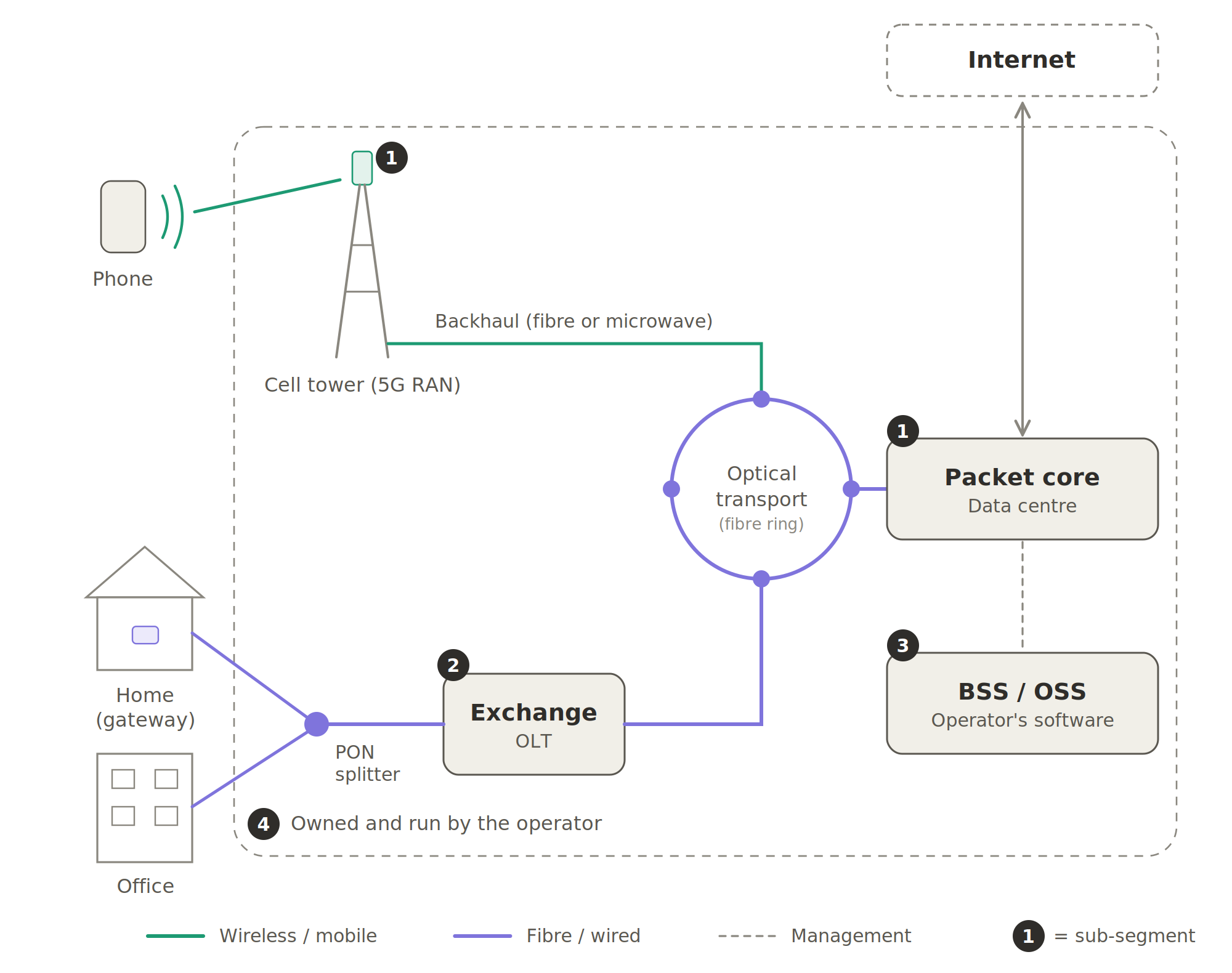 How a message travels: from the phone to the cell tower by wireless signal, then over fibre to the packet core and out to the internet. Homes and offices connect by fibre through a PON splitter and the local exchange (OLT). The operator's software (BSS/OSS) runs it all as a business. The numbers 1 to 4 match the four sub-segments below.
This Market Segment has four sub-segments, in this order:
The radio and the core
The wire into the home
The operator's software
The operators themselves
The radio and the core
5G RAN (Radio Access Network), Open RAN, packet core, backhaul
In telecom, "radio" means the wireless link between your phone and the tower, not FM radio.
A mobile network has three parts:
The RAN (Radio Access Network)The towers and the hardware on them that sends and receives the wireless signal to and from your phone.
BackhaulThe fibre optic or microwave link that carries each tower's traffic to the operator's core network.
The packet coreSoftware, running on servers in the operator's data centres, that checks your SIM, tracks you as you move between towers, and hands your traffic to the internet.
For decades, the equipment that runs mobile networks, on the towers and in the core, has been sold by a club of a few giants. Ericsson and Nokia supply most of the world's mobile networks. Huawei and Samsung are the other two big suppliers of mobile network equipment.
India kept Chinese vendors like Huawei out of its 5G rollout. So Ericsson, Nokia and Samsung built most of Airtel's 5G network and part of Jio's. Jio built a large share of its own. Both Ericsson and Nokia run some of their biggest engineering centres in India.
Operators have long complained that buying from so few suppliers leaves them no bargaining power. Their answer is Open RAN. Today, an operator buys a tower's hardware and software as one package from one company. That company's hardware runs only its own software, so the operator cannot mix brands. Open RAN sets common standards between the two parts. The tower hardware can then come from one company and the software from another, all running on ordinary servers instead of sealed boxes.
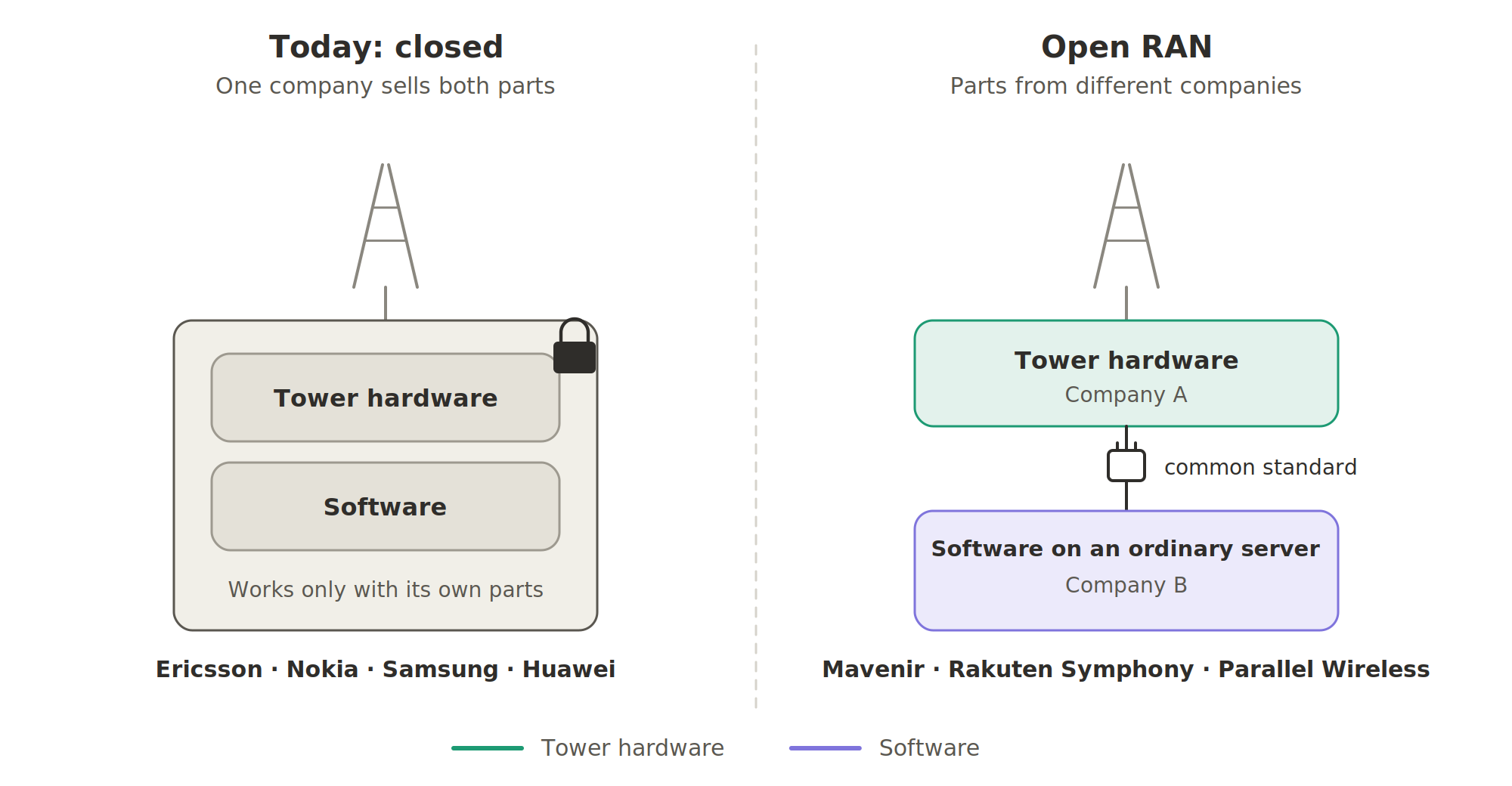 Today, one company sells a tower's hardware and software as one locked package (Ericsson, Nokia, Samsung, Huawei). With Open RAN, the tower hardware comes from one company and the software runs on an ordinary server from another, joined by a common standard (Mavenir, Rakuten Symphony, Parallel Wireless).
A few newer companies make Open RAN products:
Maveniris the best known.
Rakuten Symphonysells the platform Rakuten built for its own mobile network in Japan. It now includes Altiostar.
Parallel Wirelesssells the software that runs at the tower.
IP Infusionmakes the network operating system that lets ordinary hardware behave like telecom equipment. (More on it in Market Segment 1.2, Enterprise networking.)
Open RAN has grown more slowly than its early announcements promised. These newer companies are still far smaller than Ericsson and Nokia.
Besides these big suppliers, several smaller companies each make one piece of the network:
Ceragon Networksmakes the microwave links between towers.
JMA Wirelessmakes the radio units and antennas mounted on towers.
GreenWave Radiosmakes the chips inside 5G radio units.
iBUSprovides mobile coverage inside malls and offices, using antennas shared by all operators. It installs and runs this infrastructure itself, rather than selling equipment.
Astromeis an Indian deep-tech start-up making high-capacity wireless links.
Ribbon Communicationsworks on the voice-calling side of the network, and also makes some fibre equipment.
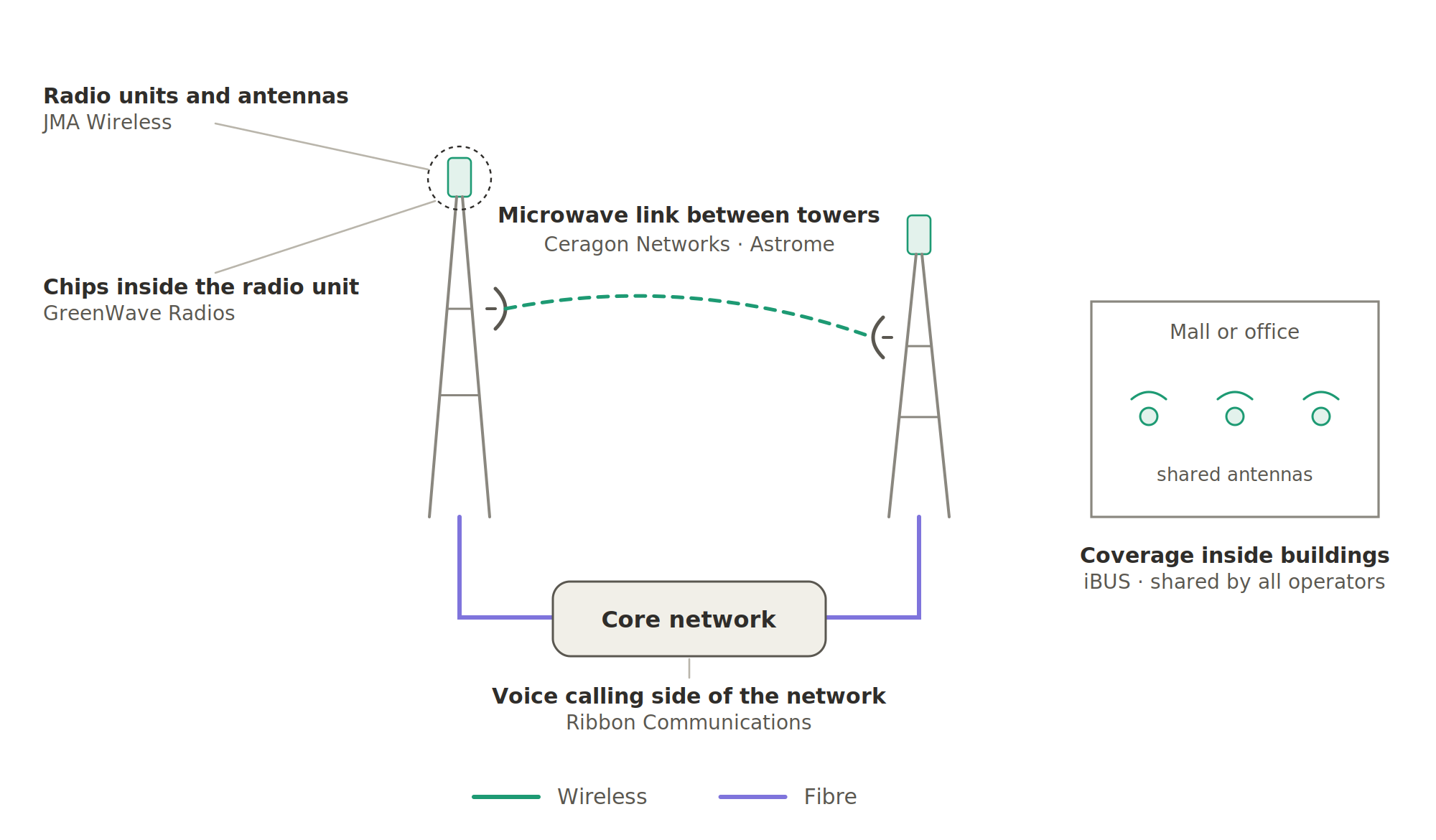 Where the specialists fit: JMA Wireless makes radio units and antennas, GreenWave Radios the chips inside them, Ceragon Networks and Astrome the microwave links between towers, iBUS the shared antennas inside malls and offices, and Ribbon Communications the voice-calling side of the core network.
The network as software.
Where the specialists fit: JMA Wireless makes radio units and antennas, GreenWave Radios the chips inside them, Ceragon Networks and Astrome the microwave links between towers, iBUS the shared antennas inside malls and offices, and Ribbon Communications the voice-calling side of the core network.
The network as software.
The tower equipment and the core are moving off sealed boxes and onto ordinary servers and cloud platforms. This is what makes Open RAN possible, and it is what Jio did for its own network. The newest use is private 5G: a company's own 5G network, used only inside its factory or port. Mavenir and Rakuten Symphony are the names here. The operators doing this themselves are in the last sub-segment.
The wire into the home
Optical transport, PON (passive optical network), broadband gateways, cable and fixed wireless
The wireless signal covers only the last few hundred metres, from the tower to the phone. Everything behind the tower runs on fibre. So does every home and office broadband connection.
Between cities and data centres, a single fibre can carry tens of terabits per second, enough for millions of video streams at once. Closer to the customer, operators use a passive optical network (PON). One fibre leaves the operator's local exchange, a building that serves a neighbourhood. The OLT (Optical Line Terminal) sits there. On the street, a splitter divides that fibre to serve 32 or 64 homes. The splitter is passive: it needs no electricity. That is what the "passive" in PON means. With no powered equipment between the exchange and your home, the network is cheaper to run and has fewer parts that can fail. The fibre ends at a device the installer mounts on your wall, called an ONT (optical network terminal). In most Indian homes, the ONT and the Wi-Fi router come as one device, called a home gateway.
Demand here keeps growing, because data use keeps growing. The companies divide the work by distance:
Between citiesCiena builds the high-capacity fibre systems that link cities and data centres.
In your areaAdtran and Calix build the equipment at the exchange and the gateways in homes. Adtran bought the German company ADVA. Calix mostly sells to smaller internet providers.
Inside the homeVantiva makes the home gateways and set-top boxes that operators install.
The fibre itselfCorning makes the glass fibre and the cable. (More on it in Market Segment 37.8, Advanced materials and specialty chemicals, in Industry Vertical 37, Manufacturing tech.)
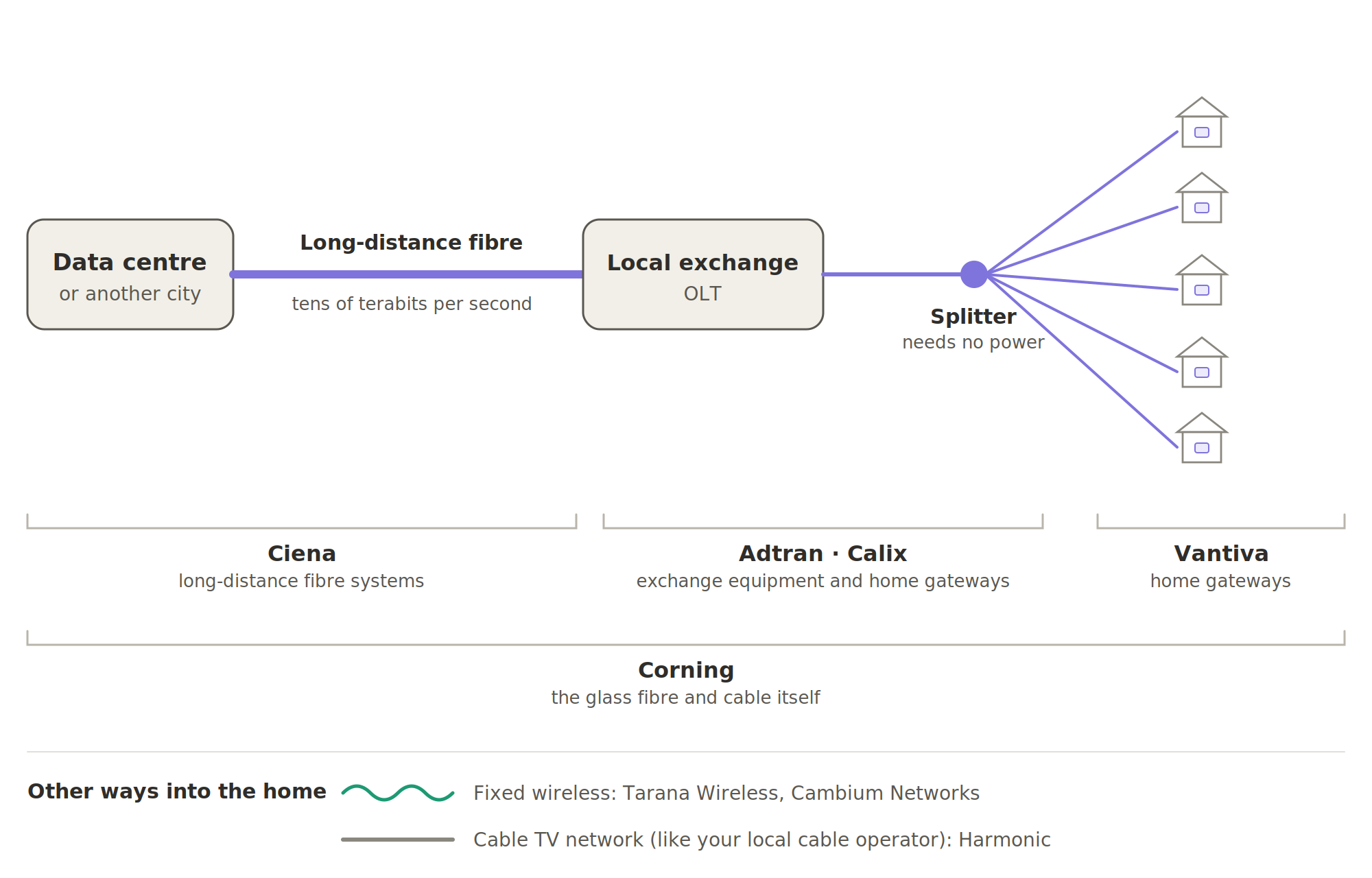 Fibre from city to home: long-distance fibre (Ciena) links data centres and cities to the local exchange and its OLT (Adtran, Calix). A passive splitter on the street, needing no power, serves 32 or 64 homes, each with a home gateway (Vantiva). Corning makes the fibre itself. Other ways in: fixed wireless (Tarana Wireless, Cambium Networks) and cable TV networks (Harmonic).
Home fibre spread fast in India in the last decade, as Jio and Airtel pushed it. The government pushed just as hard for Indian-made equipment. Tejas Networks is the Indian company that designs and builds telecom equipment at scale. It is now part of the Tata group, and it supplied a large part of BSNL's 4G network.
Not every home connection is fibre. Where laying cable is impractical, there are two other ways:
Fixed wirelesswhere the home connects to the network by a wireless signal instead of a cable. Tarana Wireless and Cambium Networks make this equipment. (More on Cambium in Market Segment 1.2, Enterprise networking.)
Cablewhere internet runs over existing cable TV networks, the way many local cable operators in India also sell broadband. Harmonic makes equipment for this. (More on it in Market Segment 32.2, Video streaming technology, in Industry Vertical 32, Streaming and broadcast.)
Wifi Dabba sells low-cost public Wi-Fi in Indian cities. It works more like a small internet provider than an equipment maker.
Fibre for the AI data centre.
Demand is now growing fastest on the links between data centres, not between cities. The driver is AI training, which needs large clusters of computers moving huge amounts of data. Ciena is the name here building for it.
You're reading as a guest. Sign in free to follow links for five minutes, once an hour.
Sign in
The operator's software
BSS/OSS (business and operations support systems), billing and charging, roaming, revenue assurance, IoT connectivity, DPI and policy, network planning
An operator with hundreds of millions of customers is also a business. It must know who each customer is, what plan they are on and what they owe. Each of those jobs is a software market of its own. Together, these systems are called BSS/OSS: business support systems and operations support systems.
The main jobs are:
OnboardingActivating a new SIM and setting up the customer.
ChargingChecking a prepaid balance in real time, every time data is used. This is why your data counter drops the moment you use it.
BillingTurning a month of usage records into a postpaid bill.
RoamingServing a customer who is abroad on an Indian SIM, and settling up with the foreign operator later.
Revenue assuranceFinding money that should have been billed but wasn't.
Deep packet inspection (DPI) and policyRecognising what kind of traffic is flowing, such as a video stream or a voice call, and deciding how to handle it.
Network planningWorking out where the next tower or fibre route should go.
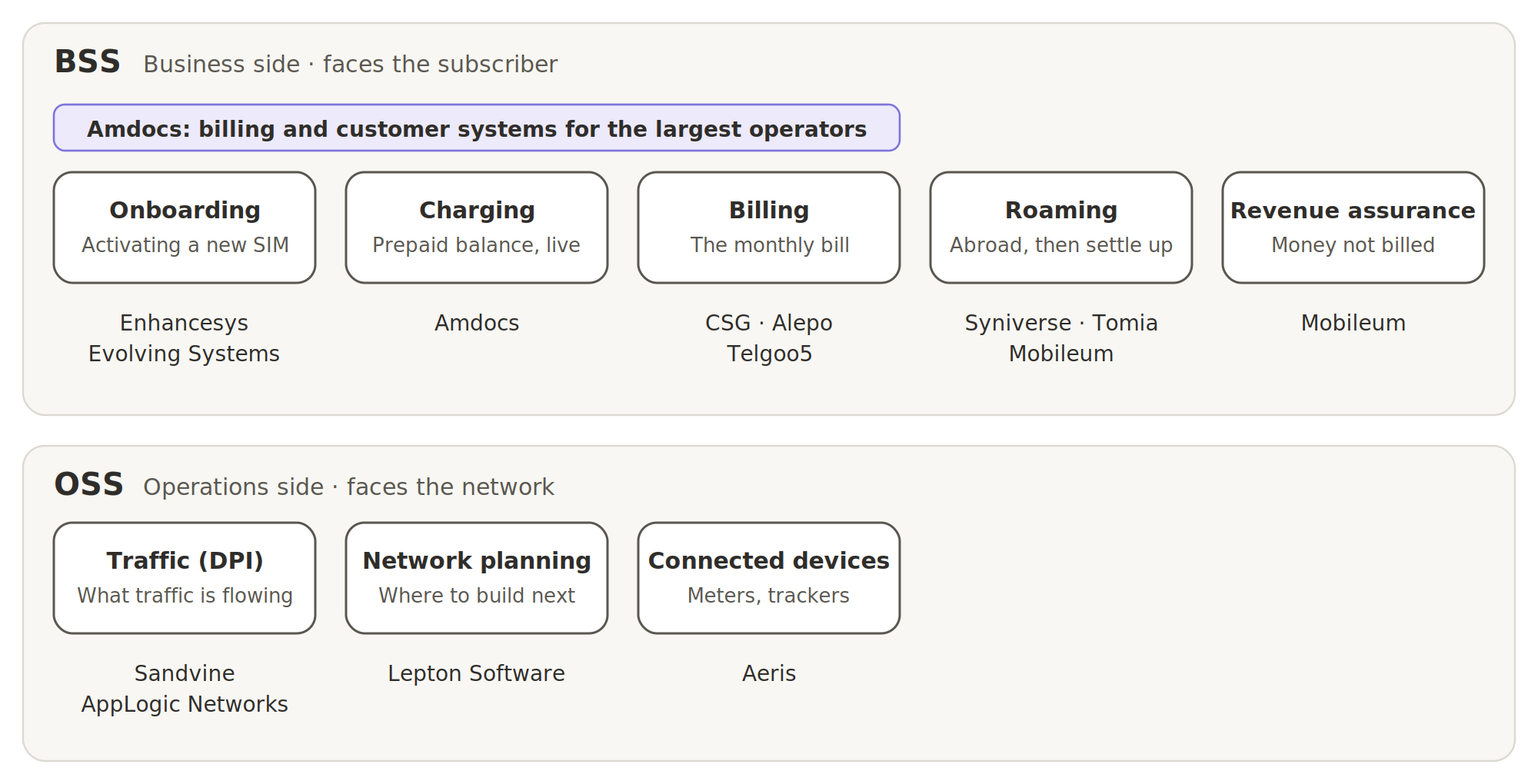 BSS, the business side facing the subscriber: onboarding, charging, billing, roaming and revenue assurance, with Amdocs across the first three. OSS, the operations side facing the network: traffic (DPI), network planning and connected devices.
This corner of telecom has the most companies, and one clear giant. Amdocs runs billing and customer systems for many of the world's largest operators. It does a very large share of its engineering from India.
Apart from Amdocs, smaller companies each focus on one job:
Billing and customer systemsCSG is strongest with US cable and telecom companies. Alepo Technologies serves broadband and Wi-Fi providers. Telgoo5 serves brands that sell mobile service on another operator's network. Enhancesys Innovations, in Bengaluru, makes the software used in operator stores, at retail agents that sell SIMs and recharges, and in self-service apps. Evolving Systems has long made software to activate SIMs and manage phone numbers.
Roaming and settlementSyniverse is the global clearing house for roaming, settlement and messaging between operators. Tomia works out who owes whom. Mobileum does roaming analytics and protects operators from fraud and lost revenue.
Connected devicesAeris runs platforms for managing large fleets of SIM-connected machines, such as electricity meters, vehicle trackers and card terminals.
TrafficSandvine identifies what kind of traffic is flowing through the network. Its application-intelligence business now goes by the name AppLogic Networks.
Where to buildLepton Software, an Indian company, makes mapping software for planning fibre routes and tower sites.
Government and emergencyPert Telecom Solutions, in Mumbai, makes systems for lawful interception (legally authorised call tapping), phone location and public alerts. Polaris Wireless locates phones for emergency services. (More on it in Market Segment 44.1, Government software, in Industry Vertical 44, Govtech and nonprofits.)
Services sold through the operatorSynchronoss Technologies makes the operator-branded cloud storage and messaging services. Truecaller works on the same phone network from the subscriber's side, identifying and blocking callers. (More on Truecaller in Market Segment 4.4, Endpoint security and device management, in Industry Vertical 4, Cybersecurity.)
Two things shape how these companies behave.
First, their systems are hard to replace. Once an operator's billing runs on one system, moving to another is a multi-year project. So contracts are long, and these businesses are stable. Much of the engineering work is modernising systems that have run for ten years or more.
Second, many of these companies are owned by private investment firms. Their shares are not traded on the stock market. So they merge, split and rename more often than the rest of telecom. Sandvine and AppLogic Networks are one example.
The operators themselves
Indian operators, and operators that build their own software
The companies above all sell to a handful of operators. An operator holds a spectrum licence, bought from the government at auction. It owns or leases the towers and fibre. And it owns the relationship with the subscriber. Everything in this Market Segment is built for these operators.
Jio launched in 2016 with very cheap data and started a price war. Many operators could not survive it. Aircel and Reliance Communications shut down. Airtel bought Telenor India and the mobile business of Tata Docomo. Vodafone and Idea merged to become Vi.
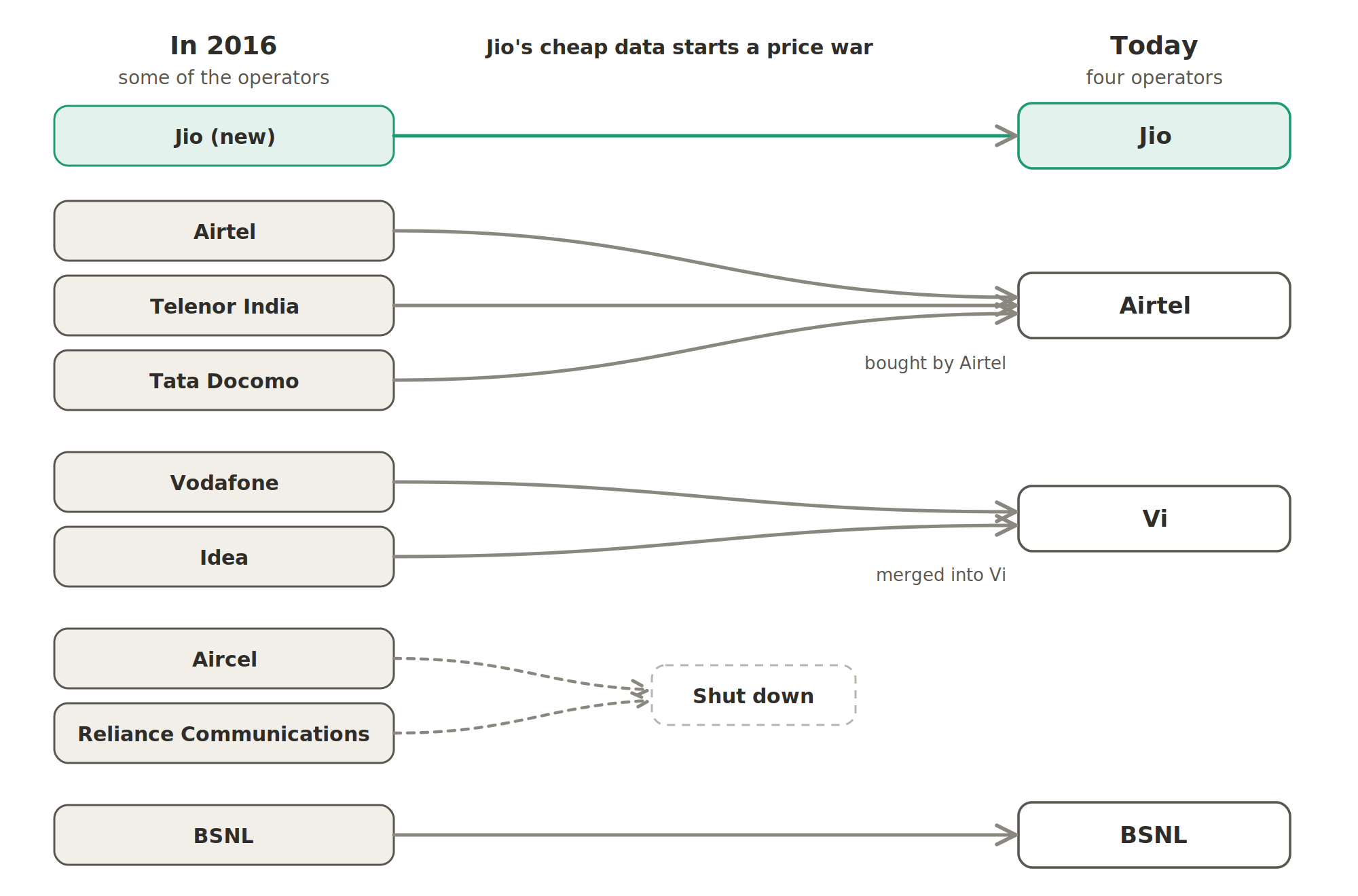 How Indian telecom shrank to four operators after Jio launched in 2016: Telenor India and Tata Docomo were bought by Airtel, Vodafone and Idea merged into Vi, Aircel and Reliance Communications shut down, and BSNL continued.
Today there are three private operators, Jio, Airtel and Vi, plus the state-owned BSNL. Jio and Airtel lead. Vi has struggled financially. BSNL is being rebuilt with government money.
Beside the consumer operators sits Tata Communications. It sells private networks to banks and large companies, international connectivity, and capacity on undersea cables. It carries a large share of India's international internet traffic, under a name few consumers know.
Some brands sell mobile service without owning a network, renting capacity from an operator instead. These are called MVNOs (Mobile Virtual Network Operators). They are common abroad but small in India.
The newer kind of operator builds its own technology instead of buying all of it. Airtel Digital is Airtel's in-house arm for its apps, digital services and internal platforms, in effect a sizeable software company inside a telecom company. Circles started in Singapore as a digital-only mobile brand. It now sells the platform it built to other operators. Jio did the same with its 5G network. It built a large part of it in-house instead of buying it from Ericsson or Nokia.
You won't find Jio, Vi or BSNL in the company list for this Market Segment. Jio posts its engineering jobs under other Reliance group names, and Vi and BSNL post very few.
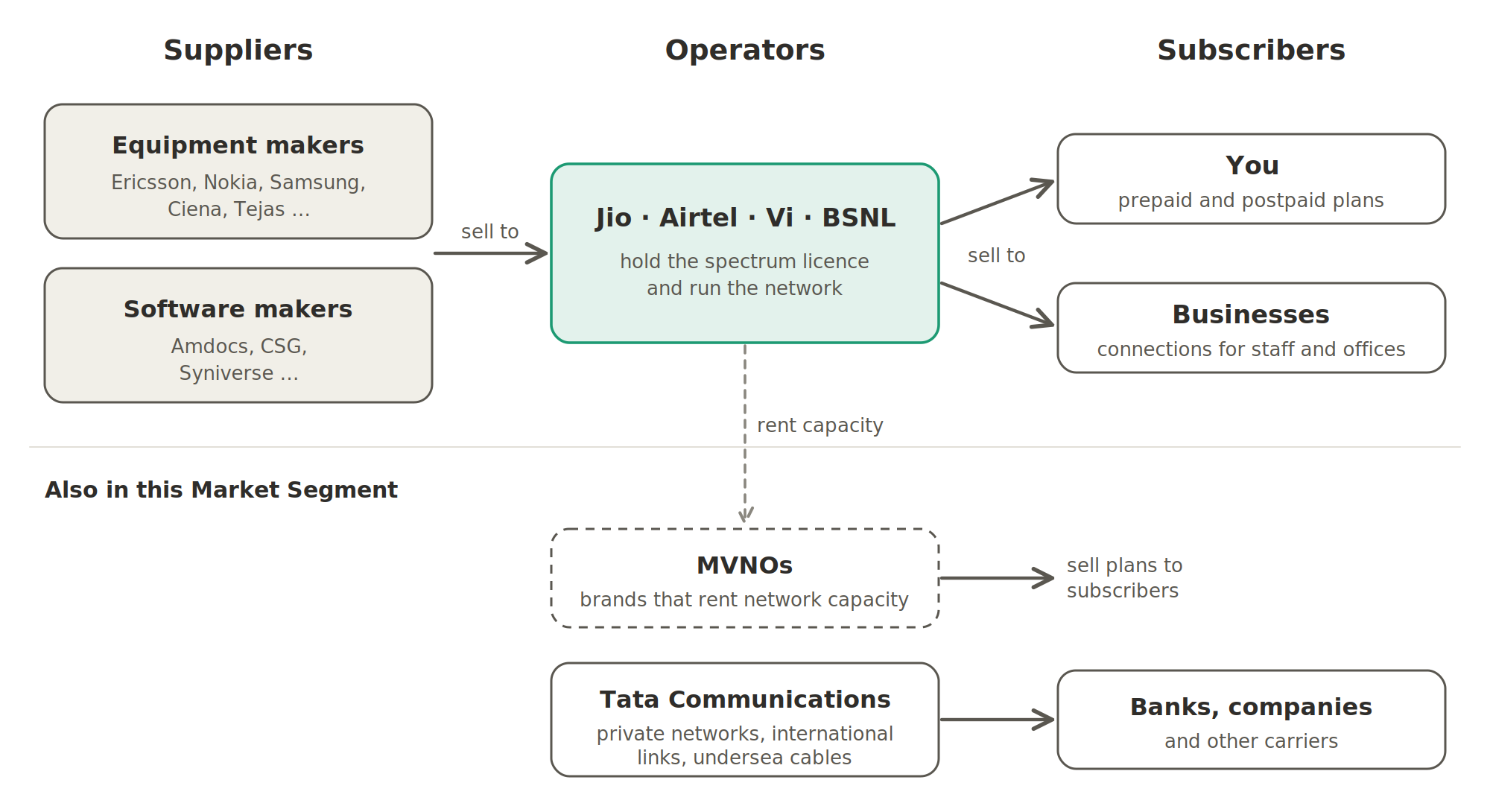 Who sells to whom: equipment makers and software makers sell to the operators (Jio, Airtel, Vi, BSNL), who sell plans to people and businesses. MVNOs rent capacity from operators and sell plans to subscribers. Tata Communications sells private networks, international links and undersea cable capacity to banks, companies and other carriers.
That is the full chain: the towers and the core, the fibre behind it, the software that runs the business, and the operators who own it all.
Who sells to whom: equipment makers and software makers sell to the operators (Jio, Airtel, Vi, BSNL), who sell plans to people and businesses. MVNOs rent capacity from operators and sell plans to subscribers. Tata Communications sells private networks, international links and undersea cable capacity to banks, companies and other carriers.
That is the full chain: the towers and the core, the fibre behind it, the software that runs the business, and the operators who own it all.