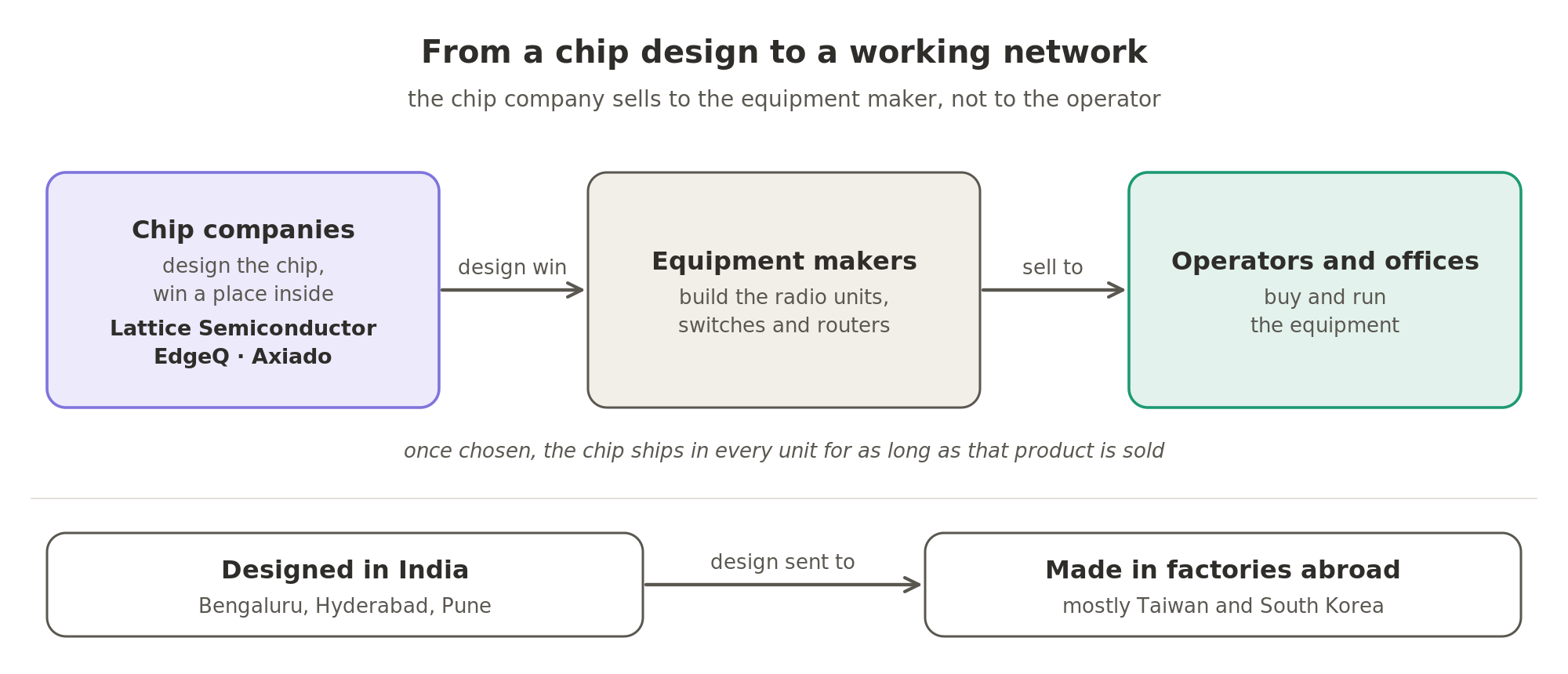
Their buyers are not operators or offices. Their buyers are the equipment makers themselves, like Ericsson, Nokia, Cisco and Arista. Getting your chip picked as the part inside another company's product is called a design win. Once a chip wins a place in a product, it usually stays for as long as that product is sold. For example, Nokia's 5G equipment uses chips developed with Marvell. Every unit Nokia sells carries those chips for as long as that product line runs. So a chip company can live for years on a handful of design wins.
Chip work across telecom. Telecom and networking equipment uses many kinds of chips. The main ones are:
- switching and routing chips, which move traffic through data-centre switches and routers
- 5G base station chips, which process the signals at a mobile tower
- optical and connectivity chips, which send data over fibre and between chips
- programmable chips, which can be configured again after the equipment ships
- security chips, which check that the equipment is safe before it starts
Most of these come from a few big chip companies. Broadcom and Marvell make many of the switching, optical and 5G chips.
Most chip companies, including all three in this Market Segment, design chips but do not make them. The factories are mostly in Taiwan and South Korea. India's part is design, and it is large. Bengaluru, Hyderabad and Pune have some of the biggest chip-design centres in the world, for the big chip companies and for start-ups alike. India does not yet make chips at large scale, though its first chip factories are being built.
This Market Segment covers three smaller companies. Each makes a chip for one specialist job inside network equipment.
Every company named here has posted software engineering jobs in India. Famous companies that don't actively hire software engineers in India are left out.
Keep reading, free
One more section is on this page: Three specialist chips. Sign in to read it here, in full.
Continue with Google- Three specialist chips
The programmable chip. Network standards keep changing after equipment is installed. A normal chip's circuits are fixed when it is made, so it cannot keep up. A programmable chip, called an FPGA (field-programmable gate array), can be configured again by software, even after the equipment has shipped.
The 5G base station chip. A base station is the electronics that run a mobile tower. It processes the signals to and from every phone nearby. Market Segment 1.1 described Open RAN: an effort to let operators buy a tower's hardware and software from different companies. For that, operators need base station chips that are not tied to one equipment maker like Ericsson, Nokia or Samsung.
GreenWave Radios also makes chips for the radio units on 5G towers.
If Open RAN spreads, chips like
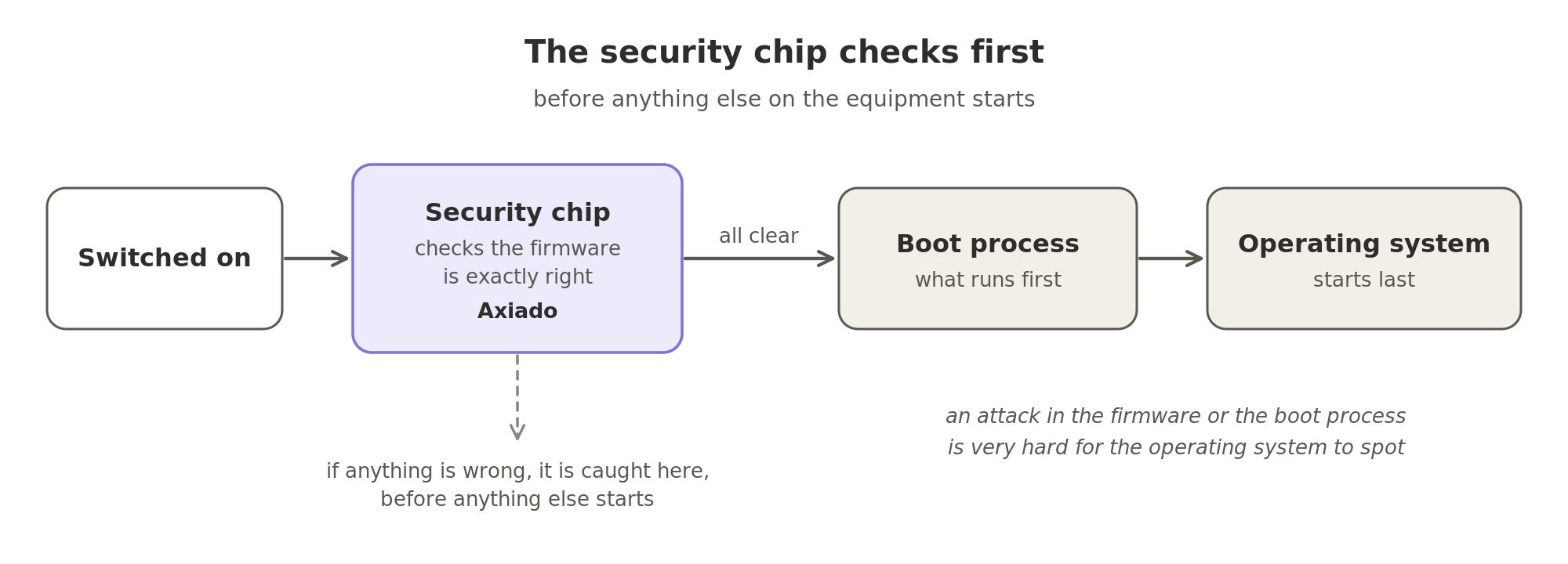
The security chip. Attackers don't always go after the software you can see. Some attack servers and network equipment at a lower level, in the firmware and the boot process. Firmware is the basic software built into the hardware. The boot process is what runs first when the equipment is switched on, before the operating system starts. An attack there can be very hard for the operating system to spot. The answer is a dedicated security chip. It checks that the equipment is running exactly what it should, before anything else starts.
Who these companies hire, and for what, is on What networking and telecom hires for.