ingrid.fyi India's software hiring trends, explained.
Sign in to ingrid.fyi with Google
Your Google account
name@gmail.com
Continue with Google
Home / Product companies / I · Networking, infrastructure and security / Business communications / CPaaS and business messaging
On this page
CPaaS and business messaging The messages and calls a business sends with a few lines of code Think of three things that reached your mobile phone this week. The one-time password (OTP) when you logged in to your bank. The WhatsApp message saying your order has shipped. The call from a masked number when the delivery rider was downstairs. A masked number hides both people's real phone numbers from each other.

No person sent any of these. A developer at the bank, the shop or the delivery app wrote a few lines of code. That code told a platform to send them. The platform did the rest. It found the right mobile operator for your number, delivered the message or connected the call, and reported back whether it reached your phone.

That platform is called communications platform as a service, or CPaaS. This Market Segment is about the companies that sell it. Their buyers are businesses and the developers who work for those businesses. You, the person receiving the message, never deal with these companies. The business pays them, and you just get the message.

Two things make this a business:

Operators are hard to deal with one by oneReaching a specific phone still means going through mobile operators like Jio, Airtel and Vi, each with its own rules, prices and connections. No app developer wants to deal with dozens of operators around the world. The platform deals with the operators once, and sells access to all of them through a single API. With it, a business can reach almost any phone number. Business messages are a separate marketMessages that businesses send to people are called A2P (application-to-person) messages. Operators check and price them separately from the messages people send each other. That is why a whole industry sits between the app and the operator.

Every company named here has posted software engineering jobs in India. Famous companies that don't actively hire software engineers in India are left out.

This Market Segment has two sub-segments:
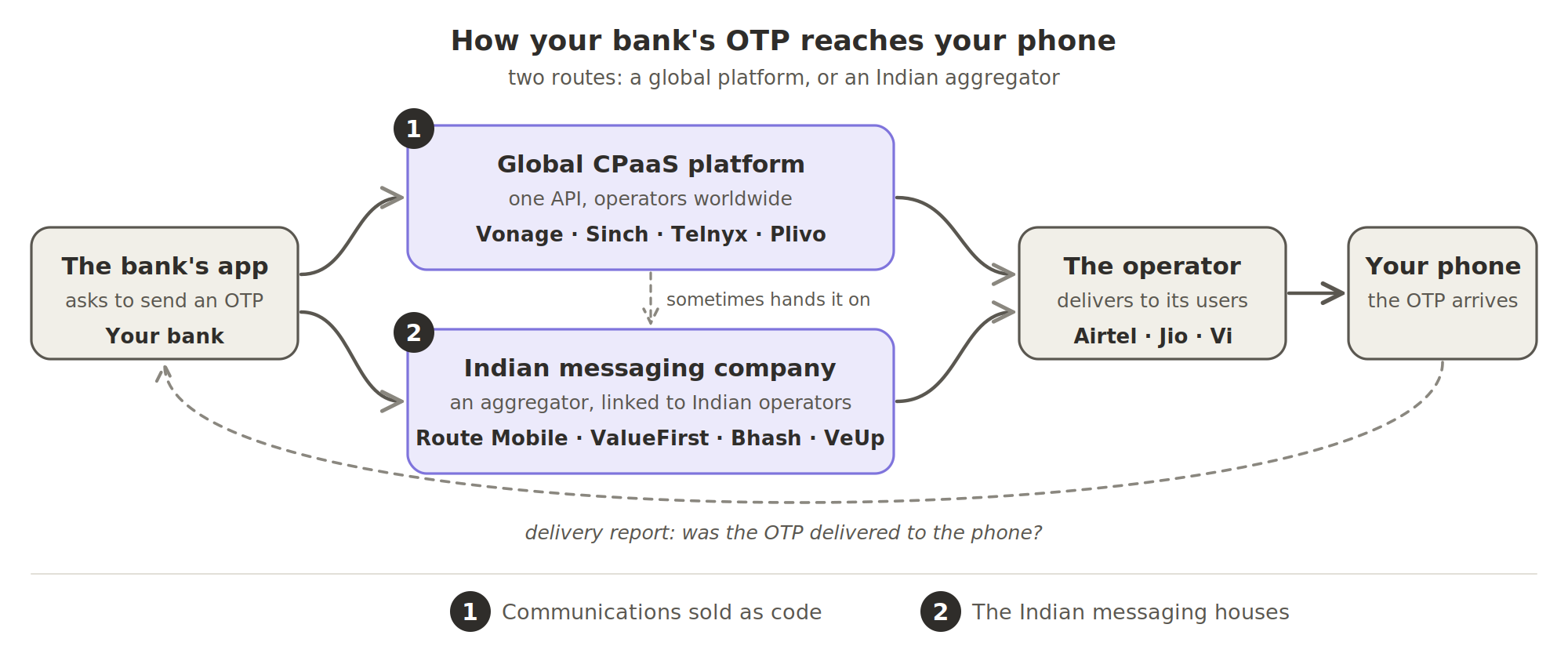
Communications sold as code: global platforms that sell SMS, voice, video and email as APIs The Indian messaging houses: Indian companies that carry businesses' messages to the operators How your bank's OTP reaches your phone, by one of two routes. The bank's app asks to send an OTP, either through a global CPaaS platform (Vonage, Sinch, Telnyx, Plivo) or through an Indian messaging company, an aggregator linked to Indian operators (Route Mobile, ValueFirst, Bhash, VeUp). A global platform sometimes hands the message on to an Indian aggregator. Either way, the operator (Airtel, Jio, Vi) delivers it to your phone, and a delivery report goes back to the bank. The two routes match the two sub-segments.How your bank's OTP reaches your phone, by one of two routes. The bank's app asks to send an OTP, either through a global CPaaS platform (Vonage, Sinch, Telnyx, Plivo) or through an Indian messaging company, an aggregator linked to Indian operators (Route Mobile, ValueFirst, Bhash, VeUp). A global platform sometimes hands the message on to an Indian aggregator. Either way, the operator (Airtel, Jio, Vi) delivers it to your phone, and a delivery report goes back to the bank. The two routes match the two sub-segments.

The other end of the same traffic, where businesses talk to their customers through contact centres and chatbots, is in Industry Vertical 15, Customer service and CX.

Keep reading, free

Two more sections are on this page: Communications sold as code and The Indian messaging houses. Sign in to read them here, in full.

Continue with Google
  • Communications sold as code
  • The Indian messaging houses
Communications sold as code The global API platforms: voice, SMS, video and email delivered as APIs

Take the bank OTP from the start of this Market Segment. The bank's developer can send it with one API call, the same way they would call any other web service. This idea started in the United States and Europe around 2008: put a phone network behind a web API, so a developer can send a text, make a call or verify a phone number with a few lines of code.

Twilio created this category. It currently posts no software engineering jobs in India, so it is not covered. The companies here are the ones that followed. Some of them started out as telecom companies, selling phone calls or running their own phone networks.

Vonageis the largest name here. It started by selling phone calls over the internet to homes. It then bought Nexmo, an API platform. Ericsson bought Vonage in 2022, to sell features of 5G networks to developers through the same kind of APIs. Vonage's India engineering is in Bengaluru. Sinchfrom Sweden, grew by buying companies in every channel: messaging, voice, email (through Mailgun) and phone-number verification. It is one of the few that carries a large share of the world's A2P messages over its own connections to operators. Telnyxruns its own private network to the operators, instead of renting one. On top of it, it sells voice, messaging, and even SIM cards for connected machines (IoT SIMs). Plivois Indian in origin. Its first code was written in Bengaluru, and it launched from San Francisco. It is a pure API company for voice and messaging, and now also sells voice bots that handle phone calls.

Two companies covered in other Market Segments also sell these APIs:

Exotelbegan as India's cloud telephony company. It made the masked-number calls and the IVR that most Indian consumer apps used before they built their own. IVR is the "press 1 for…" phone menu. Exotel still sells voice and messaging APIs, alongside the contact-centre business it grew into. (More on it in Market Segment 15.1, Contact centre software (CCaaS), in Industry Vertical 15, Customer service and CX.) SuprSendsells a layer above CPaaS. A developer sends a notification through one API, and SuprSend decides whether it goes by email, app notification, SMS or WhatsApp. (More on it in Market Segment 6.1, DevOps and CI/CD tools, in Industry Vertical 6, Devtools companies.) The network as an API.

This is why Ericsson bought Vonage. The idea is to open up the mobile network itself to developers, through the same kind of API that today only sends messages. For example, a bank's app could ask the operator whether a customer's SIM card was swapped recently, a common trick in fraud. It is early, and it depends on operators agreeing to open up. Vonage is the name here working on it.

The Indian messaging houses A2P messaging aggregators: SMS, WhatsApp, RCS and the SMS firewall for operators

Back to the bank OTP. Instead of a global platform, many Indian banks send their OTPs through an Indian messaging aggregator. Global platforms sometimes hand their Indian messages to one too.

Long before the term CPaaS was coined, Indian banks and online shops needed to send millions of SMS a day. A group of Indian companies grew up to do this. They held the connections to Airtel, Jio and Vi. They paid each operator a bulk price for every message delivered to its users, and charged businesses a little more per message. Each business also got a report showing whether each message was delivered. These companies are called aggregators.

That business has since moved on to WhatsApp Business, RCS and voice, and the aggregators have moved with it. RCS (Rich Communication Services) is an upgraded form of SMS. It is not the same as MMS, the older picture message, which could carry an image but little else and was rarely used by businesses. RCS works more like a chat app: it can show images, buttons and the business's verified name. So the same company that once sent your bank's OTP now often runs its WhatsApp conversations too.

Route Mobileis headquartered in Mumbai, and its shares are traded on the stock market. Proximus, the Belgian operator, owns most of it. It also sells an SMS firewall: the system operators use to check and filter the very business messages that aggregators send. ValueFirstin Delhi NCR, is one of the oldest. It has added cloud calling services and a platform for AI chat conversations to its messaging business. Bhash Software Labsis a smaller Bengaluru company, built on bulk SMS and WhatsApp connections for businesses. VeUpis a newer company. It sells one messaging platform across SMS, WhatsApp and other channels to banks and start-ups. It measures its business in messages sent per month, rather than in number of customers.

Some of the largest aggregators operating in India, Tanla, Gupshup, Kaleyra and Infobip, are not covered in this Market Segment. Karix, which used to be Tanla's brand for selling to businesses, is covered in Market Segment 13.1, Marketing automation and customer engagement platforms (in Industry Vertical 13, Martech), because the software jobs it posts are about marketing automation. So the companies named here are not a list of the biggest players in this market.

From message to conversation.

The aggregators' growth no longer comes from sending more SMS. It comes from running the whole conversation on WhatsApp and RCS: the chatbot, the product catalogue and the payment, all inside the chat. ValueFirst's AI chat platform and VeUp's messaging platform are the examples here. Marketing software companies are doing the same from the other direction. (More in Market Segment 13.2, WhatsApp marketing and conversational commerce platforms, in Industry Vertical 13, Martech.)

That is how your bank's OTP reaches you: the bank's code calls either a global platform or an Indian aggregator, that company carries the message to your operator, and the operator delivers it to your phone.
Who they hire

Who these companies hire, and for what, is on What business communications hires for.

Privacy Terms Refunds and cancellation Shipping and delivery © 2026 ingrid.fyi · Payments by Razorpay
You're browsing as a guest. Sign in free to follow links for five minutes, once an hour.