ingrid.fyi India's software hiring trends, explained.
Sign in to ingrid.fyi with Google
Your Google account
name@gmail.com
Continue with Google
Home / Product companies / II · Cloud platforms and developer tools / Devtools companies / Software testing platforms
On this page
Software testing platforms Testing an app on every browser, phone and screen before it reaches customers A food-delivery app in Bengaluru is about to release a new checkout screen. Before it reaches production, the live app that customers use, somebody has to find out whether it works. It has to work on every browser, every phone and every screen size. It has to keep working when thousands of people order at once, at dinner time. And it has to be checked again after every later change.

That checking is called testing. Much of it is automated. An automated test is a small program that uses the app the way a person would, and checks the result. In India, testing became the largest single occupation in the software industry long before it became a product that companies sell.

The people who test by hand work for IT services firms, in the largest test centres in the world. (More on these firms in the services-world collection.) This Market Segment is about what they buy: the companies that sell the machinery of testing, not the people. Unusually, much of this industry was founded in India.

Every company named here has posted software engineering jobs in India. Famous companies that don't actively hire software engineers in India are left out. Some of the best-known testing companies that sell to large businesses are not covered in this Market Segment.

This Market Segment has three sub-segments, and it follows the test outward. The first covers the phones and browsers a team cannot own, which it rents from a cloud test grid. The second covers the tools in which the test is written, more and more often by a tool rather than a person. The third covers the newest thing to be tested: the conversation a customer has with a machine.

Keep reading, free

Three more sections are on this page: The devices and browsers you cannot own, Writing the test, and Testing the conversation. Sign in to read them here, in full.

Continue with Google
  • The devices and browsers you cannot own
  • Writing the test
  • Testing the conversation
The devices and browsers you cannot own Cloud test grids, testing on real devices, and testing across browsers

Back to the new checkout screen from the start of this Market Segment. It has to work on hundreds of phone models and browser versions. No team can keep every phone and browser on a shelf, so the companies in this sub-segment rent them out. They keep thousands of real devices and browser versions in a data centre. The industry calls this a cloud test grid. A team's automated tests run on many devices at the same time, and a developer can also open the app on any of them by hand.
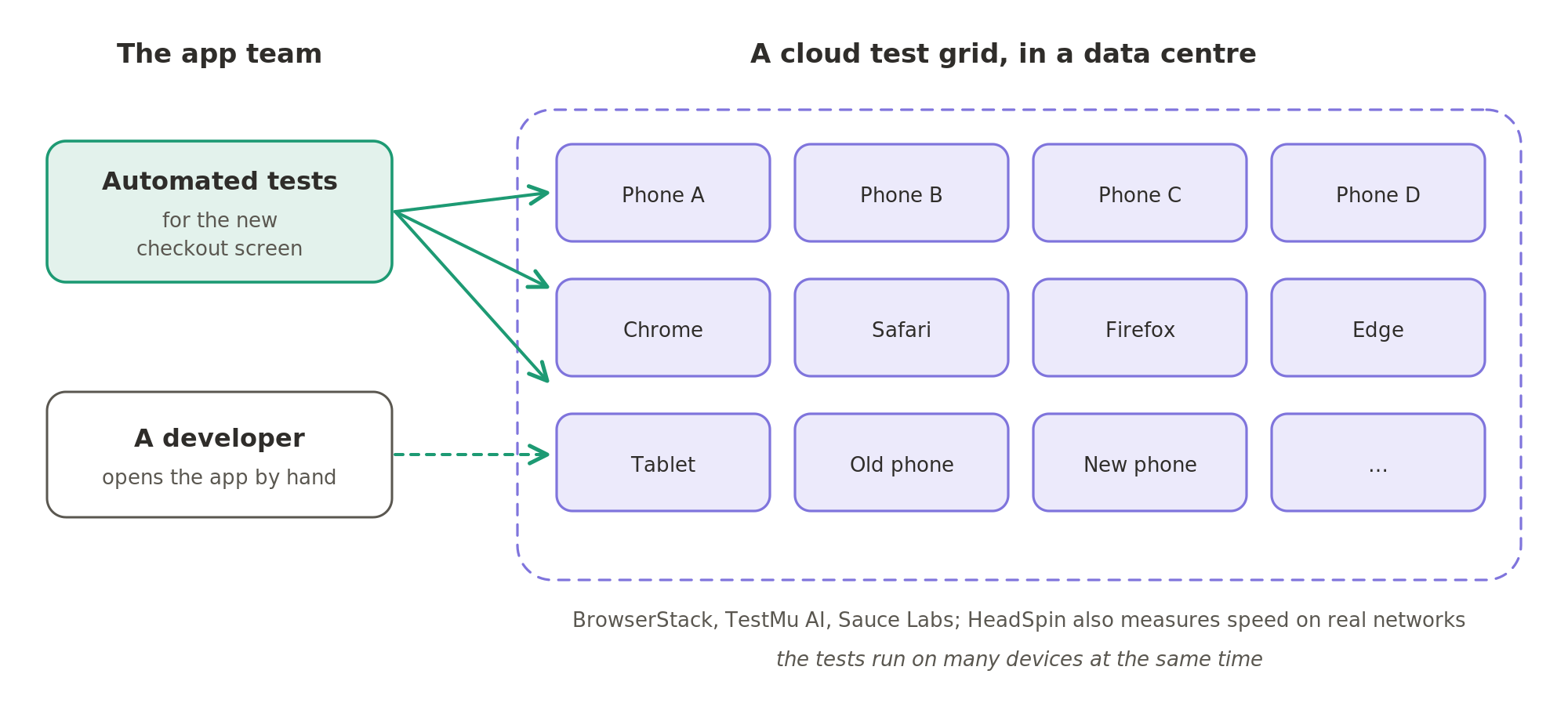
BrowserStackwas founded in Mumbai in 2011, and it is still built there. It is one of the two large names in this business. TestMu AIformerly LambdaTest, was founded in Noida. It is a newer Indian company competing in the same market. It has extended the grid into test orchestration: deciding which tests run, on which devices and in what order. More recently, it has added AI agents that write and run tests. An AI agent is software that uses a language model, the kind of AI behind chatbots, to take actions on its own. Sauce Labsthe American company that started this category, opened an engineering centre in Delhi in 2026. HeadSpinwith engineers in Bengaluru, uses the same idea to measure performance. It checks how an app actually behaves on real devices, on real networks around the world. For the checkout screen, that means how fast it works on a real phone network, not just whether it works. A cloud test grid keeps real phones, tablets and browser versions in a data centre, so a team's automated tests for the new checkout screen run on many of them at the same time, and a developer can open the app on any one by hand.A cloud test grid keeps real phones, tablets and browser versions in a data centre, so a team's automated tests for the new checkout screen run on many of them at the same time, and a developer can open the app on any one by hand. The grid that writes the test.

Both Indian grids, BrowserStack and TestMu AI, are moving beyond renting the device. They now also generate the test that runs on it. That is the business of the next sub-segment, Writing the test, arriving in this one.

Writing the test Test automation platforms, API testing, tests written in plain English or by AI, and testing of packaged business software

The checkout screen also needs its tests written. This sub-segment covers the tools in which tests are written. Their history is a series of attempts to need fewer people to write them.
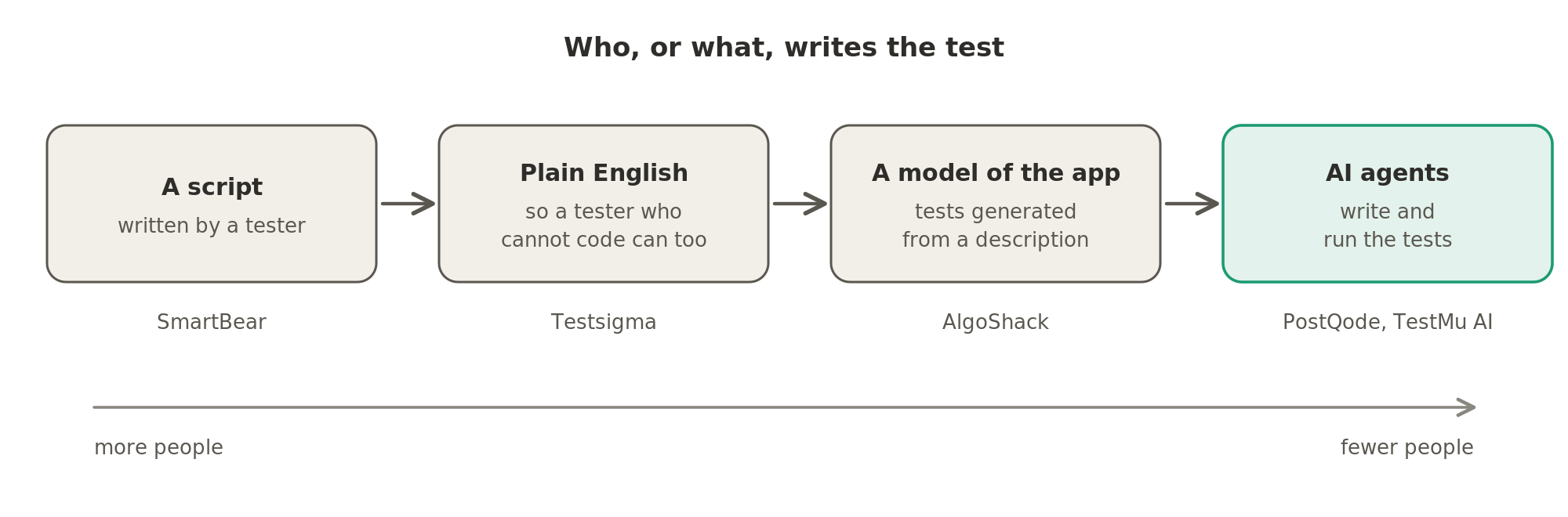
SmartBearwith engineers in Bengaluru, is the established name. It sells TestComplete for testing applications, and ReadyAPI for testing APIs. It also owns Swagger, the tools in which OpenAPI, the format for describing APIs, began. (More on APIs in Market Segment 6.1, DevOps and CI/CD tools.) Testsigmaa Bengaluru company, sells tests written in plain English. Now the tests can also be generated by an AI model. So a tester who cannot code can still automate tests. AlgoShackalso in Bengaluru, sells a platform that generates the tests from a model of the application, rather than from a script. Here, a model means a description of how the application behaves, not an AI model. Opkeyfounded in Noida, with engineers in Bengaluru and Delhi, automates one hard corner: packaged applications. These are large business systems that a company buys rather than builds, such as Oracle, SAP and Workday. Companies adapt them to fit their own business, and these changes are called customisations. The vendor's quarterly updates break these customisations, so they have to be tested again every time. (More on these systems in Market Segment 10.1, ERP and business accounting software, in Industry Vertical 10, ERP and business automation.) PostQodea young Bengaluru company, puts AI agents inside the developer's code editor. The agents write and run tests for APIs, websites and mobile apps. The tools for writing tests have moved from scripts written by testers, to plain English, to tests generated from a model of the app, to AI agents that write and run the tests, each step needing fewer people.The tools for writing tests have moved from scripts written by testers, to plain English, to tests generated from a model of the app, to AI agents that write and run the tests, each step needing fewer people.
You're reading as a guest. Sign in free to follow links for five minutes, once an hour. Testing the conversation Testing customer care centres and voice agents

Now suppose a customer calls the food-delivery app about a late order. The call may be answered by a phone menu ("press 1 for…"), a chatbot, a human agent, or a voice agent: an AI agent that talks. The whole setup is a customer care centre, and the industry calls it a contact centre. It has to be tested too. The newest thing that has to be tested is a conversation.
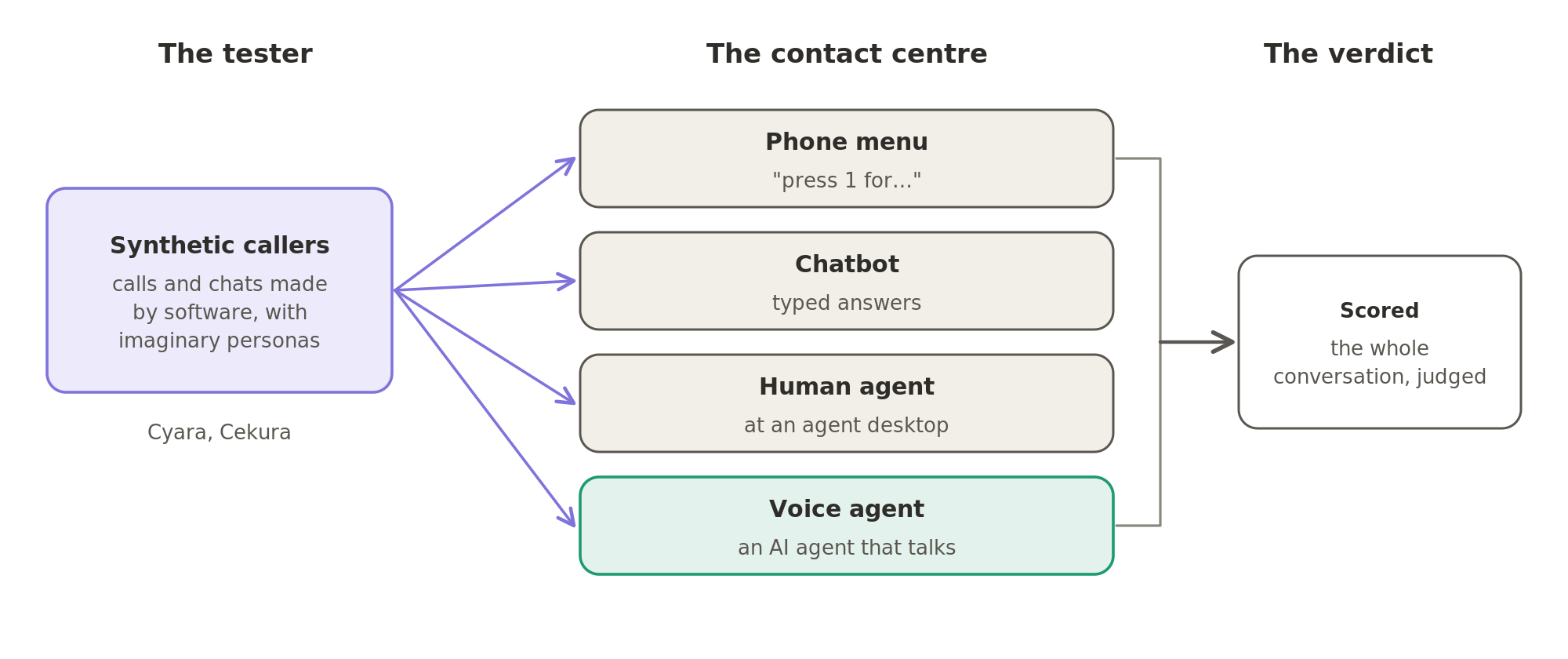
Cyarawith engineers in Hyderabad, tests contact centres. It places synthetic calls and chats, made by software rather than by real customers. They go through a company's phone menus, its chatbots and its agent desktops, the screens that human agents work on. Cyara finds out what a customer would actually experience, before a real customer does. Cyara also appears in Market Segment 15.1, Contact centre software (CCaaS) (in Industry Vertical 15, Customer service and CX). Cekurais a San Francisco start-up with engineers in Bengaluru. It came out of Y Combinator, a well-known programme that funds young start-ups. It does the same for voice agents built on language models. It creates test scenarios and personas, imaginary callers, and runs them against the voice agent. Then it scores the result. The whole customer-service industry now needs this test, and did not need it two years ago. (More on these voice agents in Market Segment 15.2, Conversational AI for customer service, in Industry Vertical 15, Customer service and CX.) To test a contact centre, synthetic callers made by software go through the phone menu, the chatbot, the human agents' desktops and the voice agent, and the whole conversation is scored rather than one answer checked.To test a contact centre, synthetic callers made by software go through the phone menu, the chatbot, the human agents' desktops and the voice agent, and the whole conversation is scored rather than one answer checked. The test for a machine that talks back.

An ordinary test compares the output with the exact answer it expects. A voice agent gives a different answer each time, so that kind of test does not work. Cekura's kind of tool judges the whole conversation instead of checking one result. This is the shape testing takes when the thing being tested is an AI model. (More on testing AI models in Market Segment 9.2, MLOps and LLMOps platforms, in Industry Vertical 9, AI labs and model platforms.)

That is testing as a product: phones and browsers rented from a grid, tools that write the tests, and a new kind of test for software that talks back.
Who they hire

Who these companies hire, and for what, is on What devtools companies hire for.

Privacy Terms Refunds and cancellation Shipping and delivery © 2026 ingrid.fyi · Payments by Razorpay
You're browsing as a guest. Sign in free to follow links for five minutes, once an hour.