Your new phone arrives with a cracked screen. You message the shop on WhatsApp. Within seconds, a reply asks for a photo, checks your order and books a pickup for the return. No person was involved at any step. The reply came from an AI agent: software that talks with customers, by chat or by voice, and handles their request without a person.
The same software is behind the chatbot on a bank's website. It is also the voice on an insurer's helpline that understands a whole sentence, not just a keypress. In Market Segment 15.1, Contact centre software (CCaaS), the big platforms were adding a virtual agent like this to their products. The companies in this Market Segment sell nothing else. Their buyers are companies that get huge numbers of customer calls and messages: banks, insurers, airlines, retailers and telecom operators.
This is the most crowded Market Segment in this Industry Vertical, and the most Indian. Most of its companies were founded in Bengaluru. India's conversational-AI industry grew up serving Indian banks and telecom operators in a dozen languages, before it sold to the world.
Every company named here has posted software engineering jobs in India. Famous companies that don't actively hire software engineers in India are left out.
This Market Segment has two sub-segments, which follow the industry's history:
The conversational platformthe tools to build the bot. These companies began before today's large language models, the AI behind tools like ChatGPT, and have rebuilt their products around them.
The agent that resolvesnewer companies, founded on the language models. What they sell is the problem solved, not just the conversation held.
Other kinds of AI agent are covered elsewhere. Agents built to sell rather than to serve are covered in Market Segment 13.2, WhatsApp marketing and conversational commerce platforms (in Industry Vertical 13, Martech). AI agents that companies hire for all kinds of work are covered in Market Segment 10.5, Enterprise AI agent platforms (in Industry Vertical 10, ERP and business automation).
The conversational platform
Conversational AI platforms, chatbots and voicebots, omnichannel virtual assistants, agent assist, voice biometrics
Take the WhatsApp chat about the cracked phone from the start of this Market Segment. Someone had to build the bot that replied, and the companies in this sub-segment sell the platform to build it. Most of them are from Bengaluru.
Before the language models, a bot like this worked from a script. Its designers listed the questions customers might ask, which the industry calls intents. Then they wrote the replies as a tree of choices. The language models replaced most of that work, and these platforms have been rebuilt around them.
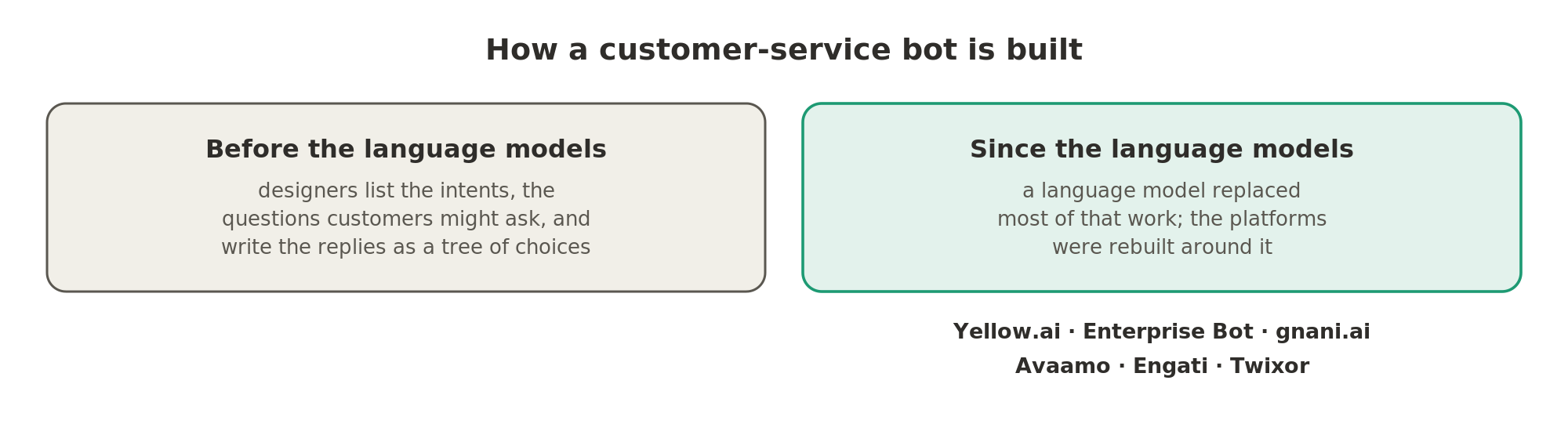 Before the language models, designers listed the questions customers might ask and wrote the replies as a tree of choices, and now a language model does most of that work.
The two biggest names:
Yellow.aifounded in Bengaluru, is the largest Indian conversational-AI company. Its platform runs the chat and voice agents of banks, airlines and retailers across Asia, the Middle East and Latin America. It has engineers in Bengaluru. It also posts jobs under Conversas inteligentes, its Brazilian company.
Enterprise Botsells a platform for generative chatbots, which write their own replies using a language model. It also sells email triage, which sorts incoming customer emails, and agent assist, which suggests answers to a human agent during a conversation. Its buyers are insurers and banks in Europe. It has engineers in Bengaluru, and more job postings than any other company in this Market Segment.
Three companies focus on voice:
gnani.aifounded in Bengaluru, sells voice agents that speak Indian languages. It also sells agent assist, and post-call analytics that study each call after it ends. And it sells voice biometrics, which recognise a caller by their voice. It has engineers in Bengaluru and Delhi. (More on checking who a customer is in Market Segment 4.3, KYC, identity verification and fraud prevention, in Industry Vertical 4, Cybersecurity.)
Avaamosells an IVR that understands speech. An IVR is the "press 1 for…" phone menu. With Avaamo's, the caller can simply say what they want. It has engineers in Bengaluru.
Commotionsells real-time voice AI, with a customer data platform built in. A customer data platform keeps one record of everything a company knows about each customer. Commotion has engineers in Mumbai.
Three more focus on chat and messaging, or on the whole customer experience:
Engatisells the WhatsApp bot. It has engineers in Bengaluru.
Twixorsells omnichannel journeys, in which one conversation can move across chat, WhatsApp, email and phone. It also sells a conversational assistant. Its buyers are Indian and South-East Asian enterprises. It has engineers in Bengaluru.
Omindsells a unified customer-experience suite. Customer experience, or CX, is the industry's name for every contact a customer has with a company. Omind has engineers in Bengaluru.
Tars, a small Bengaluru company, presents itself as a chatbot builder. [24]7.ai is an American customer-engagement company.
Haptik and Kore.ai are not covered in this Market Segment.
The agent that resolves
Generative customer-service agents, autonomous ticket resolution, AI voice agents, service resolution intelligence
Back to the cracked phone from the start of this Market Segment. Answering your message was the easy part. Booking the pickup and issuing the refund meant acting inside the shop's own systems. The companies in this sub-segment were founded on the language models, and they sell exactly that: the case closed, not just the conversation held.
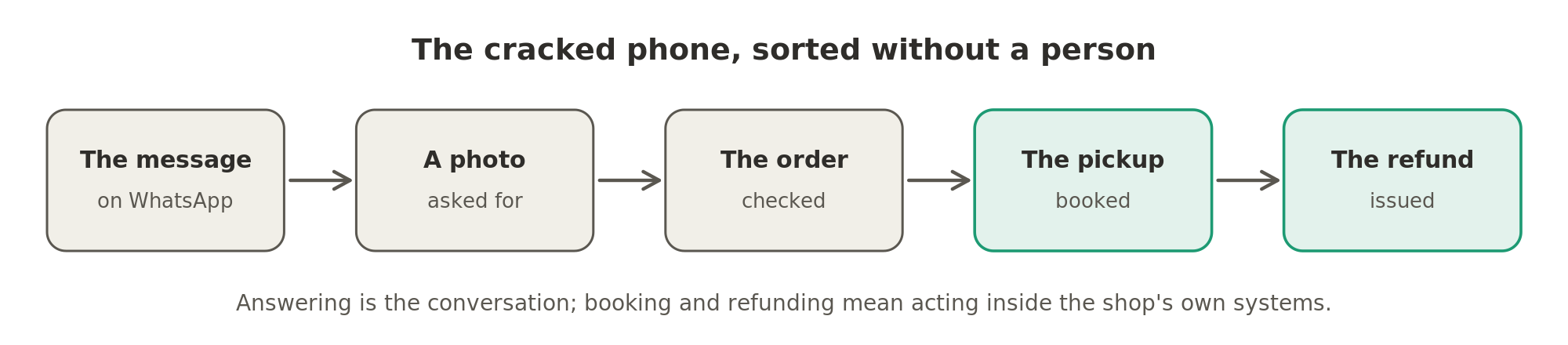 The cracked phone is sorted by an agent that asks for a photo, checks the order, books the pickup and issues the refund, acting inside the shop's own systems.
Many of them work on tickets. A ticket is a customer's complaint or request, recorded as one item to be solved. (More on tickets in Market Segment 15.4, Help desk and customer success software.)
ASAPPa New York company, sells GenerativeAgent. It handles a contact-centre call or chat from start to end. It uses the company's own systems to act, and hands over to a person only when it must. ASAPP has engineers in Bengaluru.
Fini, GigaML and Robylon AIsell the same promise to smaller companies: AI support agents that read the ticket, find the answer and resolve it. Fini has engineers in Bengaluru, Delhi and Mumbai. GigaML and Robylon AI are both small Bengaluru companies.
Broccoli AI and ShortLoopalso from Bengaluru, sell the voice version: an agent that answers the phone, books the appointment and takes a message.
Neuron7.aisells service resolution intelligence. Its model reads a company's case history and manuals. Then it tells the agent, human or AI, how the same problem was fixed before. It has engineers in Bengaluru. The same product serves technicians sent out to repair things. (More on it in Market Segment 15.6, Field service and appointment booking software.)
One much older company sits here too. West Technology Group, formerly Intrado, sells conversational automation to American hospitals and utilities. For hospitals, it also sends patient-engagement messages, such as appointment reminders. It has engineers in Bengaluru.
The case closed without a person.
The conversational platforms measured how many contacts the bot handled without passing them to a person. The industry calls this the containment rate. The resolving agents measure how many problems they actually solved. They are priced by the resolution, not by the seat, which the industry calls outcome-based pricing. This change in what is sold, from software for human agents to outcomes without them, is the biggest threat to the contact centre of Market Segment 15.1.
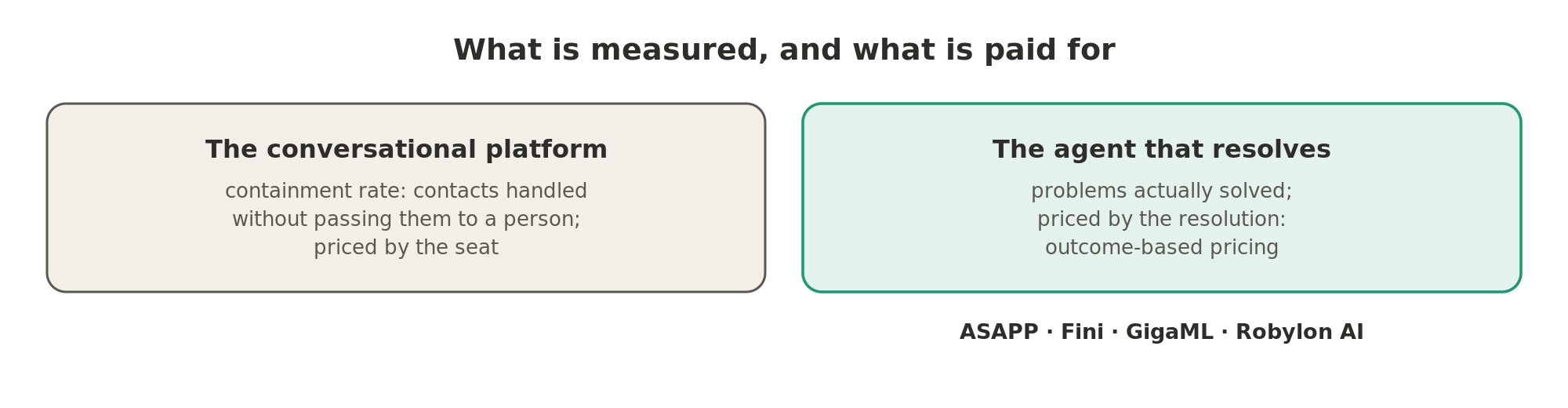 The conversational platforms measured contacts handled without a person and were priced by the seat, while the resolving agents measure problems solved and are priced by the resolution.
That is how the cracked phone got sorted out. A bot answered the message, and an agent that could act booked the pickup and the refund, with no person involved.
The conversational platforms measured contacts handled without a person and were priced by the seat, while the resolving agents measure problems solved and are priced by the resolution.
That is how the cracked phone got sorted out. A bot answered the message, and an agent that could act booked the pickup and the refund, with no person involved.