On the first of the month, your salary lands in your bank account. That afternoon, you pay your rent from the bank's app. In the evening, you take cash out of an ATM. That night, while you sleep, the bank calculates the interest on your balance. At the end of the month, it sends you a statement.
Behind all of this sits one system, the bank's core, or core banking system. The core holds every account and every loan. It posts every deposit and withdrawal, meaning it records it against the right account. It calculates the interest each night, and it produces the statement. The bank's app and website, called the digital bank, are built on top of the core.
Most banks do not write their own core. They buy it. Core banking software is some of the oldest and most important software in the world.
Around the core, a newer layer has grown. It lets companies that are not banks offer accounts and cards to their customers, through a partner bank's licence. This is called banking as a service, or BaaS.
Industry Vertical 19, Banking and regtech, covers the software that banks buy in order to be banks. This Market Segment covers four things: the core, the digital bank on top of it, the card and ledger platforms of the newer layer, and the cash machine. It has the most job postings in Industry Vertical 19. India matters to it in two ways. Many of the world's core-banking companies build their software in India. And some of the largest ones are Indian, though most of those do not post software engineering jobs of their own.
Every company named here has posted software engineering jobs in India. Famous companies that don't actively hire software engineers in India are left out.
This Market Segment has three sub-segments:
The core and the digital bank: the system that keeps the accounts, and the app and website built on it
Cards, ledgers and banking as a service: the pieces a bank or fintech needs to launch a card or an account quickly
The cash machine: the ATM and its software
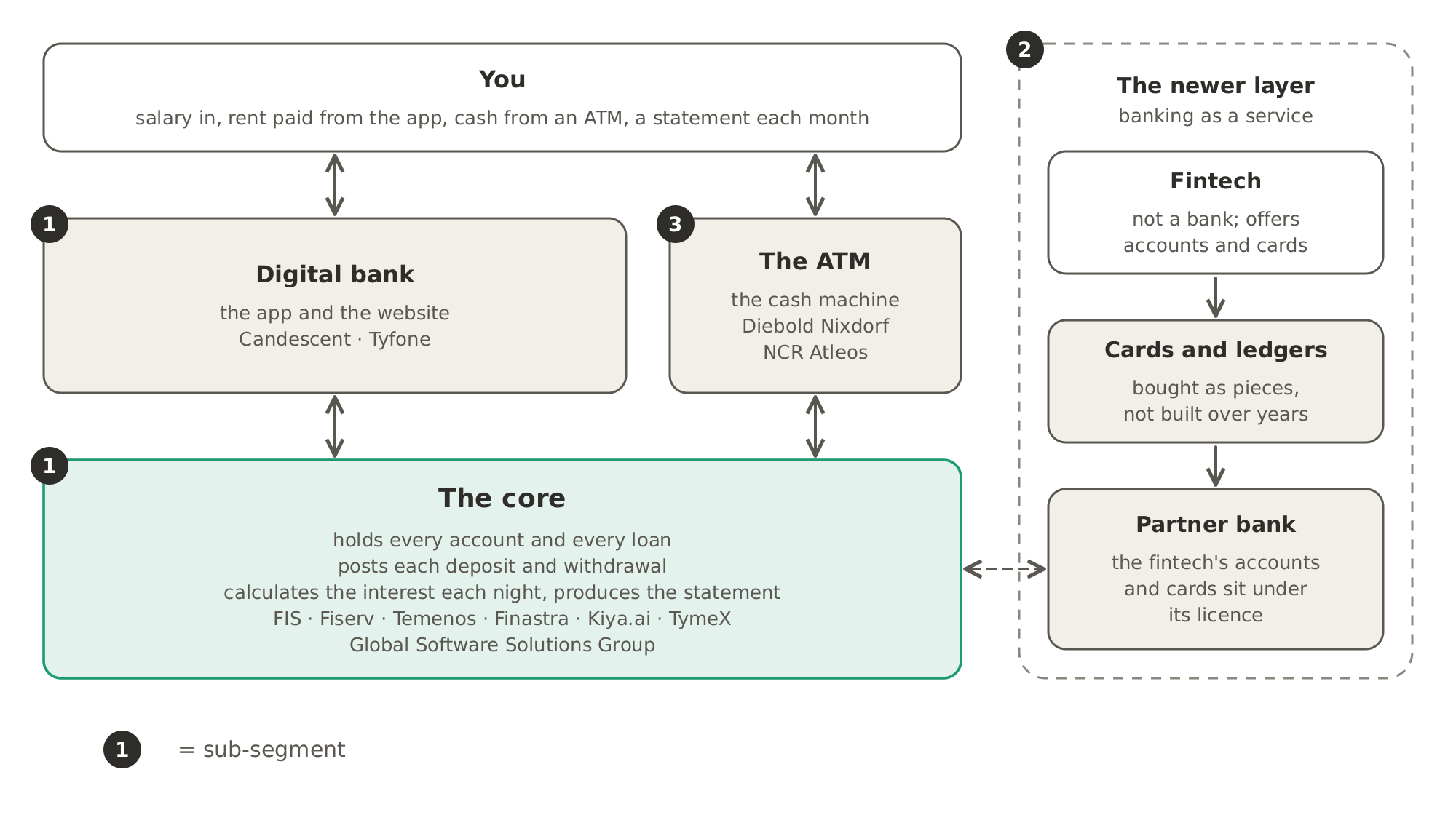 You reach the bank through its digital bank, the app and the website, and through the ATM, and both sit on the core, which holds every account and loan, posts each deposit and withdrawal, calculates the interest and produces the statement. Beside the core, the newer layer of banking as a service lets a fintech offer accounts and cards through a partner bank's licence. The numbers 1 to 3 match the three sub-segments below.
The core and the digital bank
Core banking systems, digital banking platforms, banking software for credit unions and community banks
You reach the bank through its digital bank, the app and the website, and through the ATM, and both sit on the core, which holds every account and loan, posts each deposit and withdrawal, calculates the interest and produces the statement. Beside the core, the newer layer of banking as a service lets a fintech offer accounts and cards through a partner bank's licence. The numbers 1 to 3 match the three sub-segments below.
The core and the digital bank
Core banking systems, digital banking platforms, banking software for credit unions and community banks
Take your salary from the start of this Market Segment. It landed in your account because the core recorded it there, and you saw it because the digital bank showed it to you. The companies here sell those two systems. Many of their customers are American credit unions and community banks. A credit union is a bank owned by its own members. A community bank is a small local bank.
Candescentwith engineers in Bengaluru, Hyderabad and Mumbai, has the most job postings in this Market Segment, and in Industry Vertical 19. It sells the digital bank of American banks and credit unions: the app and the website through which their customers bank. It also sells a platform through which a bank adds other companies' products to its app. Candescent was NCR Voyix's digital banking business, until it was sold and renamed in 2024.
FISwith engineers in Pune, Bengaluru and Chennai, and Fiserv are the two largest sellers of core banking and card processing in America. Thousands of banks keep their accounts on their systems. (Fiserv's point of sale, Clover, is in Market Segment 17.3, Point of sale (POS), in Industry Vertical 17, Payments.)
Temenosa Swiss company, and Finastra sell the core, the digital channels and the lending systems of banks around the world. Digital channels are the ways a customer reaches the bank online, such as the app and the website.
Global Software Solutions Groupwith engineers in Bengaluru and Chennai, sells Veracious. It is a core banking system and payments hub for banks in the Middle East, Africa and Asia. A payments hub is one system through which a bank sends and receives every kind of payment.
Kiya.aiformerly called Infrasoft Technologies, is an Indian company that sells core banking and compliance software. Compliance software helps a bank follow the regulator's rules.
TymeXbuilds the core of Tyme Group's digital banks in South Africa and the Philippines.
Tyfone Inc.with engineers in Bengaluru, sells the digital bank of American credit unions.
One company here is covered mainly in another Market Segment:
Tandemswith engineers in Delhi NCR, sells banking and advice software. (More on Tandems in Market Segment 20.5, Wealth management and advisory platforms, in Industry Vertical 20, Wealthtech and capital markets.)
Cards, ledgers and banking as a service
Card issuing and management platforms, cloud ledgers, account aggregator and banking APIs, loan management for fintechs
Now take a fintech in Bengaluru that wants to launch a credit card. A fintech is a young company that sells financial products through an app. It is not a bank, and it cannot wait years to build a core. So it buys the pieces. The companies here sell them.
Two of those pieces come up again and again. Card issuing is creating the card, setting its limit and running it through its life. A ledger is the record of every amount that goes in and out of each account.
Pismoa Brazilian company that is now part of Visa, has engineers in Bengaluru. Visa bought it in 2024. It sells a cloud core for cards and accounts: the ledger and the card issuing. On it, a bank can launch a new product without touching its old core. (More on Visa in Market Segment 17.1, Card networks and payment processing, in Industry Vertical 17, Payments.)
CARD91with engineers in Bengaluru, Vegapay, with engineers in Bengaluru and Delhi NCR, and Hyperface are Indian card-issuing platforms. Indian banks launch credit cards on them, including the credit cards that can now be spent through UPI (Unified Payments Interface). CARD91 also runs a UPI switch, the system that passes each UPI payment on to the right bank.
Episode Sixwith engineers in Chennai, sells the same kind of ledger and card issuing, in other countries.
Setuowned by Pine Labs, has engineers in Bengaluru. It sells APIs on India's public financial systems. An API is a way for one company's software to use another's. Setu's APIs cover four systems:- the account aggregator, which shares a person's bank data with a lender, with their consent
- UPI
- bill payments
- electronic signatures
OneFinsells loan origination and loan management to fintechs, as APIs. Loan origination covers everything from the application to the approval.
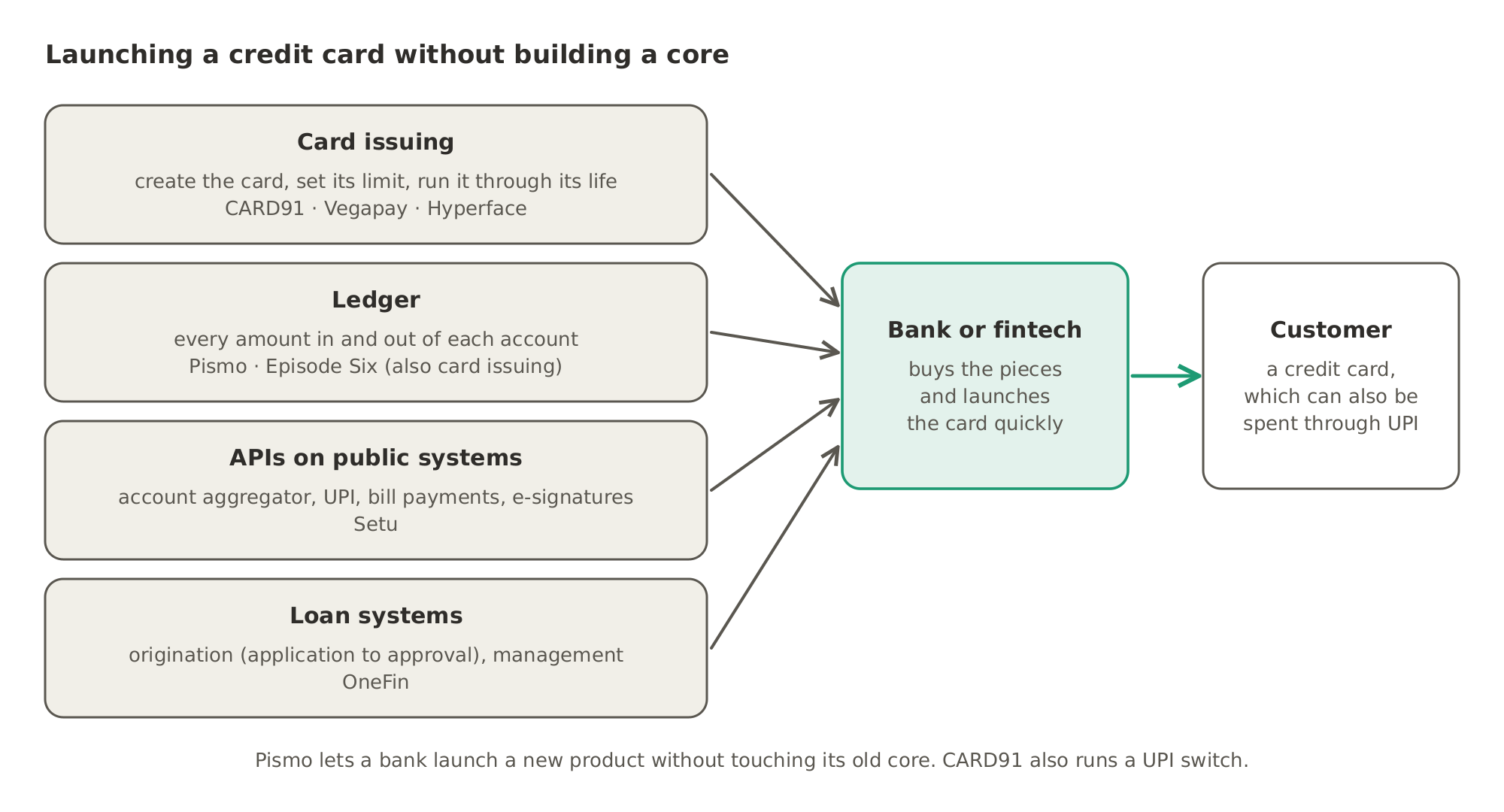 To launch a credit card without building a core, a bank or fintech buys the pieces: card issuing from CARD91, Vegapay or Hyperface, a ledger from Pismo or Episode Six, APIs on India's public financial systems from Setu, and loan systems from OneFin.
You're reading as a guest. Sign in free to follow links for five minutes, once an hour.
Sign in
The cash machine
ATMs, self-service banking terminals and their software
To launch a credit card without building a core, a bank or fintech buys the pieces: card issuing from CARD91, Vegapay or Hyperface, a ledger from Pismo or Episode Six, APIs on India's public financial systems from Setu, and loan systems from OneFin.
You're reading as a guest. Sign in free to follow links for five minutes, once an hour.
Sign in
The cash machine
ATMs, self-service banking terminals and their software
Back to the cash you took out that evening. The ATM is the bank's oldest self-service channel.
One company here is covered mainly in another Market Segment:
Diebold Nixdorfwith engineers in Mumbai and Hyderabad, makes ATMs and the software that runs them for banks. It also makes self-checkouts for retailers, the machines where shoppers scan and pay for their own goods. (More on Diebold Nixdorf in Market Segment 27.3, Retail checkout and store systems, in Industry Vertical 27, Retail tech. It also appears in Market Segment 19.3, ATMs, conversational AI and collections.)
NCR Atleos, the other large ATM maker, is covered in Market Segment 19.3, ATMs, conversational AI and collections.
The core replaced while the bank runs.
Banks' cores are often decades old. Replacing one is among the riskiest projects in business, because the bank cannot stop while it happens. The cloud cores in the second sub-segment help. A bank can launch new products on the cloud core, beside the old one, and move the accounts across a few at a time. AI models now read the old core's code and help translate it. Many of the world's core-banking replacements are built or set up partly in India.
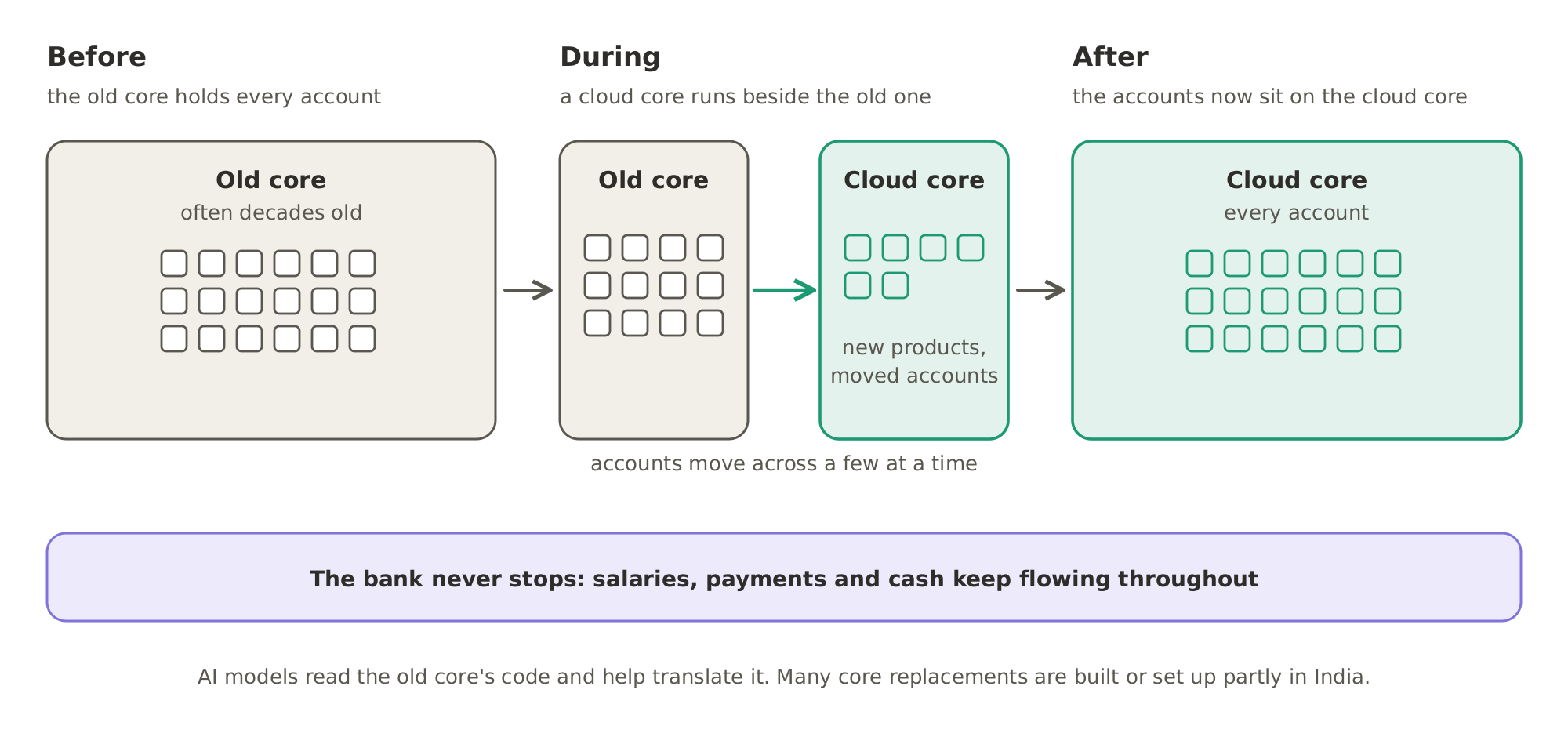 A bank replaces its old core without stopping: a cloud core runs beside the old one, new products launch on it, and the accounts move across a few at a time until the cloud core holds them all.
That is the bank in a box. Your salary, your rent payment, your cash and your statement all pass through a core that the bank most likely bought. A digital bank sits on top of it and, more and more, a newer layer sits beside it.
A bank replaces its old core without stopping: a cloud core runs beside the old one, new products launch on it, and the accounts move across a few at a time until the cloud core holds them all.
That is the bank in a box. Your salary, your rent payment, your cash and your statement all pass through a core that the bank most likely bought. A digital bank sits on top of it and, more and more, a newer layer sits beside it.