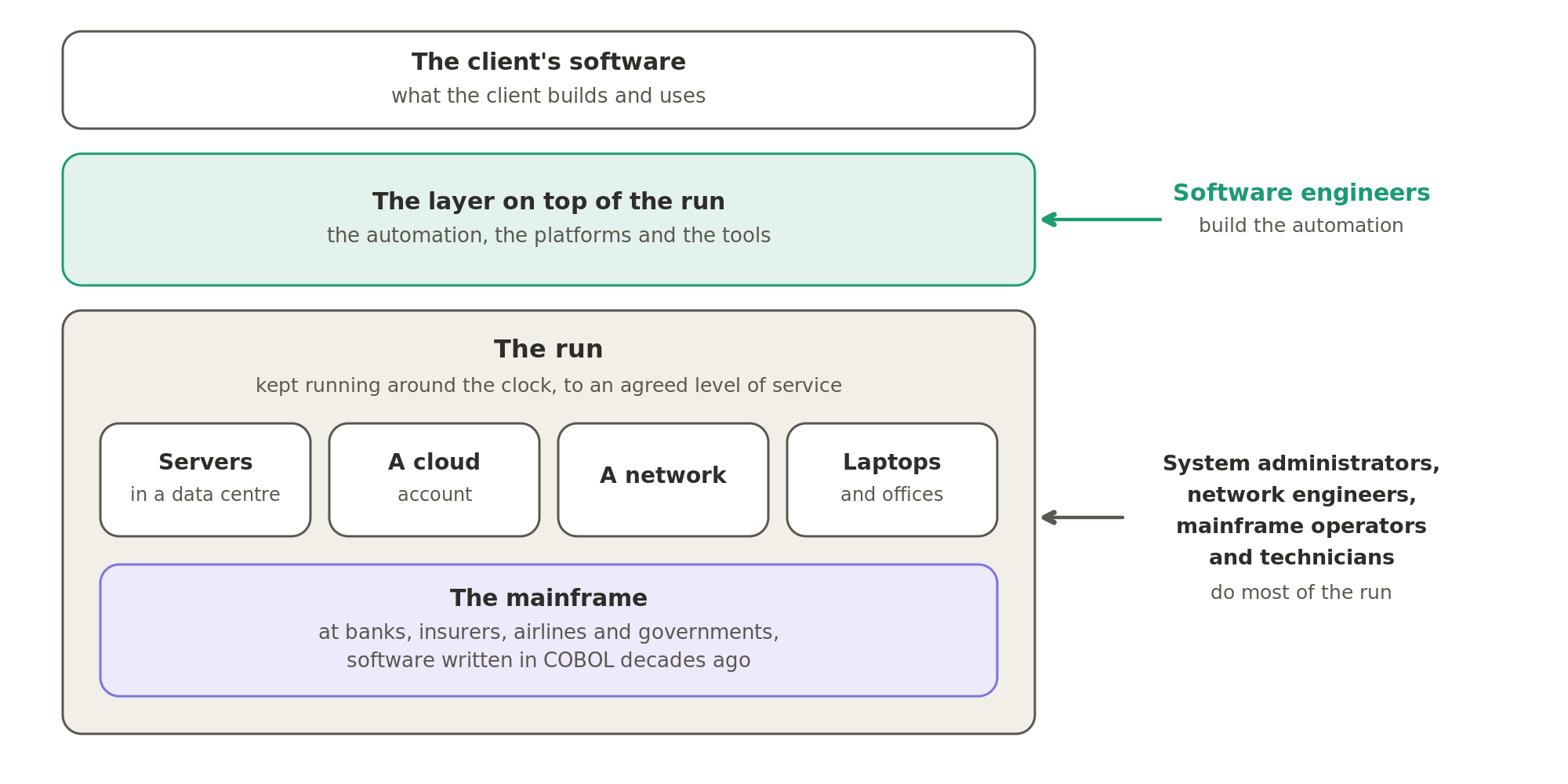
Every company's software runs on something:
- servers in a data centre
- a cloud account
- a network
- ten thousand laptops
- and, at banks, airlines and governments, a mainframe, a large central computer, often installed before most of the people running it were born
Someone has to keep all of that running, and most large companies pay a firm to do it. The firms in this Company Tier sell the run. They don't build software. They keep the machines, networks and systems that software lives on running, around the clock, with a promise about how quickly things will be fixed when they break.
There are three kinds of firm here:
In this Company Tier, the work is furthest from writing software. Most of it is done by system administrators, network engineers, mainframe operators and technicians. Software engineers work on the layer on top of the run: the automation, the platforms and the tools.
Every firm named here has posted software engineering jobs in India.
Keep reading, free
Six more sections are on this page: What these firms sell, and to whom, Managed infrastructure and the mainframe that never died, Networks, workplaces and field support, The resellers that also build, The firms, and The kit they run. Sign in to read them here, in full.
Continue with Google- What these firms sell, and to whom
- Managed infrastructure and the mainframe that never died
- Networks, workplaces and field support
- The resellers that also build
- The firms
- The kit they run
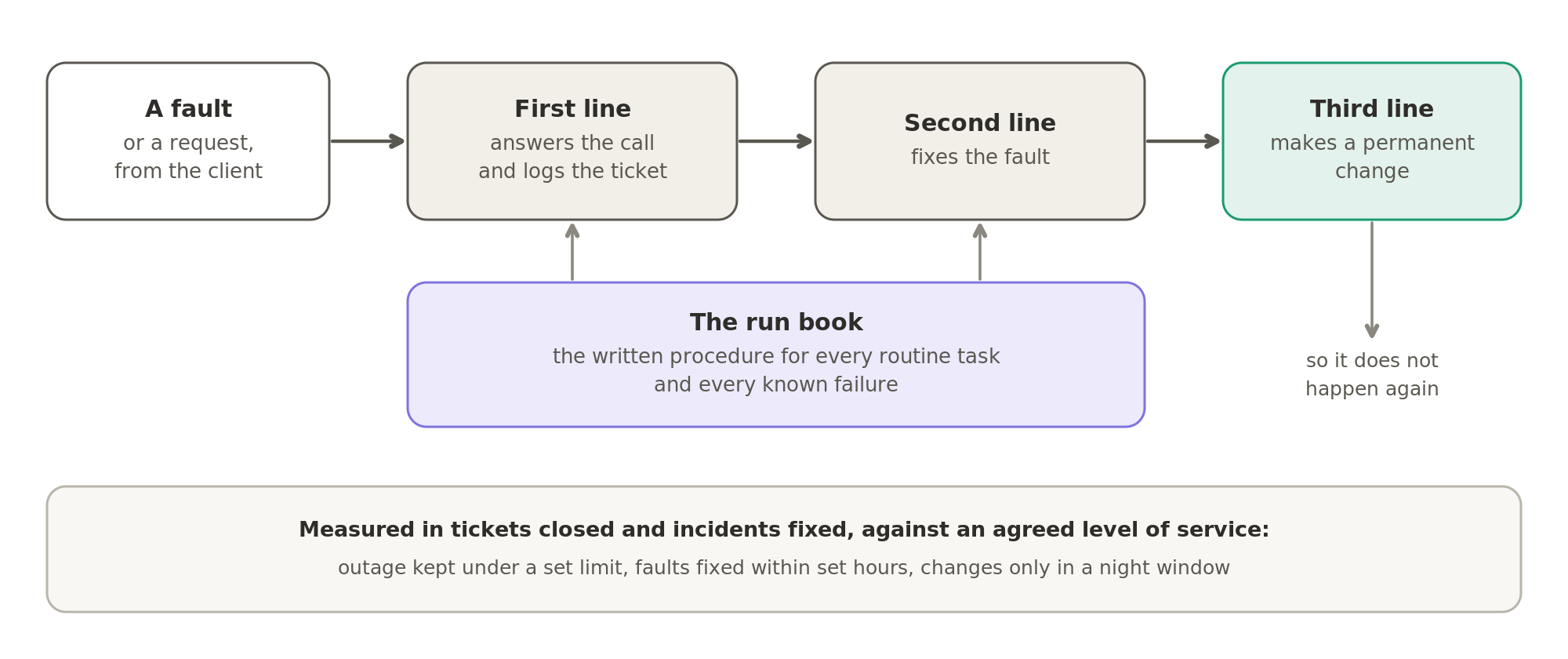
They sell uptime, by contract. A client hands over its data centres, cloud accounts, network or desktops, and pays a firm to keep them within an agreed level of service, such as:
- no more than a set number of minutes of outage a year
- a fault fixed within a set number of hours
- changes made only in an agreed window at night
The firm staffs the run in shifts, from India for most of the world's clients. It works from a run book: the written procedure for every routine task and every known failure. Its profit is the gap between what the client pays for the promise and what it costs to keep.
The work is measured in tickets closed and incidents fixed. The giants' pyramid appears here as tiers of support: the first line answers the call, the second line fixes the fault, and the third line makes a permanent change so it does not happen again.
The clients are nearly every large company with more infrastructure than it wants to manage itself. Above all, they are the ones with the oldest systems: banks, insurers, airlines, governments and retailers whose core systems still run on a mainframe, and whose newer systems run in a cloud they also don't want to manage.
The core of this Company Tier is three firms, and one machine that refuses to go away.
The mainframe is why this section exists. A large part of the world's banking, insurance and airline transactions still runs on mainframes, with software written in COBOL decades ago. The people who know how to keep them running are retiring faster than they are replaced. For a services firm, the mainframe is the steadiest account there is. The skill is narrow and in short supply, and the firms here train people in it, because hardly anyone arrives with it.
The second kind of run is physical: the network in the building, the ten thousand laptops, the video-conference rooms, and the technician who comes when a machine won't turn on.
This is also where the name does not tell you the job. At the same firm, one engineer builds software while another runs support shifts or visits offices.
The third kind of firm sold the equipment first, and the service second.
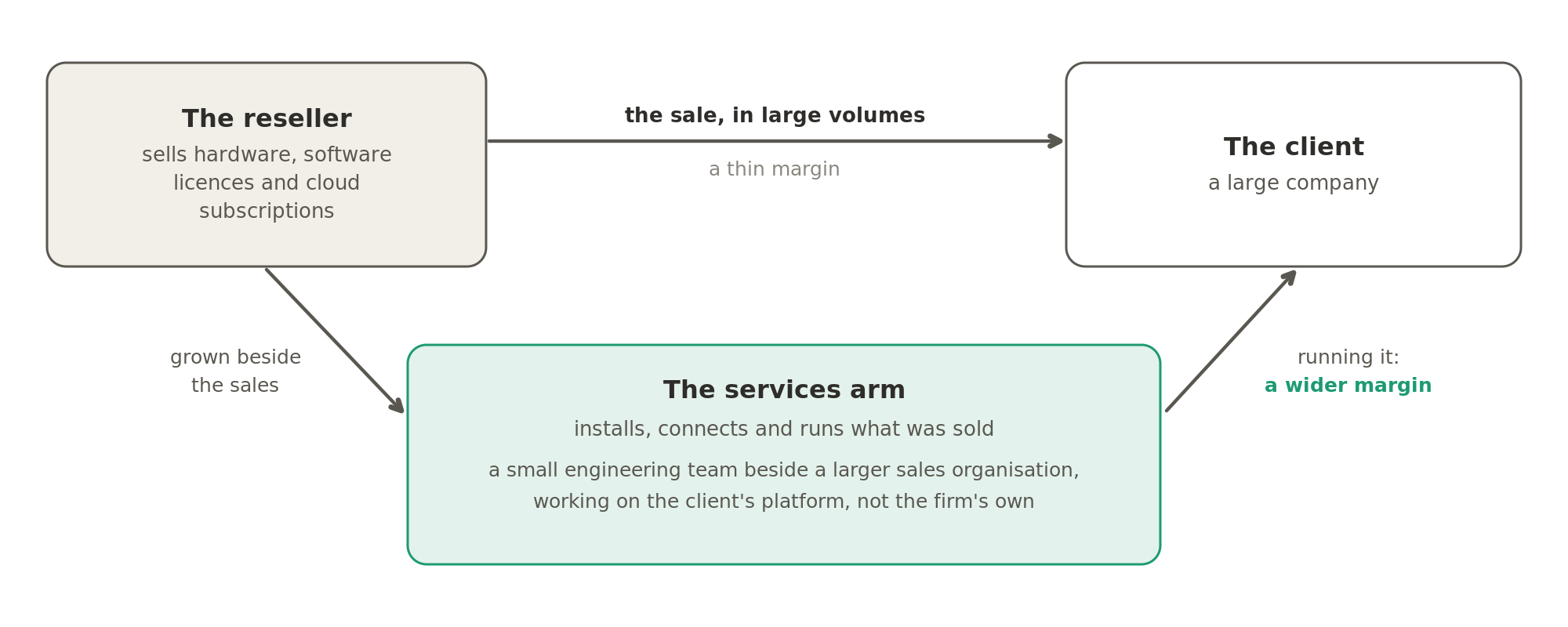
A reseller's engineering team is small, and sits beside a much larger sales organisation. It works on the client's platform, not the firm's own, so it works like a small consultancy inside a large shop.
Largest first, by size in India:
Every machine, network and licence these firms run is some company's product. The product-companies collection covers them:
- the servers and storage in a data centre
(More on it in Market Segment 3.2, Server and storage hardware, in Industry Vertical 3, Data centres and servers, in the product-companies collection.) - the clouds
(More on it in Market Segment 5.1, Cloud infrastructure and web hosting providers, in Industry Vertical 5, Cloud providers and OS makers, in the product-companies collection.) - ServiceNow, through which the run is managed, and the tools of the workplace
(More on it in Industry Vertical 16, IT management and workplace tools, in the product-companies collection.)
The firms here are among the largest buyers of those products, on behalf of their clients.
A run book is a written procedure, and a written procedure is exactly what an AI model can follow. The industry calls this AIOps: monitoring that predicts a fault before it happens, tickets resolved by a model before a person reads them, and changes made by a script the model wrote. The first line of support is already being automated. The firms here sell that automation to their clients as their own product.
Who these firms hire, role by role, is on the collection's role pages for Java backend and full-stack engineers, cloud and DevOps engineers, data engineers, test engineers, frontend and mobile engineers, .NET engineers, GenAI engineers, embedded, systems and chip engineers and the smaller roles.