When a Canadian government department upgrades one of its systems, some of the engineers doing the work may be in Bengaluru or Hyderabad, working for CGI, a Canadian IT services firm.
Some IT services firms are as large as the mid-sized firms, and a few as large as the giants, yet almost no Indian engineer could name them: CGI, NTT DATA, Sopra Steria, Atos, Tietoevry, Fujitsu, NEC, DXC, Softtek and T-Systems. Each is a household name to technology chiefs in Montreal, Tokyo, Paris, Helsinki or Munich. Each employs tens of thousands of people, and runs Indian delivery centres of several thousand engineers, some of tens of thousands.
They are quiet in India for one reason. Their clients are at home, their sales teams are at home, and India is where the work is done. So they have never needed the notice board.
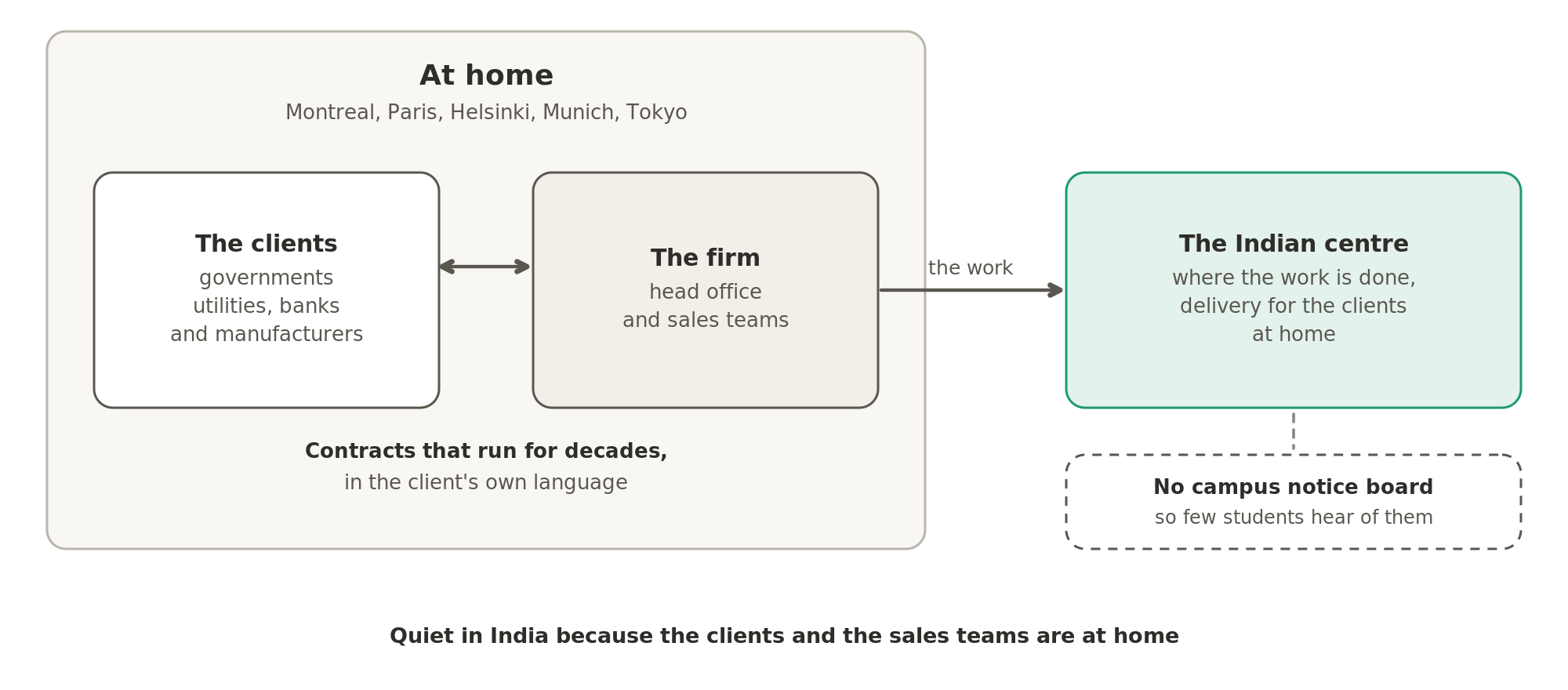 The clients and the sales teams of these firms are at home, in cities such as Montreal, Paris, Helsinki, Munich and Tokyo, while the work is done in their Indian centres. With no need for a campus notice board, few Indian students hear of them.
They run on the same pyramid as the giants. (More on it in Company Tier 1, The IT services giants, in the services-world collection.) This Company Tier is about what changes when the head office is in Europe or Japan:
- the accounts are older, and more often for governments
- the Indian centre was often an Indian firm before it was bought
- there is no campus hiring in front of it
Every firm named here has posted software engineering jobs in India.
Keep reading, free
Five more sections are on this page: What these firms sell, and to whom, European, Japanese and Nordic houses with Indian centres, How the work feels different, How they hire, and The firms. Sign in to read them here, in full.
Continue with Google
What these firms sell, and to whom
They sell the same thing the giants sell: time, in teams, with a promise attached. But they sell it to different buyers. The Indian giants and the big American firms grew on American clients, above all banks and retailers. The firms here grew on their own countries' governments, utilities, banks and manufacturers:
CGIpublic-sector and banking clients in Canada and Europe
Sopra Steriathe French and British governments
TietoevryNordic banks and public services
AtosEuropean governments, and the Olympic Games
NTT DATA and FujitsuJapanese companies and the Japanese government
NECthe British public sector, through its software unit
These clients change slowly and buy for decades. They are also regulated in ways that reward a supplier who has been there for twenty years. That is why these firms are old, steady and, to Indian engineers, almost invisible.
European, Japanese and Nordic houses with Indian centres
The largest of these firms in India are Atos, DXC and CGI.
Atosthe French firm, has tens of thousands of engineers in Pune and Chennai, mostly through the Indian firm it bought in 2018.
DXCan American firm, has one of the larger IT services workforces in India. It is here because it works like these quiet firms, rather than like the giants.
CGIthe Canadian firm, has tens of thousands of engineers across Bengaluru, Hyderabad and Chennai. They do business-platform, data and platform work for North American and European clients.
The others include:
NTT DATAthe Japanese group. Its Indian operation is largely made of American services businesses it bought over a decade, which is why it appears under a North American name. The work is business systems and backend engineering for American and Japanese clients.
T-SystemsDeutsche Telekom's services arm, with a centre of thousands in Pune
Tietoevrythe Finnish-Norwegian firm, in Pune and Bengaluru. It works mostly with Microsoft technologies, and its engineering arm adds embedded software.
Sopra Steriathe French firm, in Delhi NCR, working on business platforms
NEC Software Solutionsthe Japanese group's British software unit, in Mumbai. It does backend and full-stack work for public-sector products, and was an Indian firm before NEC bought it.
Fujitsuthe Japanese group, whose Indian work is mostly AI, with a research lab beside it
The rest are small centres for firms that are large at home: Softtek (Mexico), Stefanini (Brazil), NCS (Singapore, owned by the telecom operator Singtel), Beyondsoft (China), Version 1 (Ireland), SII (Poland and France), Astek, Aqilea, Brainsquare, InnoWave, Vivicta and Infotel.
You're reading as a guest. Sign in free to follow links for five minutes, once an hour.
Sign in
How the work feels different
These firms have a reputation in the Indian industry for being calmer and steadier, with more room for a life outside work. The reputation is real, and it has structural causes. The same causes set the trade-offs.
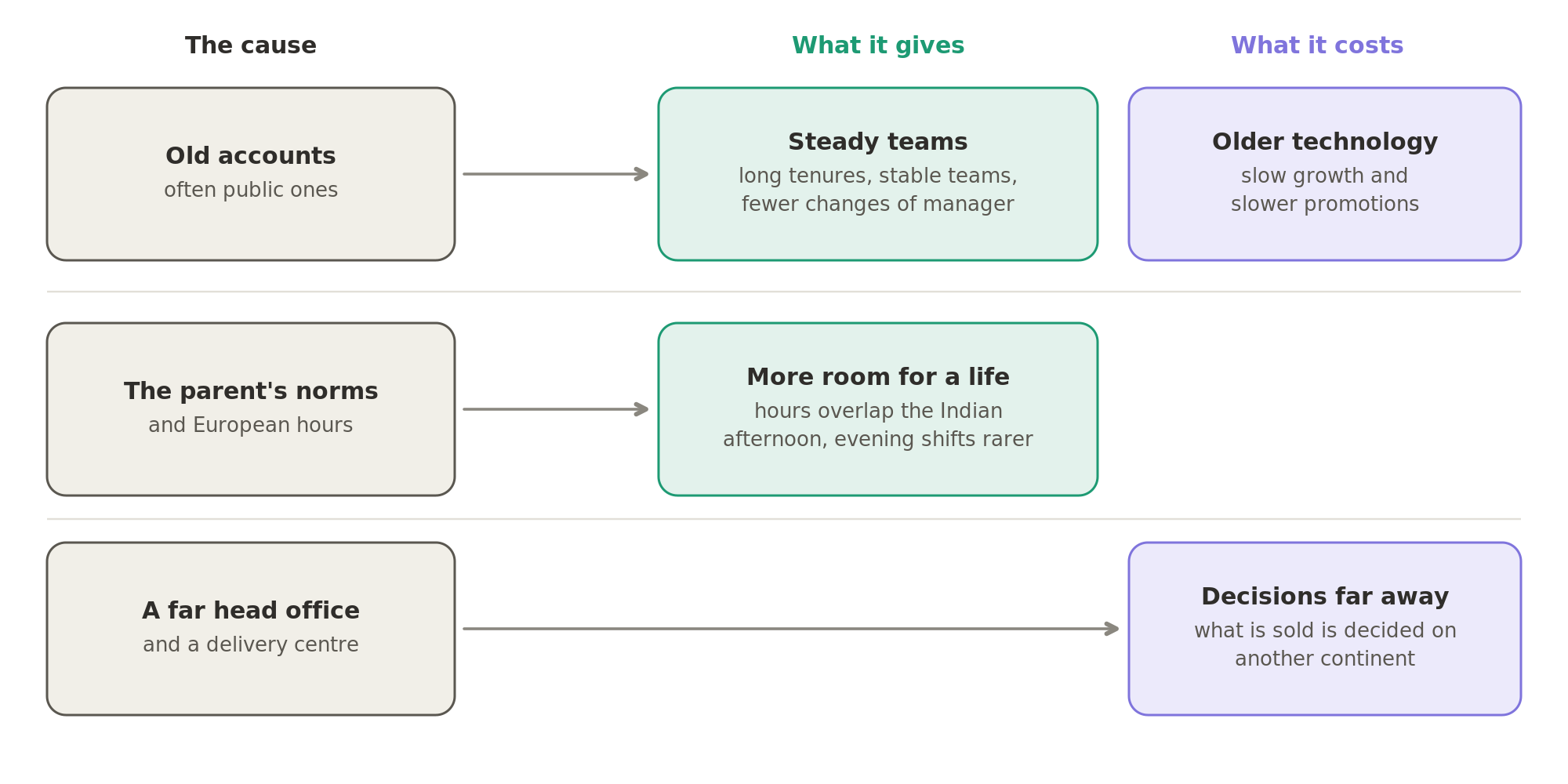 The causes of the calm also set the trade-offs. Old, often public accounts give steady teams but older technology and slower promotions, the parent's norms and European hours leave more room for a life, and a far head office keeps the decisions about what is sold on another continent.
The accounts are old, and often public. A firm whose largest clients are a European tax authority, a Nordic bank and a Japanese railway does not lose them in a quarter. So the pressure that runs through a giant's American retail account runs weaker here: the quarterly renewal, and the team cut at the client's wish. Long accounts mean long tenures, stable teams and fewer changes of manager.
The parent's working norms travel, in part. A French or Nordic head office brings expectations about hours and leave, which an Indian centre partly takes on. And European clients' working hours overlap the Indian afternoon, not the Indian night. So the evening shift that marks an American account is rarer here.
The trade-offs come from the same facts
- Old public accounts run old systems. So the technology is older on average, mostly business platforms and systems of record, the core systems that hold an organisation's main data. There is less new-build work than at the build shops. (More on them in Company Tier 5, The services firms that feel like product companies, in the services-world collection.)
- Slow accounts grow slowly. So the firm grows slowly, and promotions are slower.
- The head office is far away, and the Indian centre is a delivery organisation, even more than at an Indian giant. The roles that decide what is sold are on another continent, and often in another language.
This is also where the name does not tell you the job. A famous European or Japanese name says little about which account, and which technology, an engineer will work on.
How they hire
These firms do not hire on campus, apart from one exception. They fill their Indian centres in three ways:
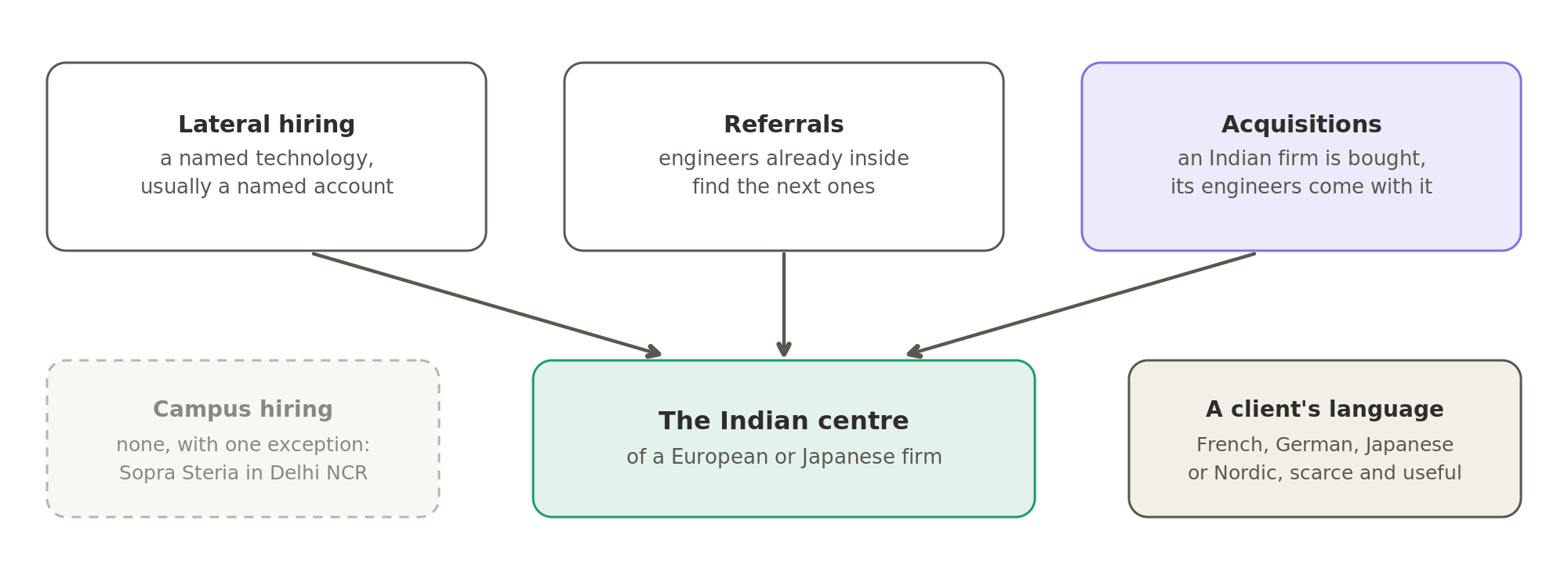 Engineers reach the Indian centre of a European or Japanese firm through lateral hiring, referrals or the purchase of the Indian firm they already work for. Campus hiring is not used, except at Sopra Steria, and knowing a client's language is scarce and useful.
Lateral hiringThey hire engineers with two to five years' experience for a named technology, and usually a named account: Java and .NET backend work, business platforms, data engineering and testing.
ReferralsBecause these firms do not advertise widely, they rely more than the giants on their own engineers to find the next ones.
AcquisitionsA large share of their Indian workforce joined by working for an Indian firm that was bought. That is why so many senior engineers at these firms never applied to them.
Engineers reach the Indian centre of a European or Japanese firm through lateral hiring, referrals or the purchase of the Indian firm they already work for. Campus hiring is not used, except at Sopra Steria, and knowing a client's language is scarce and useful.
Lateral hiringThey hire engineers with two to five years' experience for a named technology, and usually a named account: Java and .NET backend work, business platforms, data engineering and testing.
ReferralsBecause these firms do not advertise widely, they rely more than the giants on their own engineers to find the next ones.
AcquisitionsA large share of their Indian workforce joined by working for an Indian firm that was bought. That is why so many senior engineers at these firms never applied to them.
Language matters here more than anywhere else in the services world. These firms' clients work in French, German, Japanese or a Nordic language, and engineers who know one are scarce in India and directly useful on these accounts.
The exception to "no campus hiring" is Sopra Steria. Its centre in Delhi NCR hires freshers in numbers.
The firms
The largest in India
Atos
DXC
CGI
The others
NTT DATA
T-Systems
Tietoevrywhich also appears under its old name and as EVRY India
Sopra Steria
NECwhich appears three times: twice as NEC Software Solutions, and as NEC Smart Cities
Fujitsuwhich appears twice: the firm and its research lab
SIIwhich appears twice: its Indian and Polish companies
Smaller centresSofttek, Stefanini, NCS, Beyondsoft, Version 1, Astek, Aqilea, Brainsquare, InnoWave, Vivicta and Infotel
The Indian centre that stops being only a delivery centre.
CGI's Indian operation is the clearest case of a foreign major whose Indian centres have grown into the largest part of the firm, and have started to hold roles that decide what is sold. NTT DATA's Indian business is moving the same way. AI reaches these firms in a particular way. Their government clients will not switch supplier because AI arrives. But what these firms sell those clients is largely the running of systems of record: the ticket, the change request, the test. That is the work AI does first. Their response has been to sell the automation to the same clients, and much of Fujitsu's and DXC's Indian work is now AI. The counter-current comes from the parent: Atos has spent years splitting and selling parts of itself, and the future of a very large Indian centre can be decided in Paris.
That is the quiet foreign major: large, old and steady firms that serve governments and big companies at home, with much of the work done in India.