Every engineering college in India has the same notice board, with the same ten names on it:
- the Indian giants:
TCS ,Infosys ,Wipro ,HCLTech ,Tech Mahindra andLTIMindtree - the foreign four, with most of their people in India:
Accenture ,Capgemini ,Cognizant andIBM
Between them, they employ around two and a half million people, most of them in India. For a large share of India's engineers, one of them is the first job. They are also among the least understood employers in the software industry, because the firm's name says little about the job behind it.
This Company Tier explains how these firms work. A services giant does not sell a product. It sells engineers' time, arranged into teams, to clients who have decided not to hire those engineers themselves. The bench, the two entry grades and the large lateral hiring all follow from that one fact. Every other Company Tier in this collection is a variation on what these ten firms do.
Every firm named here has posted software engineering jobs in India.
Keep reading, free
Seven more sections are on this page: What these firms sell, and to whom, The delivery pyramid, the bench and the account, The mass-hire door and the lateral door, The product-engineering unit you never see on campus, How big these firms are, The firms, and The same giant runs a client's GCC. Sign in to read them here, in full.
Continue with Google- What these firms sell, and to whom
- The delivery pyramid, the bench and the account
- The mass-hire door and the lateral door
- The product-engineering unit you never see on campus
- How big these firms are
- The firms
- The same giant runs a client's GCC
They sell time, in teams, with a promise attached.
A bank, a retailer or an airline needs several hundred engineers to keep its systems running, and a few hundred more to build the next thing. It would rather pay a firm a monthly rate per engineer than hire, train and manage them itself. The services giant supplies the engineers, manages them, and promises the work will be done on time and to specification. The client pays in one of three ways:
The giant's profit is the gap between what the client pays for an engineer and what the engineer costs. That gap is widest at the bottom of the organisation, where a fresh graduate costs least but can still be billed as an engineer.
The clients are the whole economy. Banks, insurers, retailers, manufacturers, telecom operators and the governments of many countries all run parts of their software on these firms' people. That is why the same firm can put one new joiner on a banking mainframe in Kolkata, and another on a mobile app in Pune.
Three words explain most of how a services giant runs: the pyramid, the bench and the account.
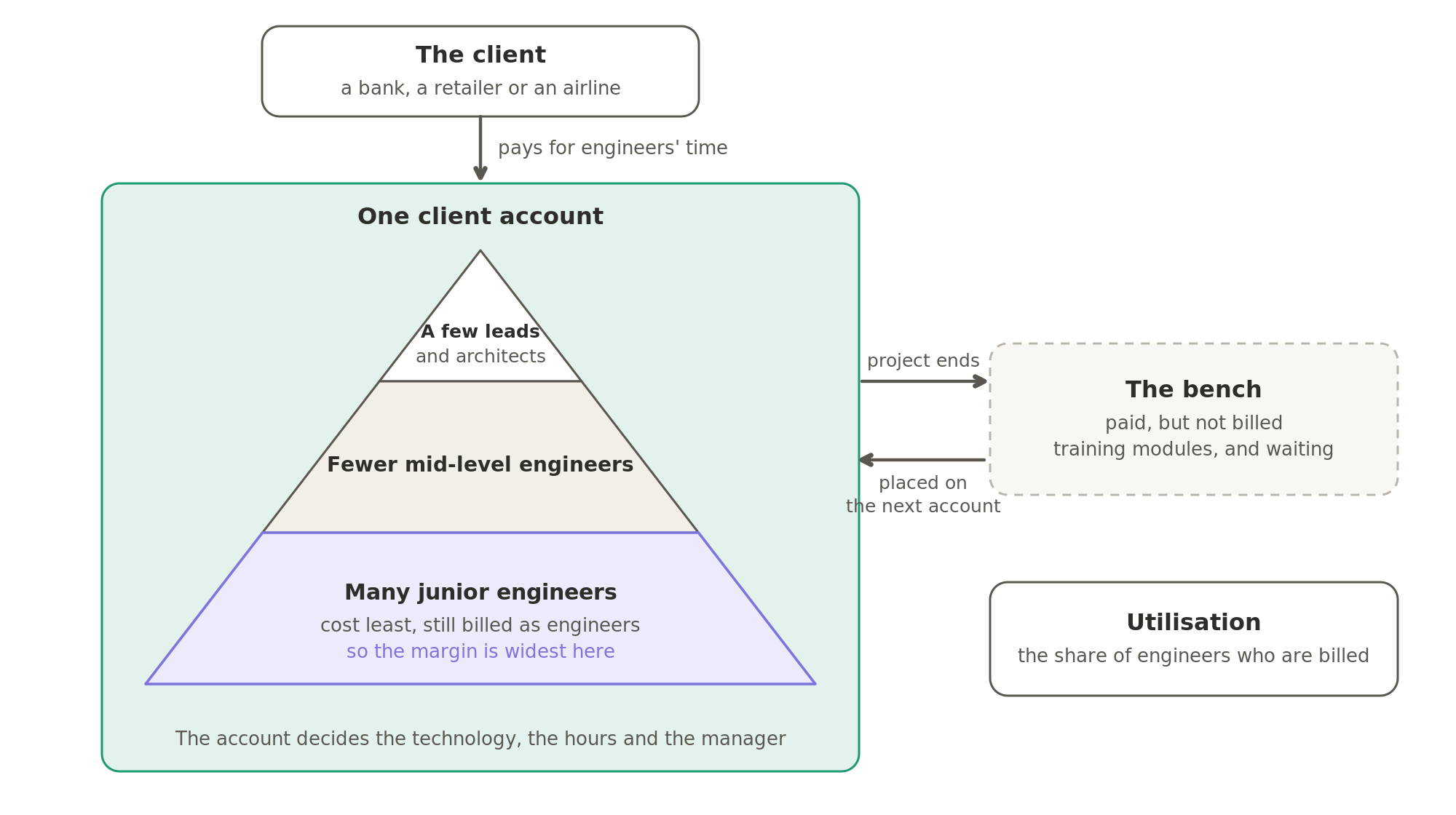
The pyramid is how a team is built to make money. A client project is staffed with many junior engineers, fewer mid-level ones, and a few leads and architects, because juniors cost least compared with what the client pays for them. The shape is deliberate. It is why these firms hire freshers in tens of thousands: the bottom layer is the business model, not a training programme. It is also why a junior's first work is often narrow, such as one component, a set of tests or a support queue. The pyramid is designed for the work to be divided up.
The bench is where engineers wait between projects. An engineer who has finished one project, and not yet been placed on the next, is paid but not billed to any client. The share of engineers who are billed is called utilisation. It is one of the numbers the firms' investors watch most closely. On the bench, engineers do training modules and wait. The wait can run from weeks to months, and in a slow year, new joiners wait there for start dates that keep moving.
The account is the client engagement: all the work a firm does for one client. Once placed, an engineer belongs to an account far more than to the firm. The account decides everything the firm's name does not:
- the technology, from a 1990s banking mainframe to a cloud platform built last year
- the pace and the working hours. An account for a US client works Indian evenings.
- the manager, and how much there is to learn
This is where the name does not tell you the job. Two engineers who joined the same firm on the same day can, a year later, have nothing in common but the badge.
The same firm hires through two entrances, into different jobs.
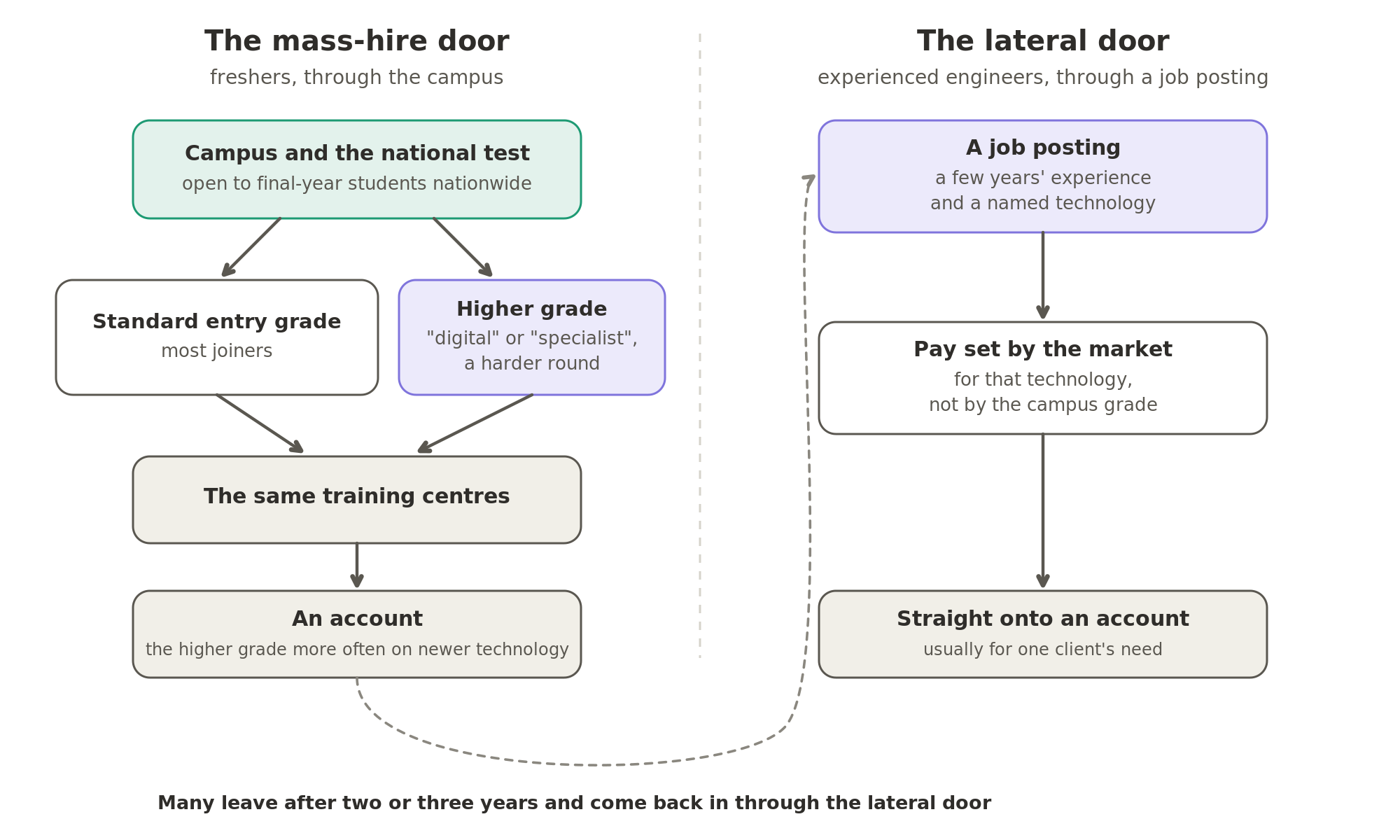
The mass-hire door is the campus and the national test. Each Indian giant runs a nationwide exam open to hundreds of thousands of final-year students, and hires tens of thousands a year through it into a standard entry grade. A smaller, higher-paid grade inside the same door, often called "digital" or "specialist", is chosen through a harder round of the same test. Both grades train in the same centres and go to the same kinds of accounts. The higher grade is more likely to be placed on newer technology, but that is a likelihood, not a rule.
The lateral door is the job posting. It hires engineers with a few years' experience and a named technology, usually for a specific client's need, straight onto an account. Their pay is set by the market for that technology, not by the campus grade. Most of these firms' job postings are for this door. Because the two doors pay differently, many engineers leave after two or three years and re-enter through the lateral door. That is when the giants lose the most people, and it is why they have started to promote engineers earlier to keep them.
Inside each giant, there are smaller units that work nothing like the pyramid. The campus process does not lead to them.
Every giant has a product-engineering or platform arm. It builds software the firm itself owns and sells, such as a banking platform, an AI platform or an automation tool. Or it does high-end engineering on a product company's own product, rather than a bank's back office.
These units are smaller and pay closer to product-company rates. They hire almost entirely experienced engineers, from outside or from the firm's own accounts. To a new joiner, the unit on the firm's website can be a different employer that happens to share its name.
In India, the ten are of a similar order of size, all within a factor of five of one another. From largest to smallest by people employed in India, they are
Each is known for particular kinds of work:
Largest first, by people employed in India:
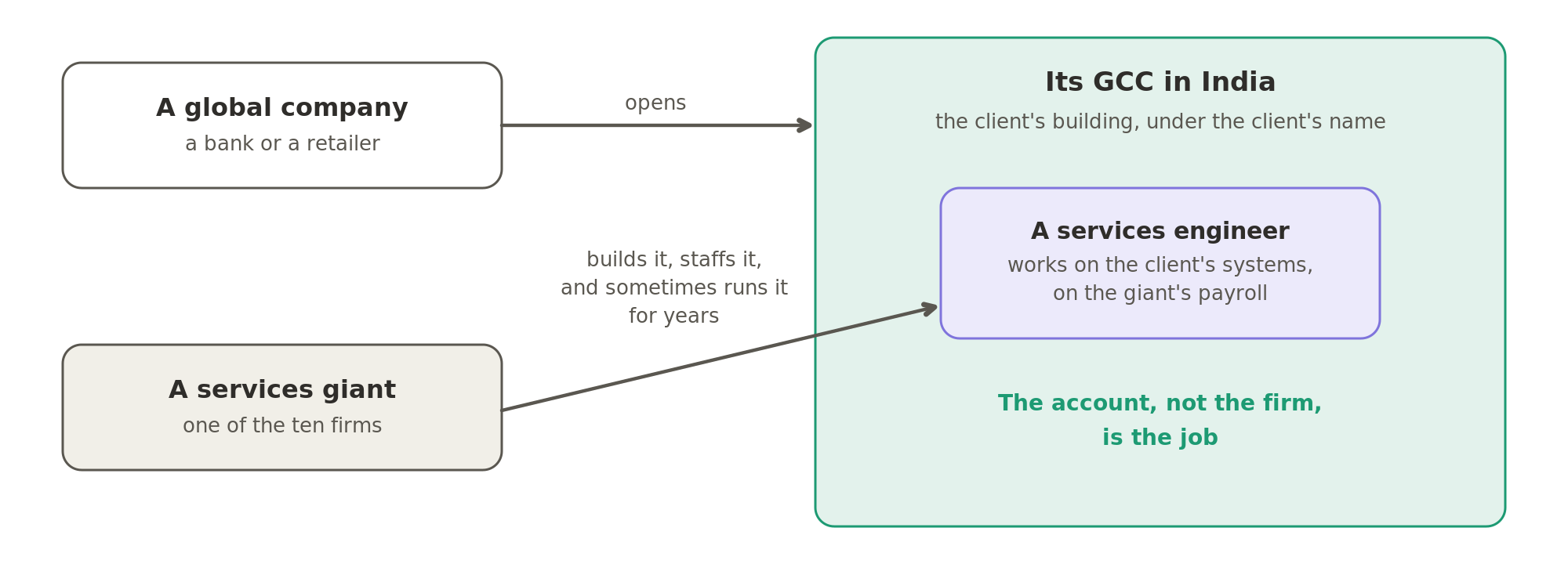
Many global companies run their own engineering centres in India, called GCCs. When a bank or a retailer opens one, it often hires one of these ten firms to build it, staff it, and sometimes run it for years. So a services engineer can work in a client's building, under the client's name, on the giant's payroll. It is one more way the account, not the firm, is the job.
The pyramid rests on the bottom layer's work being divisible and cheap: the component, the test suite, the support ticket, the code written to a specification. That is the work AI models do first. Every giant now sells its clients automation of exactly the work its juniors used to do, and says the pyramid will flatten: fewer juniors per lead, with the juniors it hires checking an AI model's output rather than producing their own. Mass hiring is already lower, and less predictable from year to year. At the same time, each giant has built a new AI unit in the last three years, such as the AI platforms at
Accenture has a hiring page of its own, What Accenture hires for, and who the other giants hire, role by role, is on the collection's role pages for Java backend and full-stack engineers, cloud and DevOps engineers, data engineers, test engineers, frontend and mobile engineers, .NET engineers, GenAI engineers, embedded, systems and chip engineers and the smaller roles.