This Company Tier covers India's mid-sized IT services firms. Some are Indian, and some have their head office in the United States with their engineers in India. They do the same kind of work as the IT services giants, for the same kinds of clients, but at a much smaller size, and each one is built around a specialism, such as banking, insurance, a business platform or a kind of engineering.
An American insurer that needs its claims platform upgraded may not call TCS or Infosys. It may hire ValueMomentum, an insurance-technology firm whose engineers are in Hyderabad.
Behind the IT services giants stand about thirty mid-sized firms. They do the same kind of work for the same kinds of clients, at a tenth to a fortieth of the size:
Indian firmssuch as Mphasis, Coforge, Hexaware, Birlasoft, Persistent, Zensar, Sonata, Happiest Minds, Mastek and ITC Infotech
American-headquartered firms whose engineers are in Indiasuch as Virtusa, UST, Synechron, Infinite, InfoVision and HTC Global
Most are listed on the stock market, have five to forty-five thousand employees, and have decades of history.
They run the same way as the giants: the pyramid, the bench and the account. (More on it in Company Tier 1, The IT services giants, in the services-world collection.) This Company Tier is about what changes when that model is smaller. Three things change:
Hiringthe mass-hire door narrows, or closes.
Specialisma firm of ten thousand cannot be good at everything a firm of three hundred thousand sells. So each firm specialises, in banks, insurers, a business platform or a kind of engineering, and that decides the work far more than at a giant.
The account's weighta client that is one of a thousand at TCS can be a fifth of the business here.
Every firm named here has posted software engineering jobs in India.
Who they are
Few freshers hear of these mid-sized firms, and there is a structural reason. The giants hire freshers in tens of thousands, because the bottom of their pyramid is their business model. A firm of fifteen thousand people cannot absorb a thousand freshers a year. So it hires a few hundred, from a short list of colleges near its offices, and fills the rest of its need with experienced engineers from the giants. These firms are, in large part, where the giants' engineers go after two or three years.
The larger firms here include:
Virtusaa banking and financial-services firm with its head office in Massachusetts and most of its engineers in Bengaluru, Hyderabad and Chennai
Happiest Mindsthe Bengaluru digital-engineering firm founded by one of Mindtree's founders, listed on the stock market in 2020
USTborn in Kerala and headquartered in California. It does more embedded software work than any other firm here.
Mphasisthe banking specialist, owned by a private-equity fund, an investment firm that buys and runs companies
Birlasoftthe business-platform firm of the CK Birla group
Synechrona banking-technology firm run from New York and Pune
Infinite, Persistent, Sonata, Zensar, ITC Infotech, InfoVision, Coforge, ValueMomentum and Prodapt
Hexaware and Mastekof the same order of size as the firms above
The rest are a dozen much smaller firms, which work more like the small software shops. (More on them in Company Tier 9, Small software shops, in the services-world collection.)
Entry and the lateral path
Mid-sized firms hire differently from the giants, because their pyramid is smaller.
Entry is narrow. A mid-sized firm hires only a few hundred freshers a year, from a short list of colleges. There is rarely a higher entry grade like the giants' "digital" grade.
The smaller pyramid changes the work. With fewer juniors per lead, a junior is given more of the work sooner. With fewer engineers on the bench, placement on a project is faster, and the wait between projects is shorter. With a shorter ladder, the first promotion tends to come earlier than at a giant. In exchange, training is thinner, processes are rougher, and a difficult account is a larger share of a small firm's world.
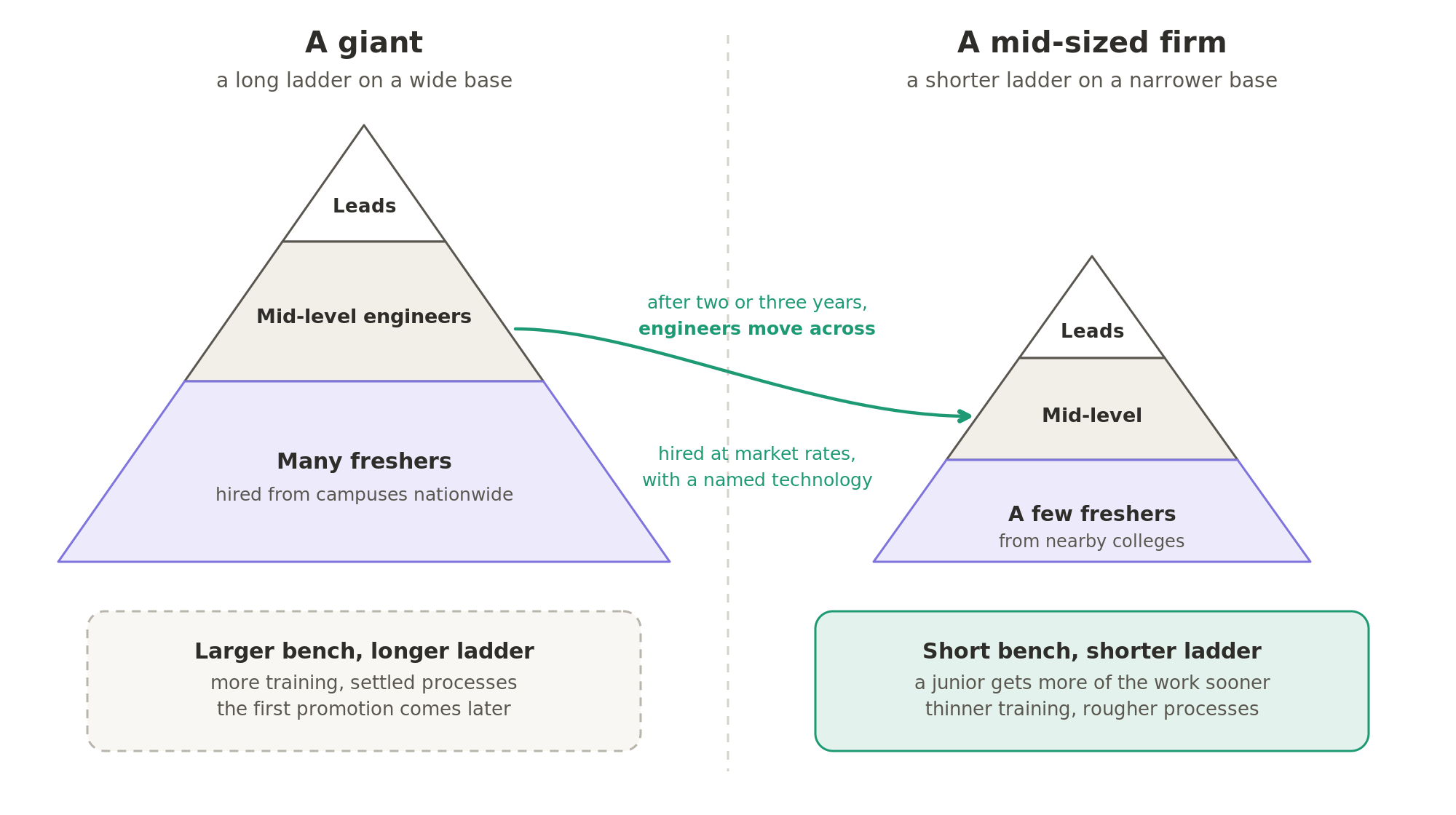 A giant runs a long ladder on a wide base of freshers hired from campuses nationwide, while a mid-sized firm has a shorter ladder, a few freshers from nearby colleges and more mid-level engineers hired across from the giants at market rates. The smaller pyramid gives a junior more of the work sooner and a shorter bench, in exchange for thinner training and rougher processes.
Lateral hiring is where mid-sized firms are strongest. These firms mostly hire engineers with two or three years at a giant, a named technology, and knowledge of a client's industry, such as banking or insurance. They pay market rates for them, because they are buying a trained person rather than training one.
The client list matters more. A mid-sized firm can have a single client worth a fifth of its revenue. When that client cuts spending, the firm cuts too.
You're reading as a guest. Sign in free to follow links for five minutes, once an hour.
Sign in
The specialisms that define them
A giant is shaped like the whole economy. A mid-sized firm is shaped like one part of it, and that decides the work.
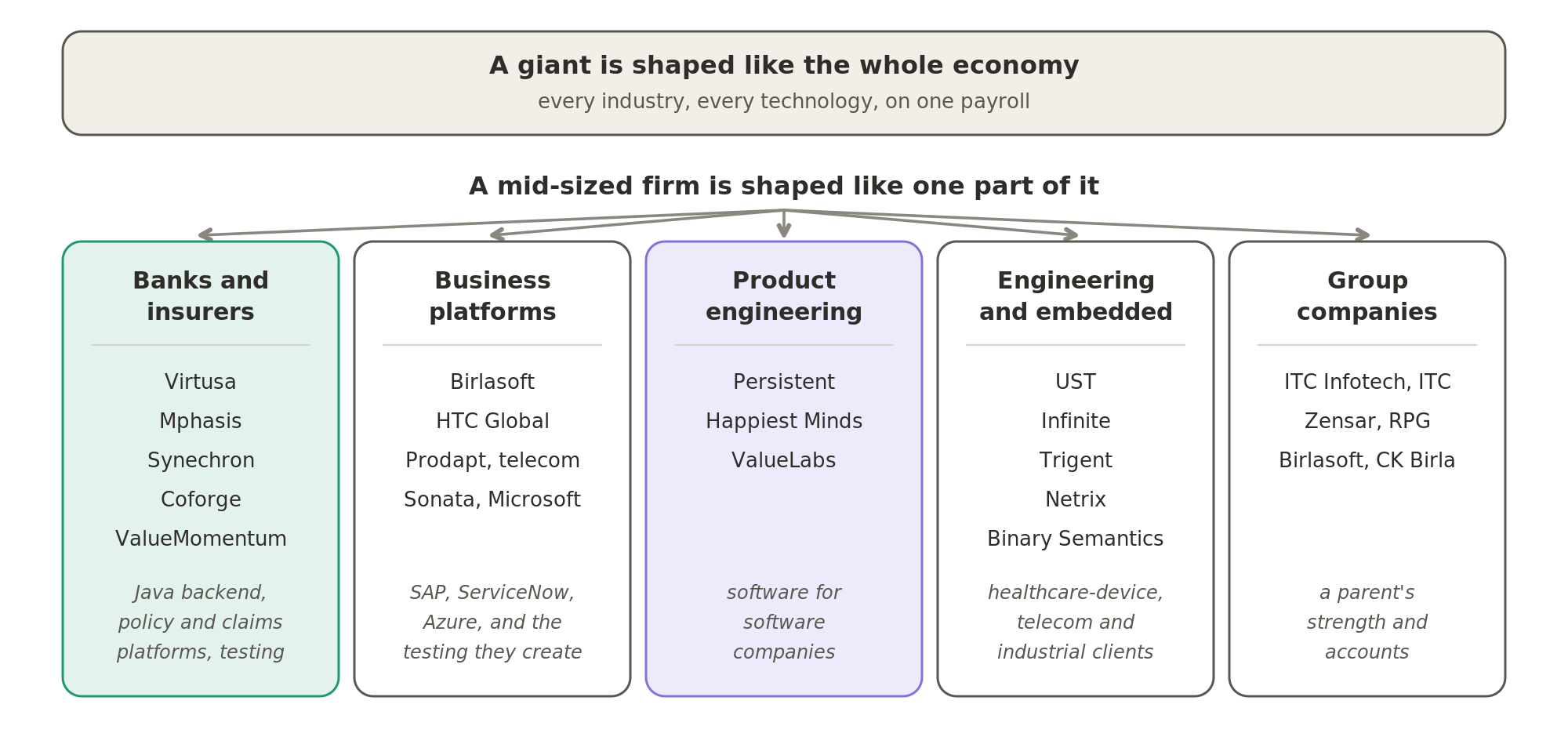 A giant covers every industry and technology, while each mid-sized firm is built around one specialism: banks and insurers, business platforms, product engineering, engineering and embedded software, or the backing of a large Indian business group.
Banks and insurers are the largest group. Virtusa, Mphasis, Synechron, Coforge and ValueMomentum work mostly for banks and insurers. They build what a bank or an insurer buys: backend and platform work, often in Java, on the bank's systems, the insurer's policy and claims platforms, and the testing of both. Engineers here learn the finance industry along with the technology. ValueMomentum, in Hyderabad, is the pure case: an insurance-technology firm and nothing else.
Business platforms are Birlasoft's specialism: SAP and similar business software, with a large amount of testing, which platform work always creates. HTC Global and Prodapt are of the same kind. Prodapt, in Chennai, does this for telecom operators, more and more on ServiceNow, and is the one telecom specialist here. Sonata is a Microsoft specialist, working on Azure and C# more than any other firm here.
Product engineering is the whole firm at a few of them. It is the mid-sized firms' version of the giants' product-engineering units. (More on those in Company Tier 1, The IT services giants, in the services-world collection.)
Persistentin Pune, built its name engineering software for software companies. It does more AI work than any of its peers.
Happiest Mindsin Bengaluru, is a digital-engineering firm of the same kind.
ValueLabsin Hyderabad, works in the newer web technologies.
These firms' accounts are closest to a product company's work. Some firms have gone all the way in that direction. (More on them in Company Tier 5, The services firms that feel like product companies, in the services-world collection.)
Engineering and embedded software is the specialism of UST and Infinite. A large part of their work is embedded and systems software for healthcare-device, telecom and industrial clients. Among the smaller firms, Trigent, Netrix and Binary Semantics also do embedded work.
Group companies belong to a large Indian business group: ITC Infotech to ITC, Zensar to the RPG group, and Birlasoft to the CK Birla group. They carry a parent's financial strength and a parent's accounts, which makes them the steadiest employers among the mid-sized firms. ITC Infotech also does more AI work than any other business-platform firm here.
US-headquartered, India-delivered
Six firms here have their head office in the United States and nearly all their engineers in India: Virtusa (Massachusetts), UST (California, though it began in Kerala), Synechron (New York), Infinite (Maryland), InfoVision (Texas) and HTC Global (Michigan). They sell to American clients from American offices, and deliver the work from Indian ones.
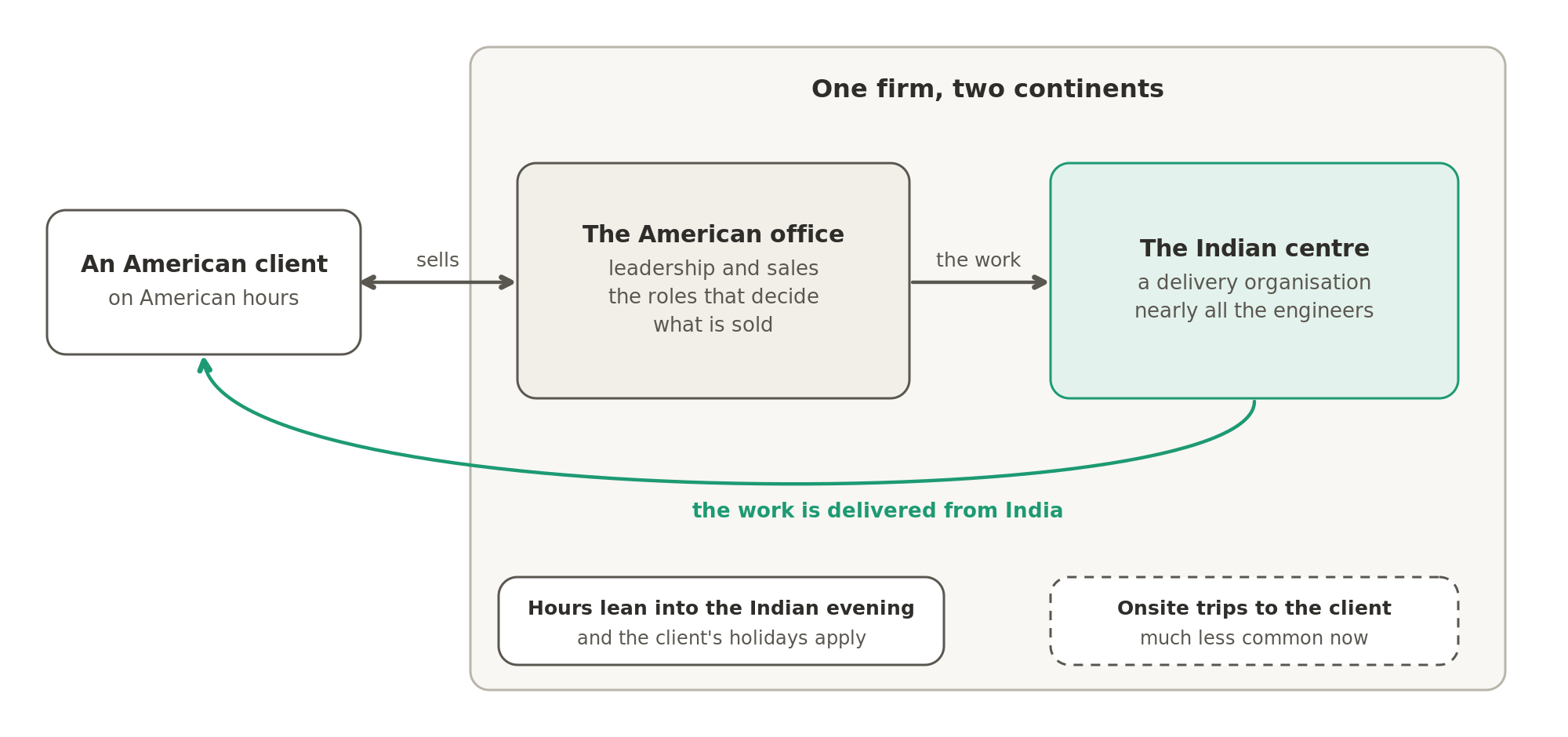 An American-headquartered firm sells to American clients from its American office, where leadership and sales sit, and delivers the work from its Indian centre, where nearly all the engineers are. For the engineers in India, that means hours that lean into the evening and far fewer onsite trips than before.
That changes three things for the engineers in India:
The hoursThe client is almost always American. So the account's hours lean into the Indian evening, and the client's holidays are not India's.
Where decisions are madeThe firm's leadership and sales are on another continent. The Indian centre is a delivery organisation, and the roles that decide what is sold are in the American office.
Onsite workFor years, these firms sent engineers to work at the client's site in the United States. Tighter visa rules have made that much less common.
The work itself does not change. It is the same banking and platform engineering as at the Indian-headquartered firms beside them. Virtusa's work and Mphasis's are hard to tell apart.
The firms
Virtusa
Happiest Minds
USTwhich also appears under its old registered name
Mphasis
Birlasoft
Synechronwhich appears under two names
Infinite
Persistent
Sonata
Zensar
ITC Infotech
InfoVision
Coforge
ValueMomentum
Prodapt
Hexaware
Mastek
HTC Global
ValueLabs
Smaller firmsCG-VAK, PureSoftware, Relanto, Miratech, MSS, Binary Semantics, Solugenix, Netrix, Trigent and Inadev
The mid-sized firm that becomes a product-engineering firm.
Persistent is the clearest case: a mid-sized services firm whose clients are more and more software companies building their own products. Happiest Minds and ValueLabs are moving the same way. AI reaches the same work as at the giants first: testing, and setting up business platforms, which is much of what Birlasoft, Coforge and the banking specialists sell. Mid-sized firms have less cushion than a giant, because they have fewer other businesses to move people into. But a specialist can also sell AI to its clients as something it knows: the insurance specialist sells the AI model that reads the claim, and the Microsoft specialist sells the AI inside the platform. The counter-current is consolidation. The private-equity owners of Mphasis, Hexaware and Virtusa buy and merge firms of this size, so a mid-sized firm can become part of another within a few years.
That is the mid-sized IT services firm: the giants' model at a smaller size, where each firm is a specialist and the client list matters as much as the name.