ingrid.fyi India's software hiring trends, explained.
Sign in to ingrid.fyi with Google
Your Google account
name@gmail.com
Continue with Google
Home / IT services firms / Small software shops
On this page
Small software shops When a start-up in London needs its first app built, it may hire a team of five from a small software shop in Pune or Bengaluru, and speak to the founder directly.

Below every firm in the other Company Tiers sits a layer of small companies that build software for other companies. Most have a few hundred people, and many have fewer. AgileEngine, Wissen Technology, Zemoso, GeekyAnts, Sahaj, thinkbridge and CodeVyasa are among the largest and best known. Behind them are about a hundred more. Together, they employ a meaningful share of India's software engineers, and for many engineers, one of them is the first job.

The giants' model does not run at this size. A firm of three hundred people has:

no pyramidbecause it has too few juniors to build one no benchbecause it cannot pay engineers it is not billing no mass hiringno separate product unit and no partner

What it has is a founder, a handful of clients, and work that a junior does all of, rather than a slice of. That makes the small shop a fast place to learn every part of building software, and a place with little protection when a client leaves. The two facts have the same cause.
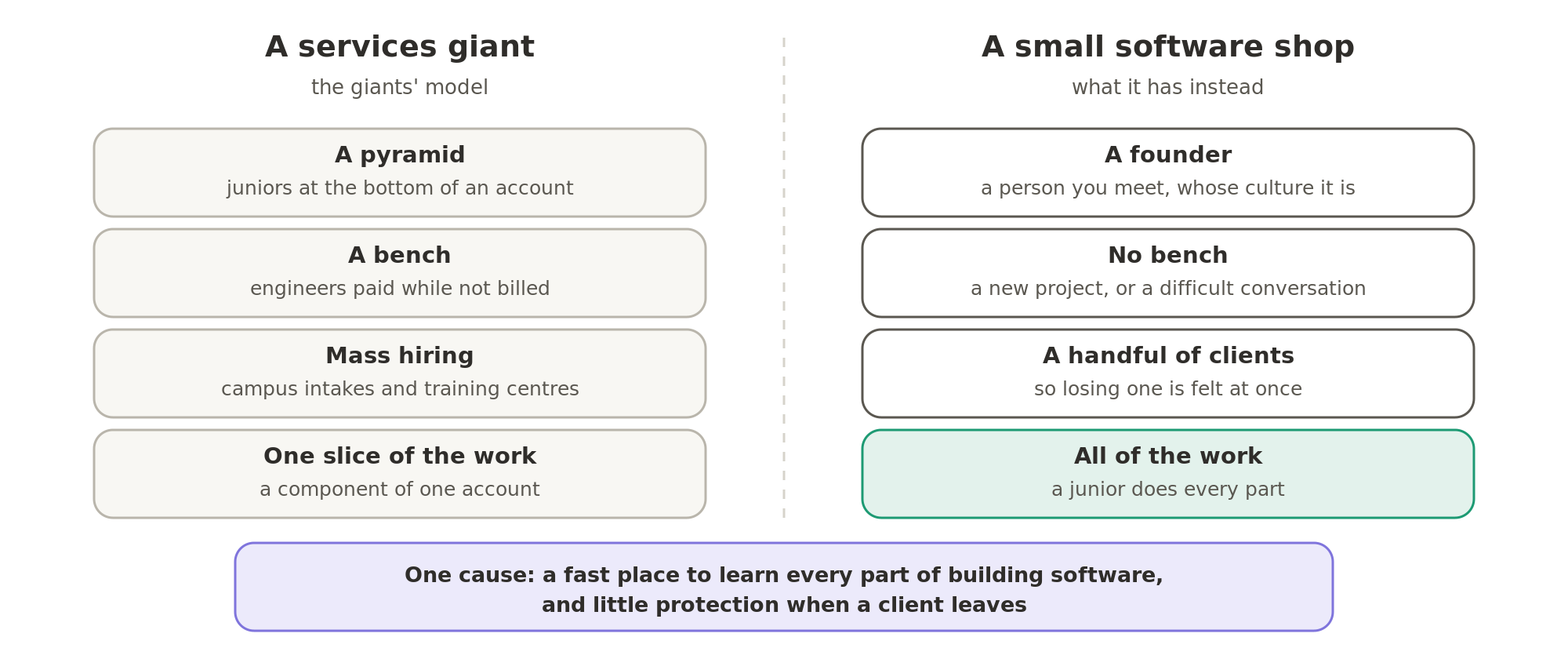
A services giant has a pyramid, a bench, mass hiring and juniors who each own one slice of an account. A small shop has a founder you meet, no bench, a handful of clients and juniors who do every part of the work, which makes it a fast place to learn and a place with little protection when a client leaves.A services giant has a pyramid, a bench, mass hiring and juniors who each own one slice of an account. A small shop has a founder you meet, no bench, a handful of clients and juniors who do every part of the work, which makes it a fast place to learn and a place with little protection when a client leaves.

Every firm named here has posted software engineering jobs in India.

Keep reading, free

Five more sections are on this page: What these firms sell, and to whom, What small means, Breadth fast, and the risk in the client list, The well-regarded boutiques and the ordinary ones, and The firms. Sign in to read them here, in full.

Continue with Google
  • What these firms sell, and to whom
  • What small means
  • Breadth fast, and the risk in the client list
  • The well-regarded boutiques and the ordinary ones
  • The firms
What these firms sell, and to whom

They sell whatever the client needs built, by a small team, at a price a large firm would not quote.

The clients are:

  • start-ups with no engineers of their own
  • mid-sized companies with a product to build or a system to modernise
  • American and European businesses too small for a firm like EPAM, and in too much of a hurry for a giant

The small shop sells them a team of three to fifteen people, who take the work from the first call to the launch. The promise is the founder's own. The price is what makes the model work: a small shop charges a fraction of what a giant or a build shop charges for a comparable engineer.

The larger firms here include:

AgileEnginean American-Argentine firm working from Delhi NCR, Pune and Hyderabad. A large part of its work is AI. Wissen Technologyin Bengaluru and Mumbai, which builds for banks Zemosoa product-engineering shop in Bengaluru and Hyderabad GeekyAntsmuch of whose work is mobile apps. It created open-source mobile tools that many developers use. Sahajin Chennai, Hyderabad and Pune, doing data engineering above all thinkbridgein Pune Litmus7which builds for retailers Unified Infotechin Kolkata CodeVyasa, Bellurbis, VAYUZ, Flexsin, Trantor, algoleap, Opteamix, Kumaran, InfoBeans, Unthinkable and Ajackus
What small means

"Small" covers a wide range. The typical firm here has a few hundred people, and about a quarter have fewer than two hundred. A firm of three hundred hires perhaps twenty engineers a year, some of them straight from college. A few firms here are larger, with over a thousand people each: SLK, Speridian, JK Tech, Emids, ThoughtFocus, Nous, InfoBeans, Kumaran, OSI Digital and Genisys.

Being small shapes the work:

The founder is a person you meetand the culture is the founder's. There is no pyramidso a junior is not the bottom layer of anything. There is no benchAn engineer between projects is a cost a small firm cannot carry for long, so the wait ends quickly, in a new project or a difficult conversation. There is no training centreThe training is the work itself.
You're reading as a guest. Sign in free to follow links for five minutes, once an hour. Breadth fast, and the risk in the client list

Breadth comes from team size. A team of five building a client's product cannot specialise. So a junior on it may write the backend on Monday, the front end on Tuesday, release the software on Wednesday, and join the client call on Thursday. After two years, they have done every part of a software project. A junior in a giant's pyramid, who owns one component of one account, usually has not.

The risk is in the client list. A shop of two hundred people usually has five to ten clients, and one or two of them bring in most of its revenue. When that client cuts its budget, runs out of start-up funding, or takes the work in-house, the shop can lose a third of its business in a month. With no bench and no other lines of business, it has nowhere to put the engineers who worked on that client. That is behind the small shop's typical failures: the sudden layoff, the delayed salary, and the founder who cannot say what next month's work is.
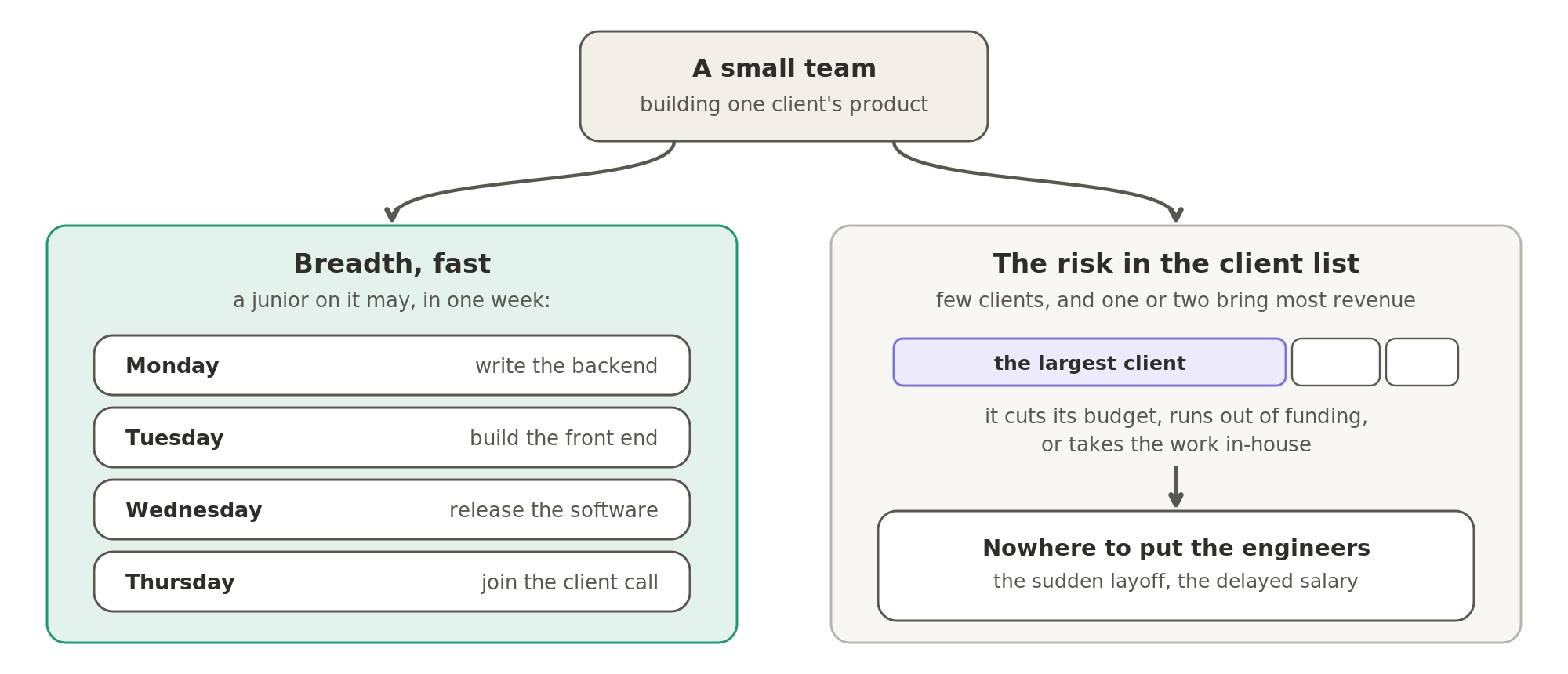
A small team building one client's product gives a junior breadth fast, from the backend to the client call in a single week. The same small size puts the risk in the client list: when the largest client cuts its budget or takes the work in-house, there is nowhere to put the engineers.A small team building one client's product gives a junior breadth fast, from the backend to the client call in a single week. The same small size puts the risk in the client list: when the largest client cuts its budget or takes the work in-house, there is nowhere to put the engineers.

This is also where the name does not tell you the job. A small firm's website may present a product studio, while most of its work is placing its engineers inside another company's team.

The well-regarded boutiques and the ordinary ones

A few small shops have reputations that carry weight at product companies. What sets them apart can be seen from outside:

They publish their engineering workblogs, open-source tools and conference talks. GeekyAnts' open-source mobile tools, and the engineering writing of Sahaj and Equal Experts, are examples. Their clients are namedand are often product companies or well-known brands. Their hiring looks like a product company'sa problem to solve at home, a session coding alongside an engineer, and a conversation about design, rather than a check for keywords. Their engineers stay for years

Most of the firms here are ordinary shops. An ordinary shop is not a bad employer. It is a small business doing ordinary work for ordinary clients. It shows the opposite marks: no public engineering voice, small or unnamed clients, a short phone call before an offer, and engineers who stay for a year or two.

Between the two sits a third kind: a firm that is really a staffing firm, placing engineers with clients, under a software-development name.
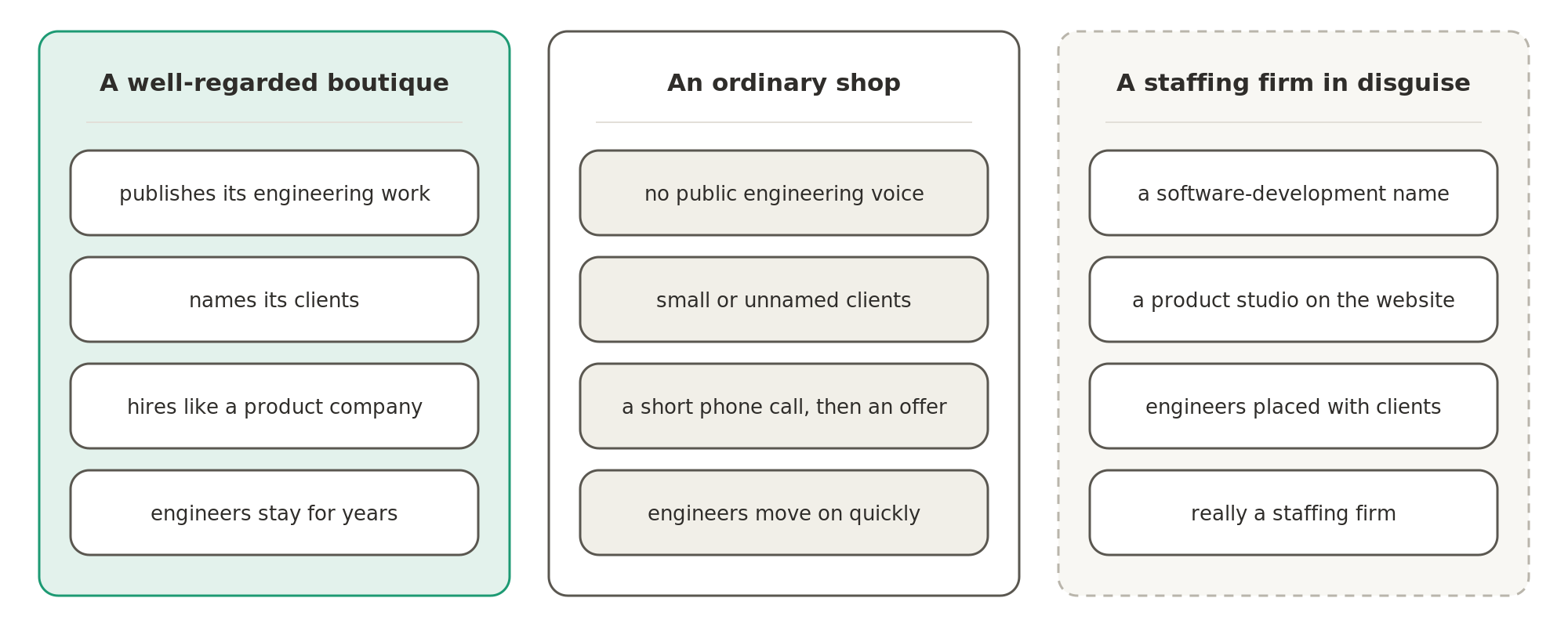
A well-regarded boutique publishes its engineering work, names its clients, hires like a product company and keeps its engineers for years. An ordinary shop shows the opposite marks, and a staffing firm in disguise places engineers with clients under a software-development name.A well-regarded boutique publishes its engineering work, names its clients, hires like a product company and keeps its engineers for years. An ordinary shop shows the opposite marks, and a staffing firm in disguise places engineers with clients under a software-development name.
The firms

The larger firms: AgileEngine, Wissen Technology, Zemoso, GeekyAnts, Sahaj, thinkbridge, CodeVyasa, Bellurbis, VAYUZ, Flexsin, Trantor, algoleap, Opteamix, Litmus7, Unthinkable, Ajackus and Unified Infotech

Firms with over a thousand people each: SLK, Speridian, JK Tech, Emids, ThoughtFocus, Nous, InfoBeans, Kumaran, OSI Digital and Genisys

Also named here: Equal Experts, Kickdrum and SynapseIndia

RIA Advisory is also covered in Company Tier 8, under the platform houses. (More on it in Company Tier 8, Specialist firms built around one skill, in the services-world collection.)

About a hundred more small firms make up the rest of this Company Tier.

The boutique that becomes a product company.

The path from a small shop to a product company is the oldest in Indian software. A shop builds something for a client, keeps the right to it, and turns it into a product it sells to others. Several firms here are part of the way along that path. AI is changing small shops faster than the giants, in both directions. A team of five building with AI can do the work of eight, so a small shop can bid for work it could not staff before. That is why shops that build with AI, such as AgileEngine, GeekyAnts and thinkbridge, are growing. But the same arithmetic means a client that needed a team of five may now need two, or none. The counter-current: the ordinary shop's clients are small businesses, and small businesses are the first to build with AI instead of hiring a vendor.

That is the small software shop: firms of a few hundred people or fewer, where a junior does every part of the work, and the client list decides the firm's fortunes.
Who they hire

Who these firms hire, role by role, is on the collection's role pages for Java backend and full-stack engineers, cloud and DevOps engineers, data engineers, test engineers, frontend and mobile engineers, .NET engineers, GenAI engineers, embedded, systems and chip engineers and the smaller roles.

Privacy Terms Refunds and cancellation Shipping and delivery © 2026 ingrid.fyi · Payments by Razorpay
You're browsing as a guest. Sign in free to follow links for five minutes, once an hour.