ingrid.fyi India's software hiring trends, explained.
Sign in to ingrid.fyi with Google
Your Google account
name@gmail.com
Continue with Google
Home / IT services firms / The services firms that feel like product companies
On this page
The services firms that feel like product companies When an American retailer rebuilds its shopping app, the small team doing the work may be from EPAM, working in Pune.

There is a kind of IT services firm whose engineers hesitate before saying they work in "services". EPAM, Nagarro, Endava, Grid Dynamics, GlobalLogic, Publicis Sapient, Thoughtworks, Luxoft, Ness, Infogain, Photon, Brillio and Ascendion all sell engineers' time, like every firm in this collection. But what the client buys with that time is a build: a new product, a new platform or a rebuilt app, delivered by a small team that works the way a product company's team works. The industry calls these firms build shops.

This Company Tier is about what that changes: the shape of the team, how hard it is to get in, and the pace. It also covers what it does not change: the client, not the firm, owns what is built. The firms range from EPAM, one of the largest engineering-services companies in the world, to studios of fifty people.

Every firm named here has posted software engineering jobs in India.

Keep reading, free

Six more sections are on this page: What these firms sell, and to whom, You join a build, not a maintenance contract, What the bar is, The link to product companies, The firms, and From a build shop to the product it built. Sign in to read them here, in full.

Continue with Google
  • What these firms sell, and to whom
  • You join a build, not a maintenance contract
  • What the bar is
  • The link to product companies
  • The firms
  • From a build shop to the product it built
What these firms sell, and to whom

They sell a team that builds. The client has a product to make or remake, a platform to move to the cloud, or an app to rebuild. It either lacks the engineers, or does not want to hire them permanently for a project that will end.

The firm supplies a small team, with more senior engineers than is usual in services, built around a specific technology. The team takes the product from design to launch, and is paid for its time or for the delivery. The promise is not uptime or a closed ticket. It is a product that works.

The giants' pyramid flattens here into what the industry calls a pod: a handful of engineers, a lead, perhaps a designer, and the client's product manager on the other side of the call.
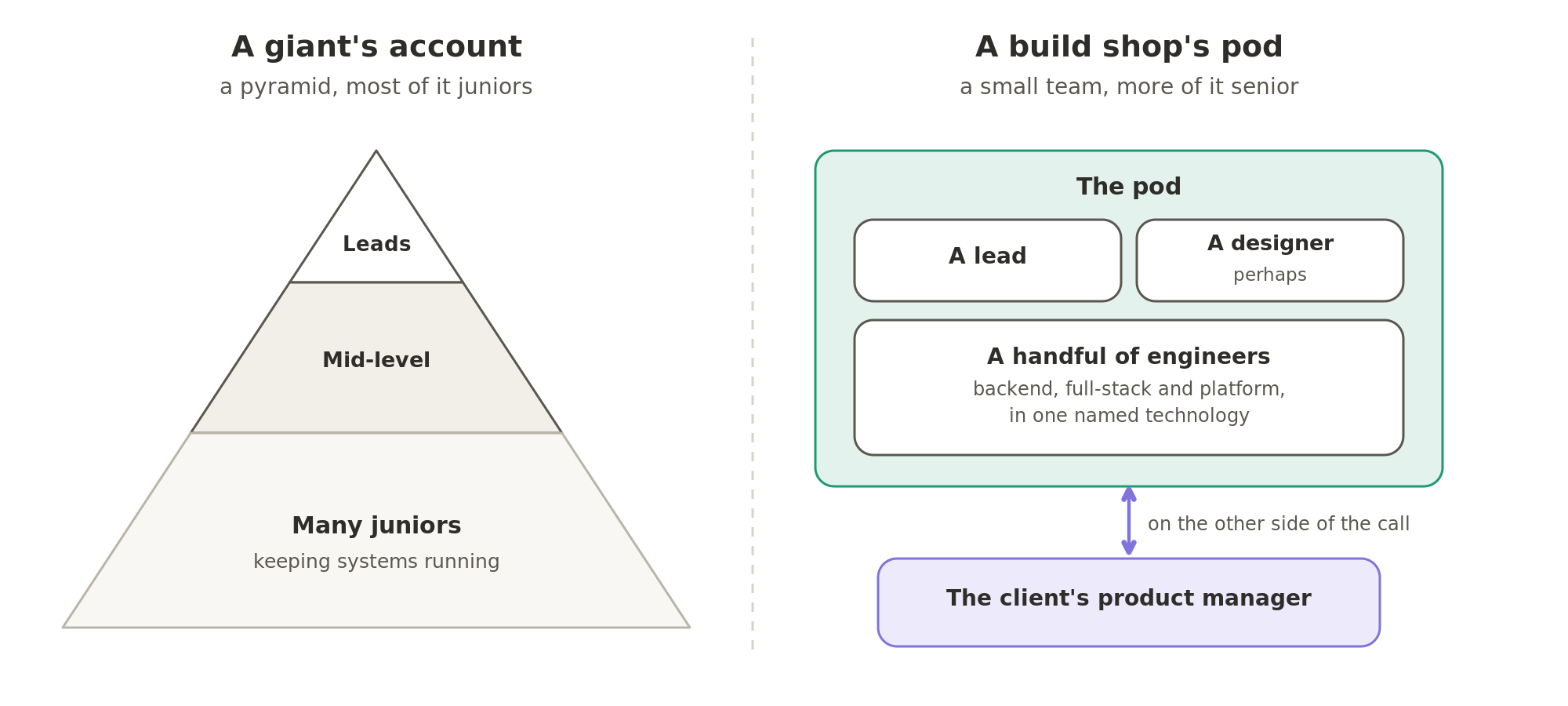
A giant's account is a pyramid, most of it juniors, while a build shop works in a pod: a lead, perhaps a designer and a handful of engineers in one named technology, with the client's product manager on the other side of the call.A giant's account is a pyramid, most of it juniors, while a build shop works in a pod: a lead, perhaps a designer and a handful of engineers in one named technology, with the client's product manager on the other side of the call.

The buyers are:

technology companieswhich hand parts of their own products to firms like these more often than they say banks, retailers and media groupsbuilding digital products that their own GCCs do not mid-sized American and European companiesfor whom a firm like EPAM or Endava is the whole engineering department
You join a build, not a maintenance contract

What separates these firms from the giants is the engagement. At a giant, the typical engagement is a run: keep the client's systems working, take the tickets and make the changes, for years. Here it is a build: make the product over some months, then move to the next one. Almost everything else follows from that.
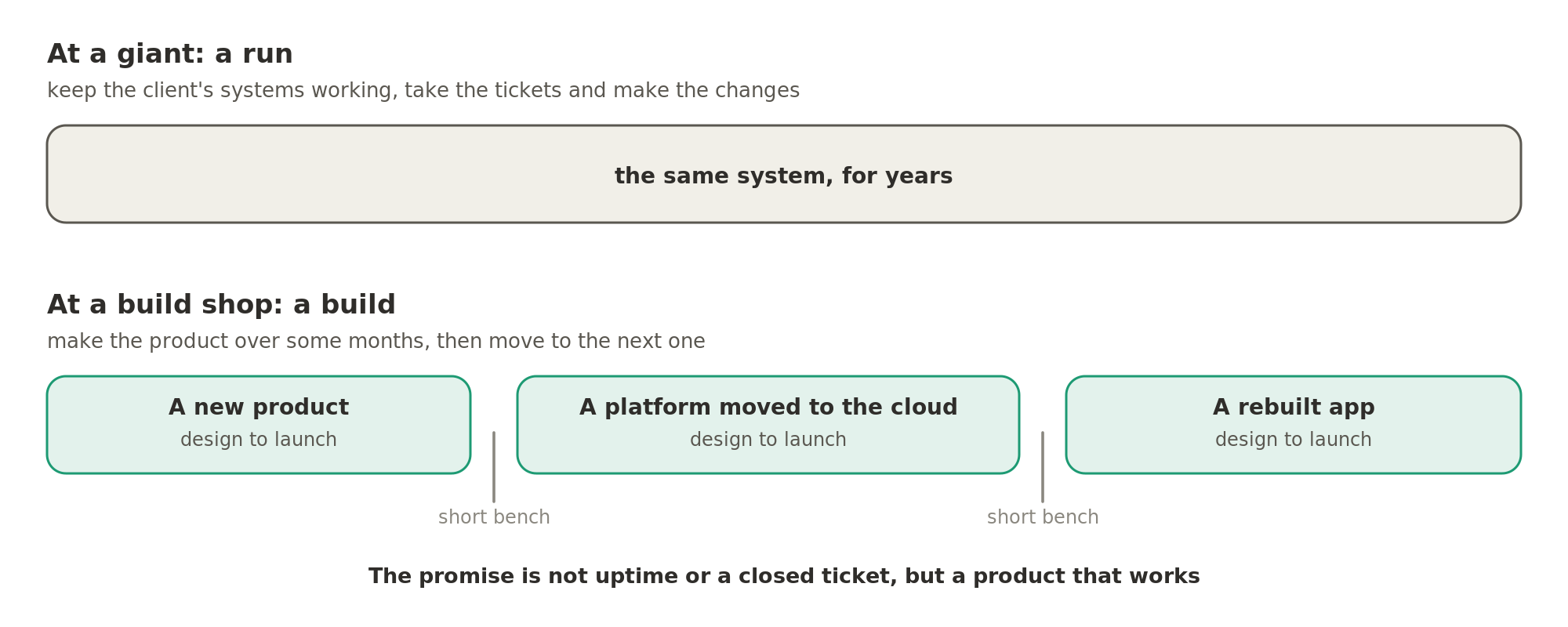
At a giant, the typical engagement is a run on the same system for years. At a build shop, a team takes one product from design to launch over some months and then moves to the next, with a short bench in between.At a giant, the typical engagement is a run on the same system for years. At a build shop, a team takes one product from design to launch over some months and then moves to the next, with a short bench in between. The work is mostly writing softwareAt EPAM, Publicis Sapient, Grid Dynamics, Nagarro and Ciklum, it is backend, full-stack and platform engineering, in named modern technologies. The junior does more of the buildingThe team is small, and juniors are a smaller share of it. So a junior builds more, sooner, than in a pyramid, and works beside the client's own engineers. The bench is shorterA firm whose builds end every few months has learned to line up the next one.

The firms differ by what they build:

Luxoftowned by DXC, builds for carmakers and banks, including embedded software. GlobalLogicowned by Hitachi, builds mobile and device software above all. Ascendion and Terralogicdo a large amount of embedded work. Endavathe British firm, and Ness, Infogain and Photon build digital products for banks, insurers and retailers. Thoughtworksbuilds the same, and has shaped how the whole industry talks about building software. Studiosof fifty to a few hundred people, such as Caizin, InRhythm, Cloudesign, Fluxon, Calfus, Proximity Works and Think41, do the same for smaller clients. They are as close to a product start-up as a services firm gets.

These firms build the product, but the client owns it. The firm's engineers learn how a product is built, while the decisions about what to build stay with the client. That is the main difference from a product company.

You're reading as a guest. Sign in free to follow links for five minutes, once an hour. What the bar is

These firms are harder to enter than the giants and the mid-sized firms, for the same reason the work is different: a small team cannot carry anyone who is not ready.

Few freshersMost of these firms hire almost no freshers. The two large exceptions are GlobalLogic and Brillio, which run graduate programmes, and a few studios take one or two. Lateral entry, the product-company wayMost engineers join with two to five years' experience. The interview looks like a product company's: a coding test, often a problem to solve at home, a system-design discussion, and deep questions on one technology. The firm is hiring someone it can put on a client's build straight away.

The services trade-offs are still there, though thinner. Engineers are still billed to clients, and the firm still watches utilisation. A client can end a build early. The hours follow the client's time zone, which for EPAM's and Grid Dynamics' mostly American clients means Indian evenings. And the ladder above senior engineer leads into delivery and account roles, not product roles.

The link to product companies

More engineers move from these firms to product companies than from any other part of the services world. The reasons are in how the work is done:

The work is the same workEngineers on a build write production code in a modern technology, work in a small team, ship, and take part in the client's design reviews. That is what a product company's engineers do. The hiring bar is the same kindThe interview at a product company is a harder version of the one used here, not a different kind.
The firms

Largest first, by size in India:

EPAM GlobalLogic Publicis Sapient Nagarrowith about twenty thousand people Luxoft Thoughtworkswith about eleven thousand people Endava Encorawith about eight thousand people Ness Infogain Photonwith nearly six thousand people Brillio Xebia DataArt Orion Ascendion Grid Dynamics Smaller firms and studiosincluding Ciklum, Terralogic, Accolite, HashedIn, Caizin, InRhythm, Cloudesign, Fluxon, Calfus, Proximity Works, Think41, CoStrategix, CAW, Nouveau Labs and Frontend Arts
From a build shop to the product it built

The client's building is the link. A build firm's team spends months inside a product company or a company's digital arm, working on a product that company owns. When the build ends, a client that liked the team often hires from it. That is the most common route from a services firm to a product company, and the industry the engineer built for is the industry they most often join. (More on product companies in the product-companies collection.)
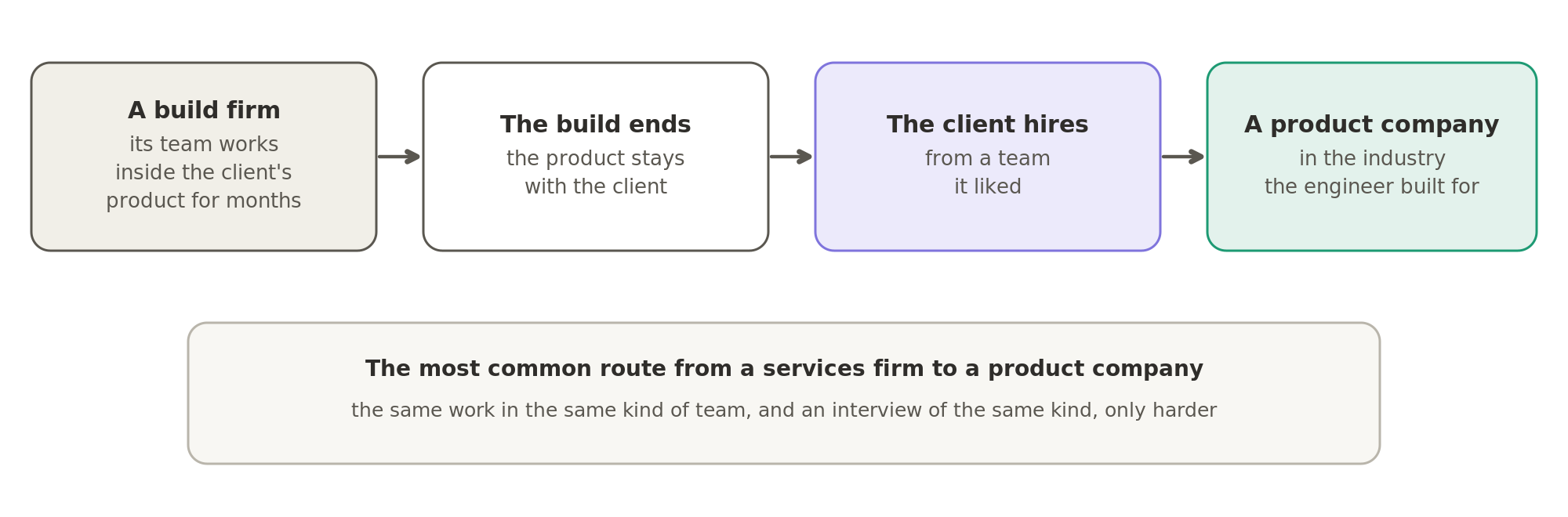
A build firm's team works inside a client's product for months, and when the build ends, a client that liked the team often hires from it. That is the most common route from a services firm to a product company, usually in the industry the engineer built for.A build firm's team works inside a client's product for months, and when the build ends, a client that liked the team often hires from it. That is the most common route from a services firm to a product company, usually in the industry the engineer built for. The build firm that owns something.

A few build firms have started to keep a share of what they build: a platform, a set of reusable tools, or a product spun out of a client's build. That is the one move that closes the ownership gap. Thoughtworks' open-source work and EPAM's platforms are the visible cases. AI reaches these firms from two sides at once. Writing code is most of what they sell, and AI models now write code. But a build firm that builds with AI is also what every client now wants. AI work is already a visible part of the work at GlobalLogic, Grid Dynamics, Fluxon, Calfus and Accolite, and the smallest studios are increasingly built around AI from the start. The counter-current is ownership: Luxoft belongs to DXC, GlobalLogic to Hitachi and HashedIn to Deloitte, and Ascendion grew out of a staffing firm. A build firm's culture can change with its owner.

That is the build shop: services firms that sell a build rather than a run, in small teams that work like a product company's, on products their clients own.
Who they hire

Who these companies hire, and for what, is on What the services firms that feel like product companies hire for.

Privacy Terms Refunds and cancellation Shipping and delivery © 2026 ingrid.fyi · Payments by Razorpay
You're browsing as a guest. Sign in free to follow links for five minutes, once an hour.