Take any everyday product, a food delivery app, a banking app or a car's dashboard. Underneath it sits a stack of layers, and each layer has its own engineers.
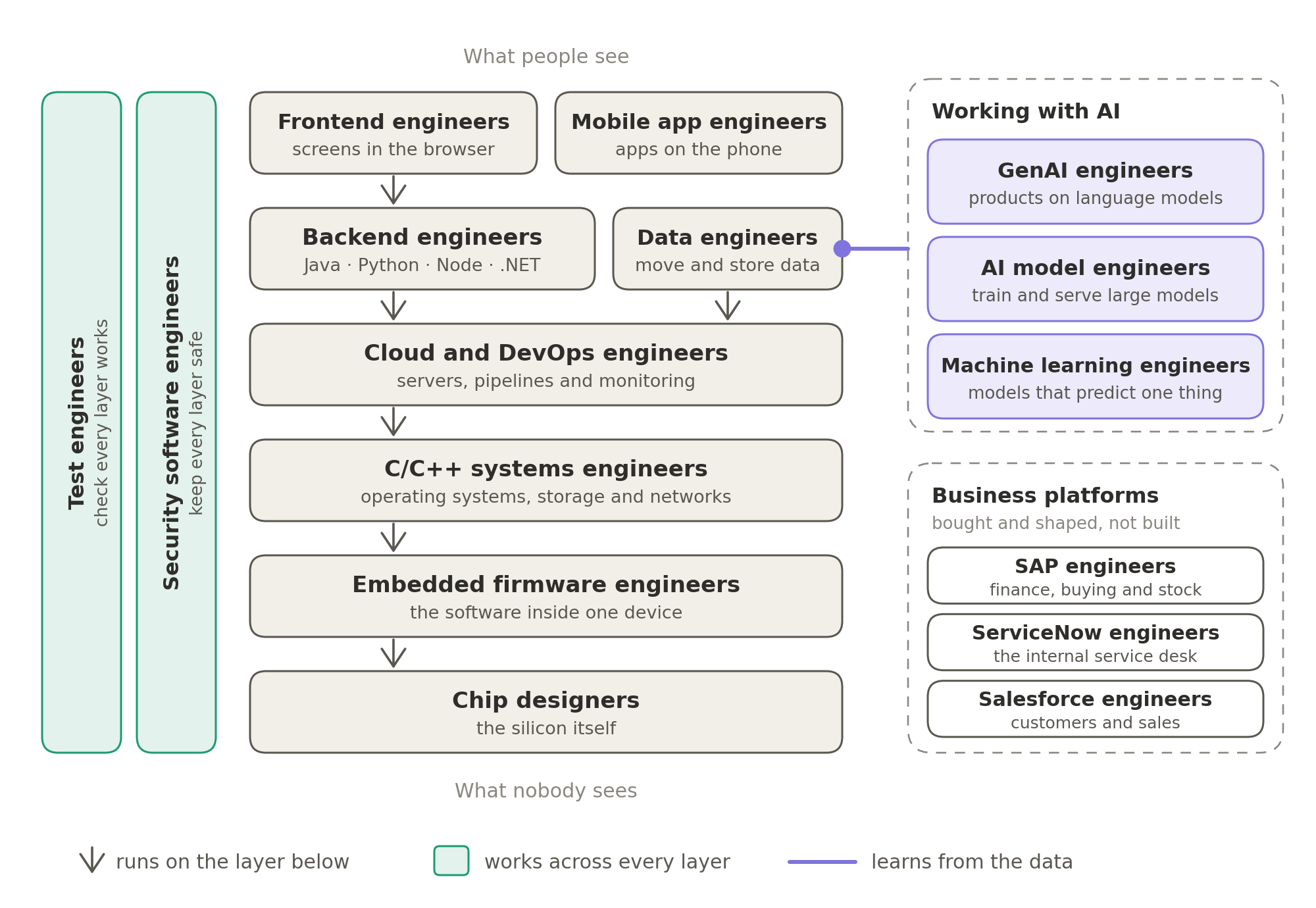
The arrows point downward, from what people see to what they never see. The higher layers are mostly software that runs on someone else's machines. The lower layers sit closer to the hardware, where memory and speed are managed by hand. Test engineers and security software engineers work across every layer. The AI roles sit beside the data, because every model learns from it. SAP, ServiceNow and Salesforce sit apart, because companies buy these platforms and shape them to their business rather than build them from scratch. The sections below follow one food order down the stack, from the screen the customer taps to the chip inside the phone.
Picture ordering dinner on a food delivery app. Everything the customer touches, the menu, the cart and the map that follows the rider, is the work of two roles.
Backend engineers write those services, the business rules, the APIs and the databases behind every order, payment and booking. When the customer taps Pay, a backend service checks the cart, takes the payment and tells the restaurant. It is one kind of work done in four main languages.
By the end of a busy evening, the app holds a mountain of orders, deliveries and payments, spread across many databases.
The rider's phone, the restaurant's billing machine and the servers in the data centre are all physical devices.
A bug can hide anywhere from the menu screen to the payment service, and so can a weakness that an attacker might use.
The food delivery company has to pay its staff, buy supplies, answer its own employees' IT requests and keep track of its restaurant partners. Large companies rarely build software for this kind of work. They buy ready-made platforms and shape them to their own business.
A business platform is one large piece of software, written by one vendor and sold to companies all over the world. SAP, a German company founded in 1972, began as software that companies installed on their own computers, and many still run it that way while others now use it from SAP's cloud. Salesforce, founded in 1999, and ServiceNow, founded in 2004, were built for the cloud from the start, so a company rents them as a service and reaches them through a browser. Either way, the company pays a licence or a subscription, gets the same core product as every other customer, and then configures it to match its own way of working.
Building this kind of software in house sounds possible but rarely makes sense. Paying salaries means following tax and labour rules that differ between states and countries and change every year. Closing the books means following accounting standards that auditors check line by line. A vendor writes these rules once, keeps them up to date and shares the cost across all of its customers. A company that built its own system would carry that whole burden alone, for software that gives it no edge over its competitors.
Once in place, these platforms are very hard to remove. SAP often runs a company's finance, purchasing and stock for decades, and every report, process and connected system grows around it. Replacing it can take years and a large budget, so companies tend to keep it and keep extending it. That long life has turned the work of shaping these platforms into a career of its own. Engineers here rarely write a program from nothing. They configure the platform, write code in its own language where configuration falls short, and connect it to the company's other systems.
Machine learning, AI model training and GenAI all involve models, but the work differs in what each engineer starts with and what each one delivers.
A machine learning engineer starts with the company's own records and builds a model for one narrow question. The food delivery app's model that guesses how long an order will take learns from the app's past orders, and it answers that one question and nothing else. The engineer chooses what the model looks at, such as the distance, the time of day and how busy the kitchen is, trains it, checks that its guesses are good, and keeps it accurate as the city changes.
An AI model engineer works on the large, general models themselves, the kind that can read, write and answer almost any question. These models learn from huge amounts of text, images or speech, and training one keeps a large cluster of specialised chips busy for weeks. The engineer prepares that data, runs and tunes the training, adapts a model to a new language or field, and makes it fast and cheap enough to serve to many users at once. This work sits with the companies that have the data and the computing power to afford it.
A GenAI engineer trains no model at all. The GenAI engineer takes a large model that already exists, from a provider such as OpenAI or from an open source release, and builds a product around it, such as the food delivery app's support assistant. The work is mostly software engineering, connecting the model to the company's data, writing the instructions that steer it, and testing that its answers stay correct.
Put simply, the machine learning engineer builds a small model for one job, the AI model engineer builds the big general model, and the GenAI engineer builds a product on top of that big model.
Cloud and DevOps engineers and security software engineers both work on the platform. The cloud engineer builds it and keeps it running, and the security software engineer makes sure nobody can misuse it.
Firmware, systems and chip design all sit close to the hardware. A chip designer designs the chip. A firmware engineer writes the software inside one device built around that chip. A systems engineer writes the software that servers, networks and operating systems run on, across many machines rather than one device.
Frontend and full-stack engineers both build screens. A frontend engineer builds only the screens, while a full-stack engineer builds the screens and the services behind them.