A metro line, a flyover, an apartment tower: most Indian cities have several of these under construction at any time. Construction is one of the largest industries in the world. It is also one of the last to go digital. Many projects are still run on drawings, spreadsheets and phone calls, and most finish late.
Who works on a project. A construction project brings together many separate companies:
The ownerpays for the project. It may be a property developer, a company or a government.
Architects and engineersdesign it.
The main contractorbuilds it, and is often called the general contractor.
Subcontractorsdo the specialist work, such as electrical wiring, plumbing and painting. These specialist jobs are called trades.
Suppliersdeliver the materials, such as cement, steel and tiles.
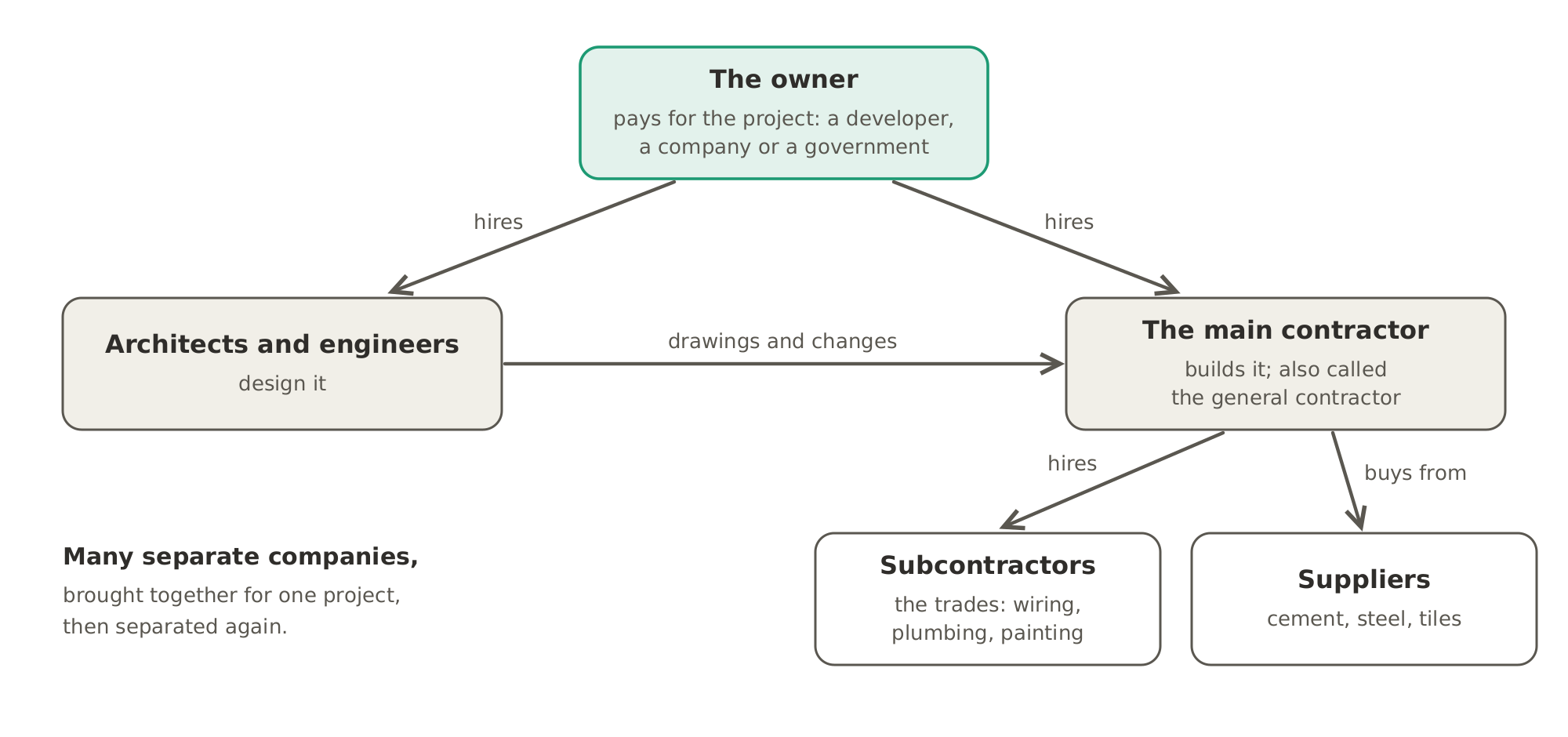 Who works on a construction project: the owner pays and hires the architects and engineers, who design it, and the main contractor, who builds it from their drawings. The contractor hires subcontractors for the trades and buys materials from suppliers.
The stages of a project. Software now covers each stage:
Design: architects and engineers draw the building, more and more as a 3D model.
Estimate and bid: contractors count the materials and labour the design needs, work out the cost, and quote a price to win the job.
Plan: the contractor sets the schedule and the budget.
Build: work on site is tracked against the schedule. Drawings change, inspections are done, and subcontractors are paid.
Hand over: the finished building passes to the owner. (More on what happens next in Market Segment 41.2, Property and facilities management software.)
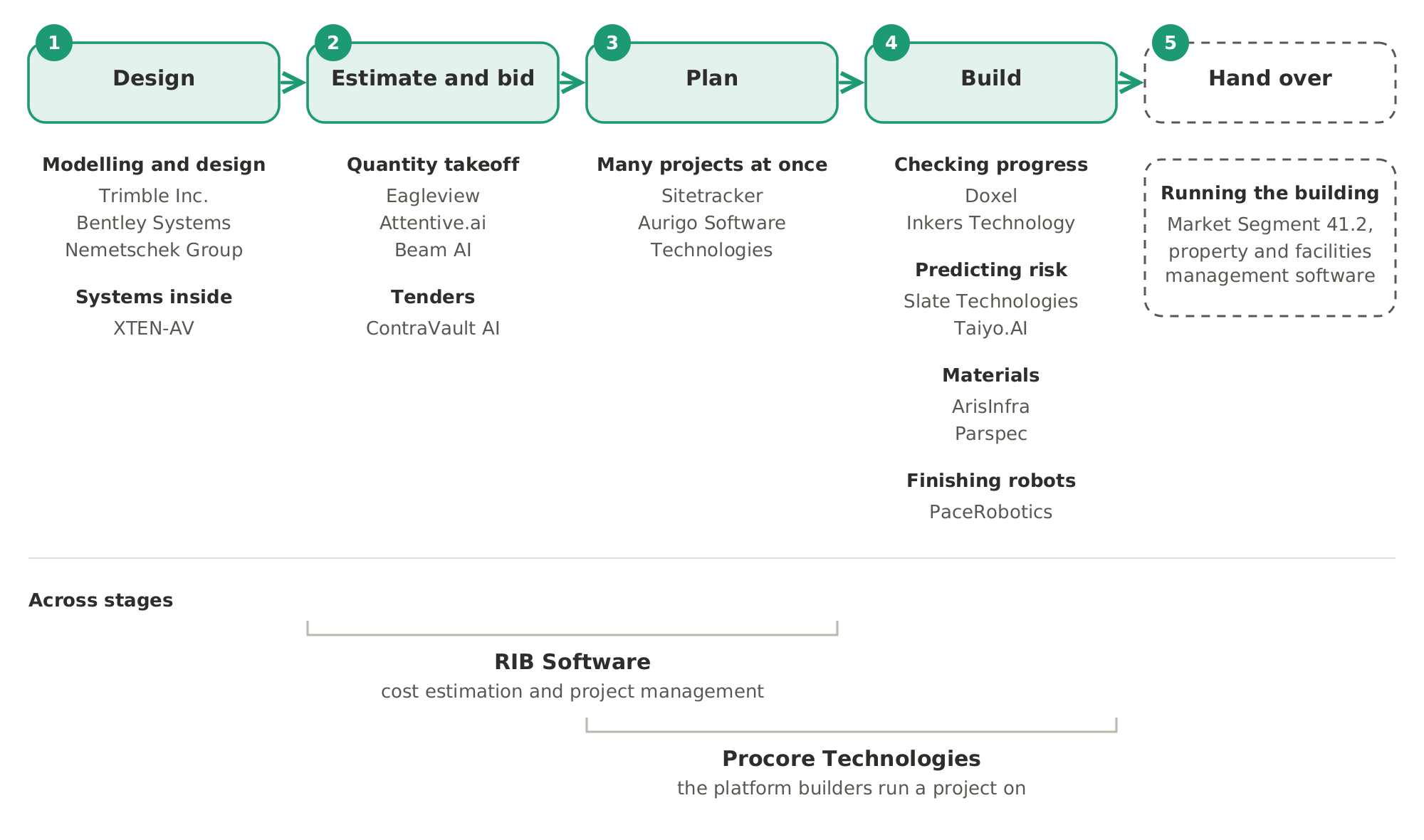 Software at each stage of a project: design (Trimble Inc., Bentley Systems, Nemetschek Group, XTEN-AV), estimating and bidding (Eagleview, Attentive.ai, Beam AI, ContraVault AI), planning many projects at once (Sitetracker, Aurigo Software Technologies) and building on site (Doxel, Inkers Technology, Slate Technologies, Taiyo.AI, ArisInfra, Parspec, PaceRobotics). RIB Software and Procore Technologies span several stages, and the finished building passes to property and facilities management software.
Why construction went digital late. Every project is different. The companies on it work together for one project and then separate. The work happens on a site, not at a desk. And contractors earn very little on each project, so they have little to spend on software. That is changing fast. A mistake found on a drawing costs little to fix. The same mistake found after the concrete is poured costs a great deal.
Who buys the software. The buyers are contractors, architects, engineering firms, owners and governments. Most of the companies here sell mainly in America and Europe. Several of the largest build much of their software in India.
Every company named here has posted software engineering jobs in India. Famous companies that don't actively hire software engineers in India are left out.
This Market Segment has two sub-segments:
Planning and running the project: software for designing, estimating, scheduling and tracking a project
Measuring, buying and building: measuring the job, buying the materials and doing the work
Planning and running the project
Construction management, building information modelling (BIM), infrastructure design, cost estimation, capital programme management, site progress tracking
Running the project
Procore Technologieswith engineers in Bengaluru and Pune, sells the platform on which builders run a project: its drawings, schedules, inspections and payments. Everyone on the project works from the same, latest information. Its Bengaluru centre is one of its largest. Procore has the most job postings in this Industry Vertical.
RIB Softwarewith engineers in Pune and Kolkata, sells software for cost estimation and project management.
Designing it. Designers now work with building information modelling, or BIM. A BIM model is a 3D model of the building. Every part in it, such as a wall, a pipe or a door, carries its own data: its size, material and cost.
Trimble Inc.with most of its Indian engineers in Chennai, makes surveying instruments, which measure the land before building starts. It also makes modelling and project software for builders.
Bentley Systemswith engineers in Pune and Kolkata, makes design software for roads, bridges and railways. It also makes digital-twin software. A digital twin is a digital copy of a real structure, kept up to date with data from it.
Nemetschek Groupwith engineers in Bengaluru and Hyderabad, makes Archicad and Bluebeam. Architects design buildings in Archicad. Builders mark up drawings in Bluebeam.
Trimble and Bentley Systems also make design software used in manufacturing. (More on both in Market Segment 37.2, CAD and PLM software, in Industry Vertical 37, Manufacturing tech.)
Managing many projects at once
Sitetrackerwith engineers in Bengaluru and Delhi, manages the roll-out of infrastructure built at thousands of sites, such as telecom towers and electric-vehicle chargers.
Aurigo Software Technologieswith engineers in Bengaluru, manages the capital programmes of governments and transport agencies. A capital programme is the full set of building projects an organisation pays for over several years, such as a state's roads and bridges.
Checking progress and predicting risk
Doxelwith engineers in Bengaluru, and Inkers Technology, founded in Bengaluru, compare scans of a site with its plans. This shows how much has really been built.
Slate Technologies and Taiyo.AIuse data to predict the risks to a project, such as delays.
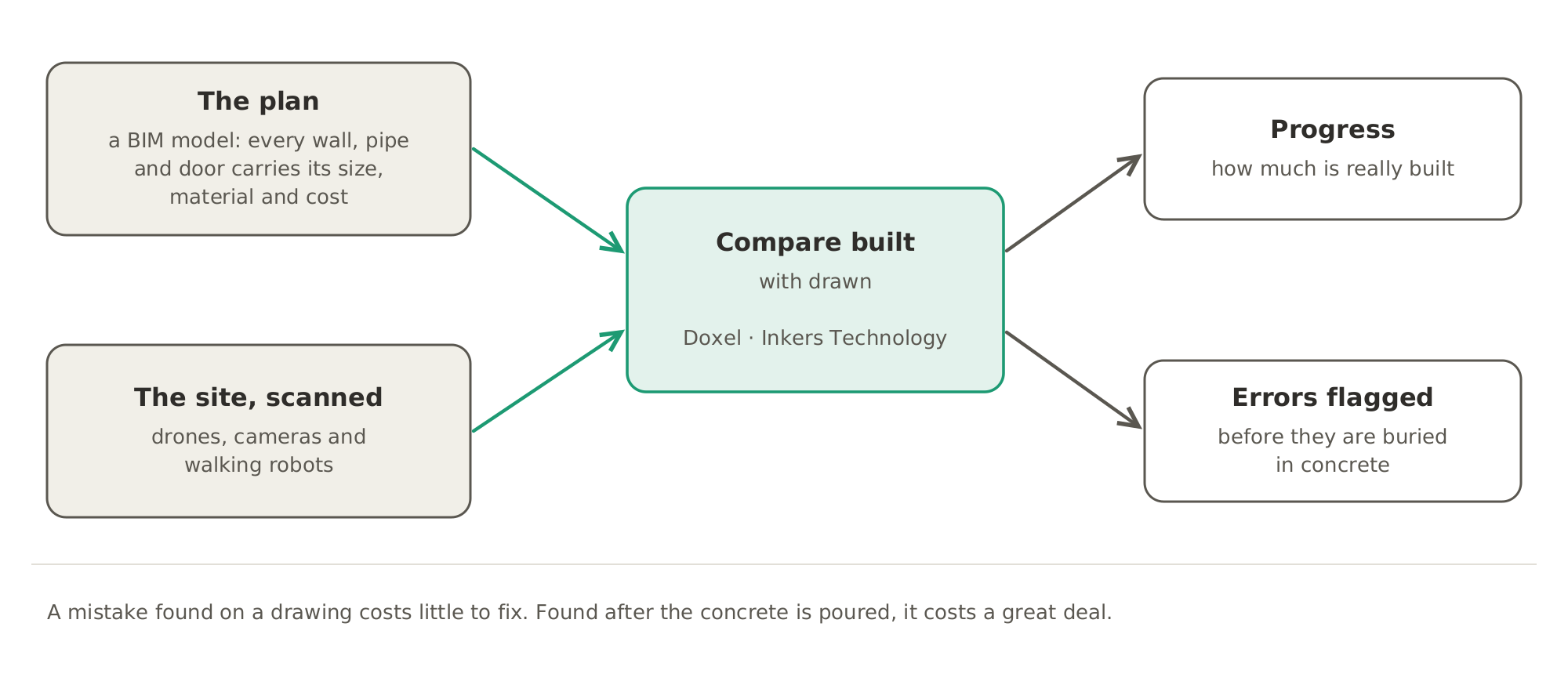 Checking a site against its plan: drones, cameras and walking robots scan what has been built, and software compares the scan with the BIM model to show how much is really built and to flag errors before they are buried in concrete. Doxel and Inkers Technology work here.
Designing the systems inside the building
XTEN-AVwith engineers in Delhi, makes software for designing a building's audio-visual systems, such as the screens and speakers in meeting rooms.
Two companies covered mainly in other Market Segments also work here:
Hexagon Asset Lifecycle Intelligencewith engineers in Hyderabad, sells software for digital project execution: running a large building project from digital plans. (More on it in Market Segment 37.2, CAD and PLM software, in Industry Vertical 37, Manufacturing tech.)
QCICwith engineers in Bengaluru, designs security systems for buildings. (More on it in Market Segment 4.15, Physical security, surveillance and trust and safety, in Industry Vertical 4, Cybersecurity.)
Measuring, buying and building
Aerial measurement and quantity takeoff, construction materials procurement, bidding, finishing robots, drilling rigs
Measuring the job. Before a contractor quotes a price, someone has to count everything the job needs: so many square metres of tiles, so many metres of pipe. This count is called a quantity takeoff. The bid is priced on it. Estimators used to do it by hand from the drawings, which took days.
Eagleviewwith engineers in Bengaluru, measures roofs and properties from aerial images, for builders and insurers. (More on it in Market Segment 8.4, Mapping and location intelligence platforms, in Industry Vertical 8, Analytics and data providers.)
Attentive.aiwith engineers in Delhi, and Beam AI use AI to read drawings and aerial images, and produce the quantity takeoff automatically.
Buying the materials
ArisInfrafounded in India, with engineers in Bengaluru, buys construction materials and delivers them to builders.
Parspecwith engineers in Bengaluru, digitises quoting for building products: the price quotes that suppliers prepare for contractors. (More on it in Market Segment 11.1, Procurement and source-to-pay software, in Industry Vertical 11, Finance and accounting software.)
Doing the work
PaceRoboticswith engineers in Bengaluru, builds a robot that plasters and paints walls.
KYZO (Khidki Homes)in Bengaluru, is another company in this area.
One company here works outside construction. H&P, with engineers in Delhi, makes drilling rigs for oil and gas wells, and the automated controls that run the drilling.
Two companies covered mainly in other Market Segments also work here:
ServiceTitanwith engineers in Bengaluru, sells software to plumbers, electricians and HVAC contractors. HVAC stands for heating, ventilation and air conditioning. (More on it in Market Segment 15.6, Field service and appointment booking software, in Industry Vertical 15, Customer service and CX.)
ContraVault AIwith engineers in Bengaluru, helps companies manage tenders. A tender is a formal invitation to bid for a job. (More on it in Market Segment 11.1, Procurement and source-to-pay software, in Industry Vertical 11, Finance and accounting software.)
The site that checks itself against the plan.
Drones, cameras and walking robots now scan a construction site. AI models compare what was built with what was drawn. They flag errors before the errors are buried in concrete. Quantity takeoffs that took estimators days now take minutes. Construction was long the least digital of industries. It is one of those that AI may change most.
That is construction software: tools to design a project, price it, plan it and track it on site. Most of the buyers are abroad, and much of the software is built in Bengaluru, Pune and Chennai.