The fourteen Market Segments before this one guard things made of bits. This last one guards things made of atoms, and people: the door, the car park, the airport checkpoint, the executive under threat. In its final sub-segment, it guards the users of an app from each other.
Think of one working day. In the morning, you tap your badge to enter your office in Hyderabad, and a camera watches the lobby. In the evening, your bag goes through an X-ray scanner at the airport. On the flight, you report a fake account on a social media app. Every one of these runs on software.
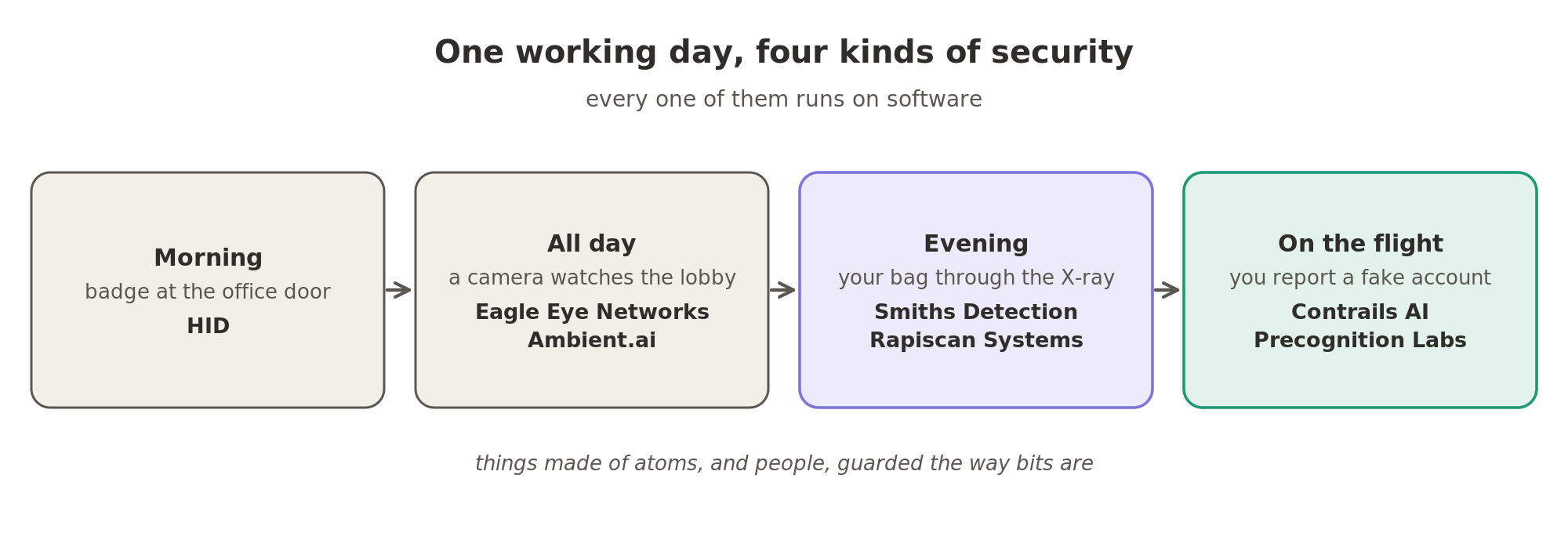 One working day, four kinds of security: the badge at the office door (HID), the camera watching the lobby (Eagle Eye Networks, Ambient.ai), the X-ray scanner your bag goes through at the airport (Smiths Detection, Rapiscan Systems), and the fake account you report on the flight (Contrails AI, Precognition Labs).
Physical security is covered in Industry Vertical 4, Cybersecurity, because the two industries have merged:
- The badge that opens the office door is issued by the same identity system as your login.
- The camera feed is analysed by the same kind of AI model as the network traffic.
- The corporate security team that watches for threats to a factory reads the same intelligence feeds as the team that watches for threats to a server.
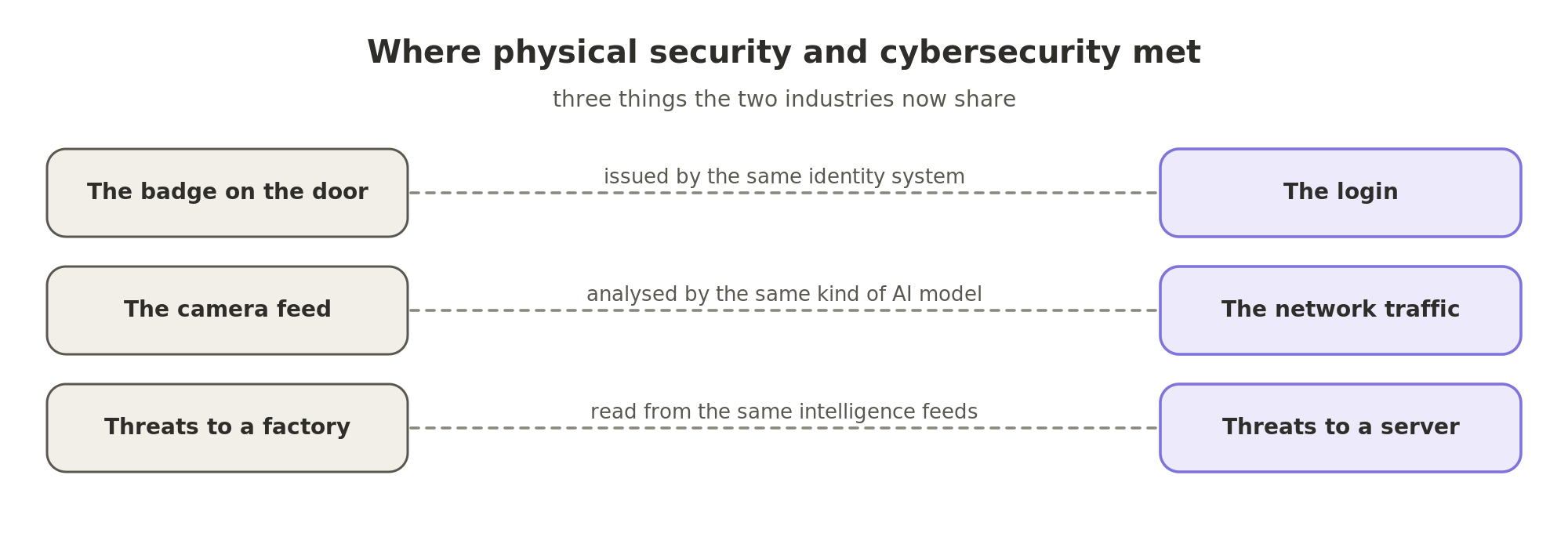 Where physical security and cybersecurity met. The badge on the door and the login are issued by the same identity system. The camera feed and the network traffic are analysed by the same kind of AI model. Threats to a factory and threats to a server are read from the same intelligence feeds.
The newest business here is trust and safety: security for the people inside an app or a platform. It covers moderating what is posted, investigating reports of abuse, and detecting fakes. It grew up inside the big platforms, and is now sold as software. (More on them in Google and Meta, in the big-tech collection.)
Most companies in this Market Segment are foreign companies with engineering centres in India, along with a few Indian start-ups. Their buyers range from office landlords and airports to social media platforms.
Every company named here has posted software engineering jobs in India. Famous companies that don't actively hire software engineers in India are left out.
This Market Segment has three sub-segments:
The door and the camera: access control, video, and the analytics on top of the video. The largest company in this Market Segment is here.
The checkpoint and the threat: the screening machines at airports and borders, and the intelligence platforms that protect people and sites.
Trust and safety: two young companies at the frontier of a new category.
It ends with a short note that links ransomware recovery to backups.
The door and the camera
Access control and credentials, video management, video analytics, security-system design, consumer home security
Back to your office from the start of this Market Segment. The first sub-segment is the physical boundary: the badge, the door and the camera.
HIDpart of ASSA ABLOY, makes the cards, readers and credentials that open doors in many large buildings. It has engineers in Chennai and Bengaluru. It also sells the software side of that business: multi-factor authentication, public key infrastructure and identity verification. The same credential now opens both the door and the laptop. (More on its software in Market Segment 4.2, Identity and access management (IAM). More on ASSA ABLOY in Market Segment 37.9, Building technology and HVAC, in Industry Vertical 37, Manufacturing tech.)
Eagle Eye Networksfrom Austin, has been one company with Brivo since December 2025. It sells the camera system as a cloud service: video management, encrypted recording, analytics and a link to the door-access system. It sells through resellers to buildings of every size.
Ambient.aia US company with engineers in Bengaluru, sells only the analytics layer. Its computer vision runs over a customer's existing cameras and sensors. It recognises an incident, such as someone following an employee through a door, a weapon, or a person where no one should be. Then it calls in the response, without a guard watching a wall of screens.
Videoneticsfrom Kolkata, is an Indian video-analytics company. It sells video management, analytics, traffic management and face recognition.
QCICfrom London with engineers in Bengaluru, does the engineering before any of this is installed. It designs the access-control and camera system for a building, with a tool that automates the drawings. (It also appears in Market Segment 41.1, Construction tech, in Industry Vertical 41, Proptech.)
Ringowned by Amazon, with engineers in Bengaluru, is the consumer version of this whole sub-segment. It sells the video doorbell, the home camera and the alarm to households, all run from a phone.
Two companies covered mainly in other Market Segments also belong here:
Alba Urmetmakes the access-control hardware, video door phones and surveillance for residential buildings. It sees this sub-segment from the housing society's side. (More on it in Market Segment 41.3, Apartment society management apps, in Industry Vertical 41, Proptech.)
Crane Authenticationprotects the object, not the building. It makes the physical anti-counterfeiting features on banknotes and branded goods, and runs a digital brand-protection service. (More on it in Market Segment 27.5, Brand protection and product authentication, in Industry Vertical 27, Retail tech.)
The checkpoint and the threat
Screening and detection equipment, protective intelligence, threat assessment, critical event management
Back to your evening at the airport from the start of this Market Segment. The second sub-segment moves from the building to the border, and from the intruder to the threat.
Two companies here make the machines at airport checkpoints and ports:
- X-ray and CT scanners for baggage, which build a 3D picture of what is inside
- inspection gantries for cargo and vehicles
- detectors that pick up traces of explosives
- walk-through metal detectors
Both are here for the software around the machines.
Smiths Detectionwith engineers in Bengaluru, sells a security-management platform that runs a whole fleet of its machines.
Rapiscan Systemswith engineers in Hyderabad, builds the software its scanners run on.
These machines are the other side of the operational technology from Market Segment 4.5, Network security, firewalls and SASE. There, the subject was the network that protects such machines. Here, it is the machines themselves.
Onticprotects people rather than places. It has engineers in Pune and Delhi NCR. Its protective-intelligence platform serves corporate security teams. It gathers threats against executives, offices and events, from public and internal sources, into a single case. (It also appears in Market Segment 4.12, Threat intelligence and attack surface management.)
One company covered mainly in another Market Segment handles the emergency itself:
Everbridgesells critical event management. When a fire, a flood, an attack or an outage happens, its system tells every affected person what to do, and tracks that they are safe. In Bengaluru, it has more job postings than any other company here that is covered mainly in another Market Segment. (More on it in Market Segment 11.4, Regulatory compliance software, in Industry Vertical 11, Finance and accounting software.)
The model watching the camera.
The change in this half of the Market Segment is that a person no longer has to watch. Ambient.ai's vision models, the analytics inside Eagle Eye's cloud and the threat scoring inside Ontic all hand the first look to an AI model. Market Segments 4.9 and 4.10 described the same shift for the security analyst. Here it arrives for the guard.
You're reading as a guest. Sign in free to follow links for five minutes, once an hour.
Sign in
Trust and safety
Content moderation, abuse and fraud investigation, deepfake and synthetic-media detection
Back to the fake account you reported on the flight, from the start of this Market Segment. Trust and safety is what a platform does to protect its users from each other:
- moderating what is posted
- investigating reports of abuse and fraud
- removing the fake account and, lately, the fake video
This is the youngest industry in Industry Vertical 4, and here it has two young companies.
Contrails AIfrom Bengaluru, detects deepfakes: images, audio and video faked with AI, also called synthetic media. A platform, a newsroom or a bank's verification team uses it to decide whether what it is looking at was ever real.
Precognition Labsfrom the Seattle area, builds AI agents that run the trust-and-safety investigation itself. The agent reads the report, gathers the evidence and drafts the decision. A human reviewer used to put all of that together by hand.
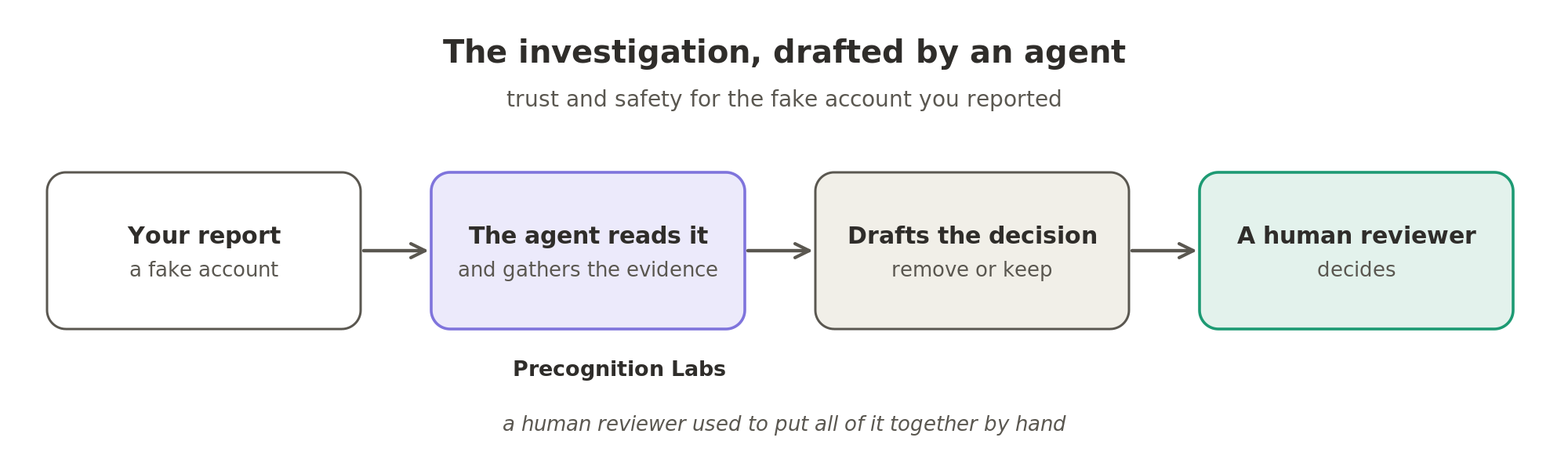 The investigation, drafted by an agent. An agent such as Precognition Labs' reads the report of a fake account, gathers the evidence and drafts the decision for a human reviewer, who used to put all of it together by hand.
The fake and the investigator, both made by models.
The investigation, drafted by an agent. An agent such as Precognition Labs' reads the report of a fake account, gathers the evidence and drafts the decision for a human reviewer, who used to put all of it together by hand.
The fake and the investigator, both made by models.
AI models make the fake media this sub-segment detects. The same models also power the detector and the investigator. It is the clearest case in Industry Vertical 4 of the same technology on both sides.
The page's connector
Ransomware recovery, linked to Market Segment 7.2
One last link belongs at the end of Industry Vertical 4. Ransomware recovery means getting a company running again after its data has been locked by ransomware. It is a security incident, but its remedy is a backup. Backups are covered in Market Segment 7.2, Enterprise storage and backup (in Industry Vertical 7, Database and storage companies). The forensics that come before the restore are covered in Market Segment 4.9, SIEM and security operations (SOC).
So security has moved well beyond the screen. It runs from the badge on your office door and the scanner at the airport to the fake account you report on your phone.