The earlier Market Segments in Industry Vertical 17, Payments, are about people paying shops. This one is about companies paying.
Take a 200-person software company in Pune. It spends money in two ways:
Its employees spend on its behalfA salesperson flies to Delhi to meet a client. She pays for the hotel, the taxi and a lunch with the client. Other employees pay for fuel and for software.
It pays its suppliersThe company buys fifty laptops from a supplier. The supplier sends an invoice. The company pays it, usually some weeks after the laptops arrived.
Each kind of spending has its own tools. Employee spending is managed with the company card and the expense report, the list of what an employee spent, sent in for approval. Supplier payments are managed by accounts payable, the team and the software that pay a company's bills.
Both are being rebuilt around one idea. The old way was to reconcile the spending afterwards, meaning to check it against the records once the money was gone. The new way is to control the spending before it happens.
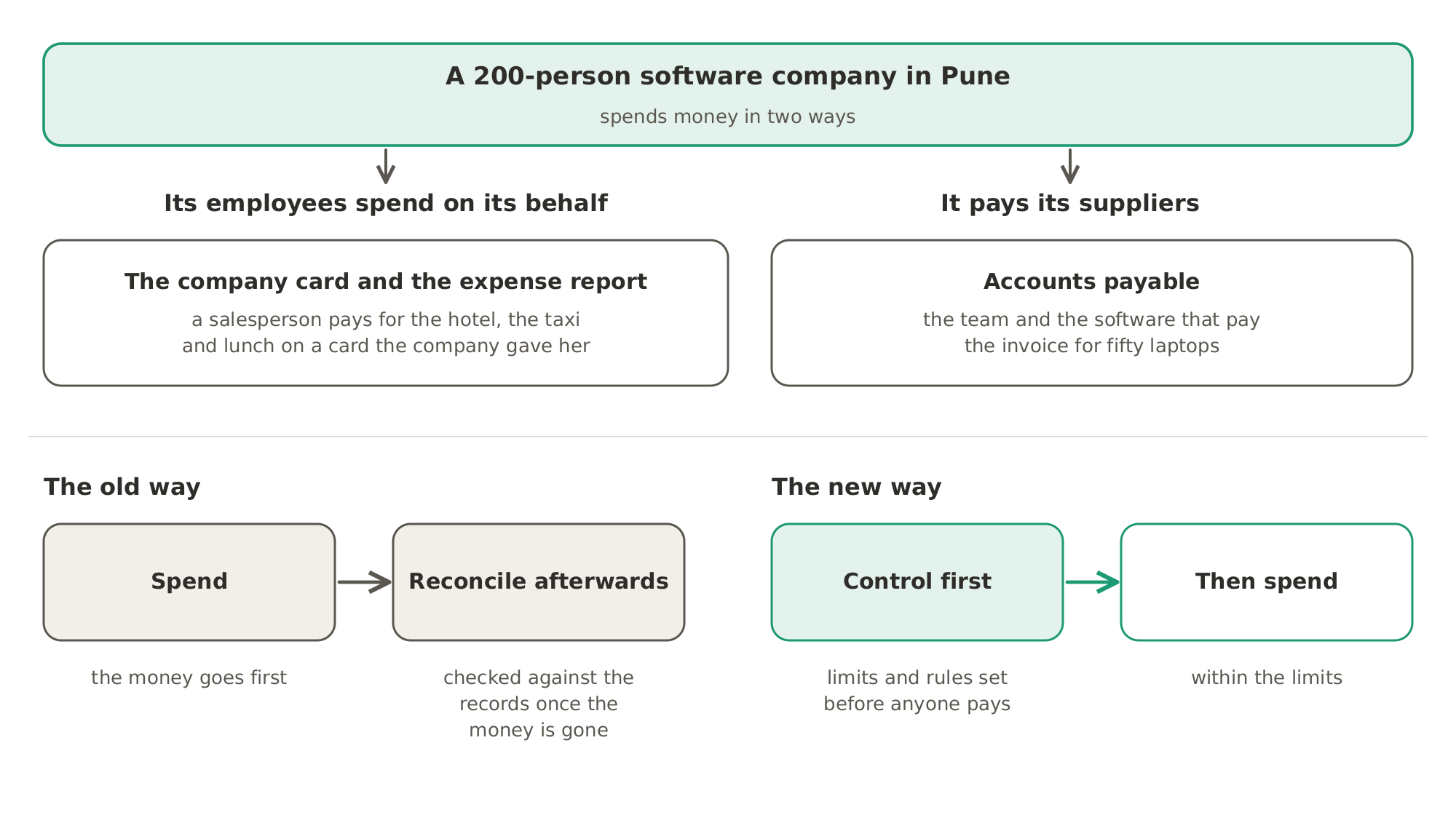 The Pune company spends money in two ways: its employees spend on its behalf, with the company card and the expense report, and it pays its suppliers through accounts payable. The old way was to spend and reconcile afterwards; the new way is to set the limits and rules first, then spend.
The same company's accounts are kept with software covered elsewhere. (More on it in Industry Vertical 11, Finance and accounting software.)
Every company named here has posted software engineering jobs in India. Famous companies that don't actively hire software engineers in India are left out.
This Market Segment has two sub-segments:
The card in the company's hands: corporate cards, fleet cards and gift cards, and the expense software around them
Paying between businesses: the invoice, the payment and the reconciliation
The card in the company's hands
Corporate and virtual cards, fleet fuel cards, gift cards and rewards, expense management, business accounts for small companies
Take the salesperson from the start of this Market Segment, on her trip to Delhi. She pays with a card the company gave her, and the company sets the limits on it. The first four companies here sell such cards, and the software around them, mostly to large companies.
WEXwith engineers in Bengaluru, has the most job postings in this Market Segment. It began with the fuel card. Drivers of truck fleets and delivery fleets use it to pay at the petrol pump, and each purchase is checked against the vehicle and the driver. WEX also sells virtual cards for paying suppliers. A virtual card is a card number with no plastic card, often made for a single payment. And it runs the benefits accounts of American employees. (WEX also appears in Market Segment 38.4, Fleet management and telematics, in Industry Vertical 38, Automotive and mobility.)
Corpaywith engineers in Chennai, sells the same kind of fleet cards. It also sells supplier payments and cross-border payments for businesses.
Blackhawk Networkwith engineers in Bengaluru, runs the gift cards on the rack in the supermarket. It also runs the digital rewards that companies send to their employees and customers. It handles the issuing and the payout behind each one. (Blackhawk Network also appears in Market Segment 13.7, Loyalty and rewards platforms, in Industry Vertical 13, Martech.)
Embursewith engineers in Hyderabad, sells expense management to large companies: the expense report, the card and the approval.
The rest sell the company card and the business account to smaller companies. Many of them are based outside India, with their engineering in Bengaluru.
Tideis a British business bank for small companies. It also runs business accounts in India. It has engineers in Bengaluru, Hyderabad and Delhi NCR.
Aspiresells a business account and card from Singapore. It has engineers in Bengaluru and Delhi NCR.
Alaanwith engineers in Bengaluru, and Peko sell corporate cards and spend control in the Gulf. Spend control means setting rules for what each employee may spend, before they spend it.
Karbon Businesswith engineers in Bengaluru, sells corporate cards to Indian start-ups.
haeywawith engineers in Delhi NCR, digitises petty cash and invoices. Petty cash is the small amount of cash an office keeps for minor expenses.
CashBookwith engineers in Bengaluru, is the app in which a small Indian business records the cash it spends.
Paying between businesses
Accounts payable and receivable automation, business-to-business (B2B) payment networks, treasury, order-to-payment for distributors
Back to the fifty laptops from the start of this Market Segment. The supplier's invoice arrives at the Pune company. Someone has to check it against the order, approve it, pay it, and record the payment. The supplier, on its side, has to track which customers have paid. That side is called accounts receivable.
Bottomlinewith engineers in Bengaluru, runs Paymode. It is a network through which American companies pay their suppliers electronically, instead of by cheque. Bottomline also sells the accounts-payable software, and the software for the payment messages that banks send each other.
Billtrustwith most of its Indian job postings in Hyderabad, sells the other side: accounts receivable. It sends the invoice and accepts the payment. An AI model then matches the cash received to the right invoice.
OpenEnvoywith engineers in Bengaluru, audits each supplier invoice before it is paid. It checks the invoice against the order and the delivery.
Stavtar Solutionssells spend management to investment firms.
Tinviosells order and payment software to distributors, and to the shops that buy from them, in South-East Asia.
Finmowith engineers in Bengaluru, sells a treasury system to finance teams. Treasury is the team that manages a company's cash. The system shows the cash in every currency and every account in one view.
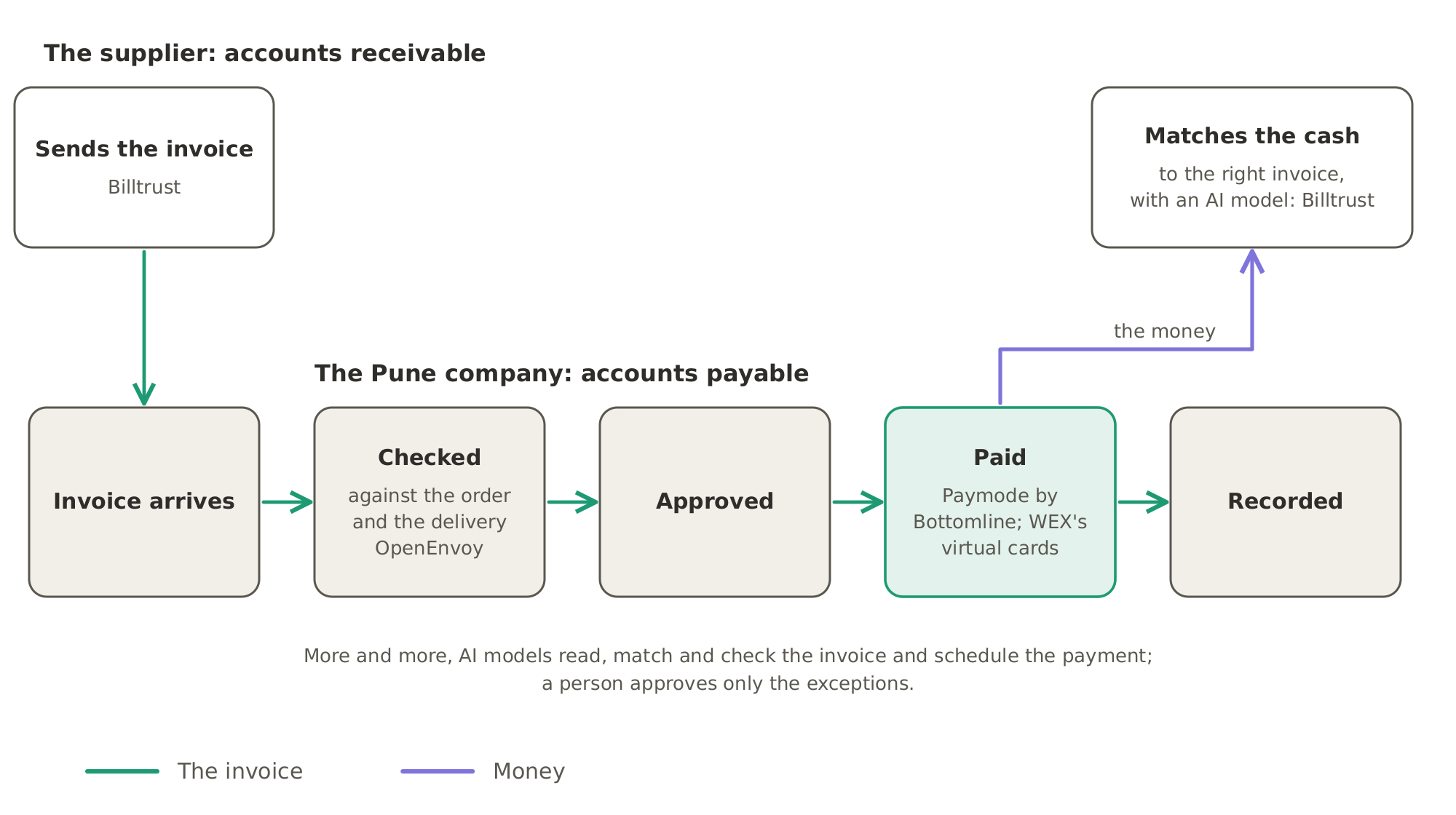 The supplier's invoice for the fifty laptops arrives at the Pune company, where it is checked against the order and the delivery, approved, paid and recorded. The money goes back to the supplier, whose accounts-receivable software, such as Billtrust's, matches the cash to the right invoice.
The invoice nobody keys in.
The supplier's invoice for the fifty laptops arrives at the Pune company, where it is checked against the order and the delivery, approved, paid and recorded. The money goes back to the supplier, whose accounts-receivable software, such as Billtrust's, matches the cash to the right invoice.
The invoice nobody keys in.
Accounts payable used to be a department of people. They typed invoices into a system and matched them to orders. Now AI models read the invoice, match it, check it and schedule the payment. A person approves only the exceptions. The same work is done in India's shared service centres, for companies around the world. A shared service centre is an office that does back-office work, such as paying invoices, for a whole company or for many companies. The work is changing as fast in India as anywhere.
That is how a company pays. The Pune company's salesperson spends on a card whose limits are set in advance. And the invoice for its fifty laptops is checked, paid and recorded by software.