The exchanges
Crypto exchanges and trading apps, institutional trading and prime brokerage, fiat on-ramps
Take the ₹1,000 of Bitcoin from the start of this Market Segment. The engineer bought it on an exchange: a marketplace that matches buyers with sellers. Four Indian companies here sell to investors like her.
CoinDCXwas founded in Mumbai. It has engineers in Bengaluru, and the most job postings in this Market Segment. It is India's largest crypto exchange. For individuals, it offers spot trading, which means buying the asset itself at today's price. It also offers margin trading, which means trading with money borrowed from the exchange. For institutions, it runs an over-the-counter desk, where large trades are agreed privately instead of on the open exchange.
CoinSwitchwith engineers in Bengaluru, is its main Indian rival. On top of spot trading, it offers futures and options. These are contracts on the future price of an asset.
Mudrexwith engineers in Bengaluru, sells crypto investing in themed baskets, each a set of assets bought together.
Carretsells crypto trading and yield to Indian investors. Yield is the return an investor earns on the assets they hold.
Two global exchanges build their exchanges, wallets and cards partly in India:
Coinbasewith engineers in Bengaluru, is the largest American exchange.
Crypto.comis the other.
Two more companies serve other businesses, not individual investors:
FalconXwith engineers in Bengaluru, is a prime broker for institutions. It routes their orders across many exchanges, and holds their assets.
Transak C-Corpwith engineers in Bengaluru, sells the on-ramp. It is a small payment window placed inside other companies' apps. It turns rupees or dollars into crypto, and back. The industry calls ordinary money, like rupees and dollars, fiat.
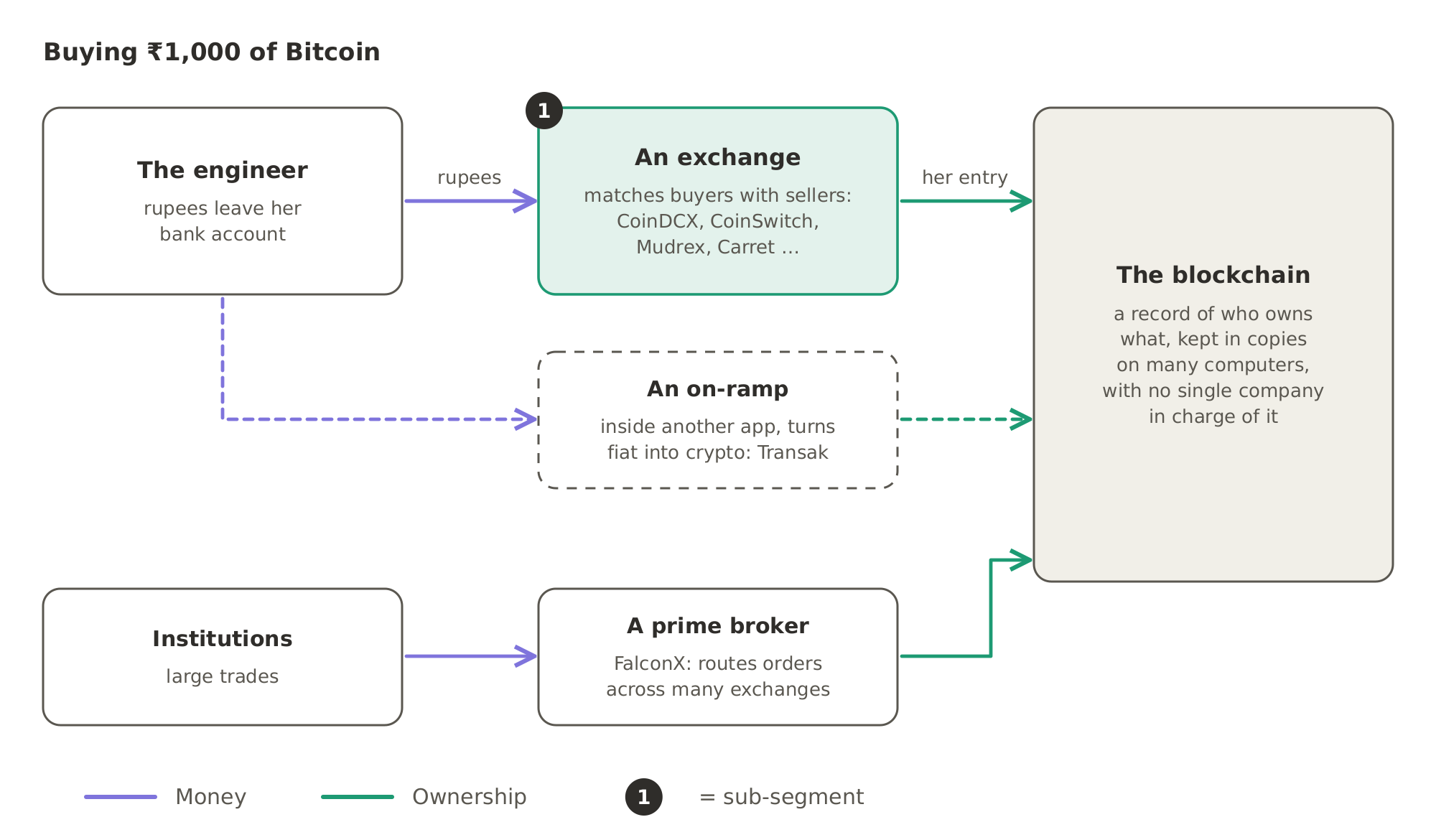 The engineer's rupees go to an exchange, such as CoinDCX or CoinSwitch, which matches her with a seller, and her ownership is recorded on the blockchain. An on-ramp such as Transak does the same inside another company's app, and institutions trade through a prime broker such as FalconX.
Custody and the chain
Institutional custody and wallets, wallet and chain infrastructure, tokenisation of bonds, funds and credit
The engineer's rupees go to an exchange, such as CoinDCX or CoinSwitch, which matches her with a seller, and her ownership is recorded on the blockchain. An on-ramp such as Transak does the same inside another company's app, and institutions trade through a prime broker such as FalconX.
Custody and the chain
Institutional custody and wallets, wallet and chain infrastructure, tokenisation of bonds, funds and credit
Back to the engineer's Bitcoin. What proves that it is hers is a key: a long secret number. Whoever holds the key can move the money. A wallet is the software that holds keys. Keeping keys safe for someone else is called custody, and a company that does it is a custodian.
BitGowith engineers in Bengaluru, holds digital assets for institutions. In its wallet, each key is split between several parties, so that no single one can move the money. It also sells the same custody as a service to other companies.
Liminal Custodywith engineers in Bengaluru, sells the same kind of institutional custody from India. (Because of its key management, it also appears in Market Segment 4.2, Identity and access management (IAM), in Industry Vertical 4, Cybersecurity.)
Arcanawith engineers in Bengaluru and Delhi NCR, builds a wallet and the infrastructure around it. With these, an app can work across several blockchains, without its users noticing which one they are on.
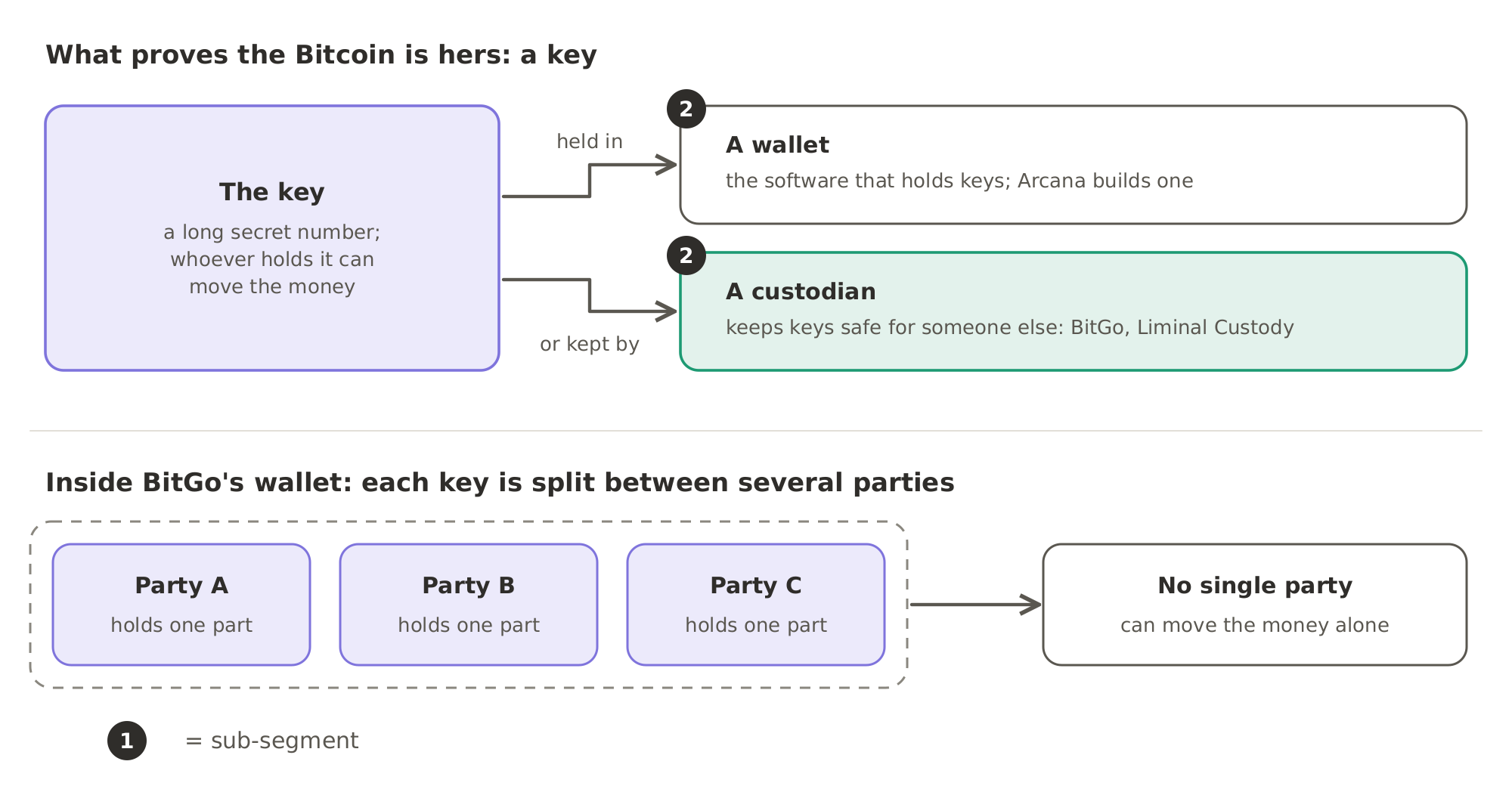 What proves the Bitcoin is hers is a key, a long secret number that is held in a wallet or kept safe for her by a custodian such as BitGo or Liminal Custody. In BitGo's wallet, each key is split between several parties, so that no single one can move the money.
The other four put real assets on a blockchain. This is called tokenisation: a bond, a fund or a loan is issued as a token, a digital record of ownership on a blockchain. In Market Segment 17.1, Card networks and payment processing, tokenisation meant something else: replacing a card number with a stand-in number.
Marketnodewith engineers in Bengaluru, is a Singapore platform. Bonds and investment funds are issued and settled on it as tokens.
Spydrasells a tokenisation platform for large companies. It is built on permissioned blockchains, which only approved members can join.
Qiro Financeis a marketplace for tokenised private credit. Private credit means loans made by investment funds instead of banks.
KrypCis a Bengaluru blockchain company.
The bond on a blockchain.
The crypto exchanges made the headlines. But institutions are more interested in the ledger underneath: the bond, the fund and the loan, issued and settled as a token in minutes instead of days. Banks and exchanges around the world are running pilots of tokenisation. The custodians and platforms in this sub-segment are selling to them, not to the trader.
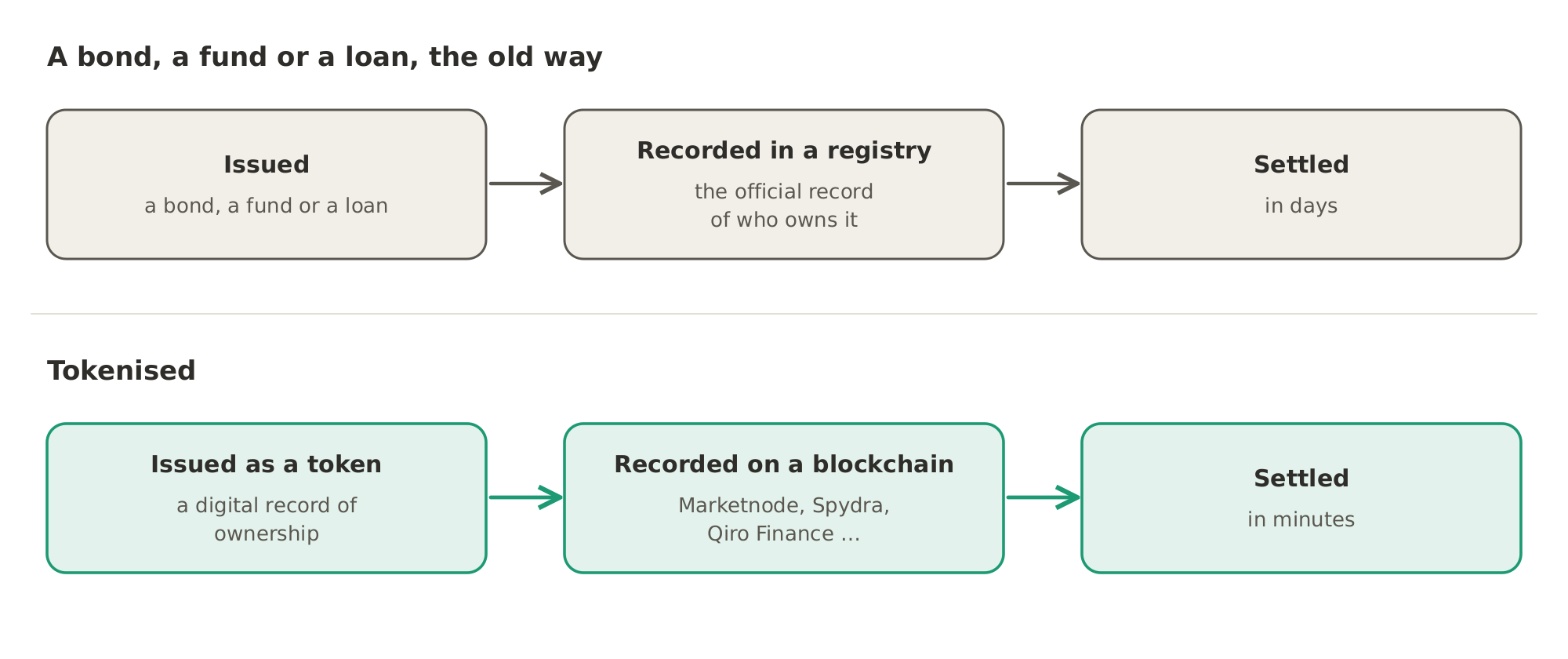 The old way, a bond, a fund or a loan is recorded in a registry and settled in days. Tokenised, it is issued as a token, recorded on a blockchain by platforms such as Marketnode, Spydra and Qiro Finance, and settled in minutes.
That is the money no central bank issues. The engineer's ₹1,000 of Bitcoin is bought on an exchange and kept safe by a key. And the same technology is now used to issue bonds, funds and loans.
The old way, a bond, a fund or a loan is recorded in a registry and settled in days. Tokenised, it is issued as a token, recorded on a blockchain by platforms such as Marketnode, Spydra and Qiro Finance, and settled in minutes.
That is the money no central bank issues. The engineer's ₹1,000 of Bitcoin is bought on an exchange and kept safe by a key. And the same technology is now used to issue bonds, funds and loans.