Take the food-ordering app from Market Segment 5.1, Cloud infrastructure and web hosting providers, built by a five-person start-up in Pune. Its backend runs on a virtual server that the team rents from a cloud provider. But the app does not sit directly on the hardware. Between the server and the app sits a stack of software. Most people never see it, and almost every company runs on it.
From the bottom up, the stack has three layers:
The operating system, which runs the server. It is usually a version of Linux, or Microsoft's Windows Server.
The virtualisation layer, which splits one physical server into many virtual machines. The start-up's virtual server is one of them.
The container layer, the newest. It packs apps into containers, and decides which server in a group of servers runs each one.
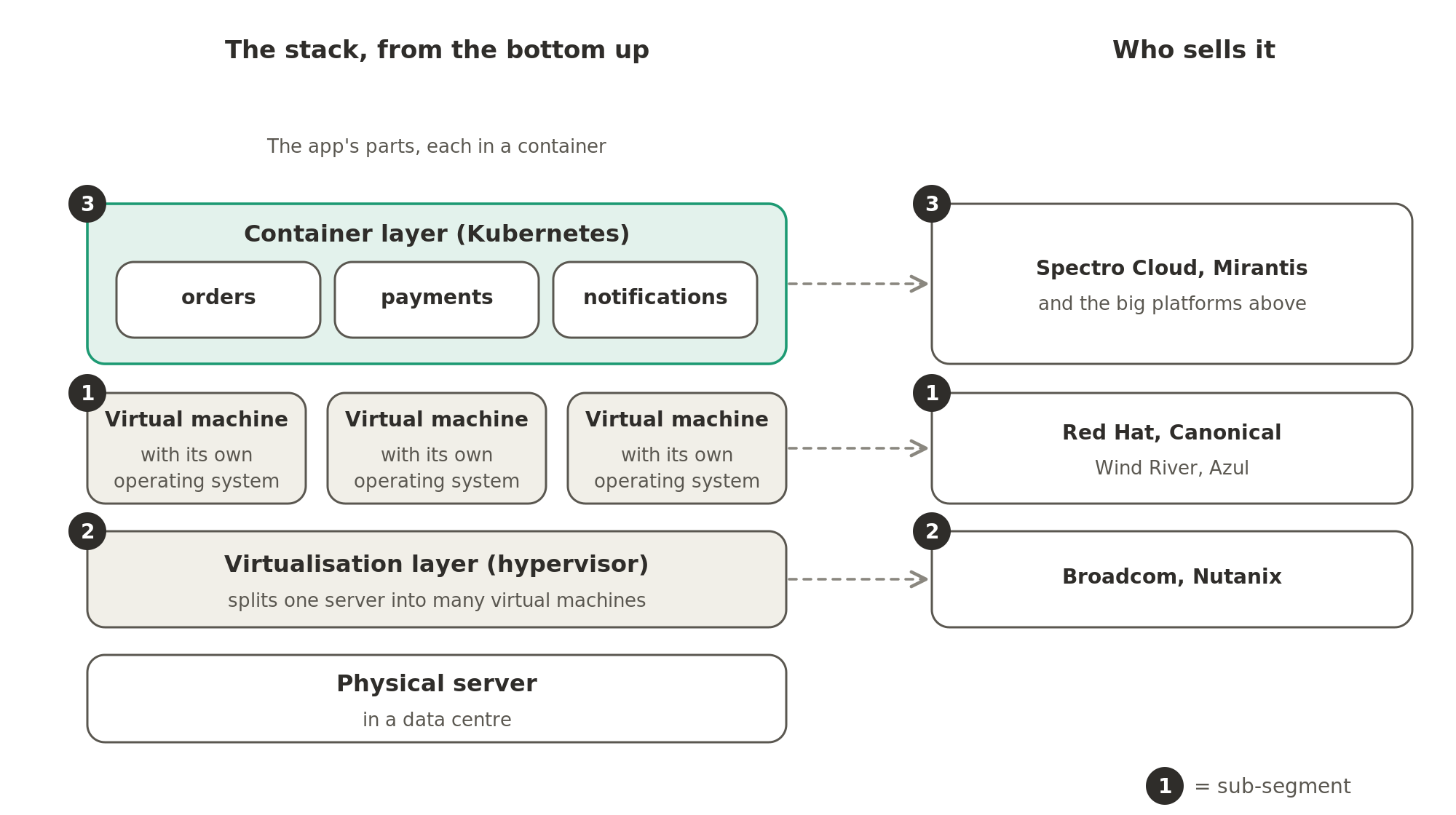 Between the physical server and the app sit three layers of software, the hypervisor, the operating system in each virtual machine, and Kubernetes running the app's containers, and each layer has its own sellers.
Almost all of this software is open source, and that makes the business unusual. Anyone can download it for free, and the Pune start-up does exactly that. So the companies here do not sell the software itself. They sell what a large customer, such as a bank, needs before it will trust free software with its business:
A subscriptionwhich brings tested updates and security fixes.
Supportsomeone to call when a server fails at 2 a.m.
Certified versionswhich other big software and hardware makers have tested and promise will work with their products.
Toolsthat turn a pile of free parts into one platform, with a company standing behind it.
Only a few companies sell this. But two of them, Red Hat and Canonical, have made India one of their largest engineering bases anywhere. The other main server operating system, Microsoft's Windows Server, is covered elsewhere. (More on it in Microsoft, in the big-tech collection.)
Every company named here has posted software engineering jobs in India. Famous companies that don't actively hire software engineers in India are left out.
This Market Segment climbs the stack from the bottom, in three sub-segments:
The operating system and its subscription: Linux sold as a subscription, and operating systems for machines other than servers
One machine pretending to be twenty: the software that splits one server into many virtual machines
Containers and Kubernetes: the software that runs apps in containers across many servers
The operating system and its subscription
Enterprise Linux, open-source support subscriptions, embedded and real-time operating systems, language runtimes
Take the Pune start-up from the start of this Market Segment. Its virtual server runs Ubuntu, a free version of Linux, and the team pays nothing for it. Now take a large bank in Mumbai, with thousands of servers in its own data centres. It will not run its business on software that nobody stands behind. So it pays for a subscription.
Two companies here sell these subscriptions:
Red Hatproved that free software could be a business, by selling the subscription rather than the code. It hires more engineers in India than any other company here. Most of them are in Pune and Bengaluru, where Red Hat builds its core products. These are Red Hat Enterprise Linux, the OpenShift container platform (covered in the third sub-segment), and the automation and virtualisation products around them. Red Hat has been part of IBM since 2019. (More on IBM in the services-world collection.)
Canonicalis the other big name here, with the same kind of business. It publishes Ubuntu, the Linux most developers and most cloud machines actually run. It sells support and certification for Ubuntu. It also sells its own versions of OpenStack and Kubernetes, built around Ubuntu. OpenStack is open-source software for building a private cloud out of a company's own servers. (More on software for running your own cloud in Market Segment 5.1, Cloud infrastructure and web hosting providers.) Canonical hires almost entirely remotely. Its engineers in India work from Bengaluru, Mumbai and Chennai because that is where they happen to live, not because Canonical has an office there.
Two smaller companies work on something other than the server's operating system.
Wind Rivermakes an operating system for a different kind of machine. Its VxWorks is a real-time operating system. It must respond within a fixed time, every time, because a late response counts as a failure. VxWorks runs inside aircraft, industrial controllers, medical devices and telecom equipment. Wind River also sells an embedded Linux, a version of Linux built to run inside a device rather than on a server. And it sells a simulation platform for testing such systems: an ordinary computer pretends to be the device, and runs the device's software. Wind River has been owned by Aptiv, the automotive supplier, since 2022. (More on Aptiv in Market Segment 38.7, Auto components and EV batteries, in Industry Vertical 38, Automotive and mobility.) Wind River has a team in Bengaluru. (It also appears in Market Segment 37.1, Industrial automation and control software, in Industry Vertical 37, Manufacturing tech.)
Azulworks one level up, on the runtime: the program that runs an app's code. It sells a supported, tuned version of the Java virtual machine (JVM), which a large share of enterprise software runs on. Despite its name, the JVM is not the kind of virtual machine in the next sub-segment. It does not pretend to be a whole computer. It runs Java programs on any operating system. So Azul's product is the closest thing here to an operating system for apps rather than for machines. Azul hires in Bengaluru.
One machine pretending to be twenty
Virtualisation, hyperconverged infrastructure, private-cloud management
Back to the Pune start-up's virtual server. It is one slice of a physical server in the cloud provider's data centre. The software that does the slicing is called a hypervisor. It lets one physical server act as twenty virtual machines, each with its own operating system, so the hardware is never idle. This idea is what made the cloud possible.
The start-up never deals with this layer, because its cloud provider runs it. But a bank that runs its own data centre has to buy it. VMware owned that market for two decades.
Broadcomhas owned VMware since 2023. Broadcom is covered mainly in another Market Segment. (More on Broadcom in Market Segment 35.5, Connectivity and wireless chips, in Industry Vertical 35, Semiconductors and chip design.) Its engineering centres in Hyderabad, Bengaluru and Pune are, in large part, the former VMware centres. Price rises are reported to have followed the change of owner. Every other company in this sub-segment is selling against that change.
One company here gains the most from it:
Nutanixsells hyperconverged infrastructure. A data centre usually has servers for computing, and a separate storage array: a dedicated system full of disks that all the servers share. (More on storage arrays in Market Segment 7.2, Enterprise storage and backup, in Industry Vertical 7, Database and storage companies.) Nutanix's software joins a group of ordinary servers into one system that does the computing, the storage and the virtualisation together. It replaces both the hypervisor and the separate storage array. Nutanix's Bengaluru centre builds the platform itself.
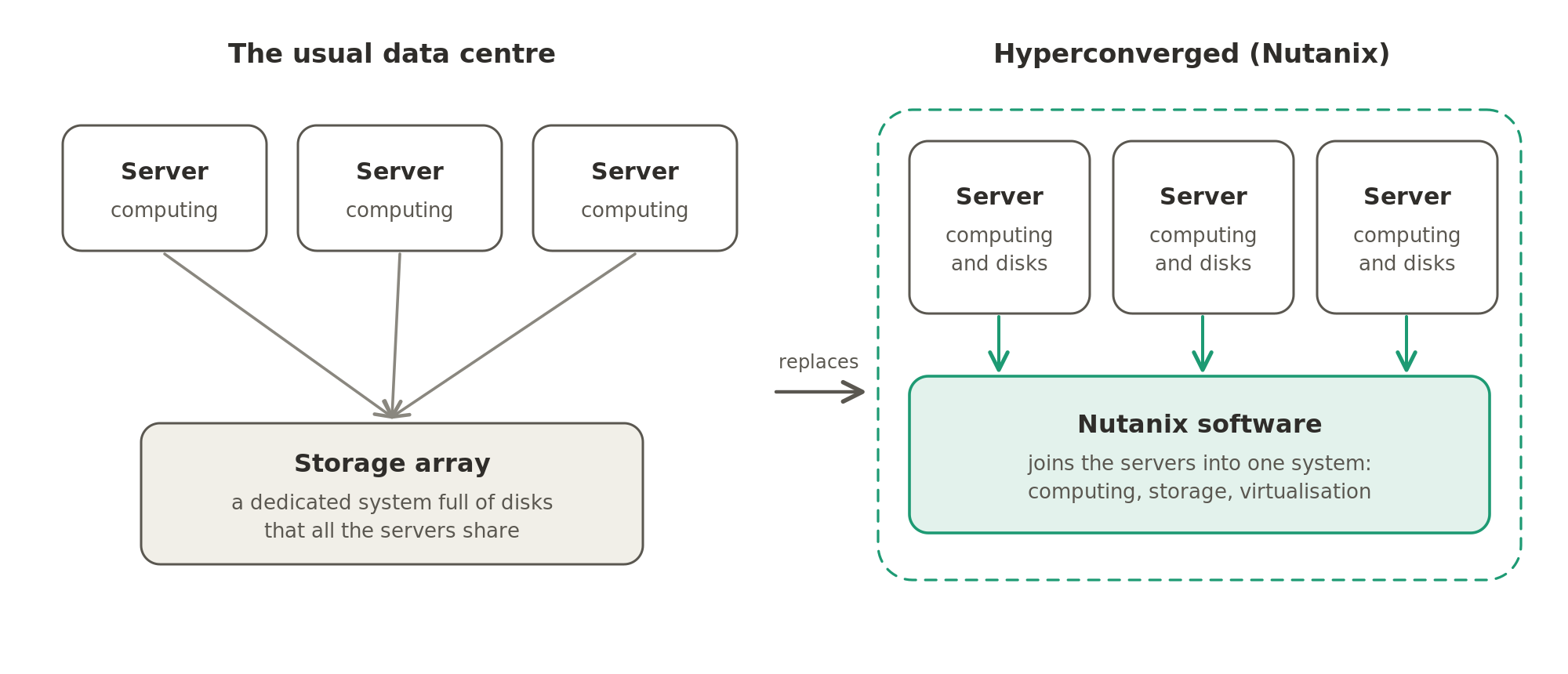 A usual data centre has servers for computing and a separate storage array they all share, while Nutanix's software joins ordinary servers into one system that does the computing, the storage and the virtualisation together.
Life after VMware.
A usual data centre has servers for computing and a separate storage array they all share, while Nutanix's software joins ordinary servers into one system that does the computing, the storage and the virtualisation together.
Life after VMware.
The price rises that followed Broadcom's purchase have pushed many companies to look for another hypervisor, for the first time in twenty years. The companies here offer three answers: Nutanix, Red Hat's virtualisation on OpenShift, and Canonical's OpenStack.
You're reading as a guest. Sign in free to follow links for five minutes, once an hour.
Sign in
Containers and Kubernetes
Running containers across a cluster of servers (orchestration), and platforms for managing clusters
Back to the Pune start-up once more. Its app is not one big program. It is split into parts: one takes the orders, one handles the payments, one sends the notifications. Each part is packed into a container.
A container is a newer way of packaging an app, lighter than a virtual machine. It holds the app's code and everything the code needs to run. But it shares the server's operating system with the other containers, instead of bringing its own.
Kubernetes is the open-source system, born at Google, that schedules containers across a cluster, a group of servers working together. It decides which server runs each container, and restarts a container when it fails. It has become the operating system of the cloud in everything but name. The Pune start-up rents Kubernetes ready-made from its cloud provider. (More on that in Market Segment 5.1, Cloud infrastructure and web hosting providers.)
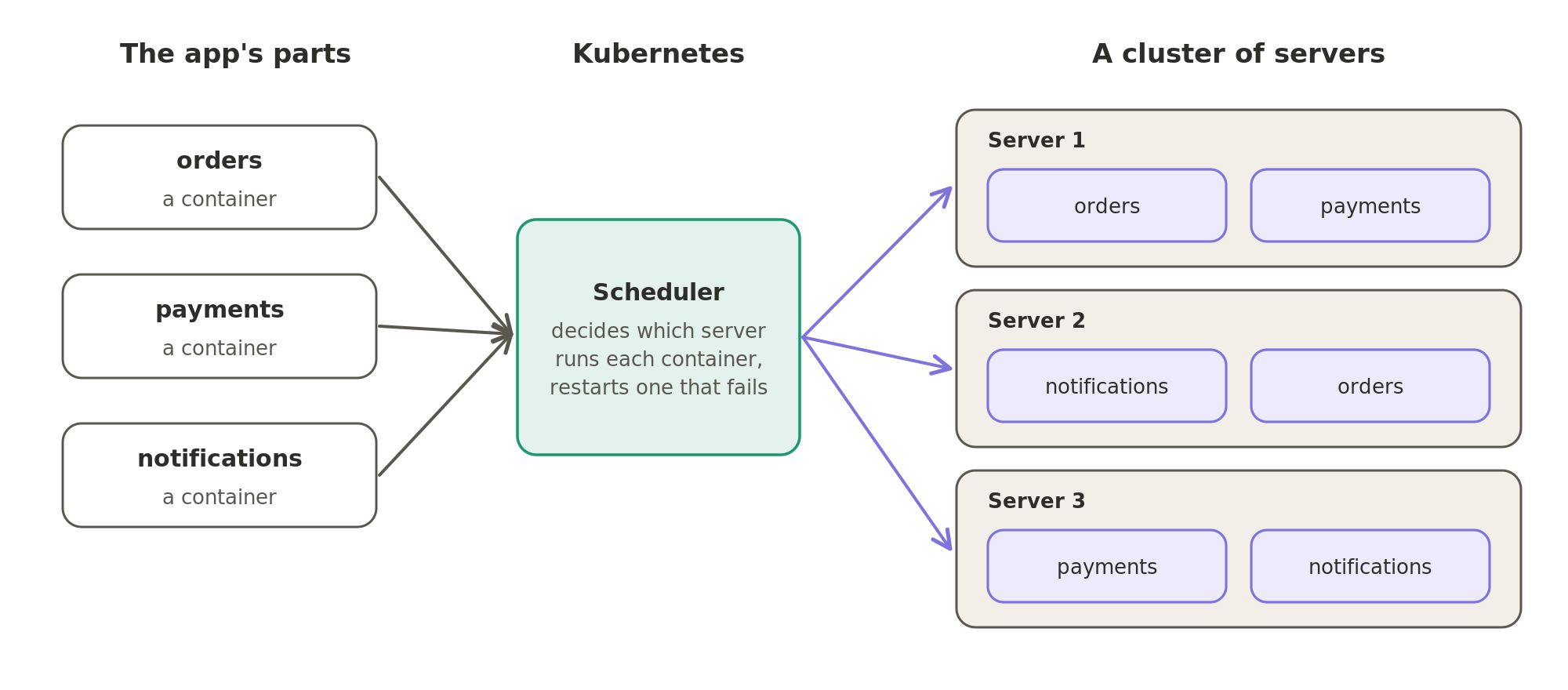 Kubernetes takes the app's parts, each packed in a container, and decides which server in the cluster runs each one, restarting a container when it fails.
The large platforms built on Kubernetes belong to companies in the sub-segments above: Red Hat's OpenShift and Nutanix's Kubernetes platform. So the companies in this sub-segment are the specialists.
Spectro Cloudsells Palette, a platform for managing many Kubernetes clusters at once. The clusters can be in the cloud, in a company's own data centre, or at the edge, in small sites close to the users. Palette manages all of them from one place, which the industry calls a control plane. Spectro Cloud hires in Bengaluru.
Mirantisis the older name. It made its name as an OpenStack company. In 2019 it bought Docker's enterprise business. Docker is the best-known tool for building containers. Mirantis now sells its own versions of Kubernetes, and Lens, the desktop tool developers use to look inside a cluster. Since August 2026, Mirantis has belonged to IREN, which runs GPU data centres.
That is the stack under the app's backend. The Pune start-up runs free Linux on a rented virtual machine, with its app in containers on Kubernetes. A bank running its own data centre pays the companies here for the same layers, so that a company stands behind each one.