A hospital group in Hyderabad takes hundreds of scans a day: X-rays, CT scans and MRIs. Each scan is a large file, and the hospital must keep it for years. Its patient records sit in a database, the subject of Market Segment 7.1, Databases and data warehouses. Underneath every database and every file is a simpler question. Where are the bytes, physically? And what happens if they are lost?
This Market Segment covers the companies that answer that question. Some make the storage systems that hold the bytes. Others make the backups that bring them back. The buyers are the IT departments of companies of every kind, from hospitals and banks to AI labs.
For most of its history, this industry sold hardware with software inside it. Now more and more storage is sold as a subscription, or as a cloud service. The industry calls this storage as a service. The biggest change is in backup, which is where the industry's money has moved. The reason is ransomware: software that locks a company's data by encrypting it, then demands money to unlock it. A backup that ransomware cannot reach is now a company's last line of defence.
Almost every company here is headquartered abroad. The Indian-founded name is Druva, from Pune, in the backup sub-segment. Lucidity, in the last sub-segment, has its engineering in Bengaluru.
Every company named here has posted software engineering jobs in India. Famous companies that don't actively hire software engineers in India are left out.
This Market Segment has four sub-segments. They follow the bytes from the drive to the copy:
The array and the file systemthe storage systems that hold a company's data.
Storage built for the GPUa new kind of storage, fast enough to feed the chips that train AI models. It has become a category of its own.
The backup and the clean roomthe copies that bring the data back after an attack.
The file in the cloudstorage and backup that have moved out of the office, including backup for apps that run in the browser.
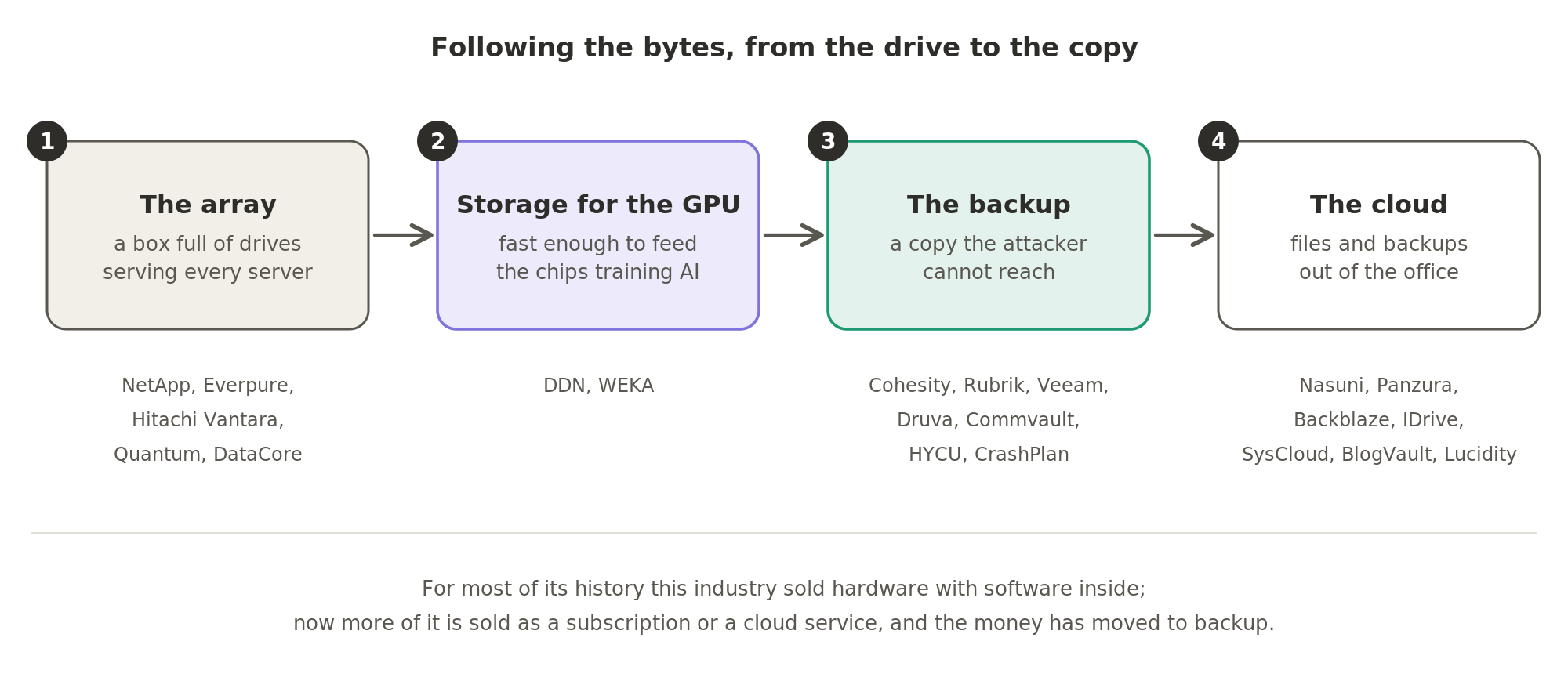 The four sub-segments follow the bytes: the array that holds a company's data, the storage fast enough to feed GPUs, the backup an attacker cannot reach, and the files and backups that have moved to the cloud.
The array and the file system
Enterprise storage systems, all-flash arrays, software-defined storage, tape and archive
The four sub-segments follow the bytes: the array that holds a company's data, the storage fast enough to feed GPUs, the backup an attacker cannot reach, and the files and backups that have moved to the cloud.
The array and the file system
Enterprise storage systems, all-flash arrays, software-defined storage, tape and archive
Take the hospital from the start of this Market Segment. Its records and scans don't sit on each server's own disk. They sit on a storage array: a dedicated box full of drives that holds a company's files and databases, and serves them to every server over the network. This is the oldest business in this Market Segment. The software inside the array, including its file system, lets many servers share the same drives at once.
NetAppbuilds ONTAP, the operating system that runs its arrays. More and more, it also sells the same storage as a service inside the public clouds. Its Bengaluru organisation works on its storage and data-management software.
Everpureformerly called Pure Storage, sells arrays built only on flash, instead of spinning hard drives. Flash is the same kind of memory chip as in a phone or an SSD. It has turned its arrays into a subscription. It has engineers in Bengaluru.
Hitachi Vantarahas been Hitachi's storage company since 2017. It sells the Virtual Storage Platform arrays that large enterprises run their core databases on. It has engineers in Bengaluru and Pune.
Quantumis a tape and archive specialist. Magnetic tape is still the cheapest way to keep data that must be stored for decades and read rarely, such as video and research data. Quantum has engineers in Bengaluru.
DataCoresells the software-defined version: storage software that runs on ordinary servers and turns them into an array.
Dell and HPE, two other big array makers, are covered mainly in another Market Segment, as server makers. (More on them in Market Segment 3.2, Server and storage hardware, in Industry Vertical 3, Data centres and servers.) The drives and memory chips inside the arrays, and drive makers such as Western Digital and Micron, are covered in Market Segment 35.6, Memory chips and storage drives (in Industry Vertical 35, Semiconductors and chip design). Vast Data, Infinidat and Qumulo are not covered in this Market Segment.
Storage built for the GPU
Parallel file systems, and fast storage for AI and high-performance computing (HPC)
Now take a very different customer: a lab training an AI model to read scans like the hospital's. It uses an AI cluster, thousands of GPUs working together as one machine. GPUs are the graphics chips used to train AI models. (More on AI clusters in Market Segment 3.2, Server and storage hardware, in Industry Vertical 3, Data centres and servers.)
A cluster like this reads data faster than any ordinary array can supply it. So a new kind of storage company has grown up to feed it. Its product is the parallel file system. It spreads each file across many storage servers, so thousands of GPUs can read different parts of it at the same time.
DDNhas built parallel file systems for supercomputers for two decades. Since 2018, it has employed the team behind Lustre, the open-source parallel file system used by many of the world's supercomputers. DDN has engineers in Pune and Bengaluru.
WEKAis the newer company. It sells a software-defined parallel file system, built for flash and for the GPU cloud, the companies that rent out GPUs by the hour. WEKA started as software, sold as a platform that runs on ordinary servers or in the cloud. Now it also sells a ready-built system. It has engineers in Bengaluru.
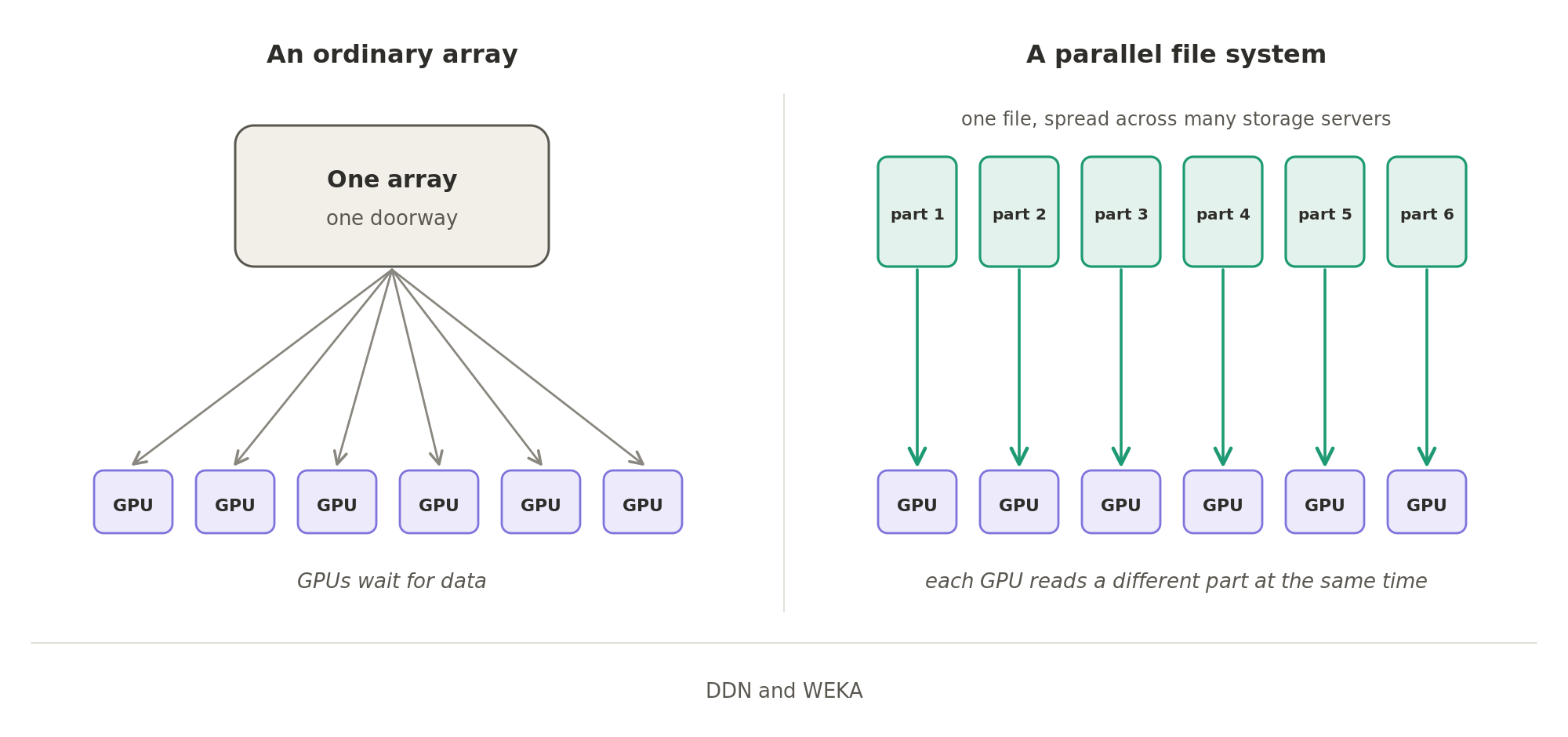 An ordinary array serves every GPU through one doorway, so the GPUs wait; a parallel file system spreads each file across many storage servers, so thousands of GPUs can read different parts of it at the same time.
The storage that keeps the GPU busy.
An ordinary array serves every GPU through one doorway, so the GPUs wait; a parallel file system spreads each file across many storage servers, so thousands of GPUs can read different parts of it at the same time.
The storage that keeps the GPU busy.
GPUs are very expensive, so every moment they spend waiting for data is money wasted. With ordinary storage, they waited too often. That is why DDN and WEKA exist. The array makers from the first sub-segment are moving the same way. NetApp and Everpure both now sell versions of their arrays built for AI.
You're reading as a guest. Sign in free to follow links for five minutes, once an hour.
Sign in
The backup and the clean room
Backup and recovery, immutable backups, ransomware recovery, cyber resilience, and backup for laptops
Back to the hospital from the start of this Market Segment. One morning, its staff find every file locked, with a message demanding money to unlock them. That is ransomware at work. Hospitals are a common target, because they cannot stop treating patients while they wait.
The backup used to be the dullest product in IT. Ransomware made it the most important. Once a company's live data has been encrypted, it has exactly one way back: a copy the attacker could not reach. The industry has rebuilt itself around that idea:
Immutable backupsThese cannot be changed or deleted once written, even by someone with the administrator's password.
Copies kept off the networkAn attacker who is inside the network cannot reach them. The industry calls this an air gap.
The clean roomThis is a separate, sealed-off system. The company restores its data there and checks it for traces of the attack before trusting it again.
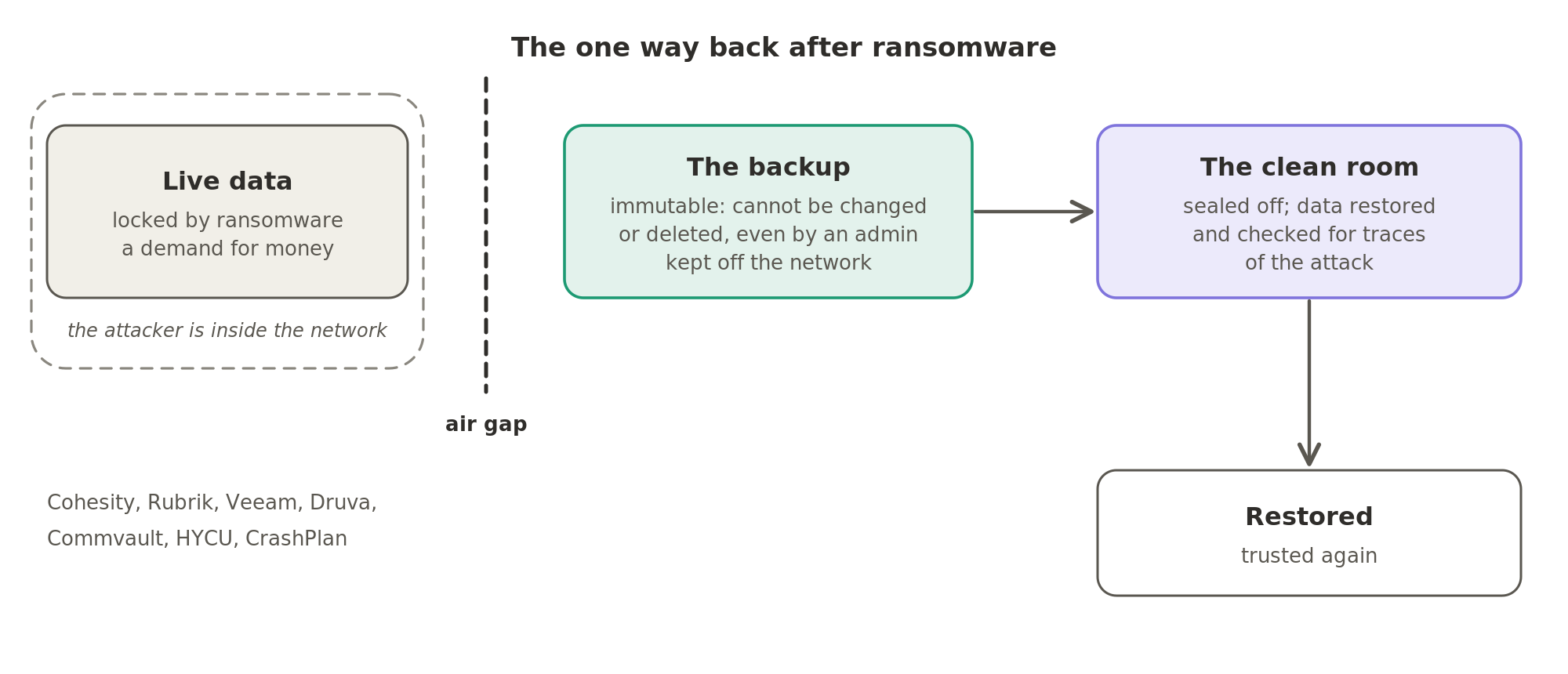 Once ransomware has locked the live data, the one way back is a backup the attacker could not reach, immutable and kept off the network, restored first in a sealed-off clean room and checked before it is trusted again.
Seven companies here sell backup:
Cohesitybuilds the backup platform and the security products around it. In December 2024, it combined with the data-protection business of Veritas. So it also sells NetBackup, Veritas's long-established backup product. Cohesity has engineers in Bengaluru and Pune.
Rubriksells the same idea under the name zero-trust data security. Zero trust means trusting no user or device by default, and checking every access. Rubrik has also added monitoring that spots an attack from what it does to the backups. It has engineers in Bengaluru and Pune.
Veeamgrew up backing up virtual machines. A virtual machine is a computer made of software, and many of them can run on one physical server. Veeam is widely installed in the mid-market, meaning medium-sized companies. It has engineers in Pune, Bengaluru and Hyderabad.
Druvafounded in Pune, sells backup entirely as a cloud service. The customer has no backup hardware at all.
Commvaultis one of the older enterprise names in this sub-segment. It now sells clean-room recovery, and decoys that catch an attacker in the act. A decoy is a fake file or system that no real user needs, so anyone who touches it sets off an alarm.
HYCUwith engineers in Bengaluru, backs up the newer platforms. One is Nutanix, whose software runs a company's servers, storage and virtual machines as one system. The others are SaaS applications, the software a company uses in a web browser and rents by subscription. (More on virtual machines and Nutanix in Market Segment 5.2, Enterprise Linux and private cloud platforms, in Industry Vertical 5, Cloud providers and OS makers.)
CrashPlanwas split off from Code42. It backs up laptops, and now SaaS applications too. Its engineering is in Bengaluru.
Recovering from ransomware starts as a security incident, but it ends with a backup being restored. That is why the backup companies are covered here. The attack itself, and how a company's security team responds to it, are covered in Market Segment 4.9, SIEM and security operations (SOC) (in Industry Vertical 4, Cybersecurity).
The file in the cloud
Cloud file services, cloud backup for people and small businesses, backup for cloud apps, and cutting the cost of cloud storage
The last sub-segment is storage that has left the building. Back to the hospital group from the start of this Market Segment. Doctors in its different branches need the same files. Its staff write email and documents in apps that run in the cloud.
Two companies put the office's shared drive in the cloud:
Nasunisells the file system as a cloud service. The company's files live in cloud object storage, the cheap storage that the big clouds sell for very large amounts of data. To staff, the files appear as an ordinary shared drive in every office. Ransomware protection and recovery are built into the platform. Nasuni has engineers in Hyderabad.
Panzurasells the same kind of hybrid file system, with part of it in the office and part in the cloud. It has engineers in Pune.
Two more sell cloud storage and backup directly:
Backblazeis a low-cost cloud storage and backup provider. It has engineers in Bengaluru.
IDrivea California company with an engineering centre in India, sells backup and cloud storage to people and small businesses.
Many companies no longer install their office software. They use SaaS applications like Google Workspace and Microsoft 365 in the browser. Microsoft and Google keep these services running. But keeping a separate copy of the data, in case staff delete it or an attacker encrypts it, is left to the customer. The industry calls this the shared responsibility model. SysCloud, from Hyderabad, sells that copy: it backs up Google Workspace and Microsoft 365.
One company here backs up websites instead. BlogVault, from Bengaluru, backs up and secures WordPress websites, for the small businesses and agencies that run them. WordPress is the free software behind a large share of the world's websites.
One more company works on cost, not safety. Lucidity, with its engineering in Bengaluru, sells software that resizes a company's cloud disks automatically. That way, the company stops paying for storage it is not using.
Dropbox, Box, Egnyte, Wasabi and Acronis are not covered in this Market Segment.
That is where the hospital's scans live. They sit on drives in an array or on tape, with a copy in a backup that an attacker cannot reach. And more and more of them now live in the cloud.