When a T-Mobile customer in the United States pays a bill in the app, the platform behind it may have been built in Hyderabad, by T-Mobile's own engineering centre in India.
A telecom operator owns a network and sells access to it. The software that runs an operator is some of the largest and oldest in any industry:
billingwhich charges every customer for every call, message and gigabyte
provisioningwhich switches on a new SIM or connection
the customer's app
the systems that watch the networkand spot faults
For thirty years, the operators handed that software to others: to the equipment makers that sold them the network, and to the Indian IT services firms that ran the systems on top of it. The companies here are foreign operators that have recently decided to take some of it back. Their Indian centres are where they are doing it.
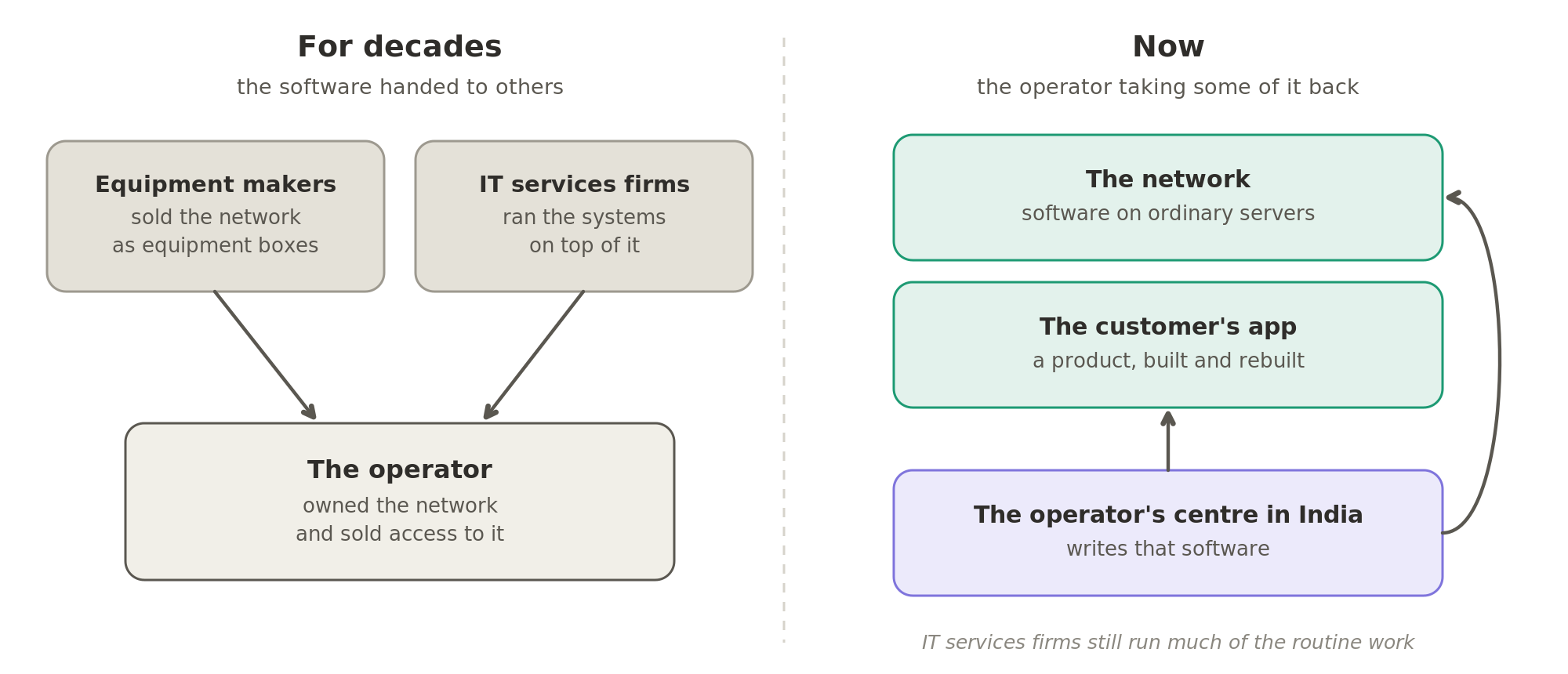 For decades, equipment makers sold the operator its network and IT services firms ran the systems on top of it. Now the network is software on ordinary servers and the customer lives in an app, and the operator's own centre in India writes that software, while IT services firms still run much of the routine work.
Only foreign operators are covered here. India's own operators, such as Airtel and Tata Communications, build their own technology. (More on them in Market Segment 1.1, Telecom equipment and operators, in Industry Vertical 1, Networking and telecom, in the product-companies collection.) What an operator is, and who builds its equipment, is also explained there.
This is the only Parent Industry with no stage 1. No operator here has a centre that only runs the parent's systems, because that work went to IT services firms decades ago, and is still there. Instead, almost all in the last six years, the operators have built centres that write software. The GCCs here do two kinds of work:
- Building the operator's apps and platforms (stage 3)
- The whole engineering function, moved here (stage 4)
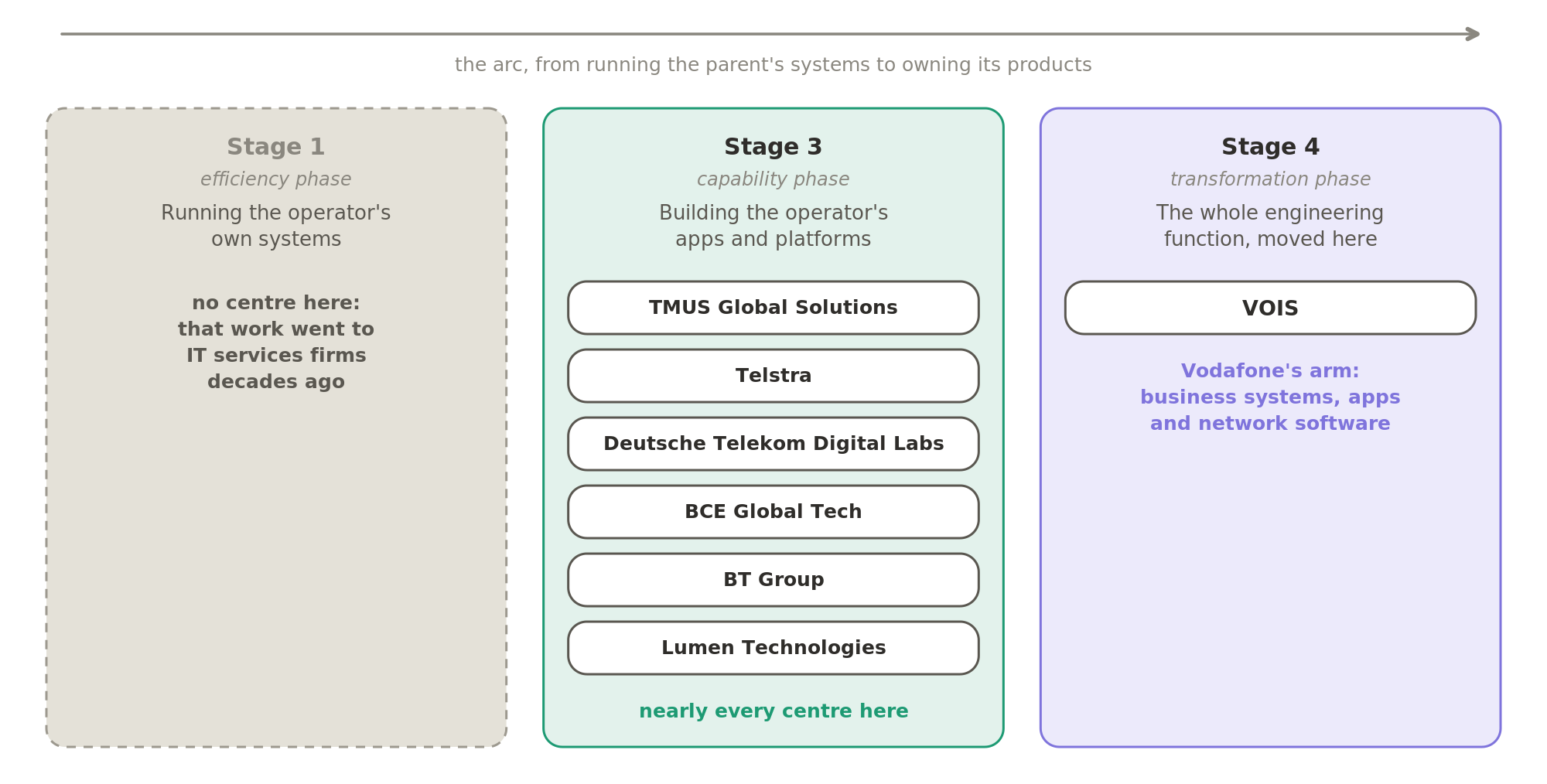 The stages present here, with each centre placed in its stage. Stage 1 is empty because that work went to IT services firms decades ago, nearly every centre builds apps and platforms, and VOIS, Vodafone's arm, holds the whole engineering function.
Every centre named here has posted software engineering jobs in India. Companies not placed under a mandate are listed at the end, in The names with a desk here.
Why the operators came
They came because the network became software, and they did not have the people who write it.
The network became softwareA mobile network used to be made of equipment boxes from Ericsson and Nokia. More and more, it is now software running on ordinary servers. An operator that cannot engineer software cannot shape its own network.
The customer moved into an appThe operator's relationship with its customers now happens mostly in an app. An app is a product that has to be built and rebuilt.
The operators that took both seriously opened engineering centres in India. The same engineers were already building the equipment makers' software nearby, and the operators' IT services partners had run their systems here for years.
The operators are:
American carriersT-Mobile US, Verizon, AT&T and Lumen
European operatorsDeutsche Telekom, BT and Vodafone
The long-established operators of Australia, Canada and Saudi ArabiaTelstra, Bell Canada and Mobily
Most of their centres are in Bengaluru. The largest is in Hyderabad.
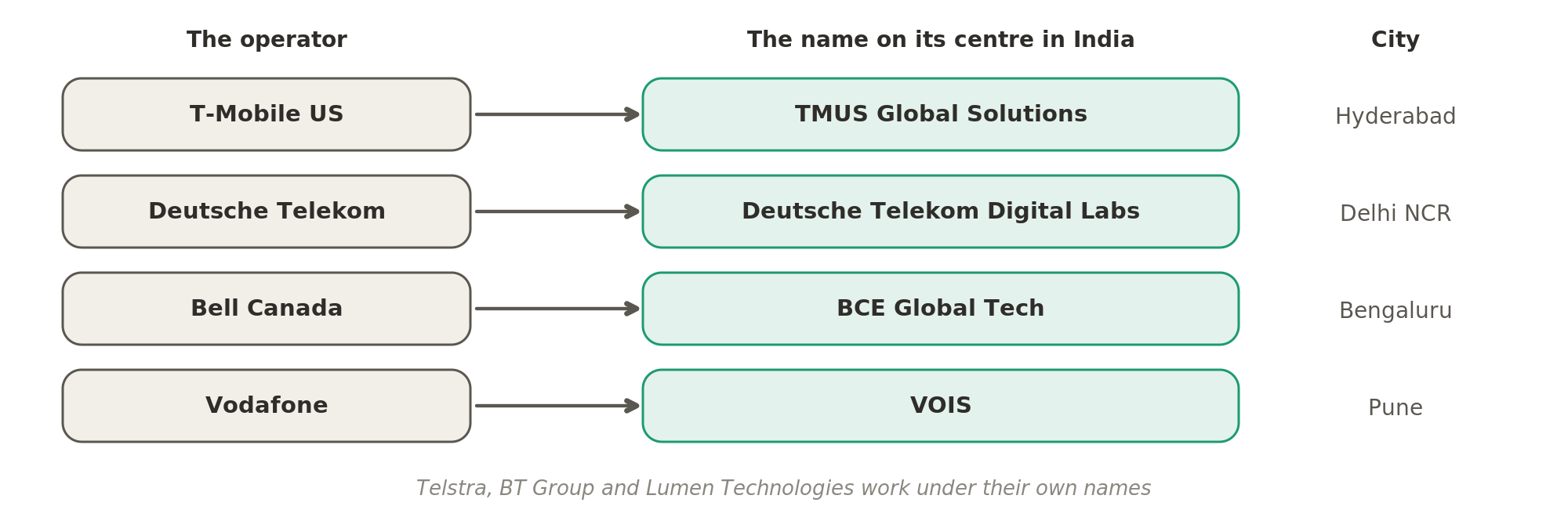 Several operators run their Indian centres under a different name: T-Mobile US as TMUS Global Solutions, Deutsche Telekom as Deutsche Telekom Digital Labs, Bell Canada as BCE Global Tech and Vodafone as VOIS.
Building the operator's apps and platforms
Stage 3 of the arc · capability phase
Several operators run their Indian centres under a different name: T-Mobile US as TMUS Global Solutions, Deutsche Telekom as Deutsche Telekom Digital Labs, Bell Canada as BCE Global Tech and Vodafone as VOIS.
Building the operator's apps and platforms
Stage 3 of the arc · capability phase
Nearly every centre here has this mandate. It is the reason they exist: building the software an operator now considers its own.
TMUS Global Solutionsin Hyderabad, is T-Mobile US's centre. It is the largest centre in this Parent Industry by a wide margin, and one of the newest. It was opened to build the carrier's platforms, backend systems and cloud infrastructure at scale.
Telstrain Bengaluru, the Australian operator, has built software here for several years, mostly backend and platform work.
Deutsche Telekom Digital Labsin Delhi NCR, is the German group's product-engineering arm in India. It builds the customer's app and the services behind it.
BCE Global Techin Bengaluru, is Bell Canada's new centre. Its work is platform infrastructure and the operator's own systems.
BT Groupin Bengaluru, the British operator, does app engineering with some AI work beside it.
Lumen Technologieswith a small team in Bengaluru. It is an American carrier that serves businesses.
You're reading as a guest. Sign in free to follow links for five minutes, once an hour.
Sign in
The whole engineering function, moved here
Stage 4 of the arc · transformation phase
One centre does every kind of work at once.
VOISin Pune, with a team in Bengaluru, is Vodafone's shared-services and technology arm. It is one of the largest operator GCCs in India, with thousands of people across Pune, Bengaluru and Ahmedabad. It holds the group's business systems, its app engineering and its network software together.
The names with a desk here
These companies are not placed under a mandate here. The first two run two of the largest operator technology centres in India, with thousands of engineers each.
Verizonin Chennai and Hyderabad
AT&Tin Bengaluru
Deutsche Telekom, Lumen Technologies and T-Mobileother units of the groups whose centres are listed above
Mobily Infotechthe Indian arm of the Saudi operator, in Bengaluru
The operator that engineers its own network.
T-Mobile US's Hyderabad centre, opened at scale to own the carrier's platforms, is the clearest case. Deutsche Telekom Digital Labs and Telstra's Bengaluru centre are older centres that got there first. AI is changing the network itself: finding faults, changing settings and planning capacity are becoming jobs for AI models. Centres like TMUS Global Solutions and BCE Global Tech were opened partly to write that software. The counter-current: much of the operators' routine work is still run for them by IT services firms.
Where this industry is explained
Industry Vertical 1, Networking and telecom, in the product-companies collection, explains what an operator is and who builds what it runs on:
Market Segment 1.1, Telecom equipment and operators
Market Segment 1.2, Enterprise networking
Market Segment 1.3, Network testing, visibility and monitoring
Market Segment 1.4, Home Wi-Fi and broadband devices
Market Segment 1.5, Satellite and wireless communications
Market Segment 1.6, Networking and telecom chips
The foreign operators here buy from the equipment makers in Industry Vertical 1. In their Indian centres, they are beginning to build what they once bought.
That is the telecom GCC: operators taking back the software they once handed to others, and building their apps, platforms and networks in India.